
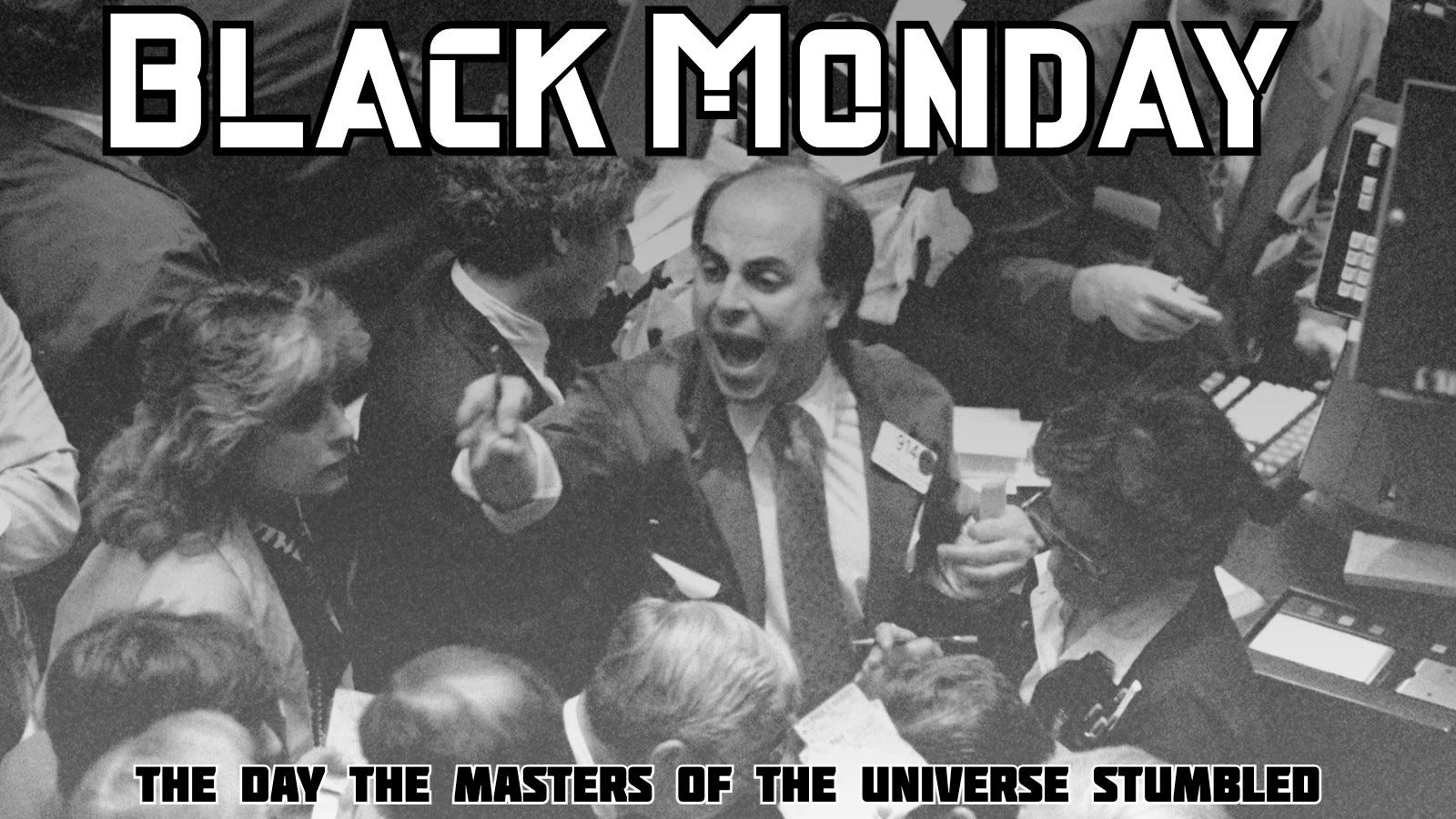
Black Monday
The Day the Masters of the Universe Stumbled

The point is, ladies and gentlemen, that greed—for lack of a better word—is good.
Greed is right.
Greed works.
Greed clarifies, cuts through, and captures the essence of the evolutionary spirit.
Greed, in all of its forms—greed for life, for money, for love, knowledge—has marked the upward surge of mankind.
And greed—you mark my words—will not only save Teldar Paper, but that other malfunctioning corporation called the USA.[1]
If you were a union member, the Reagan years were not so good. One of Reagan’s first major actions was breaking the Air Traffic Controller’s Union strike in August 1981; his relations with organized labor were generally strained thereafter. If you relied on welfare, the decade brought cuts and retrenchment.
If you were seriously mentally ill, you likely found yourself out of the mental hospital and onto the sidewalk. Decades of deinstitutionalization culminated under Reagan in a system where many promised community-based programs never materialized, and countless people saw their status change from institutionalized to homeless.
For most other Americans, things were looking up. Stagflation was over. The Cold War was winding down, and it was becoming increasingly clear that capitalism had triumphed. Wall Street was booming and young urban professionals (yuppies for short) were reaping the spoils. After the humiliation of Vietnam, the disillusionment of Watergate, and the long years of malaise, it looked like America was back on top again.
Oliver Stone’s Wall Street was released on December 11, 1987. Several weeks earlier, America had witnessed the largest stock market decline in its history, a 22.6 percent drop on Black Monday. But even after October 19, many theatregoers saw Gordon Gekko (Michael Douglas) not as a cautionary tale but as a hero to be emulated.
Throughout most of the 20th century, stocks were viewed primarily as long-term investments. Investors bought shares to collect dividends, build retirement savings, and participate in a company’s growth. The 1920s saw a speculative stock frenzy that swept the nation. It ended poorly. After the crash of 1929, most Americans treated stocks as assets to hold, not commodities to buy on margin and flip for profit.
Stock speculation and trading was largely limited to a small, exclusive class who could afford seats on the exchanges. Trading costs were steep, and real-time stock price information was mostly available to those who could afford a ticker tape machine. The average middle or working-class stockholder might hold some shares in his company and use the annual dividends as a part of his retirement plan. My grandmother-in-law was still collecting small dividends from Bell, where she once worked, when she died at 101.
By the 1980s, stock speculation had moved from the fringes of Wall Street to the center. The patient investor was giving way to the aggressive trader. Long-term growth and reliable dividends were dull next to the fortunes to be made on takeover rumors and inside information. Insider trading was and remains illegal, but when you’re talking about making millions before lunch, those laws were often bent, broken, or ignored. One arbitrageur explained his method for concealing insider trading profits.
Take a few hundred dollars cash to Panama and hire a lawyer to set up a Panamanian bearer corporation [one that’s registered to any bearer of the certificate of incorporation]. Use the Panamanian corporation to establish a Liechtenstein Instalt [corporation] and the Liechtenstein Instant to open a brokerage account at a Swiss bank. Have the Swiss open trading accounts for you at banks in the Bahamas. If the Feds crack the Liechtensteiners, Swiss, and the Bahamians, they may get the money. But they won’t get you, because the Panamanian lawyer doesn’t even know who you are.[2]
Many of the most successful traders of the era saw the system as something to beat rather than follow. They thought themselves untouchable, and for years they were. But clever schemes, like bull markets, can only last for so long.
In the 1980s, the online world was still in its infancy. But mainframes and trading algorithms were already transforming finance. These computers could buy and sell securities automatically, at transaction speeds no human broker could match. Some old-school traders worried that automated trading would amplify market swings, turning ordinary declines into stampedes. But for traders looking for a quick score, volatility was a feature rather than a bug.
There was always a great deal of chicanery, collusion, and backstabbing in the financial industry. But financiers also felt a sense of stewardship. They wanted to maintain generational ties to their clients and felt a duty to see that the markets continued to function They had reputations to uphold, and so they honored ethical standards in the breach if not always the observance.
These new traders asked, like E.B. White’s Templeton the rat, “What’s in it for me?” The old-guard distrusted upstarts like Ivan Boesky and feared his bare-knuckle style would draw unwanted attention from regulators. But the only reputation the upstarts cared about was their reputation for turning profits, and they assumed that any legal problem could be solved with enough money.
The 1980s also saw an explosion in new financial instruments. Bundling allowed investors to buy and sell illiquid assets like mortgages in tradable securities. “Junk” bonds offered a higher yield and helped finance many of the leveraged buyouts and hostile takeovers that characterized the decade. Futures contracts let investors hedge against overall market volatility and became a major tool in portfolio management. But many of the people buying them—and some of the people selling them—did not fully understand the risks involved.
In 1975 the SEC abolished fixed commissions. This led to a boom in discount brokerages that offered cheap, no-frills stock trades without investment advice. Their job was simply to take orders; investors were expected to make their own financial decisions. This opened the stock market to a new generation of aspiring stock millionaires. During the early years of the Reagan boom, many of them did surprisingly well.
During the Roaring Twenties, an aspiring stock tycoon could borrow up to 90 percent of a stock’s cost on margin; brokers and banks financed the rest. If the stock rose, the investor pocketed most of the gains. But if it fell sharply, the losses were magnified just as dramatically. A buyer who put down $1,000 to purchase $10,000 worth of stock could see his investment wiped out by a relatively modest decline. If the company collapsed, he could lose his entire stake and still owe thousands of dollars to his lender. Many discovered this painful reality during the 1929 crash.
After Black Tuesday and the Great Depression, regulators imposed stricter margin requirements. During the 1980s boom, margin investors had to put down at least 50 percent of a stock’s purchase price. That seemed an acceptable risk. Few stocks lose half their value in a single day. But leverage still magnifies both losses and gains. Large market declines could trigger margin calls, forced sales, and financial ruin. But after years of rising stock prices, few investors expected a serious downturn any time soon.
On October 14, 1987, the House Ways and Means Committee introduced a bill to effectively eliminate the tax benefits associated with financing mergers and leveraged buyouts. Takeover target stocks had already fallen 5% since the first rumors arose on October 9. By the end of Black Monday, they will have dropped as much as 50%.
A few weeks earlier, Alan Greenspan talked the Federal Reserve board into raising a key interest rate by 0.5 percent. His intention was to cut off inflationary pressures at the pass, but many traders were relying on cheap credit to keep the money train flowing. And as they were grappling with this continuing bad news, they discovered that the August trade deficit had come in over $1 billion over expectations.
None of these developments were out of the ordinary, and there was no obvious reason why they triggered a crisis. But they posed a threat to cheap money, rising stock prices, and the lucrative mergers and acquisitions markets. By the end of the day, the Dow Jones Industrial Average was down 95.46 points (3.81 percent); on Thursday it fell another 57.61 points (2.39 percent); on Friday the DJIA was down 108.35 points (4.6 percent).
Many stockholders had a very difficult weekend. While the stock market was tumbling on Friday Iranian missiles struck a U.S.-flagged oil tanker in the Persian Gulf. Amidst mounting uncertainty, one thing seemed sure: stocks would open lower on Monday morning. The only question was how bad the damage would be.
After a fall of over 10 percent, many analysts expected there would be some traders looking to pick up trustworthy stocks at fire sale prices. But those traders who bought the dip got burned as prices continued to drop. By the end of the day, the S&P 500 was down an additional 22.6 percent, the largest daily decline in NYSE history.
The S&P 500 market is the king. It’s the most aggressive, volatile market in the entire world. There is nowhere you can make or lose as much money as quickly.
Scott Serfling[3]
Most people who enter “the pit”—the trading floor of the Chicago Mercantile Exchange—leave within three years after losing their entire investment. By 1987 Scott Serfling had been there for five years and had no intention of leaving. While other traders focus on commodities like wheat, cattle, or oil, Serfling specialized in S&P 500 stock futures.
These highly leveraged contracts allowed him to control enormous stock positions with relatively little money down. A correct guess could earn spectacular profits. A bad one could lead to equally spectacular losses.
Serfling was an exceptional trader. On Friday, October 16, during an exceptionally bad downturn, he took a calculated risk. Instead of closing out all his S&P 500 positions before going home—a cardinal rule of futures trading—he chose to keep $287,000 worth of contracts that he had secured for just over $20,000. He was holding those contracts when the market opened on Black Monday.
Many traders were trying to reduce their exposure amidst the bloodshed. Others were convinced that a rebound was inevitable. Serfling was in the latter camp. He purchased $650,000 worth of December contracts that morning, He sold them a few hours later at a $9,000 loss. His total losses for that day exceeded his father’s annual salary at any point during fifty-one years as a teacher and guidance counselor.
Powerful politicians, cabinet officials, and financial titans pulled together to staunch market losses and prevent the crash from spreading into the banking system and the broader economy. This was not a shadowy conspiracy castle to steal from the poor and give to the rich. It was days of bickering, backbiting, jockeying for position, and arguing among people who had just lost enormous sums of money themselves.
Yet, for all that, it worked reasonably well. Banks remained liquid enough to meet their obligations. The financial system survived. By 1989, the market had recovered its losses and returned to its pre-crash highs. But many investors at all levels never recovered from their Black Monday losses. Among them was Scott Serfling.
Tim Metz, a respected Wall Street journalist and editor, had profiled Serfling in his 1988 book on the crash, Black Monday. In November 1989 Metz spoke with Serfling about investing through his company, Serfling & Associates, Incorporated. On December 21, 1989, Metz withdrew $360,850 to an IRA and granted Serfling access to the account. He had no idea that Serfling’s registration with the National Futures Administration had earlier been revoked for misconduct.[4]
Serfling used the money he gained from Metz and three other individuals not for investment purposes but for rent, a luxury car, children’s toys, a membership in a dating service, and payments of debts to previous investors. When he was finally caught in 1995, he was sentenced to 37 months in federal prison and ordered to pay $425,850.99 in restitution.
After his release from prison, Serfling worked as a car salesman at a Waukegan, Illinois Ford dealership. When plans to open a second dealership fell through in early 2002, Serfling and loan broker Mary Capri made an offer to purchase the property and lease it to Ford. To get a loan, Serfling and Capri provided a lease agreement with Ford Leasing Development Company showing that Ford would be leasing the Gurnee property for $125,000 a month.
Based on that agreement, appraiser Robert Schmidt valued the property at $15.7 million. Loan officer John Byers, relying on the appraisal, on tax returns from Serfling and Serfin Trust LLC, and on bank statements faxed to Byers showing Serfling had over $10 million in a personal account, agreed to an $11,750,000 loan.[5]
After receiving partial payment, Serfling settled personal debts, paid overdue bills, and opened a line of credit at the Sun Coast Hotel and Casino. He did not use any of the proceeds to develop the Gurnee property or make the first loan payments. Further investigation revealed that his bank statements, tax returns, and leasing agreement were forgeries and that the phone number used to verify the Ford lease agreement belonged to Capri. In October 2005, a jury found Serfling guilty of three counts of wire fraud and mail fraud. A judge sentenced him to 78 months imprisonment.
During the Reagan years, the corporate raiders seemed unstoppable. The future lay in leveraged buyouts, mergers, acquisitions, and ruthless trading. Success was measured by your net worth and the size of your latest deal. Black Monday marked the beginning of the end for those cultural heroes. They remained wealthy and influential, but they had lost their aura of invincibility. The insider trading scandals that followed only accelerated their decline.
The 1990s belonged to the tech geek. Instead of tailored suits, these new cultural heroes favored khakis and T-shirts. They often seemed more comfortable around computers than people, but their eccentricity was part of their charm. They didn’t buy and sell companies, but they built them. And in an era where software seemed as safe a career path as finance once did, software entrepreneurs like Steve Jobs and Bill Gates became the new Masters of the Universe.
Social media has brought us from the Age of Technology to the Age of Attention. Influencers, podcasters, streamers, and personal brands are the new celebrities. Success is measured not merely by wealth or intelligence, but by one’s audience share. Some tech entrepreneurs, notably Elon Musk, have adapted to this new world and become attention merchants. Others, like the corporate raiders before them, have retreated from the spotlight. A few, like Scott Serfling, continue to chase the dreams of an earlier age.
Serfling had multiple opportunities to build a respectable and prosperous life. He held a veterinary degree and originally planned to work with horses before going into finance. He was a successful automobile salesman. But even after America had moved on from celebrity corporate raiders to geeky bespectacled men who built computers in their garages, Scott Serfling remained fixated on the world he had lost. He spent years trying to win back the wealth, status, and sense of purpose he enjoyed. He failed.
[1] Wall Street, 20th Century Fox, 1987.
[2] Tim Metz, Black Monday: the catastrophe of October 19, 1987, and beyond. New York: W. Morrow, 1988. 21.
[3] Metz, 28.
[4] Robert T. Metz v Independent Trust Corporation (1993), US Court of Appeals, Seventh Circuit.
[5] United States vs Serfling (2007), US Court of Appeals, Seventh Circuit.