
Carrying the Fire
Cormac McCarthy and survival without triumph

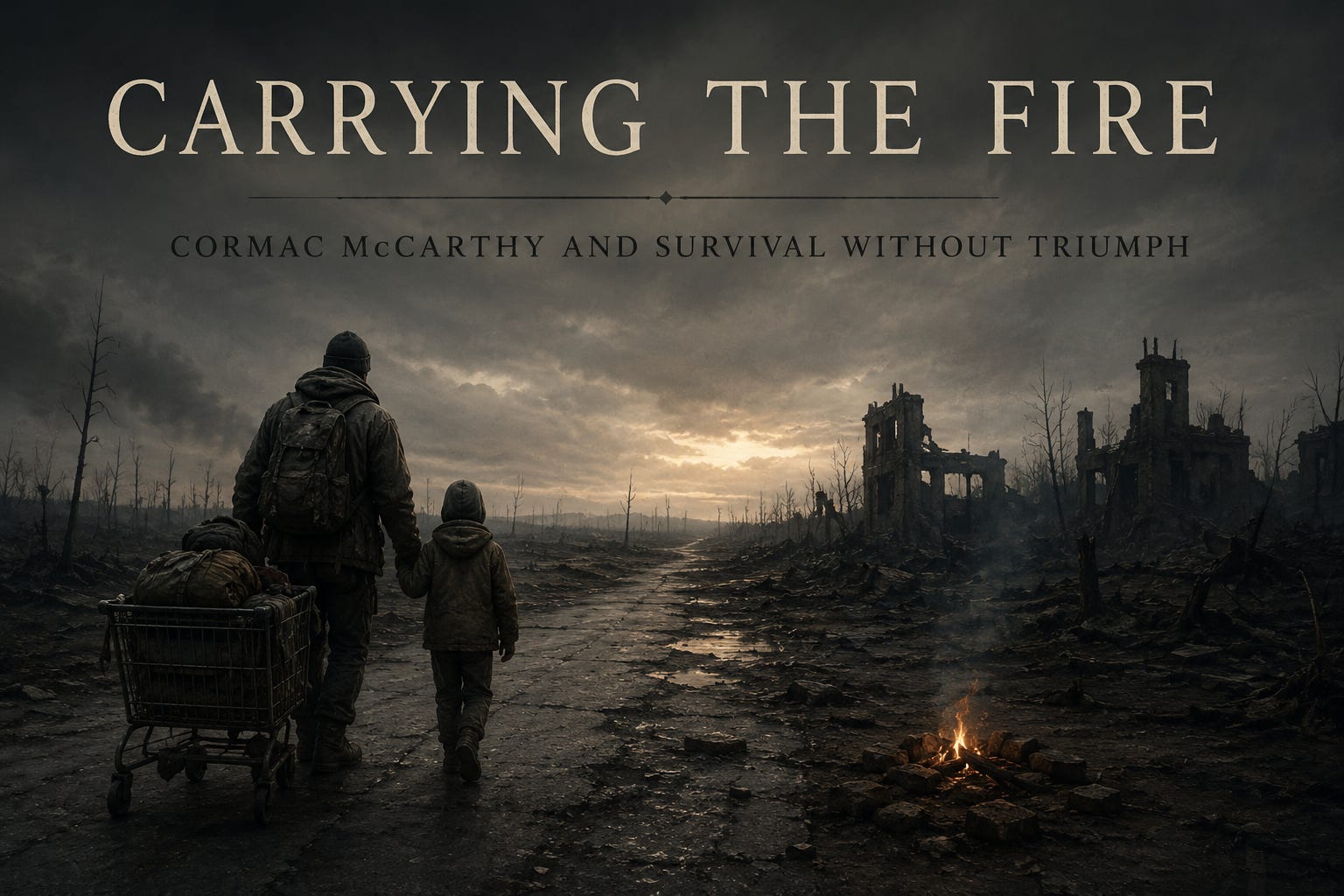
He shifted the pack higher on his shoulders and looked out over the wasted country. The road was empty. Below in the little valley the still gray serpentine of a river. Motionless and precise. Along the shore a burden of dead reeds. Are you okay? he said. The boy nodded. Then they set out along the blacktop in the gunmetal light, shuffling through the ash, each the other’s world entire.
Cormac McCarthy[1]
When we hear “post-apocalyptic fiction,” we are likely to think of films like Mad Max or George Romero’s Living Dead cycle. Those stories frame civilizational collapse as a purification ritual. Social constraints disappear. Moral limits erode. Chaos becomes a ladder. The weak are crushed while the strong inherit the earth. Those with the right combination of determination and ruthlessness become action heroes—or finger-steepling villains. The end of the world becomes a wish fulfillment fantasy.
For all their talk of imminent doom, most post-apocalyptic fantasies are at heart optimistic. The restrictions and decadence of our bureaucratic society are burned away to make room for a better, purer world. Survivalist fiction promises us the death of the Deep State. The end of civilization brings the demise of the parasites who have sucked it dry. Those who have kept the powder dry and their weapons clean are ready not only to survive but thrive.
With collapse comes a jubilee. Our debts are no longer payable and our oppressors are no longer in power. We can imagine ourselves beating enemies with chain-wrapped baseball bats or picking off the hordes with head shots from our bunker. Things may be rough for a time, but you can finally give that HOA board what it’s had coming for years.
In a world that feels lonely, morally uncertain, and spiritually dead, collapse can seem like a new beginning. The institutions we no longer trust, the symbols we no longer share, the spectacles that no longer thrill us—all can be cleared away, and our exhausted culture can finally be put to sleep.
Cormac McCarthy’s 2006 novel The Road strips away those comforting illusions and reminds us that collapse is not liberating: it is simply worse. McCarthy gives us a world where a good day means finding a few cans of food for yourself and your child. There are no epic battles, just crumbling buildings and desiccated corpses. Heroism comes not in glorious deeds but in the slow grinding determination to keep the fire going one more day.
The man has forgotten much of the world before the conflagration; his son was born shortly afterward. His wife chose suicide not long after the child’s birth. He keeps a revolver beside him with a single bullet should the boy’s death become preferable to what the world still has in store. Exhausted and starving, they carry everything they own in a shopping cart with a bad wheel as they wade through the ashes of a dead culture.
Apocalyptic fantasies generally begin with an explanation. Nukes, aliens, zombies, and plagues are among the most popular. McCarthy never tells us exactly what happened. There are ashes, mass deaths, and widespread crop failures. The man and his son pass burned corpses along the roadside, so perhaps it was nuclear war. Ultimately, the cause no longer matters. History and politics are luxuries for people with warm homes and full bellies. Their concerns are entirely immediate; food, shelter, warmth, and survival.
Amidst the dead forests and silence, some have resorted to cannibalism. One scene describes a mob carrying chain-wrapped pipes, followed by “wagons drawn by slaves in harness and piled with goods of war and after that the women, perhaps a dozen in number, some of them pregnant.” [2] Later, they walk past a camp where they find the remains of an infant roasted on a spit. Yet there are no spectacles and no scenes of righteous vengeance. The post-conflagration world has been depleted even of outrage.
Modern catastrophe narratives are entertaining. Violence becomes spectacle; think Negan’s “eenie meenie miney mo” slaughter in The Walking Dead or the Capitol Building blowing up in Independence Day. Bloodshed is aestheticized, villains become charismatic antiheroes, and mass death arrives in all its CGI-rendered glory. All these things are absent in The Road. The lives of his protagonists are tedious, repetitive, and cold.
Most catastrophe movies end on a hopeful note. The world is scarred, perhaps irredeemably so. But it will go on. McCarthy gives us no signs of rebuilding, no bandit camps, no towns gathering amid the wreckage. Fellow survivors are greeted with suspicion and with good reason; your supplies may mean my continued survival and vice versa. Scavenging and predation have become mechanical even for McCarthy’s protagonists.
The man still maintains a few hard limits—we won’t eat other people even though we’re starving. Yet he also turns away a wandering survivor rather than share the little food they have left, until his son acts as a moral compass and insists they share. McCarthy recognizes both morality’s inherent value and the difficulty of holding onto it in difficult times.
The protagonists of post-apocalyptic fantasy find themselves suddenly blessed with new skills in first aid, foraging, shooting, and hand-to-hand combat. They become smarter, tougher, more assertive, and more charismatic. The characters in The Road have no fairy godmother to transform them into mighty warriors or brilliant engineers. They are filthy and emaciated. Early in the story the man notices blood on his hand after coughing. It soon becomes clear that he is not growing stronger but slowly dying.
When the book begins, they are following a crumbling map to the coast. This is a common trope in post-apocalyptic stories. The heroes are searching for a legendary sanctuary, for a gathering of survivors, for a scientist who knows how to stop the virus. The man and the boy are walking toward the sea because they have no better place to go; they are heading south because the weather continues to grow colder. And when they arrive, all they find is:
Along the interstate in the distance long lines of charred and rusting cars. The raw rims of the wheels sitting in a stiff gray sludge of melted rubber, in blackened rings of wire. The incinerate corpses shrunk to the size of a child and propped on the bare springs of the seats. Ten thousand dreams ensepulchred within their crozzled hearts. They went on. Treading the dead world under like rats on a wheel. The nights dead still and deader black. So cold. They talked hardly at all. He coughed all the time and the boy watched him spitting blood.[3]
Catastrophe porn typically ends in resolution. The world may be gone but we have not only survived; we have learned how to survive in chaos and discovered our triumphant warrior self. McCarthy gives us a far more unsettling truth. Catastrophe does not make us greater. It reduces us to starving skeletons coughing up blood and pushing a shopping cart with a bad wheel.
When civilization collapses, so does universal morality. The man and the boy are each the other’s world entire. They live for each other and because of each other. They carry the fire, even if they do not know where, how, or if they will light it again. Their past and their future are ashes, but they are together in this present. The father cannot restore what was lost, but he can protect the boy for another day.
In most grimdark fiction, morality is treated as hypocrisy masking power. In The Road, morality is a fragile persistence that keeps his protagonists human. Their quest is doomed, but no less holy for that. Their world is a wicked place, but they, to the best of their ability, will choose the good. Even when hope is gone, the father does what he can. He acts neither out of optimism nor ideology but from duty driven by love.
McCarthy’s novel refuses both despair and fantasy. His apocalypse is not spectacle but slow decay. He does not provide the reader with redemption, rebuilding, or triumph. The world as it was cannot be put back, cannot be made right again. But despite all that he reminds us of our duty to love and to care for another.
He slept close to his father that night and held him but when he woke in the morning his father was cold and stiff. He sat there a long time weeping and then he got up and walked out through the woods to the road. When he came back he knelt beside his father and held his cold hand and said his name over and over again.[4]
The man dies as he lived: exhausted, frightened, and diminished by a world slowly consuming him. He cannot save the world. He cannot even save himself. All he can do is preserve one small fragment of human goodness long enough to pass it on. Their world has been stripped of institutions, futures, and certainties. Love remains the one thing not entirely reduced to ash.
[1] Cormac McCarthy, The Road. Picador Collection, E-Book.
[2] Ibid.
[3] Ibid.
[4] Ibid.