
Challenger
The closing of the final frontier

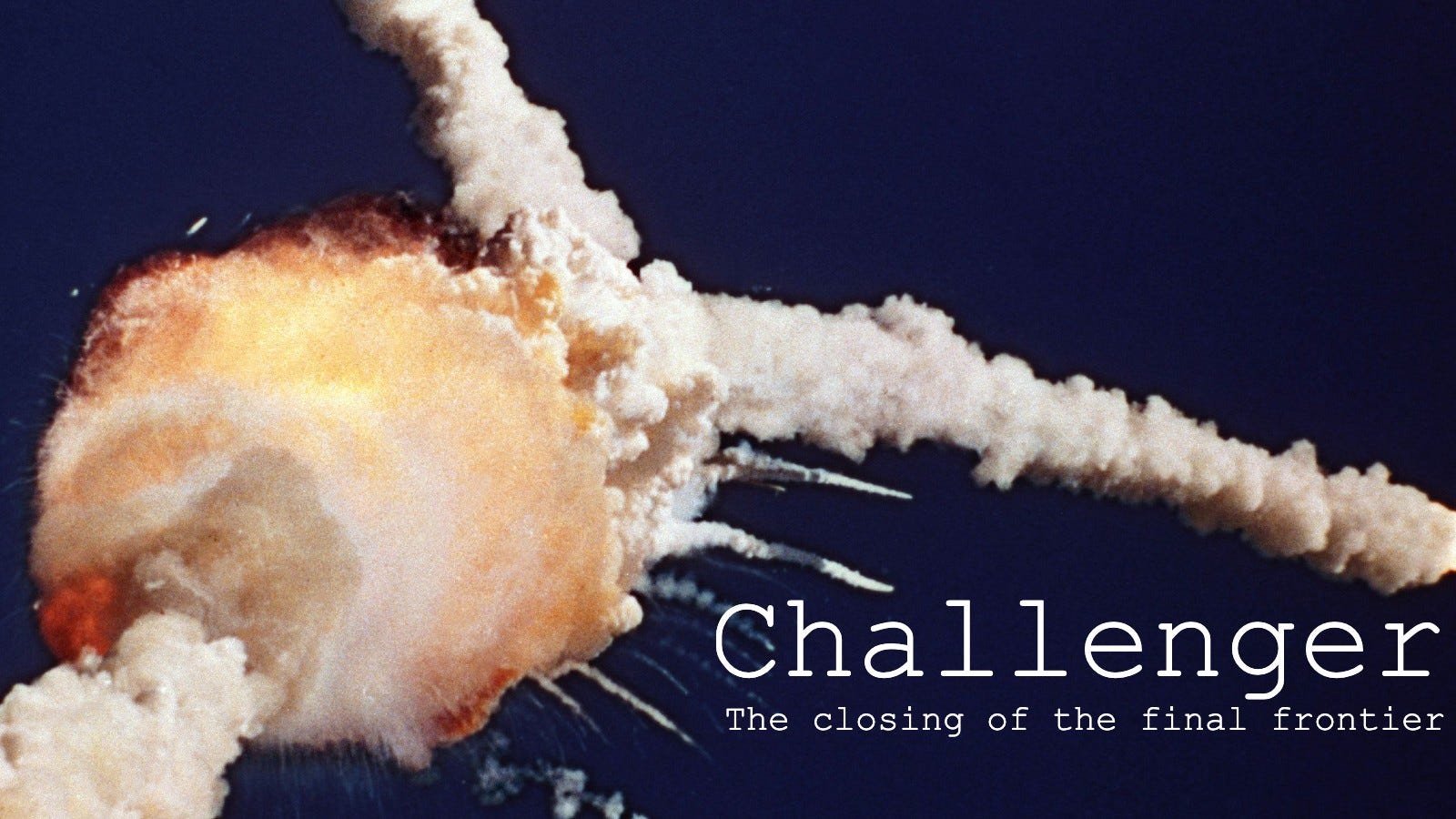
I’m used to waking up with a joint. I’m less accustomed to starting my day (OK, my noon) with an exploding space shuttle. Joe got up a bit before me, so he has already turned on the television.
“Challenger just got blown the fuck up.”
His comment wasn’t exactly a spoiler. I’m puffing harder than usual while I watch the explosion on instant replay, then pass the joint to Joe.
“Holy fucking shit.”
“Flight controllers here looking very carefully at the situation,” the narrator explains. “Obviously a major malfunction.”
The crew is dead; that much seems obvious. We later learn that they survived the shuttle’s breakup. Investigators could not determine how long the astronauts remained conscious during their two minute and forty-five second descent into the Atlantic, but the forces of the initial breakup were probably survivable. The impact with the ocean was not.
At the time, we simply assume that they, like their space shuttle, have just got blown the fuck up.
Like everyone else in America, we know that Christa McAuliffe was supposed to be the first schoolteacher in space. Children across the nation just watched her die in their classrooms. Douglas Coupland hasn’t yet popularized the label “Generation X,” but Joe and I both know that this is going to be one of those events we remember the way our parents remember Pearl Harbor and the JFK assassination.
One of my earliest memories involved the Apollo 13 splashdown. I did not notice that the people glued to the black-and-white luncheonette TV were unusually nervous. Neither did I grasp the dangers facing the astronauts, or how lucky they were to survive their major malfunction. I remember knocking over a Coke glass. My mother complained that the owner, who went to our church, charged her five cents for the damage. I felt bad about that, as five-year-olds do, and had no idea until later that Houston was dealing with much bigger problems.
We had not put a man on the moon for over thirteen years, but we have been putting space shuttles into orbit regularly. Most of those trips have seemed, from a stoned outside viewer’s perspective, as uncomplicated and unexciting as any airline flight. We had grown accustomed to the idea that we would soon be traveling to airport-sized space stations and hopping on shuttles to the Moon, Mars, and beyond.
Apollo launches were events. The space shuttle looks like an airplane and lands on a runway. It travels into space so regularly that networks no longer interrupt their regularly scheduled programming. McAuliffe was traveling to show the world that space flight was now so ordinary that even schoolteachers could fly into orbit. Millions of people, and two stoners in a seedy Scranton apartment, now know that every shuttle launch is an escape from Earth by means of a controlled explosion. And there is no guarantee that the explosion will remain controlled.
In 1968 Arthur C. Clarke imagined that we would be traveling to Saturn in 2001; Stanley Kubrick changed the location to Jupiter. While both those journeys ended with some computer issues, Clarke imagined a second voyage in 2010. Clarke was not just a science fiction writer. He had a first-class Mathematics/Physics degree and noted, in a 1945 paper entitled “Extra-Terrestrial Relays,” that satellites in geostationary orbit could provide worldwide telecommunications. He was admittedly a space optimist, but he was also a space expert.
We, like Clarke, had assumed since the first moon landing that we would soon colonize the solar system. The longest of the Wrights’ four December 17, 1903 flights went 852 feet (260 meters). In 1911 Calbraith Perry Rodgers flew across the country in 49 days, with eighty-two hours and four minutes of flying time—and roughly fifteen crashes. On May 20-21, 1927, Charles Lindbergh flew from New York to Paris in 33.5 hours. We expected to see a similar trajectory from dangerous experiment to commonplace transportation.
But that seemingly logical analogy missed several important points. The Wright brothers could build an airplane in their bicycle workshop and prove powered flight feasible. Deeper pockets then financed larger engines, safer airframes, longer flights, and, eventually, passenger service. Nobody is sending rockets into orbit from their backyard.
Space travel requires a vessel capable of reaching orbital velocity (17,500 mph/28,400 kph). An underpowered airplane will only fly a short distance. A spacecraft that cannot reach orbital velocity falls out of the sky. That craft must also be built to survive vacuum and re-entry. And it must carry everything needed to keep its occupants alive. Spaceflight requires heavy investments in resources, testing, and manpower. And governments are generally loath to make those investments without some very pressing reasons.
On November 5, 1958, Floyd J. Thompson, acting director of NASA’s Langley Research Center, formally established the Space Task Group to implement America’s manned-satellite project. NASA had recently absorbed the laboratories, engineers, and personnel of the National Advisory Committee for Aeronautics (NACA). Thirteen months earlier, the Soviet Union had launched Sputnik and, with it, the Space Race. We were willing to fund our best and brightest because we wanted to achieve parity with, and ultimately superiority over, our Cold War nemesis.
Two months after the first moon landing, in September 1969, Richard Nixon’s Space Task Group offered several possible directions for new space projects. Their plans included three separate options for a Mars voyage; based on the level of effort and investment, the first human landing was projected for between 1983 and 2000.
The report also proposed a space station that would hold 6 to 12 occupants in a low earth orbit and that would grow through modular expansion to a permanent base housing fifty to one hundred persons. Future astronauts would travel into space on chemically fueled earth-to-orbit ferries and use nuclear shuttles for trips into deep space and interplanetary missions. These plans were not science fiction or fantasy. They were presented as plausible national goals by some of the world’s leading space experts.
But “plausible” and “cost-effective” are two different things. Between domestic expenses and the ongoing Vietnam conflict, the extra billions of dollars required for these projects were simply unavailable. Skylab, the space station launched in 1973, held just three astronauts. The NERVA (Nuclear Engine for Rocket Vehicle Application) project was stricken from the budget that same year. Only the earth-to-orbit program survived budget cuts. As Nixon said in his January 5, 1972 announcement:
I have decided today that the United States should proceed at once with the development of an entirely new type of space transportation system designed to help transform the space frontier of the 1970’s into familiar territory, easily accessible for human endeavor in the 1980’s and ’90’s.
This system will center on a space vehicle that can shuttle repeatedly from Earth to orbit and back. It will revolutionize transportation into near space, by routinizing it. It will take the astronomical costs out of astronautics. In short, it will go a long way toward delivering the rich benefits of practical space utilization and the valuable spinoffs from space efforts into the daily lives of Americans and all people.[1]
The president also announced that 1972 would be “a year of conclusion” for manned moon landings. for America’s current series of manned flights Future efforts would concentrate on satellites, which he recognized as “tools in global monitoring and management of nature resources, in agricultural applications, and in pollution control.” [2] The goal was no longer simply to go to space, but to make space travel useful – and keep it on a more reasonable budget.
Three presidents later, on April 12, 1981, Columbia took off from the Kennedy Space Center. The space shuttle project had faced funding challenges, engine issues, and heat shield tile problems that had set back its originally scheduled 1979 launch date. The Columbia launch had originally been scheduled for April 10 but was delayed for two days by a timing delay between the primary and backup computer systems. Despite those setbacks the first shuttle flight made 36 orbits around earth before landing safely at Edwards Air Force Base on the 14th.
The lunar landings were a historic achievement. Next to a trip to the Moon, a voyage into orbit seems almost pedestrian. But from an engineering perspective, the space shuttle is arguably a more complicated machine.
The Apollo rockets only had to work once; the capsule only had to survive one splashdown. The shuttle was not only expected to handle the temperature extremes and vacuum of orbit and the searing heat of atmospheric re-entry, then descend without engine power and make a runway landing. It was also designed to do this repeatedly.
And, for its first twenty-four flights, it succeeded.
Several engineers from Morton Thiokol, the company that designed the shuttle’s boosters, warned against launching Challenger on January 28, 1986. The rubber O-rings that sealed the joints against hot pressurized gases had a record of performing poorly in low temperatures. That morning the temperatures were 31°F (-0.6°C); before this the coldest launch had happened at 53°F (11.7°C).
But Morton Thiokol administration and NASA overrode their concerns. There had already been multiple delays, including a January 27 launch that was scrubbed with the team aboard because of high winds and a stuck bolt in the cabin door. As a compromise, they delayed the launch two hours for ice inspections. At the time of launch temperatures were at 36°F (2°C).
Within a few seconds after takeoff puffs of black smoke could be seen rising from the right booster. Debris from the heated propellant temporarily plugged the opening, but fifty-eight seconds into the flight a jet of flame emerged from the damaged booster. That flame worked like a blowtorch, damaging both the fuel tank and the structure that held it to the booster. Seventy-three seconds after takeoff, the tank failed and released its contents.
At 5:00 p.m. President Ronald Reagan spoke to the nation:
I want to say something to the schoolchildren of America who were watching the live coverage of the shuttle’s takeoff. I know it is hard to understand, but sometimes painful things like this happen. It’s all part of the process of exploration and discovery. It’s all part of taking a chance and expanding man’s horizons.
The future doesn’t belong to the fainthearted; it belongs to the brave…
The crew of the space shuttle Challenger honored us by the manner in which they lived their lives. We will never forget them, nor the last time we saw them, this morning, as they prepared for their journey and waved goodbye and “slipped the surly bonds of earth” to “touch the face of God.”[3]
It was a magnificent speech. For all his flaws, Reagan knew how to speak to a grieving nation. But his paean to courage and exploration would later be complicated by an ugly truth: this was an avoidable accident. Space travel will always involve danger, as the president rightly pointed out. But it becomes much more dangerous when administrators grow complacent and schedule pressure overrides engineering judgment.
We have learned how to monetize orbiting earth objects. Satellites are used by the television, radio, and telecommunications industries. They track weather, gather intelligence, and provide internet access. They can also be placed into orbit by unmanned rockets for a small fraction of what a manned launch costs. There is no need to worry about oxygen, food, water, or loss of life. When their orbit degrades they burn up in re-entry.
Over a hundred unmanned objects have landed on or orbited the moon to gather information, including missions from India and China. Our rovers have traversed the dust of Mars; our satellites have explored the Sun and our probes have sailed out beyond interplanetary into interstellar space. These missions are marvelous achievements. But they have not brought us closer to the space bases we still thought inevitable on the day Challenger took off.
Vinland never developed the population, supply lines, or export trade needed to survive. Greenland’s Norse settlements survived for a few centuries. Greenland was closer to Scandinavia than the Canadian coast. That journey was dangerous but doable, especially if you used Iceland as a stepping-stone to gather supplies and men. There is no Iceland between Earth and the Moon for travelers to obtain food, water, timber, or help. Greenland’s settlements helped support themselves by trading walrus ivory. There is no walrus ivory on the Moon.
The Antarctic Treaty of 1959 dedicates Antarctica entirely to peaceful purposes and scientific cooperation, while freezing any new territorial claims. The 1991 Madrid Protocol further prohibits mining for mineral resources. Antarctica may hold billions of barrels of hydrocarbons, as well as iron, coal, and precious metals.
These treaties may have helped stave off international conflict. But what has proved at least as effective is Antarctica’s harsh living conditions. We do not know exactly what resources Antarctica holds beneath the ice because prospecting is prohibited—and because conducting that research would be extraordinarily difficult and getting those resources to market would be even more challenging.
Antarctica’s mean annual temperature ranges from approximately −10°C (14°F) along the coast to −60°C (−76°F) in the highest parts of the interior. Keeping machinery operating under those conditions is enormously challenging. Several wealthy countries nevertheless maintain scientific stations there. These bases are expensive to operate, and most food, fuel, equipment, and replacement parts must be transported through extreme conditions. Water can be obtained by melting the ice beneath their feet, while breathable air remains free and inexhaustible.
Temperatures near the Moon’s equator can rise above 250°F (121°C) in daylight, then plummet to −208°F (−133°C) after nightfall. Temperatures on Mars have been measured or estimated between approximately 70°F and −225°F, depending upon location and season. Lunar or Martian bases would require regular shipments from a much greater distance.
Their inhabitants would also depend continuously upon machinery to provide oxygen and water. Even if colonists eventually extracted them from lunar ice, Martian ice, or the surrounding rocks and atmosphere, they would first have to transport and maintain the equipment needed to do so. Should the oxygen plants break down, the colonists would be dead long before help could arrive. The most hazardous and hostile conditions on Earth are a balmy spring day beside everywhere else in our solar system.
Elon Musk has talked about colonizing Mars. In 2016, he suggested an unmanned Mars landing could happen as early as 2018. Later he claimed we could have Martian cargo missions in 2022 and human landings in 2024. More recently he has claimed that we could build a city on the Moon within ten years.[4] SpaceX continues to develop Starship and Super Heavy, and there is still interest in interplanetary travel. But while we have managed to overcome the unforgiving laws of physics and travel into space, even the world’s wealthiest space advocate has not yet found a way to master the laws of interplanetary economics.
[1] “Statement by President Nixon,” January 5, 1972 at NASA. https://www.nasa.gov/history/president-nixons-1972-announcement-on-the-space-shuttle/.
[2] Ibid.
[3] Ronald Reagan, “Address to the Nation on the Explosion of the Space Shuttle Challenger” (January 28, 1986). At Ronald Reagan Presidential Library and Museum. https://www.reaganlibrary.gov/archives/speech/address-nation-explosion-space-shuttle-challenger.
[4] Claire Cameron, “Elon Musk says SpaceX will prioritize a city on the moon instead of a colony on Mars.” Scientific American, February 8, 2026. https://www.scientificamerican.com/article/elon-musk-says-spacex-to-prioritize-landing-on-the-moon-instead-of-mars-city/.
I remember where I was, Brookhaven Community College Farmers Branch Texas, a north suburb of Dallas, the last of the 6 area Junior collages back when Texas had a $2 Billion dollar surplus so they threw on a copper roof, we were all traumatized watching the TV set in the student union, it's a long way from there to here and I'm super stocked to go space trucking with Elon, I want to tee off from Olympus Mons and hit Antarctica and get 4 stars on each corner of the Hollywood walk of fame