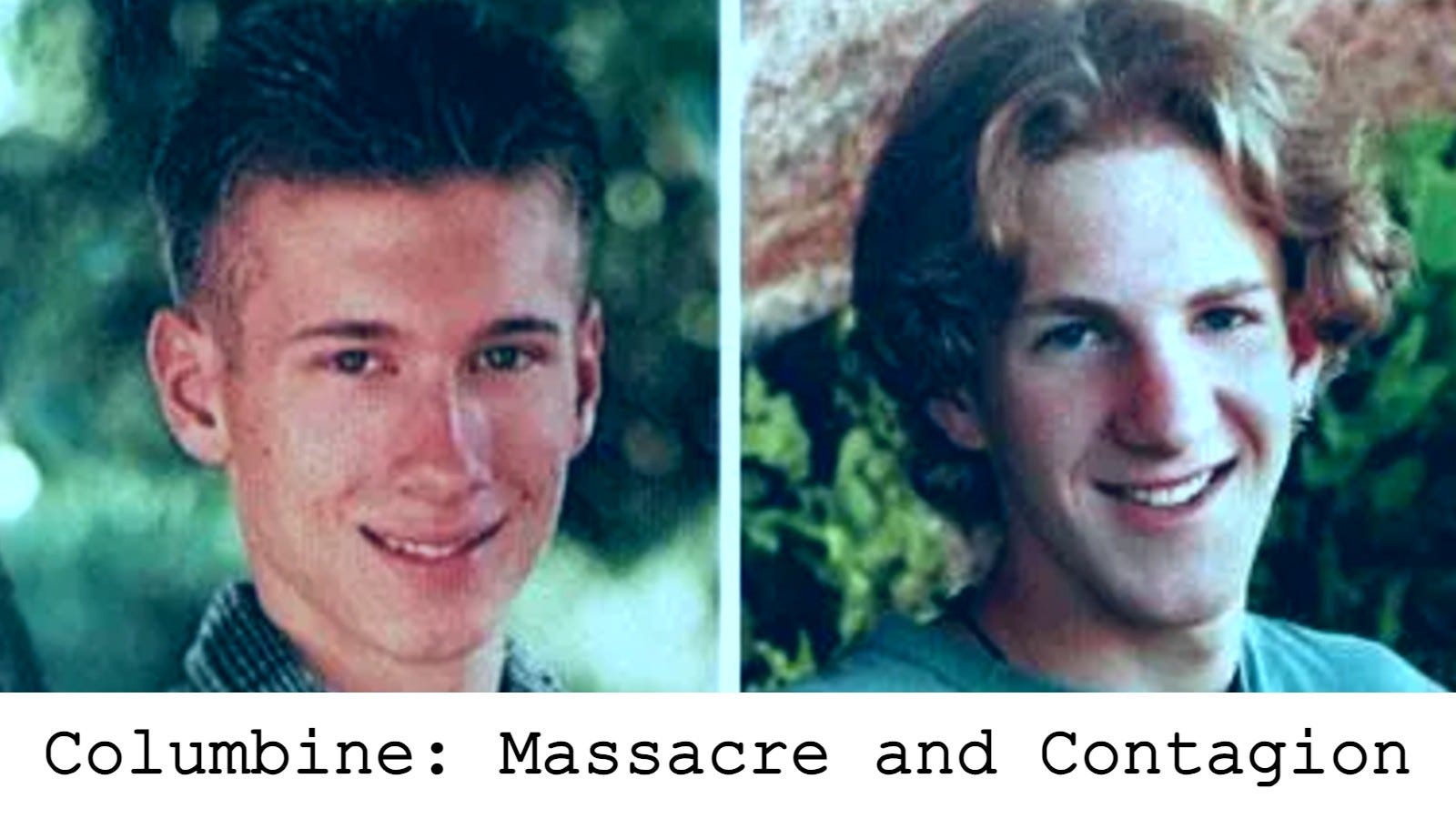
Columbine: Massacre and Contagion
How a School Shooting became a Foundational Myth
On the morning of April 20, 1999, seniors Eric Harris and Dylan Klebold walked into Columbine High School and murdered twelve students and one teacher before taking their own lives.
Columbine was not the first school massacre. On January 29, 1979, Brenda Spencer wounded eight children and killed two adults at the Cleveland Elementary School in San Diego because “I don’t like Mondays.” On May 18, 1927, Michigan farmer Andrew Kehoe used explosives to kill 45 people and injure 58 in the Bath School Disaster. On November 12, 1966, Robert Benjamin Smith, an admirer of mass murderers Charles Whitman and Richard Speck, killed four women and a toddler at the Rose-Mar College of Beauty.
These crimes horrified the nation, and most Americans were shocked and disgusted by Columbine. But alongside the rage and grief there was a small but persistent kernel of admiration. By 2015, Mother Jones identified 74 Columbine-inspired plots or attacks across thirty states, with 89 killed—including nine shooter suicides—and 126 wounded. Thirteen plotters hoped to surpass Columbine’s death toll. Ten cited the shooters as heroes, idols, martyrs, or God. Three made pilgrimages to Columbine while planning their attacks.[1]
Columbine continues to attract the disaffected. On June 23, 2026, a few weeks after his high school graduation, 18-year-old Bradley Scott Sayer walked into a Chico, California library and fatally shot two people. He was wearing a T-shirt bearing the words “Natural Selection,” the same slogan Eric Harris wore during the killings. Butte County District Attorney Michael Ramsey noted that Sayer’s social media postings showed he “had been a fan, and a fan for a long time.”[2]
Twenty-seven years later, people are still emulating Harris and Klebold.
The Columbine contagion has crossed borders. Artyam Kazantsev wore braided keychains with the words “Columbine,” “Dylan,” and “Eric” when he opened fire at a school in Izhevsk, Russia on September 26, 2022. Seventeen people, including eleven children, died.[3] 27-year-old Julio César Jasso Ramírez was carrying an AI image of himself standing alongside Harris and Klebold as he opened fire on tourists at Mexico’s Teotihuacan pyramid on April 20, 2026 – the anniversary of the Columbine massacre.[4]
How did two angry high school students create a template for mass murder that has endured for over a quarter century?
Many have guessed at what caused Columbine. Psychiatric drugs, bullying, video games, easy access to guns, the collapse of traditional values—lots of people are certain we can stop school shootings if only we fix one or two big problems. Their explanations are not without some merit, but they do not fully account for the tragedy or for the acolytes who continue to emulate Harris and Klebold.
Their urge to find explanations and solutions is understandable. We’re storytelling apes driven to impose order out of chaos. Few events seem more senseless than a school shooting. When they become regular occurrences, we’re driven to find out why for practical and existential reasons. We want a world we can comprehend, a flaw we can correct, a lesson we can learn—something that will bind the open wound left behind by an unimaginable act.
Instead of searching for answers and solutions, let’s look for anomalies.
Mass murder is nothing new. Neither are mass murders committed in schools. What is anomalous about Columbine is that it became a meme—not an internet joke, but a self-replicating cultural idea. There was no wave of school bombings after the Bath School Disaster. There were no shooters firing into playgrounds because the attacker didn’t like Mondays, not even after the Boomtown Rats turned Brenda Spencer’s slogan into a hit song. That is the first thing that sets Columbine apart.
We have an underground culture of serial killer devotees. Most content themselves with collecting trading cards, writing to inmates, and attending conventions. They rarely aspire to be the next Jack the Ripper or Richard Ramirez. Americans are likewise fascinated by assassins. We are still arguing about who killed the Kennedys and where Jimmy Hoffa is buried. But while wishing death on politicians has become a social media sport, very few set out to become the next Lee Harvey Oswald or John Wilkes Booth.
These figures inspire books, podcasts, and documentaries. They do not produce the culture of emulation that has grown up around Columbine. What is most important about Harris and Klebold’s admirers is not the size of their club. It is their eagerness to follow in the footsteps of their idols. Columbine speaks clearly to a very small but very angry audience. That is the second thing that sets Columbine apart.
Harris and Klebold offer angry, disaffected loners a shortcut to notoriety. Walk into a crowded area. Start shooting. Be remembered forever.
You probably—hopefully—read those sentences with horror. But for that small, angry audience, Columbine represents something very different. With one moment of indiscriminate violence, they can strike back at the world that they believe has rejected them. They can ensure that their names will be remembered long after their classmates, teachers, and perceived enemies have been forgotten. The world doesn’t remember Columbine’s 2000 prom queen, valedictorian, or most valuable football player. But it knows Eric Harris and Dylan Klebold.
Harris and Klebold blazed a path that is easy to follow and promises international notoriety. In the Age of Influencers, attention is a commodity. It not only provides its adherents with the vicarious thrill of fictional antiheroes like Hannibal Lecter or Dexter Morgan. It gives them a chance to join the story themselves. We may consider their actions appalling, but the attention economy makes little distinction between admiration and infamy. To the algorithm, outrage is still engagement. That is the third thing that sets Columbine apart.
Columbine sparked national discussions about bullying because many of us spent our school years being bullied. The idea that two young men could be driven to a horrible crime after years of cruelty and abuse made sense to us. We did not support or excuse their actions, but we felt we understood them.
It’s no longer clear how extensively Harris and Klebold were bullied, or whether bullying played a key role in their decisions. But we often project our past experiences onto others. Many students who felt themselves trapped in a hostile environment looked at Columbine and felt they could understand Eric and Dylan. A few saw a script for striking back at the world that had made their lives miserable. They could sympathize with the school shooters and dream of revenge. A very few did more than dream. That is the fourth thing that sets Columbine apart.
In 1979, the Cleveland Elementary School shooting faded quickly from the headlines and television news. “I Don’t Like Mondays” only reached No. 73 on the Billboard Hot 100. By 1999 most Americans had access to 24-hour cable news. 41 percent of American adults were using the Internet. A December 1998 Pew Research study found 64 percent of Internet users went online at least once a week for news.[5]
In this new media environment, Columbine dominated public discussion for weeks. It was discussed on newspapers, television, and internet forums. Usenet had a dedicated group, alt.current-events.massacre.columbine, as well as many Columbine discussions on alt.conspiracy. 206 Associated Press news and broadcast editors ranked Columbine the second-biggest story of 1999, behind the Clinton impeachment trial and ahead of the Kosovo war. That is the fifth thing that sets Columbine apart.
This kind of wanton school slaughter was once very rare. In 1927 Andrew Kehoe blew up a Michigan school. In 1966, nearly forty years later, Robert Benjamin Smith attacked the Rose-Mar College of Beauty. Thirteen years later, Brenda Spencer shot at an elementary school playground in 1979. Another twenty years elapsed before Columbine.
On April 28, 1999, after eight days of watching the Columbine massacre on the news, fourteen-year-old Todd Cameron Smith killed one student and wounded another at his former school in Taber, Alberta. A month after Columbine Anthony “T.J.” Solomon pledged allegiance to the Columbine attackers and injured six students with a .22 caliber rifle. On November 1, German student Martin Peyerl killed four students and injured seven before taking his own life.
Today Columbine-style school shootings have become recurring events despite increased school security, stricter anti-bullying rules, and increased awareness of teen mental health issues. Our efforts to staunch this bloodshed have so far borne little fruit. We are still shocked when schoolchildren are slaughtered. We are no longer surprised. That is the sixth thing that sets Columbine apart.
So, what can we glean from these anomalies? Taken individually, not very much.
We know that school shootings and public spree killings have become far more common since Columbine. We know that the Internet has changed the way we get our news, and that it rewards outrage as readily as praise. We know that bullying is less tolerated today than it was twenty-seven years ago, thanks in large part to conversations sparked by Columbine. And we know that many disaffected young people empathize and even identify with Eric Harris and Dylan Klebold—and that each year we see Harris and Klebold name-dropped by multiple killers.
We have spent years trying to understand the Columbine shooting. But in our quest to determine what afflicted Patient Zero, we have paid less attention to how the contagion has spread. What other anomalies can we find that will help us better understand this memetic disease and, perhaps, find ways to contain it?
The answers we seek are unlikely to be found solely in debates over guns, school security, or antidepressants. Those questions matter, but they do not explain why Columbine became contagious. To understand how this mythology spread, we must first understand why its adherents came to see Harris and Klebold as demigods and murder as a ritual.
The Columbine admirers have not created an organized religion. There are no sacred texts, no temples, and no official clergy. But Harris and Klebold serve roles that are filled by the saints, martyrs, and culture heroes of many religions. Some adherents make pilgrimages to Columbine. Others adopt the killers’ symbols and iconography.
A few of the most devout perform acts of mass murder as a ritual re-enactment of the founding myth. By re-enacting the founding myth, they become part of the ongoing story and are joined with the founders in symbolic immortality. In death they become part of the myth. They become the Remembered and rise above the Forgotten. In seeking revenge, they win rebirth.
The mythology of Columbine is deeply pessimistic. Like many Gnostic sects, the Columbine mythos sees the world as a prison ruled by hostile forces—classmates, schools, parents, institutions, and the corrupt society they view with fear, loathing, and contempt.
Gnosticism and Monasticism were peaceful efforts to understand suffering and how to transcend it. Gnostics felt society was corrupt because it was rooted in the warped material creations of a Demiurge. The fourth century also saw the rise of the Circumcellions, a radical North African movement associated with the Donatists.
Christianity had recently become an accepted religion of the Roman Empire. The age of persecution was ending, but it left behind an uncomfortable question: what should become of bishops and priests who had surrendered scriptures, handed over Church property, or otherwise compromised with imperial authorities to save themselves?
The Donatists argued that such clergy had forever forfeited their spiritual authority. The Circumcellions went even further. They regarded the established Church as irredeemably corrupt, welcomed outcasts, and elevated martyrdom into the highest religious ideal.
Contemporary sources claim that many Circumcellions sought violent confrontations in the hopes of dying for their cause. Screaming “Laudate Deum!” (praise to God), they would attack random travelers and Roman legionaries with wooden clubs. If they prevailed, they took the spoils. If they lost, they won the martyr’s crown. Others would interrupt court proceedings to scream at the judges, knowing as they did so that contempt of court carried a death sentence under Roman law.
We know little about the Circumcellions, and what we know comes from uniformly hostile sources. But we see in those reports a pattern that has repeated itself throughout history. When a movement comes to see the existing world as beyond redemption, some of its believers will eventually conclude that the old moral rules no longer apply. Acts the greater society regard as atrocities can become sacred pathways to transcendence.
[1] Mark Follman and Becca Andrews, “How Columbine Spawned Dozens of Copycats.” Mother Jones, October 5, 2015. https://www.motherjones.com/politics/2015/10/columbine-effect-mass-shootings-copycat-data/.
[2] Louis Casiano, “Suspected California library gunman influenced by Columbine shooting and wore matching shirt, officials say.” Fox News, June 23, 2026. https://www.foxnews.com/us/suspected-california-library-gunman-influenced-columbine-shooting-wore-matching-shirt-officials-say.
[3] Robyn Dixon, “At least 17 dead, many wounded, at school shooting in Russia.” Washington Post, September 26, 2022.
[4] Maria Verza, “Gunman at Mexican pyramids carried materials related to 1999 Columbine massacre.” PBS, April 20, 2026. https://www.pbs.org/newshour/world/gunman-at-mexicos-teotihuacan-pyramids-kills-1-canadian-tourist-injures-6
[5] Pew Research Center, “The Internet News Audience Goes Ordinary” (January 14, 1999) at Pew Research Center. https://www.pewresearch.org/politics/1999/01/14/the-internet-news-audience-goes-ordinary/.