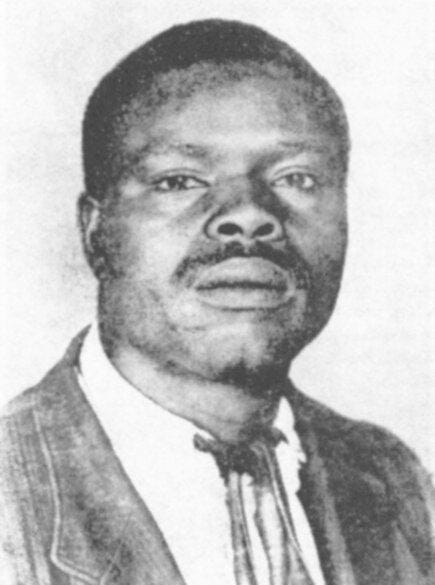
Confessions of Jim Conley
May 1913
Those stains on his shirt were not blood, Jim Conley insisted. He was simply trying to wash out rust marks. The day watchman was mistaken when he said they were blood. And yes, he had dropped the shirt, but that was because he was startled. He had no intention to hide anything. He just needed a clean shirt to wear to the coroner’s inquest.
The Atlanta Police Department already knew Jim Conley. He had spent a few stays on the chain gang during his 27 years. Three months earlier, he had fired a shot at his former girlfriend, Lorena Jones and had a long history of drunk and disorderly arrests. The police booked Conley into jail on May 1, expecting to release him as soon as they determined the true nature of those stains. Conley claimed he could not write, so the investigators assumed he could not have written the notes found by Mary Phagan’s body.
On May 5, Leo Frank sat before the coroner’s inquest. While Atlanta detectives had described Frank as jumpy and nervous during their first encounters, he remained calm and collected throughout his deposition. In passing he noted that during the 55-minute span between the time Mary Phagan left his office and he went to lunch he had been visited by Lemmie Quinn, a plant foreman. Detectives checked the claim. Quinn confirmed Frank’s story; he had indeed spoken with the superintendent during that interval. Even the Georgian, chastened after the controversy of its April 30 headline, admitted that Frank’s testimony was “considered distinctly favorable.”
Earlier that morning, gravediggers had disinterred Mary Phagan’s body. Dr. Henry Fauntleroy Harris, one of Atlanta’s most prominent physicians, worked for hours on the body in an effort to establish the cause of Phagan’s death and the extent of her injuries. Dissatisfied with the original autopsy, Fulton County Solicitor General Hugh Dorsey ordered the body exhumed for a second examination. He would order a second exhumation on May 7 for further information.
Jim Conley was still in jail on May 15, when John Black and Harry Scott came to him for a statement. They had learned, despite his claims to the contrary, that he could read and write. (Frank had told a Pinkerton detective, “I know he can write. I have received many notes from him asking me to loan him money.”[1])
The police were now inclined to believe that Newt Lee was not involved with Mary Phagan’s murder. They were keeping him in custody largely for his own safety. Many Atlantans—and quite a few Atlanta investigators—were certain that the Phagan murder was the sort of savagery that could only be a “Negro crime.” It was highly probable that releasing Newt would leave him hanging from a tree soon thereafter.
Those investigators now knew that Conley had lied during his first interview. After examining a sample of his handwriting, they realized he had written the notes found beside Mary Phagan’s body. They still had not gotten around to testing the stains on his shirt, but he had now become one of the investigation’s prime suspects.
When Detectives Black and Scott showed Conley a jeweler’s watch installment contract bearing his signature, he admitted, “White folks, I’m a liar.”[2] He denied writing the notes at first, but after some time in solitary confinement he admitted on May 24 that he had indeed written them—but claimed he had done so at Leo Frank’s request.
On May 23 a grand jury had convened to decide whether Leo Frank should be charged with murder. The following day the grand jury met to deliberate. Five minutes later, they returned an indictment charging Frank with the murder of Mary Phagan.
The Atlanta Journal announced, “State Didn’t Show its Case to Secure Indictment Against Superintendent Leo M. Frank” and proclaimed:
Sharing interest with the returning of a true bill against the factory superintendent, is the sensational eleventh-hour statement of James Conley that he wrote certain notes similar in language to those found by the murdered Mary Phagan at Mr. Frank’s dictation.[3]
This is one of the more interesting and controversial anomalies in the Frank case. The notes pointed suspicion toward Newt Lee, something that would benefit the real killer. But why would Leo Frank choose to leave notes?
The obvious answer is that he panicked and made a rash decision. Many people do foolish things under extreme stress, and few things are more stressful than murder. But if Conley were the murderer, he would also have reason to frame Newt. Did he write the notes in the hope of avoiding execution, then shift the blame to Leo Frank after detectives caught him in a lie?
For Frank’s supporters, the answer is obvious: Conley falsely accused Frank to save his own skin. The purported motivation is certainly understandable. Nobody doubts that the notes were in Jim Conley’s handwriting. But that raises another question. How did a black laborer with a long history of petty crime, a man who admitted lying and who was directly connected to some of the case’s most important evidence, convince detectives, prosecutors, jury members, and judges that his final account was believable?
Frank’s supporters would respond with another obvious answer: endemic anti-Semitism and class resentment led the jury to convict an innocent Jew. There were certainly anti-Semites to be found in 1913 Atlanta, and there was no shortage of class resentment. But there was also a long-standing, deep-rooted horror of black men raping white women. Dorsey’s autopsies had revealed evidence that Mary Phagan was subjected to a brutal sexual assault before death—something that had been rumored beforehand and which had already raised racial tensions to a fever pitch.
At this point in the investigation, Frank and Conley were the two most likely suspects. Frank had already hired a prominent attorney, and his family could afford to spend a great deal of money on more lawyers. Conley was a half-step above indigent. Throwing him to the wolves would give Atlanta the satisfaction that the brute black beast had been punished for his crimes against white womanhood. It would also be a far easier conviction. Yet investigators concluded that Conley was more valuable as a witness than as a defendant.
Antisemitism in Georgia was real. Jews were not allowed into many of the most exclusive clubs, and preachers regularly accused the Jewish people of denying or even killing Jesus. Jewish peddlers were often targeted for robbery and occasionally run out of town by local merchants. There were bad feelings about carpetbaggers in general and Jewish carpetbaggers in particular. But the idea that these feelings would so inflame a jury that they would accept Conley over Frank is hard to reconcile with the racial tensions of the day.
That said, I might offer an alternative explanation to why Atlantans found Jim Conley more credible than Leo Frank.
Conley lied multiple times. Most white Atlantans in 1913 would expect that from a poor black laborer in jail. In their estimation lying came as naturally to shiftless no-account negroes as fighting, drinking moonshine, and playing craps. They would have a harder time imagining that Conley had hatched an elaborate scheme to frame his wealthy employer than accepting that he was telling the truth about a man who was already under suspicion.
Leo Frank was Jewish, but most 1913 Atlantans would hold him to the same standards they expected from any prosperous white man of his social position. An innocent man should have no fear of cooperating with investigators. He should fight to clear his name rather than calling in lawyers before he was even charged with a crime. Leo Frank was behaving like a man who was trying to hide something. Antisemitism might well have played less of a role than his failure to measure up to Georgia social expectations.
These preconceptions are unfair, outdated and offensive to modern sensitivities. But this crime happened over a century ago. We cannot understand what happened unless we are willing to acknowledge how contemporary expectations influenced the participants. We may find these ideas distasteful. Georgians in 1913 regarded them as common sense, just as people in every era find their assumptions self-evident.
Not everybody trusted Conley. On May 27 the Georgian front page declared CONLEY NEW PHAGAN SUSPECT and stated:
Careful study of the negro’s story has revealed many absurdities in its structure, wherein evidences of childish cunning are rife in an effort to throw the blame onto Frank. It is this which has served to bring the deed to Conley’s door…
The police, in spite of bending every effort to show that Frank is guilty, therefore, have resorted to a dissection of Conley’s story. One of its weakest links, they believe, is the negro’s quotation of Frank’s statement to him, “Why should I hang?” That the superintendent should place this confidence in the negro sweeper appears absurd.[4]
Shaken by the headline, Conley made a second affidavit in which he claimed:
[W]hen I came back to the pencil factory with Mr. Frank I waited for him downstairs, like he told me, and when he whistled for me I went upstairs and he asked me if I wanted to make some money right quick, and I told him, yes, sir, and he told me that he had picked up a girl back there and had let her fall and that her head hit against something—he didn’t know what it was—and for me to move her and I hollered and told him the girl was dead…
Mr. Frank then asked me to write a few lines on that paper, a white scratchpad he had there and he told me what to put on there and I asked him what he was going to do with it and he told me to just go ahead and write, and then after I got through writing Mr. Frank looked at it and said it was all right, and Mr. Frank looked up at the top of the house and said, “Why should I hang? I have wealthy people in Brooklyn,” and I asked him what about me and he told me that was all right about me, for me to keep my mouth shut and he would make everything all right.[5]
Earlier Conley said that he had written the notes the day before Phagan’s murder, suggesting that Frank had planned to kill her all along. Now his story changed. In this new telling, Mary Phagan’s killing was an accident. Frank had panicked, offered Conley money to help him move her body, and wrote the notes to throw suspicion on Newt Lee.
On Friday, May 30, Jim Conley and a group of people including Chief Beavers walked through the National Pencil Company after ordering workers to leave the premises. Conley walked to the metal room and lay down where he had found Phagan’s body; she was lying on her stomach with a cord around her neck. He described helping Frank carry the body to the basement and insisted that this third affidavit was voluntary; that he had not been browbeaten are mistreated; and that he was telling the whole truth because “Mr. Frank and his friends have forsaken me.”[6]
Conley was now a celebrity; gawkers and reporters gathered round him to ask questions that he was happy to answer. His recently hired lawyer, William Smith, was less than amused. He had told Conley in no uncertain terms to keep quiet—the same advice Frank’s lawyers had given him. But while Frank complied, Conley basked in his newfound notoriety. With the assistance of Dorsey and Atlanta Chief of Detectives Newport Lanford, Smith had Conley transferred to lockup with access restricted to approved visitors.
[1] Leonard Dinnerstein, The Leo Frank Case. Athens and London: University of Georgia Press, 2008. 22.
[2] Oney, 130.
[3] “State Didn’t Show its Case to Secure Indictment Against Superintendent Leo M. Frank,” Atlanta Journal, May 24, 1913. https://www.leofrank.org/state-didnt-show-its-case-to-secure-indictment-against-superintendent-leo-m-frank/.
[4] “Conley New Phagan Suspect,” Atlanta Georgian, May 27, 1913. https://www.leofrank.org/suspicion-turned-to-conley-accused-by-factory-foreman/.
[5] “Negro Conley’s Affidavit Lays Bare Slaying,” Atlanta Georgian, May 29, 1913. https://www.leofrank.org/negro-conleys-affidavit-lays-bare-slaying/.
[6] “Conley, Taken to Factory, Shows Where Girl Was Found—How They Put Body in Basement,” Atlanta Journal, May 30, 1913. https://www.leofrank.org/conley-taken-to-factory-shows-where-girl-was-found-how-they-put-body-in-basement/.