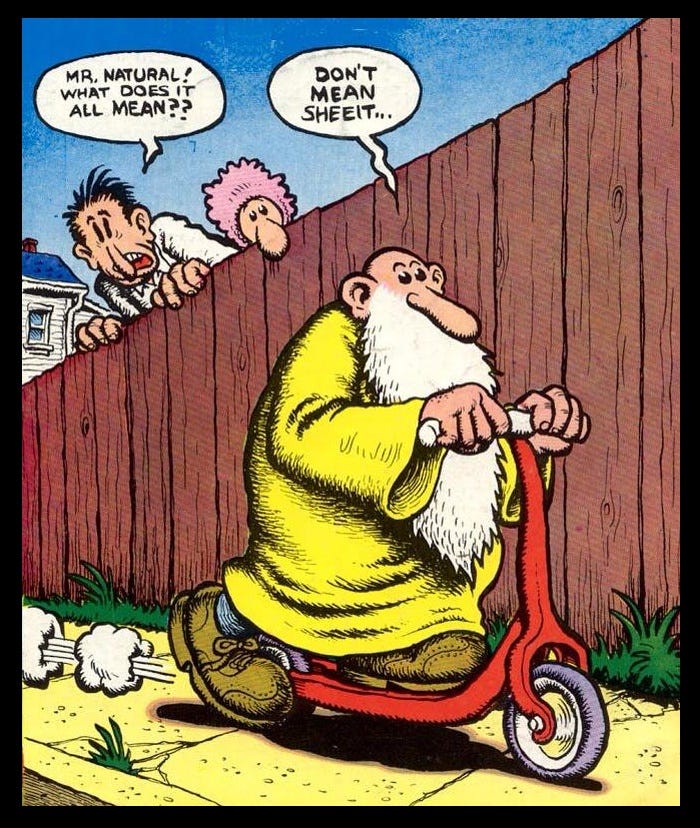
From Dada to Strongman
Politics and the Crisis of Meaning
Today we’re always just a few swipes away from a debate. We argue from our smartphones about art, culture, and economics. We declare our loyalties to causes, celebrities, and teams. We define ourselves and others by beliefs, preferences, strengths, and limitations.
We’ve come to see ourselves as the sum total of what we say and do. Indeed, many modern thinkers have argued, in different ways, that our actions and expressions do indeed define who we are.
And yet, amid all that performance and self-construction, we rarely ask the more fundamental question:
What gives any of it meaning?
Meaning sits underneath all our arguments. It shapes how we interpret success and failure, how we assign blame, and how we decide what matters in the first place.
We can disagree about policies or outcomes and still share a sense of purpose. But when that shared sense breaks down, the arguments don’t just multiply. They change in character. Our debates become less about solving problems and more about asserting identity, assigning responsibility, and demanding recognition.
The World Before “Finding Yourself”
The old alchemical dream was changing base metals into gold. The new alchemical dream is: changing one’s personality—remaking, remodeling, elevating, and polishing one’s very self … and observing, studying, and doting on it. (Me!)
Tom Wolfe, “The Me Decade and the Third Great Awakening”
New York Magazine, August 23, 1976
For most of history, identity was something you inherited. You were born into the structures that gave your life meaning—your faith, your family, your place in the world. Meaning wasn’t something you had to search for. It was already there.
That made life more legible. But it also came with real constraints. Your gender, ethnicity, and social status opened certain doors while closing many others. Freedom, in the modern sense, was limited. More often than not it was reserved for the wealthy and powerful. Most were expected to know their place and live within it.
By 1976, that world was already giving way. The self was no longer a birthright, but something you examined, refined, and, if necessary, reinvented. Tom Wolfe saw the shift as it was happening.
I turned 11 in 1976. My father had reinvented his life, and his marriage, two years earlier. Like many Gen Xers, I grew up in a single parent household. A generation earlier, walking out of a troubled marriage came with serious stigma. By the 1970s, no-fault divorce left partners free to leave unions they found stifling.
The shifts went beyond the family. On April 8, 1966, Time magazine asked on its cover “Is God Dead?” The accompanying article described a group of theologians attempting something that would have been unthinkable a generation earlier: a religion without God.
Roles that had once been fixed were becoming negotiable. Institutions that had once anchored meaning were being questioned, revised, or set aside. The self was no longer something you inherited. It was something you had to reshape.
The Collapse of Shared Meaning
Gas! Gas! Quick, boys!—An ecstasy of fumbling,
Fitting the clumsy helmets just in time,
But someone still was yelling out and stumbling,
And flound’ring like a man in fire or lime.
Dim through the misty panes and thick green light,
As under a green sea, I saw him drowning.
In all my dreams before my helpless sight,
He plunges at me, guttering, choking, drowning.
Wilfred Owen, “Dulce et Decorum Est” (published posthumously, 1920)
The cultural shifts of the 1970s were the downstream effects of a rupture that began half a century earlier. The First World War didn’t just kill millions. It destroyed the language that had made those deaths intelligible.
Honor, glory, and sacrifice were drowned in gas and mud. After WWI the old words still existed. But they no longer meant the same thing.
Today many dismiss Dadaism as weird art created by weirder poseurs. But Dadaism was a rejection of meaning in a world that had proven itself meaningless. It embraced absurdity, contradiction, and nonsense as a statement. The world no longer made sense, so why should art?
Duchamp’s “Fountain” isn’t a joke, it’s a manifesto. A mass-produced urinal, signed with a pseudonym and placed in a gallery, asks a simple question: what makes something art?
Duchamp’s answer is deliberately unsettling. The object itself doesn’t change. Only its context does. Meaning is not inherent—it is assigned. The systems used to define art were no longer reliable. A urinal could become a sculpture simply by being declared one.
In a world where established meanings had led to catastrophe, even something as basic as “this is art” could no longer be taken for granted. This was not decadence. It was disillusionment made visible.
Victor Frankl’s Search for Meaning
To those who love peace there can be no other hope in the present conflict than the defeat, the utter discrediting of the German legend, the ending for good and all of the blood and iron superstition, of Krupp, flag-wagging Teutonic Kiplingism, and all that criminal, sham efficiency that centres in Berlin. Never was war so righteous as war against Germany now. Never has any State in the world so clamoured for punishment.
H.G. Wells, The War to End War (1914)
In 1914 socialist and utopian H.G. Wells described the Great War as “the war that will end war.” For Wells, this war was not against the German people but against the bloody militarism and imperialism that had taken root in European consciousness. Once we put down this nastiness, we could build a new, peaceful world ruled by science and reason.
Alas, the future did not turn out the way Wells had hoped. After the 1919 Paris Peace Conference, Field-Marshall Earl Wavell bitterly noted that the diplomats had made the “Peace to end Peace.”
The onerous terms of the Treaty of Versailles left Germany crushed. Out of that crisis came a new leader who gave their suffering meaning. Germany was not weak, he told them. It was not guilty. It had been betrayed, and was being looted, by enemies within and without.
When meaning collapses, explanations become power. Other politicians complained about problems. Hitler promised solutions. And vengeance.
In 1942, Viktor Frankl, an Austrian psychiatrist, was deported with his family to the Theresienstadt ghetto. His parents, brother, and wife did not survive. Frankl himself endured four concentration camps, including a brief stay at Auschwitz, before liberation.
In 1946, he published Ein Psychologe erlebt das Konzentrationslager (“A Psychologist Experiences the Concentration Camp”). In 1959, it appeared in English as From Death-Camp to Existentialism. A few years later, it was retitled Man’s Search for Meaning.
The shift in title is telling. The first emphasizes the experience. The second emphasizes the question that emerged from it.
The Dadaists looked at catastrophe and rejected the very idea of meaning. Viktor Frankl arrived at a different conclusion. Even in the worst imaginable conditions, something remained within human control. Not the body. Not circumstances. But the ability to choose one’s response — to find meaning even in suffering. As Frankl put it:
There is nothing in the world, I venture to say, that would so effectively help one to survive even the worst conditions as the knowledge that there is a meaning in one’s life. There is much wisdom in the words of Nietzsche: ‘He who has a why to live for can bear almost any how.’
The Burden of Freedom
Today, finding your “why” is more like choosing your own adventure. In the twentieth century, we were expected to discover ourselves. Now, discovery has given way to construction. We are tasked with creating ourselves in our own image.
Freedom doesn’t eliminate the need for meaning. It privatizes it. When identity is no longer inherited, it becomes a matter of choice. Every path taken closes off others. Every failure feels personal. Instead of inhabiting a role, we are forced to justify it. We must explain what we do, who we are, and why it matters.
If the self is something we construct, it is also something that can come undone.
The 1990s and early 2000s saw the rise of “Otherkin”—people who identified as Elves, Dragons, Dwarves, and other non-human identities. The 2010s and 2020s brought us an ever-expanding landscape of gender identities, each with its own language, symbols, and claims.
It’s easy to laugh at all of this. But mockery misses the point. What we’re looking at is not just an online fad. It’s a response to the same question that has been building throughout this essay:
Who am I?
In a world where identity is no longer inherited, people try things on. They test roles, labels, and ways of describing themselves. Some of it is provisional. Some of it is performative. Some of it sticks. Adolescence has always involved experimentation. What’s changed is the scale, and the absence of shared boundaries.
Many of these terms are attempts to articulate internal states that don’t fit easily into older categories. Previous generations might have relied on religion, archetype, or metaphor. Today’s vocabulary draws from psychology, identity, and subculture.
Finally, they are a form of community-building. Shared identities create shared spaces where people can find recognition and belonging. Flags, pronouns, labels, and rituals mark inclusion, establish norms, and provide a sense of structure in an otherwise fluid environment.
These identities are not just personal choices. They are tools. In the absence of inherited meaning, identity becomes one of the primary ways people construct it.
When Meaning Collapses
The absence of fixed roles and inherited meaning doesn’t eliminate the need for identity. It divides the response.
For some, identity becomes something to explore rather than something to fix. People experiment with roles, beliefs, and affiliations. They treat ambiguity as a form of freedom. Play becomes a method. Fluidity becomes a virtue. Meaning is assembled over time, revised as needed, and rarely treated as final.
The other path moves in the opposite direction.
Faced with the same instability, people look for clarity, structure, and limits. If identity is negotiable, they want it anchored. If meaning is fluid, they want it fixed. Ambiguity becomes exhausting, not liberating. Over time, the appeal of open-ended exploration gives way to a desire for certainty.
Both responses exist side by side. But they do not carry equal weight under pressure. When costs rise, when systems strain, when the future feels less secure, the second path gains strength. And the greater the external instability, the greater the demand for internal order.
Rising costs, declining stability, and a sense that things no longer work as they should create pressure. But pressure alone doesn’t mobilize anyone. It has to be interpreted. When systems begin to fail, people don’t just want solutions. They want explanations.
That’s where meaning becomes political.
Problems are no longer impersonal or systemic. They are framed in moral terms. Someone is responsible. Someone made decisions. Someone benefited while others paid the price. Frustration becomes accusation, and accusation turns into action.
Blame turns private unease into a shared narrative. And once that narrative takes hold, it does more than explain the problem.
It declares what must be done about it.
Enter the Strongman
The strongman does not begin by offering policy. He begins by offering clarity.
He makes a complex world simple. Where other politicians hedge, he speaks plainly.
There are causes and there are culprits.
There are those who belong and those who do not.
But clarity is only the beginning. He also offers identity. He tells people who they are—not as individuals, but as a people. He defines the boundaries of belonging. He restores a sense of “us,” often by naming “them.”
From identity comes purpose. Suffering is no longer random or meaningless. It is part of a larger story with causes, enemies, and solutions. People are no longer drifting. They are participants in something larger than themselves.
From purpose comes belonging. The individual becomes part of a solid, coherent, and directed collective. The uncertainty of self-construction gives way to the certainty of shared identity.
Juan Perón spoke to a population that felt overlooked, fragmented, and excluded from the nation’s story. As a military officer turned politician, he positioned himself as the voice of the urban working class, long treated as an afterthought by Argentina’s traditional elites.
Perón offered more than material reforms. He gave the descamisados (shirtless ones) dignity. Workers were no longer just laborers; they were the foundation of the nation. Their struggles were not personal failures. They were evidence of a system that had ignored them. Perón transformed economic grievance into moral legitimacy.
Peronism blurred the line between politics and identity. Loyalty to Perón was not just support for a platform. It was a marker of belonging. Mass rallies, labor unions, and the highly visible role of Eva Perón reinforced a shared purpose and emotional connection. The state recognized, celebrated, and incorporated its supporters into a national narrative.
This sense of belonging came with a cost. Independent institutions weakened. Opposition was marginalized. The press was constrained. But for many supporters, these trade-offs were secondary to what Perón provided: a coherent story about who they were, why they mattered, and where they fit in a rapidly changing society.
Perón did not just promise solutions. He gave his followers a role to play and a reason to believe that role mattered.
The American Sickness
Modern American society has an abundance of ideas, options, and information. It has a decided shortage of shared meaning.
We no longer agree on what America is, what it represents, or what it is for. Our institutions function, more or less, for people who have largely ceased to believe in them. Rules are followed when they produce acceptable outcomes and questioned when they do not.
There are few moments, symbols, or experiences that bind large numbers of people into a common story. What remains is often contested, reinterpreted, or ignored. In that environment, Americans are left to construct meaning on their own.
Some succeed. Many do not. And even then, individual meaning does not automatically scale into collective stability. Millions may know who they are, yet still lack a shared sense of direction.
This is the final problem.
It is not simply a matter of policy or leadership. It cannot be solved by better messaging, smarter regulation, or more efficient administration. These are not technical failures.
They are cultural ones.
And until they are addressed at that level—through shared legitimacy, renewed trust, and some common understanding of purpose—the pressures described throughout this essay will continue to build. And Americans will continue searching for outlets, for answers, and, ultimately, for a strongman.
Meaning is not optional. It does not vanish when it becomes harder to define or agree upon. When societies fail to provide shared purpose, that need is redirected—into movements, identities, and, at times, into figures who promise clarity in place of confusion.
The question isn’t whether people will find meaning. It’s who will provide it.
Who will tell us who we are and what we must do?
Who will judge those who stand in our way?
Who will force the world to make sense?


We are what we are, and thus it is malicious harm when we are led to the contrary. Why is a strong man to lead us attractive? Because it is like a father to a family, or like God to mankind; that is to say both natural and right. It is not an accident that things grow worse as we drift away from these.
Our true hope is in the enthroned king, Jesus Christ, tearing away the veil and bringing us through the white throne judgment that ushers in the new heaven and earth. In the meantime, a true king who rules in accordance with the will of God must be better than what we have lately been subjected to.
I consumed this recent missive with my afternoon coffee, thank you for your intelligent and provocative piece. Is the Strongman always a singular figure or can there be a Strongman "network" or team? That seems to be the direction of things, where the cult-minded follow the Trump strongman and the rest of us turn to a collective for meaning?