
Greek Tragedy in Furnished Rooms
Cornell Woolrich's Existential Noir

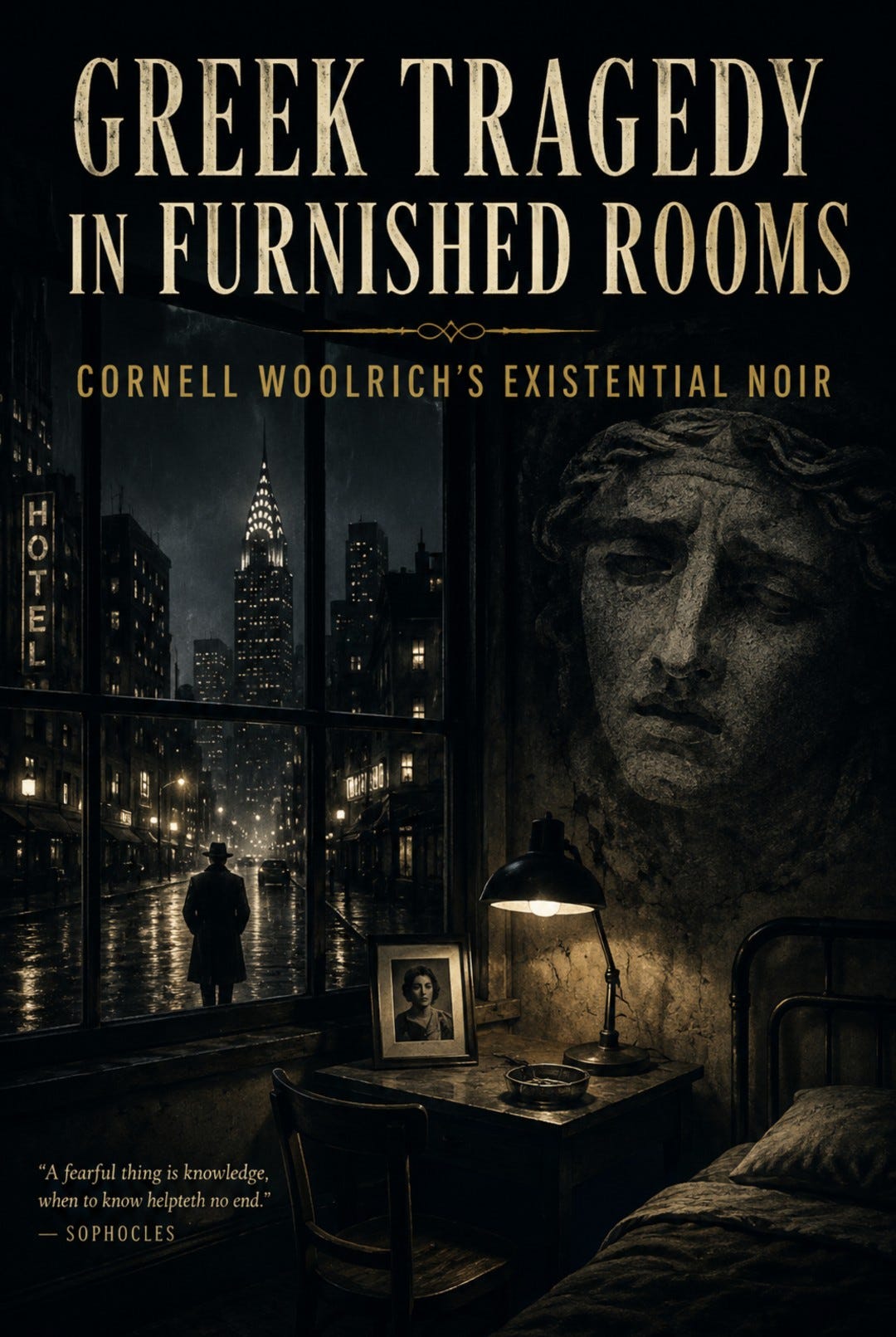
Tiresias (to himself).
Ah me!
A fearful thing is knowledge, when to know
Helpeth no end. I knew this long ago,
But crushed it dead. Else had I never come
Sophocles.[1]
Unless you’re a fan of 1940s and 1950s hardboiled fiction, you’ve probably never heard of Cornell Woolrich. Today he’s best remembered for the movie adaptation of his short story “It Had to be Murder,” Rear Window. French New Wave fans may recall Truffaut’s The Bride Wore Black while admirers of Edward G. Robinson may remember his doomed psychic in Night Has a Thousand Eyes. More than thirty films in several countries were adapted from Woolrich’s fiction, though critics often dismissed both the films and their sources as disposable pulp.
In a May 1982 interview, Brian Eno said that while the first Velvet Underground record sold only 30,000 copies in its first five years, “I think everyone who bought one of those copies started a band!”[2] Cornell Woolrich had a similar influence on mystery and suspense writers, though he has not attained comparable fame with the masses. But many of the themes and emotional textures we commonly associate with grimdark can be traced back to Woolrich. And the originals were often much more powerful than the imitators who followed.
The classic murder mystery starts with a corpse and a handful of suspects. It ends with the guilty punished, the aberration explained, and order restored. Woolrich rarely gives you that kind of closure. His protagonists are lonely, frightened people trapped in dirty, dangerous cities. They are alienated, paranoid and teetering on the edge of emotional collapse as they drift through lonely days and sleepless nights. They reflect what will become a common grimdark trope; the chaos undergirding our illusions of certainty and stability.
Woolrich’s urban landscapes are filled with furnished rooms, hotel corridors, late-night diners, and strangers watching each other through half-lit windows. His characters remain isolated even when surrounded by people. Voyeurism replaces intimacy and fantasy replaces connection. Their greatest enemies are not flesh and blood but loneliness, grief, obsession, and lives they have built around fragile, doomed illusions. In the hands of lesser writers this approach often becomes bleak and nihilistic; Woolrich’s stubborn compassion makes it mournful.
Murder mysteries and police procedurals reassure us that reason and deduction can bring order out of chaos. His horrors are emotional rather than cosmic but, like Lovecraft, Woolrich understands that knowledge can become corrosive. His characters frequently descend into paranoia or fatalism because they have seen too much or understood too late. For the damaged characters walking through his rain-soaked streets, wisdom leads not to salvation but to alienation, dread, and emotional collapse.
On March 21, 1926 the New York Times reviewed Cornell Woolrich’s first novel, a Fitzgerald-inspired Jazz Age drama called Cover Charge. While the critic started with “Mr. Woolrich has done fairly: one would wish he had done better,” he also noted:
If Cover Charge is less sharp than Manhattan Transfer, the author has not revelled so often or so deep in unpleasantnesses. He has not forgotten that the life he is watching is mainly centred about the table set by the cabaret manager for his guests: he does not seek to penetrate into the remoter regions. the alleys that lie beyond the lighted room, the alleys where the garbage cans are left for the morning scavenger.[3]
Later that year, Woolrich won a $10,000 windfall for his short story “Children of the Ritz.” He also landed a screenwriting job at First National Pictures in Hollywood. In December 1930, with five more Jazz Age novels under his belt, he married Violet Virginia Blackton, the daughter of Vitagraph co-founder J. Stuart Blackton. To most bystanders, Cornell Woolrich looked like a young man on his way to the top.
But for years Woolrich had been cruising the Los Angeles waterfront in a sailor suit seeking anonymous homosexual encounters. When his efforts to consummate the marriage failed, Woolrich left Blackton and returned to New York, where he moved into his mother’s hotel suite. He would stay in New York for the remainder of his life.
By 1932 Jazz Age novels were becoming passé as Depression-era audiences searched for darker, more grounded material. When efforts to sell his seventh novel, I Love You, Paris, failed, Woolrich reinvented himself as a crime and detective fiction writer. He produced stories at such a pace that he began using multiple pen names in various pulp magazines. In 1940 he published his first major crime novel, The Bride Wore Black.
He went upstairs, closed the door and looked around the room. He’d been living here twelve years. The room had acquired facets of his personality in that time. There were framed photographs of girls galore all over the walls. A regular gallery. It wasn’t that he was a roue; he was a romanticist. He’d kept looking for his ideal. He’d wanted her to be glamorous, mysterious. Masks and fans and secret rendezvouses and that sort of stuff. And all he’d ever got was waitresses from Childs and salesgirls from Hearn’s. Pretty soon it would be too late to find Her anymore; pretty soon it wouldn’t matter.[4]
Mrs. Nick Killeen constructs a new identity for each assassination; an exotic blonde, a mousy kindergarten teacher, a mysterious redhead. She chooses new weapons with equal care—poisoned liquor, a shove from a balcony, a bow and arrow. Yet she also takes care to see that no innocents are caught in the crossfire or punished in her place. The detectives cannot understand her motivation or even agree if the murders were committed by a single woman. But her methodical approach and her moral code suggest this is something more than madness.
The men Mrs. Nick Killeen targets are not monsters. Bliss is an alcoholic whose life veers between “boy-I-feel-swell, I-wonder-what’s-up-tonight” and “God-I-feel-terrible, be-glad-to-get-to-bed.” Mitchell is six weeks behind on the rent for his furnished room with “framed photographs of girls galore.” Moran is a family man in an unsatisfying marriage. Ferguson is a skirt-chasing artist bouncing between beds. They appear to have nothing in common except two things: they were all lonely and emotionally adrift, and they were all killed by a woman.
When Julie Killeen is finally caught, she confesses readily. Her husband was shot outside the church as they were leaving the wedding. She caught the license plate of the car that sped past, tracked down the occupants, and systematically avenged her murdered husband. Yet in the end it was all for naught. The men she killed had nothing to do with Nick Killeen’s murder. And twice she spared Corey, the man who actually pulled the trigger.
In the 1967 screenplay, François Truffaut and Jean-Louis Richard removed many of the more improbable plot twists. The story was more visually elegant and narratively coherent. Each of the victims was aware of why death was coming for them, and each insisted, to no avail, that Nick Killeen’s death was accidental. It was slick and stylish, but it lacked the aching loneliness that makes Woolrich’s book so melancholy and so memorable. Though its reputation has improved over time, La mariée était en noir was a critical and commercial flop upon release.
Woolrich often relied on improbable plots and coincidences. But readers are willing to overlook improbable plots if the characters are emotionally consistent. Truffaut could strip away details that appeared silly to a critical eye. But he failed to capture the exhaustion, longing, vulnerability, and urban melancholy that gives Woolrich’s best work its haunting power.
I didn’t know their names. I’d never heard their voices. I didn’t even know them by sight, strictly speaking, for their faces were too small to fill in with identifiable features at that distance. Yet I could have constructed a timetable of their comings and goings, their daily habits and activities. They were the rear-window dwellers around me.[5]
In February 1942, Dime Detective Magazine published “It Had to be Murder” under Woolrich’s “William Irish” pen name. The story was popular enough to be republished two years later in the William Irish anthology After-Dinner Story.
Woolrich’s unnamed narrator is confined to his apartment with a broken leg. Unable to leave, he spends hours watching people through his rear window. In place of human connection, he gleans fragments of information from his nightly viewing. We glimpse a newly married teen couple, a young widow raising a child, and a working man caring for his sick wife. But ultimately the narrator understands their lives no better than Woolrich’s readers.
As he continues watching, the narrator develops a growing conviction: the working man has murdered his wife. He has seen neither murder, arguments, nor blood. He has simply noticed the man give a “peculiar, comprehensive, semicircular stare at all the rear windows around him.” As he keeps watching, he notices other gestures and routines that he interprets as signs of murderous intent. But when he contacts Hal Jeffries, his friend on the force, he learns that suspicion and intuition are not enough to get police involved without some kind of concrete evidence.
Jeff (Jimmy Stewart), the protagonist of Hitchock’s 1954 Rear Window, is also laid up with a broken leg. But he has Lisa Fremont, a glamorous, emotionally engaged partner (Grace Kelly). Hitchcock also provides us with more information about the people Jeff sees from afar by showing them onscreen. They are now fully visible presences rather than silhouettes assembled from prose. The movie is witty, suspenseful, and polished, but it is entertaining rather than mournful. Hitchcock transforms Jeff’s neighbors into objects of entertainment rather than pity.
Woolrich’s story is ultimately less about murder than about urban alienation and the limits of observation. The narrator watches endlessly, trying to assemble routines, gestures, and tiny irregularities into a coherent narrative. Yet he is forever a viewer observing the action from the balcony. For a director like Hitchcock, this viewpoint is endlessly fascinating. For a reclusive writer like Woolrich, it is also heartbreakingly lonely.
She didn’t rail, berate him, go into the usual dramatics, he noticed. For his part he didn’t know what to say. He didn’t know what you said to people right after you stopped them from doing such a thing.
Someone had to begin. They couldn’t stand there all night like that, in sodden posed conjunction.
He thought: I could offer her a cigarette. But he didn’t. If they didn’t want the whole world, they didn’t want a cigarette either. That was one of the smallest parts of the world.[6]
In 1945, under the pen name “George Hopley,” Woolrich published Night Has a Thousand Eyes. In 1948 Paramount released a movie based on the novel. Today that movie is best remembered for its main theme; it has become a jazz standard that was covered by John Coltrane, Paul Desmond, Horace Silver, and many others. Edward G. Robinson’s performance as the doomed clairvoyant won praise and the film has been praised for its atmosphere. But the screenplay substantially altered Woolrich’s plot and characters.
Both the movie and the book begin with a woman named Jean saved from suicide. The movie has her prepared to jump in front of an oncoming train; in the book she is prepared to throw herself into a river. Both feature a tormented psychic who sees the future even when he doesn’t want to. But the movie transfers the action to Los Angeles, while the book is set in New York.
In the movie John Triton (Edward G. Robinson), a vaudeville mentalist who found himself developing genuine precognitive abilities, helped Whitney Courtland, Jean’s father, amass a fortune in the stock market. In Woolrich’s novel, Jean is introduced to John Tompkins, a broken man living with two childhood friends in a tenement. His second sight has brought him only misery; his friends gave him a place to stay after they stopped him from hanging himself.
Tompkins refuses at first to help Harlan Reid, Jean’s father. Finally, he gives a few portentous hints that help Reid amass a great deal of money. But his predictions upend the Reids’ comfortable world. Harlan tries at first to explain Tompkins away as a fraud. But he soon grows increasingly dependent on Tompkins as an advisor—until Tompkins finally tells him he will die “on the seam between the fourteenth and fifteenth of June. At midnight on the stroke.” In the film, Triton instead foresees Jean’s death.
The film ends with Jean saved from murder by Triton, who is then killed by police who mistake him for an accomplice. In his pocket investigators find a note stating that he foresaw his own death, but it was the only way to save Jean. Woolrich’s novel is far less comforting. Tompkins is shot by an embezzling accountant who was trying, unsuccessfully, to blackmail Tompkins into manipulating Reid. And despite the best efforts of a police team to prevent it, Harlan Reid dies exactly as Tompkins had foretold.
In Woolrich’s world, wisdom rarely brings salvation. More often it isolates, corrodes, and destroys. His characters long for meaning but find that it becomes a trap; they seek knowledge only to learn they can do nothing with what they have learned. Woolrich’s noir is not stylish and snappy; it is an existential wasteland that owes more to classical Greek tragedy than pulp fiction.
We see Woolrich’s emotionally damaged protagonists and lonely urban streets in modern grimdark material. We less often see Woolrich’s compassion. Many readers find his writing bleak and despairing, and not without reason. But throughout that darkness Woolrich never loses compassion for the failed romantics, alcoholics, and voyeurs hiding in furnished rooms and walking through rain-soaked, garbage-strewn streets. He finds sorrow and admiration in their lonely search for some shard of meaning before the lights finally go out.
[1] Sophocles, Oedipus, King of Thebes at Project Gutenberg. https://www.gutenberg.org/files/27673/27673-h/27673-h.htm.
[2] “Quote Origin: Everyone Who Bought One of Those 30,000 Copies Started a Band” (March 1, 2016) https://quoteinvestigator.com/2016/03/01/velvet/at Quote Investigator.
[3] “IN THE JAZZ MANNER; COVER CHARGE. By Cornell Woolrich. 286 pp. New York: Boni & Liveright. $2” (March 21, 1926) at New York Times Archive. https://www.nytimes.com/1926/03/21/archives/in-the-jazz-manner-cover-charge-by-cornell-woolrich-286-pp-new-york.html.
[4] Cornell Woolrich. The Bride Wore Black. New York: Simon & Schuster, 1940. 34.
[5] Cornell Woolrich, (as William Irish) “It Had to be Murder” (1942). At City Tech Open Lab. https://openlab.citytech.cuny.edu/profscanlan-english2400-o552-fall2020/files/2020/09/it_had_to_be_murder_story.pdf
[6] Cornell Woolrich (as George Hopley), The Night Has a Thousand Eyes, 1945. E-Book Edition.