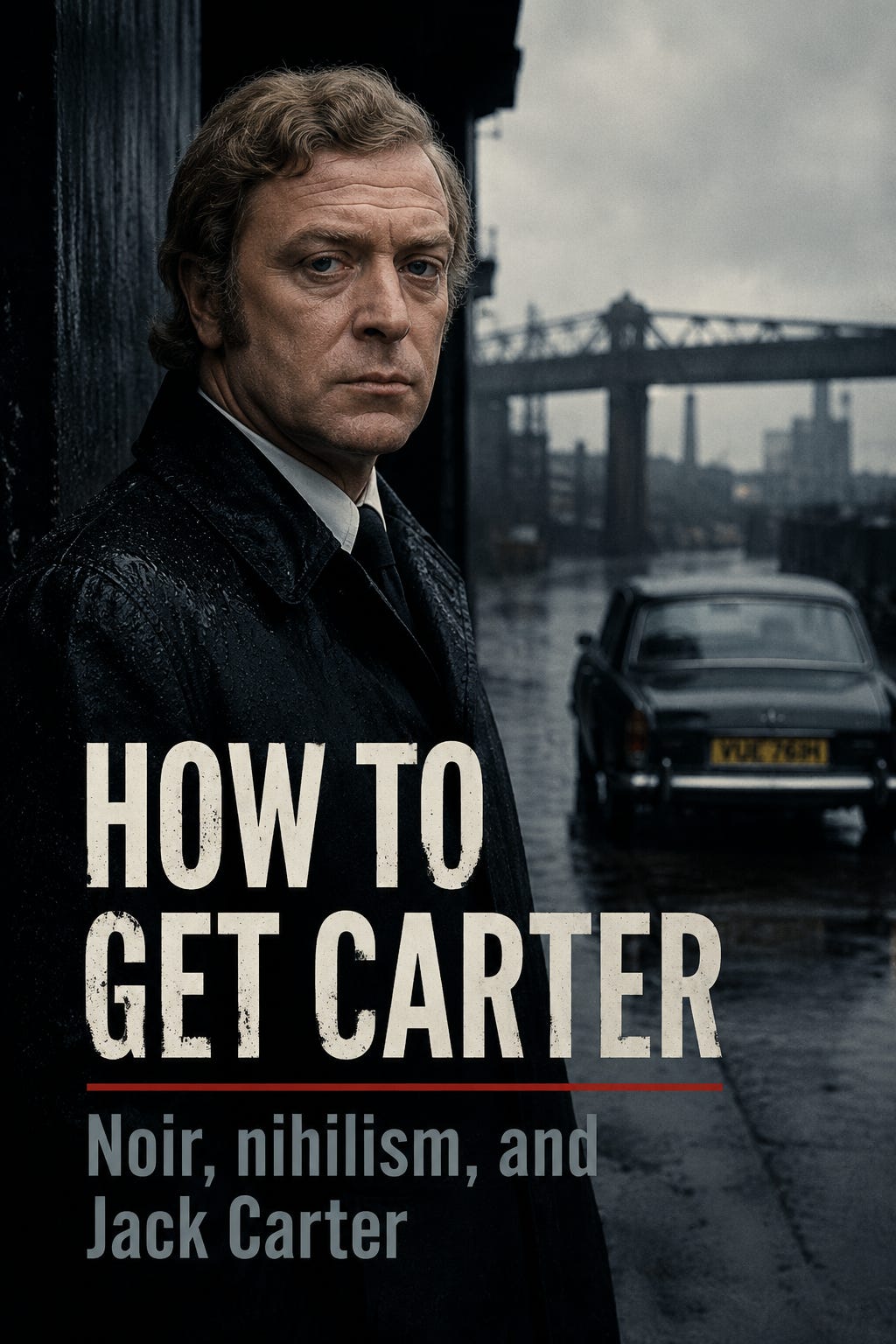
How to Get Carter
Noir, nihilism and Jack Carter
There’s nobody to root for but the smartly dressed sexual athlete and professional killer (Michael Caine) in this English gangland picture, which is so calculatedly cool and soulless and nastily erotic that it seems to belong to a new genre of virtuoso viciousness. What makes the movie unusual is the metallic elegance and the single-minded proficiency with which it adheres to its sadism-for-the-connoisseur formula.
Pauline Kael[1]
Today Get Carter is considered one of Britain’s greatest films, certainly its finest crime drama. 1971 audiences reacted to its gritty violence with shock and disgust. Director Mike Hodges’ vision was unleavened by the wisecracking wit of Dirty Harry or the stylized ultraviolence of A Clockwork Orange or The Wild Bunch. Set amidst the smoldering scrap heaps and dive bars of Newcastle, Get Carter looked like it was filmed in a dirty ashtray.
Protagonist Jack Carter (Michael Caine) was a vicious contract killer, no better than the whores and ruffians he dispatched with steely-eyed efficiency. Most critics and cinemagoers dismissed Get Carter as a nasty film about nasty people doing nasty things to each other. A 1972 Blaxploitation version of the story, Hit Man, performed better in American theaters than the British film.
After its unimpressive release Get Carter sank into obscurity, forgotten by all but a few cinephiles. (Most notably two young directors named Quentin Tarantino and Guy Ritchie). But as Swinging London gave way to Maggie’s Millions and Free Love was replaced by the Age of AIDS, it looked less like a dog-end in a punchbowl and more like a harbinger of things to come.
Get Carter is lauded as a Very Important Movie. Ted Lewis, the author of Jack’s Return Home and two subsequent Jack Carter prequels, is less widely remembered. Yet Lewis’s novels reveal more clearly that what many viewers still mistake for celebratory nihilism is in fact a parable that is as ordered and moral as a Greek tragedy.
A full understanding of the concept of frith will show that “peace” is not identical to frith; rather, peace is generally an outgrowth of frith, resulting from the conditions of frith being met. When frith has been achieved, usually peace is there too, though that is not always the case... Frith is the ethical value which underlies the successful establishment and maintenance of healthy families, groups, communities and societies.
Winifred Rose Hodge[2]
Outside the confines of respectable society reside those who are neither respectable nor particularly social. This is the world Jack Carter inhabits, a place where he has earned some success as a foot soldier to a London mob boss.
Like many of the mercenaries slashing their way through sagas Carter has escaped both his humble beginnings and his earliest crimes. He has no reason to pry when his estranged brother dies in a drunken accident, no reason to go against the friendly advice his employer proffers like a velvet glove. No reason save that an empty whisky bottle was found in the wrecked car and his brother always hated whisky.
In the 1971 movie, we watch Jack Carter’s rampage with a detached fascination and horror. The 1970 novel tells the story from Carter’s point of view. We learn almost immediately that Jack had a dalliance with his brother’s fiancée, and that his niece Doreen may well be his daughter. The film withholds this information until a few moments before Carter sees Doreen in a pornographic 8mm reel.
We also learn that Frank was the good child while Jack was the black sheep. Frank studied hard and stayed out of trouble. Jack did neither, despite frequent beltings from his father—beltings that only ended when Jack beat him nearly to death. Frank stayed in their crumbling town (Scunthorpe in the novel, Newcastle in the film) and worked menial jobs while Jack rose through London’s organized crime circles.
The Old English “frith” became our modern “friend.” Frith is the responsibility you share with your fellows. By honoring these obligations, Hodge tells us, you become “free men towards the rest of the world.” Carter has achieved a measure of success by making himself a valuable player in the underworld. He is trusted because he is trustworthy; he gives and returns favors to preserve and strengthen his position. This moral code shaped the Anglo-Saxons who rose in Britannia through conquest, alliance, and reciprocal obligation.
Frith works in concentric circles; family, then clan, then tribe. His standing within the underworld is generally solid—save for the fact that he, like Lancelot, is having an affair with his boss’s wife. Carter’s relations with his family have been something less than ideal. But when Frank is murdered, Carter has no choice but to avenge his brother.
Lewis’ first-person narrative puts us in Jack Carter’s world as Carter sees it. We become complicit in his violence and soon come to treat it with the same detachment Carter feels when he’s on a job. He is neither a monster nor a glamorous anti-hero—just a flawed man who has internalized the moral and ethical codes of his community and who follows them with neither pity nor sadistic glee.
Carter is aware that his quest for justice endangers his mob ties, his life, and even his lover. Were he a mere nihilist who cared about nothing more than getting ahead in a cruel world, he would go back to London and let the dead stay buried. But the same codes that made him a successful gangster also lead him inexorably toward his doom. They are his tragic flaw—the thing which makes him a hero, and which ultimately destroys him.
[I]n the prequel Jack Carter’s Law, the mob enforcer has nothing remotely noble in mind. His job is to find a squealer and kill him, and his motivation is to keep himself and his bosses out of jail. In this way, Jack Carter’s Law is even tougher and more uncompromising than its famous predecessor.
Max Allan Collins[3]
Most people would agree with Max Allan Collins: there is nothing remotely noble about killing a squealer to protect a criminal. But most people are not criminals. We have given the state a monopoly on violence; we expect law enforcement officers to protect us from people like Jack Carter. But those who live outside that world have different expectations. Ted Lewis’ second Carter book gave us a firsthand look at that world.
Jimmy Swann has disappeared from police custody and cannot be located. That can mean only one thing: Swann is cooperating with the filth to avoid a lengthy sentence. Since he has worked for Carter’s bosses for years, that means Swann’s testimony could send most of the organization to prison for a very long time. Including Jack Carter. Criminal organizations can only function when everybody involved is loyal to the group. Swann must be silenced both to stifle his testimony and to send a message.
For centuries the Mafia operated under a code of omertá (silence). Informing was punishable by death. Captured mobsters who refused to talk knew their families would be looked after while they were in prison; those who talked knew their families were at risk. Even if you were asked to inform on a mortal enemy or a member of an opposing family, you kept quiet.
In 1963, that silence was broken when “made man” Joseph Valachi testified before a Senate hearing. While in prison Valachi had murdered an inmate he thought was a Genovese family hitman. To avoid the death penalty, Valachi agreed to provide details about the Mafia’s history and organization. In 1991, testimony by Sammy “The Bull” Graviano sent John Gotti, the notorious “Teflon Don,” to prison.
Today the American Mafia is a pale shadow of what it once was. Mobsters who were a generation or two away from Sicily knew the code; after a few generations, the new mobsters had American values. They were willing to cooperate with police to save their own skins, especially once the Witness Protection Program offered informers better protection than the mob.
Carter despises Les and Gerald Fletcher, his bosses. He dreams of taking over the organization and running it properly with Audrey, his lover and Gerald’s wife. But when he is offered a chance to cut a deal with Hume, a crooked police inspector, and turn evidence on Les and Gerald, Carter refuses, saying “I’m going to play this the way I set out to play it.”[4] Within the confines of his moral world, Jack Carter behaves with honor even when it is to his personal disadvantage. His ethics may be alien, but they are coherent.
For much of his life, Lewis exhibited the virtues and flaws of a classic noir antihero: nobility, infidelity, weakness, sickness, sex, cigarettes, love, booze and bad choices play a part. He was the star of his own film, damaged and dangerous. As a writer, he achieved an astonishing amount in a short period of time, though never enough to satisfy his expectations. His fall, when it came, was rapid.
Nick Triplow[5]
When Ted Lewis was writing Carter’s Law, his marriage was falling apart, his finances were crumbling, and his heavy drinking had become full-blown alcoholism. By the time it was published his wife had left with their daughters and Lewis had, after a stretch in a psychiatric hospital, moved back in with his parents. Shortly before the release of 1977’s Carter and the Mafia Pigeon, he declared insolvency.
Carter and the Mafia Pigeon is a poorly done pastiche of Lewis’ earlier work. Lewis is clearly writing for a much-needed paycheck. His attempts at writing scripts for Doctor Who went nowhere; British audiences still preferred cozy mysteries and police procedurals to hard-boiled noir. In a 1980 interview to promote his final novel, GBH, Lewis said that the time for Carter had passed, noting “Since then, there have been so many spinoffs like The Sweeney that everybody knows all about the underworld.”[6]
GBH (an acronym for the term “Grievous Bodily Harm”) tells the story of George Fowler, a wealthy pornographer who has built an empire on torture pornography and snuff films. The story moves alternately between two locations: Smoke (London) and Sea (Mablethorpe, a seedy off-season seaside resort). Fowler is trying to determine who has been skimming money from his operation. After torturing and murdering several of his employees, he retreats into Mablethorpe and paranoia.
There is no frith here; what we see is a truly nihilistic world filled with people seeking unwholesome pleasures and trying to avoid inevitable pains. Jack Carter had a Dark Ages conscience; Fowler and his associates are as thoroughly modern as George R.R. Martin’s scheming nobles. In George Fowler’s decline into madness, we bear witness to the slow self-induced decay of Ted Lewis.
There is no escape plan and no hope of even tragic redemption. In his finest prose, Lewis gives us an account of his sad last days.
On March 27, 1982, Ted Lewis died in Scunthorpe General Coronary Ward 10 of a heart attack. He was also suffering from chronic pancreatitis and cirrhosis. Six months after Lewis died, his mother Bertha saw him at the bottom of the stairs, looking up as she readied to come down.
She reported later “I knew he was at peace.” [7]
[1] Pauline Kael, “Get Carter” at Pauline Kael Reviews. https://web.archive.org/web/20120225154115/http://www.geocities.ws/paulinekaelreviews/g2.html.
[2] Winifred Rose Hodge, “Heathen Frith and Modern Ideals” at Heathen Soul Lore. https://heathensoullore.net/heathen-frith-and-modern-ideals/.
[3] Ted Lewis. Jack Carter’s Law (Kindle Locations 123-126). Soho Press. Kindle Edition.
[4] Ted Lewis. Jack Carter’s Law (Kindle Location 3071). Soho Press. Kindle Edition. 1974.
[5] Nick Triplow. Getting Carter: Ted Lewis and the Birth of Brit Noir. Exit Press, E-Publication. 2017.
[6] Ibid.
[7] Ibid.