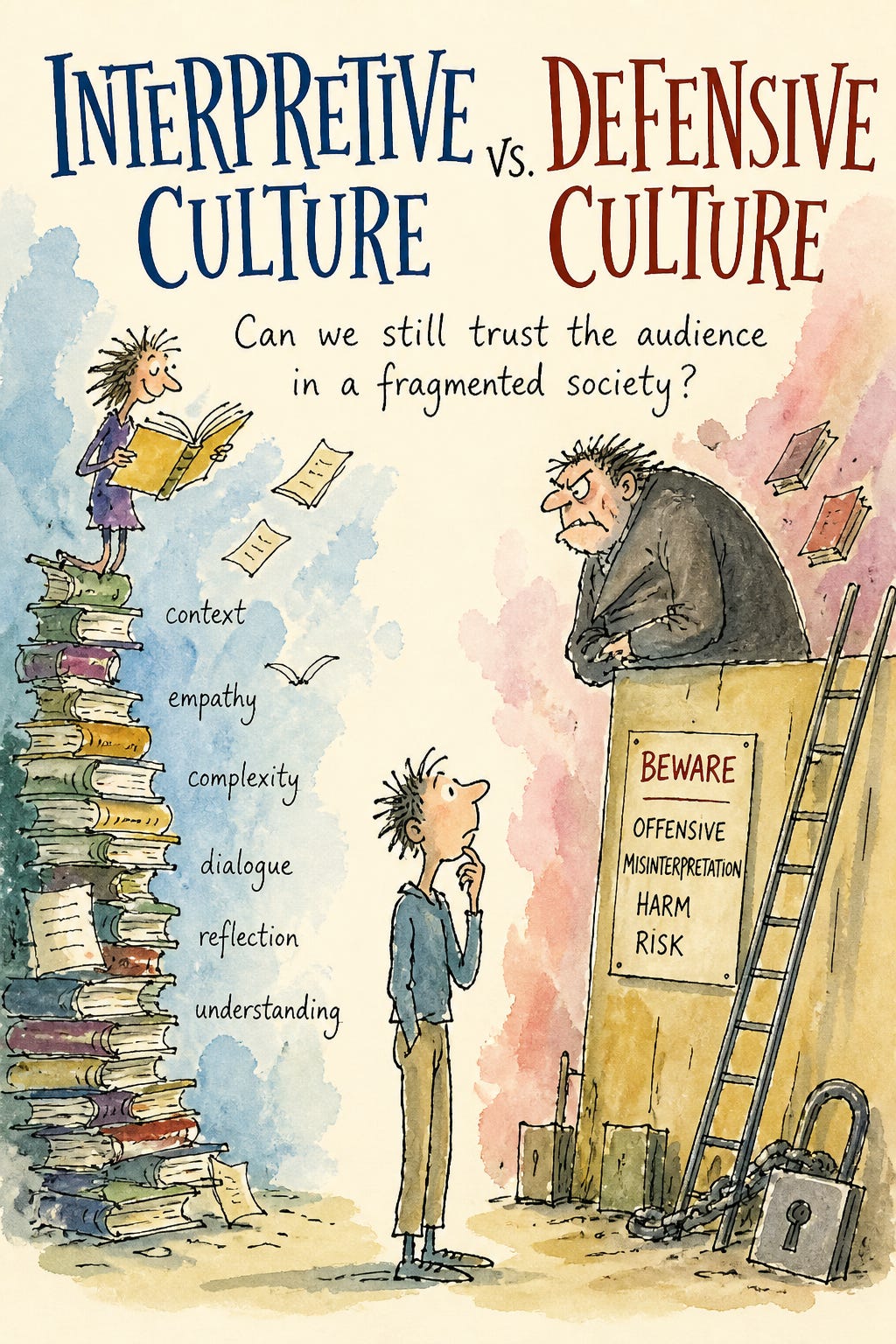
Interpretive Culture vs Defensive Culture
Can we still trust the audience in a fragmented society?
On June 6, 1982, Israel launched its second invasion of Lebanon in response to a series of battles between PLO guerrillas in southern Lebanon and Israeli Defense Forces troops. The clashes caused civilian casualties on both sides of the border; by the time Israeli forces withdrew from Lebanon in 1985, over 19,000 people had died and more than 30,000 had been wounded.
One of the earliest critics of the invasion was children’s book author Roald Dahl. But his response went far beyond condemning the bloodshed. In 1983, writing in the New Statesman, Dahl argued that:
There is a trait in the Jewish character that does provoke animosity. I mean, there’s always a reason why anti-anything crops up anywhere; even a stinker like Hitler didn’t just pick on them for no reason.[1]
Decades later, after Dahl’s death, Mark Rosenblatt’s Giant premiered at London’s Royal Court Theatre. Giant dramatizes a visit from representatives of Dahl’s British and American publishers, and their efforts to confront a figure who remained stubbornly unapologetic about his views. Rosenblatt’s debut play has received widespread acclaim—and sharply divergent criticism about how it handles the presentation of Dahl’s harmful beliefs.
Rosenblatt told the Jewish Daily Forward he was inspired to write Giant by the British Labour Party’s antisemitism controversies in the late 2010s. Reflecting on that period, he said:
I found the medieval nature of some of those stereotypes shocking… the grouping together of millions of people as if we all have innate characteristics.[2]
Juan A. Ramirez begins his review of the American staging by calling Giant “brilliantly structured, quite funny, and…superbly acted by a cast led by John Lithgow.” Then he says “I wish it didn’t irk me the way it did.”
Why is Ramirez irked? Not because of the performances or staging, but because of how the play handles its subject. He accuses Giant of “playing cat and mouse with the broader question of whether anti-Zionism equals antisemitism.”[3]
By presenting Dahl as a clear-cut antisemite whose objections to the Lebanon invasion are rooted in Jew-hatred, Ramirez argues, Rosenblatt ultimately produces “a type of weaponized censorship that deems any criticism of governments as human-scale hate speech.” For Ramirez, the problem is not what the play says, but what its ambiguity allows.
This concern is shaped, in part, by a broader shift in context. Although Rosenblatt completed the play before the events of October 7, those events have reshaped how audiences interpret it. For many viewers, the Lebanon setting now reads as a proxy for Gaza. That conflict has cast a retrospective shadow over the work, reframing its meaning and placing it within a different interpretive context.
Christopher Caggiano arrives at the opposite conclusion. His concern is not that the play is too ambiguous, but that its conclusion is predetermined. As he puts it:
No one is asking Rosenblatt to defend Dahl’s views. But drama thrives on complexity, and Giant never bothers to make a case for why Dahl believed what he believed, no attempt to give his positions internal logic, however wrongheaded, or to suggest that a man capable of writing some of the most beloved children’s books of the twentieth century might have arrived at his ugliest opinions through some twisted, traceable path.[4]
By setting its moral judgment in advance, he argues, Giant limits the audience’s ability to understand how such beliefs can take shape. He objects not to ambiguity, but to simplification.
Caggiano’s objection reflects a long-standing expectation within dramatic tradition. Ambiguity has played a central role in theatre for centuries. Is Sweeney Todd a serial killer or a wronged lover seeking revenge? Is Hedda Gabler a victim of society or of her own selfishness? Will Vladimir and Estragon ever meet Godot? Some of the most enduring characters resist easy classification into clear moral categories.
This tension points to a broader cultural divide. Interpretive Culture assumes that meaning emerges through context, narrative, and reader engagement. Defensive Culture that assumes meaning is unstable and must be actively constrained to prevent harm or misreading. The disagreement over Giant is not simply about a play, but about which of these frameworks should govern how meaning is made.
There is no real dispute over Dahl’s comments; both Caggiano and Ramirez agree that they are morally repugnant. Where they differ is in their concept of how meaning should be produced and managed. That underlying divide is what led them to radically different complaints about the same play.
For Ramirez, the framing of Dahl’s statements in the context of an Israeli invasion could be used to discredit criticism of Israel. Because meaning is produced through audience interpretation, the playwright bears responsibility for guiding that process and steering audiences away from problematic readings.
Roland Barthes argued in 1967 that “the birth of the reader must be the death of the author.” Defensive Culture reverses that logic. It tasks the author with constraining interpretation and preemptively managing risk.
Caggiano is concerned with interpretive depth. Simplified heroes and villains are the stuff of melodrama, not serious theatre. Clearly defined, finger-wagging moral stories are the stuff of children’s tales—and not the kind Dahl wrote. Rosenblatt’s script dumbs down a complicated story about a complicated man. Caggiano calls instead for a story where the audience is left to grapple with Dahl’s motivations rather than being guided to a predetermined judgment.
Defensive Culture arose in an environment where “call-outs” are a regular occurrence, and where ideas or scenes are regularly snipped from their context and reframed. Critics and readers are encouraged to point out problematic material and cast judgment on it. By recasting Rosenblatt’s play as an attack on antizionism, Ramirez situates it within a broader political context and responds accordingly, treating his interpretation as a moral responsibility.
The term “Defensive” carries a lot of weight. Few playwrights make it to Broadway or the Strand; fewer still make it back a second time. The bigger your audience, the more likely you are to find someone offended by your work. And in social media, a call-out can spread around the world before an artist finds out about it. This leads to increasing self-censorship, as writers scrub their drafts of things that might be misinterpreted, isolated, or reframed.
Interpretive Culture, by contrast, gives the audience a central role. Texts are left open, layered, and incomplete, with meaning emerging through context, discussion, and reflection. Unresolved characters and tensions are intentional, inviting engagement and rewarding repeated interpretation. Meaning is not given—it is discovered.
But while Interpretive Culture gains depth and nuance, it also carries risks. It is more vulnerable to misinterpretation and hostile readings. Like a Rorschach blot, an interpretive work produces different meanings for different viewers. When a viewer is looking to be outraged, they can usually find something to confirm that response.
Roald Dahl was in Defensive Culture’s crosshairs before Giant. In 2023 Puffin, Dahl’s publisher, revised his books and removed or altered hundreds of potentially offensive words relating to race, mental health, and physical appearance. In new editions of Charlie and the Chocolate Factory, Augustus Gloop is no longer “enormously fat” but simply “enormous.” In James and the Giant Peach, the “crazy” glow worm is now merely “silly.”
These changes sparked controversy among writers such as Salman Rushdie, who criticized the revisions as excessive. At the same time, other critics argued that Dahl’s work remained problematic even after such edits. Discussing Charlie and the Chocolate Factory, Maria Nikolajeva, an education professor at Cambridge, noted:
Wonka is vegetarian and only eats healthy food, but he seduces children with sweets.
It’s highly immoral.[5]
Ultimately, Puffin chose to release the original texts of Dahl’s books as the “Classic Collection.” Dahl’s work remains available in expurgated and unexpurgated versions, and the debate over interpretation and meaning remains unresolved.
Dahl’s work can be revised to remove potentially offensive language. In the case of Mark Twain’s Adventures of Huckleberry Finn, we are faced with a more difficult question: what happens when the offensive material is essential to the work itself?
Renaming Nigger Jim as Black Jim or simply Jim is easy enough. The word is deeply offensive by modern standards, and few would want it read aloud in a middle school classroom. But that still leaves us with Jim’s dialect:
“Say, who is you? Whar is you? Dog my cats ef I didn’ hear sumf’n. Well, I know what I’s gwyne to do: I’s gwyne to set down here and listen tell I hears it agin.”
In 1884, minstrel shows were popular entertainment. Many of Twain’s 19th century readers would have recognized him as a minstrel archetype. But readers gradually grow accustomed to Jim’s speech. As they do, they also slowly realize that Jim is one of the few decent adults in the book, and that he genuinely cares for Huck.
When Jim is captured, Huck agonizes over his Christian duty. He helped a slave run away from the old maid who owned him. He had been told that slaves were bound to obey their masters, and yet he helped Jim escape. Huck writes a letter to Miss Watson, Jim’s owner, letting her know her slave has been caught and she can come get him.
But then he remembers Jim’s kindness:
I took [the letter] up, and held it in my hand. I was a-trembling, because I’d got to decide, forever, betwixt two things, and I knowed it. I studied a minute, sort of holding my breath, and then says to myself:
“All right, then, I’ll go to hell”—and tore it up.
Defensive Culture would respond that students might not reach that transformation; not all readers engage deeply with texts; classroom conditions are uneven; racial slurs cause real harm and may cause genuine distress for Black students. In fairness, while it is a sequel to Twain’s Tom Sawyer and is frequently taught to younger audiences, Huck Finn was written for an adult audience. The book includes scenes of drunkenness, severe child abuse, and violence. Its moral and psychological complexity was never designed for simplified classroom consumption.
Twain’s novel works because readers undergo an interpretive transformation. Defensive Culture questions whether modern audiences can still be trusted to complete that process.
While they are frequently framed as moral issues, these conflicts are not primarily over morality. Both sides often agree that the material in question is offensive; sometimes they even agree that it is potentially harmful. But the real disagreement is how meaning should be handled and whether audiences can be trusted with ambiguity, or with historical material that uses now-toxic language and stereotypes.
Interpretive Culture assumes that readers grow through engagement and difficult material can transform understanding. Meaning develops gradually and involves participation from the reader. Huckleberry Finn uses minstrel show clichés to teach us a lesson about our shared humanity. Ambiguity gives rise to reflection and discomfort leads us to question ourselves and our world. The audience participates in meaning rather than passively receiving it.
Defensive Culture recognizes that words and images can be harmful. Twain wrote a bitter indictment of racism and slavery; D.W. Griffith’s Birth of a Nation gave us Black savages who were only kept in check by heroic Klansmen. Today many would distinguish between the two—but both rely on dehumanizing stereotypes. And with fragmented audiences and unstable context, Defensive Culture thinks it is wisest to put up barriers against potentially dangerous interpretations.
Is greater self-censorship and less nuanced art inevitable in a world that has lost shared context? Can a world that has lost trust in institutions and universal frameworks still trust audiences to handle difficult material responsibly?
These questions will only become more pressing as meaning continues to fragment. The battle between Interpretive and Defensive Culture is ultimately a struggle to decide whether meaning should be discovered or controlled.
[1] Hephzibah Anderson, “The Dark Side of Roald Dahl” at BBC Culture. https://www.bbc.com/culture/article/20160912-the-dark-side-of-roald-dahl.
[2] Dan Friedman, “Tony nominee Mark Rosenblatt’s ‘Giant’ journey began with Menachem Begin.” Forward, May 5, 2026. https://forward.com/culture/theater/822610/mark-rosenblatt-giant-playwright-broadway-tony-awards-roald-dahl/.
[3] Juan A. Ramirez, “GIANT: John Lithgow’s Uneasy Dahl – Review.” Theatrely, March 23, 2026. https://www.theatrely.com/post/giant-john-lithgows-uneasy-dahl-review.
[4] Christopher Caggiano. “Theater Review: In “Giant” on Broadway, John Lithgow Towers Above the Material.” The Arts Fuse, March 30, 2026. https://artsfuse.org/326674/theater-review-in-giant-on-broadway-john-lithgow-towers-above-the-material/.
[5] Anderson, “The Dark Side of Roald Dahl.”