
Jim Conley's Testimony
August 4-7, 1913

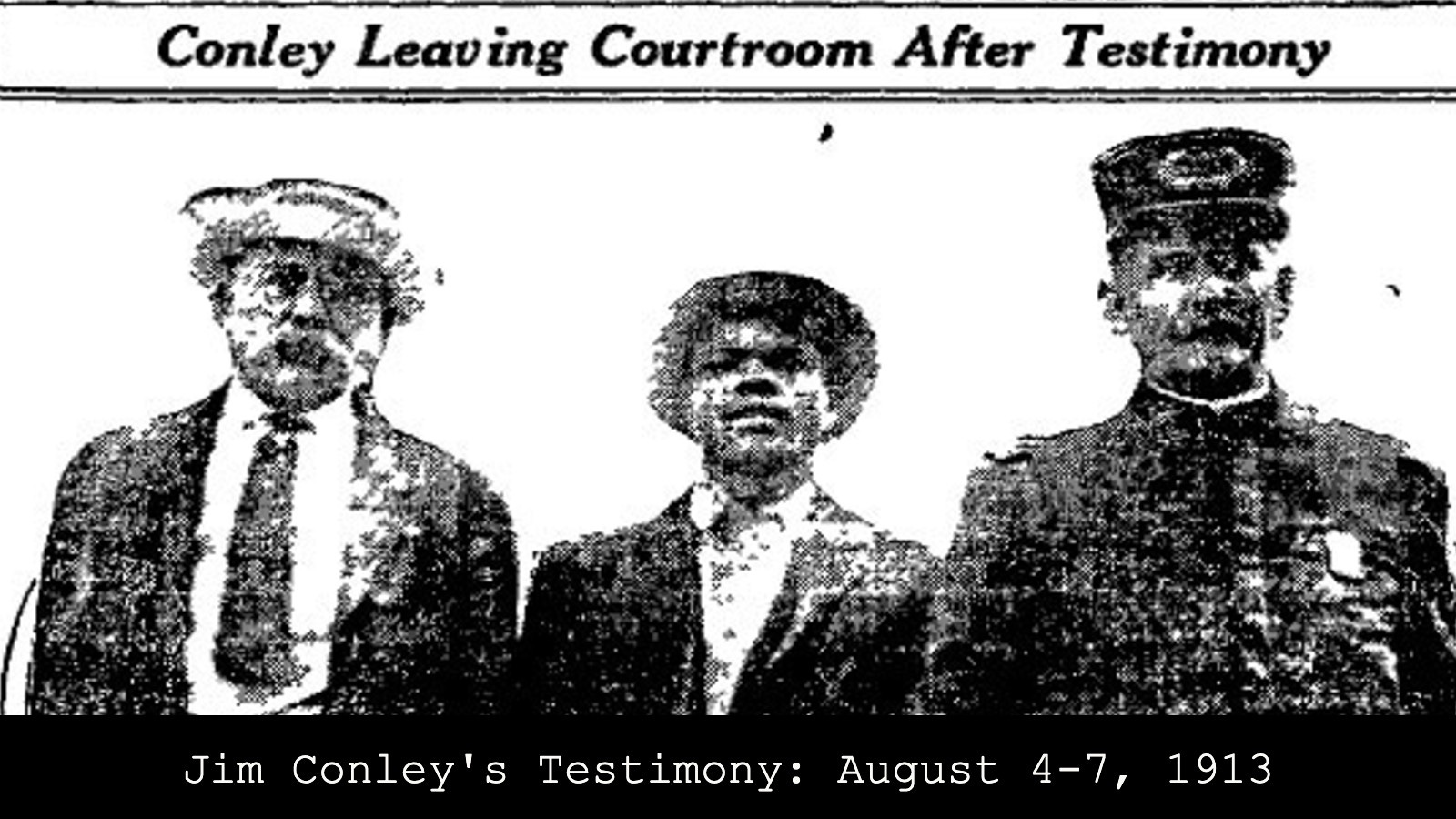
At 9:42 a.m., Hugh Dorsey called Jim Conley to the witness stand and discovered Conley had not yet arrived at the courthouse. After a telephone call, Conley arrived with his lawyer, William Smith, as well as Chief of Police James Beavers and Chief of Detectives Newport Lanford. Lanford removed Conley’s handcuffs and walked him to the witness stand.
After he was sworn in, Dorsey began his questioning. Conley affirmed that he was in the factory on the day of Mary Phagan’s death. He also said that he had served as lookout on other Saturdays and holidays while Frank received visits from other women at his office. The first edition of the August 4, 1913 Atlanta Journal says delicately that Conley “accused Frank of perversion.” Steve Oney provides us with the transcript’s recollection of Conley’s testimony.
[Frank] says, “Well, that one you say didn’t come back down, she came into my office a while ago and wanted to know something about her work and I went back there to see if the little girl’s work had come, and I wanted to be with the little girl, and she refused me, and I struck her and I guess I struck her too hard and she fell and hit her head against something, and I don’t know how bad she got hurt. Of course, you know I ain’t built like other men.”
The reason he said that was, I had seen him in a position I haven’t seen any other man that has got children. I have seen him in the office two or three times before Thanksgiving and a lady was in his office, and she was sitting down in a chair and she had her clothes up to here, and he was down on his knees, and she had her hands on Mr. Frank. I have seen him another time there in the packing room with a young lady lying on the table, she was on the edge of the table when I saw her.[1]
Today very few would raise an eyebrow at the idea of consenting adults performing oral sex. In 1913 Atlanta cunnilingus was a felony. In that passage, Jim Conley accused Leo Frank of two extremely serious crimes—murder and oral sodomy. The Atlanta Journal editors had good reason to be circumspect. In 1913, federal obscenity laws under the Comstock Act severely restricted the mailing of sexually explicit material, and publishers generally avoided printing detailed descriptions of sexual conduct.
By modern standards Conley’s testimony seems restrained; in 1913 Atlanta it ventured into territory many newspapers considered unprintable. To an upstanding Atlanta citizen of the time, allegations of oral sodomy would be as shocking as allegations of child molestation are today. The allegations of “lechery” and “perversion” seem like prosecutorial abuse today. Even then there were judicial leaders who felt Dorsey had overstepped his limits. The “lechery” evidence became one of the principal grounds on which critics argued that Frank deserved a new trial.
Rosser remained silent as Dorsey questioned Conley about moving Mary Phagan’s body and ended with inquiries about other women whom Conley had seen while he was keeping watch for Frank. He apparently thought it best to break Conley down during the upcoming cross-examination than to keep the court focused on the explosive allegations.
After Dorsey concluded his examination, Rosser requested a brief recess to prepare strategy. When he came back, he started with a series of polite, jovial exchanges. As the Atlanta Constitution described it:
Jim’s face showed that he could not see what in the world a great big white man with the knowledge of Luther Rosser could want to take up the time in court to go into a spelling bee with him, but he replied with his face beaming, “Yes, sir, we sho’ does, sir.”
Then followed more words for Jim to spell. The white man and the darker had reached a perfect understanding, such as a white man and a negro have when they are raised together on the same plantation...
Then Jim’s education in mathematics was taken up and gone over in the same detailed and kindly way. Jim did not know what was meant by the word “figuring,” but he did know what counting went and showed proudly that he could count just as far as Mr. Rosser would let him go, and he could add too. Jim proudly added small sums, and all the time his face beamed and pride showed.[2]
Rosser’s initial line of questioning appeared to be an effort to demonstrate Conley’s limited intelligence. In those first few minutes, he also established that Jim was frequently in debt and that he often left through the cellar door on payday to avoid his creditors at the front door. Since the defense contended that Conley killed Phagan for the $1.20 she had just collected, those were potentially devastating claims.
While we will never know Rosser’s strategy, it appears that he was hoping that Conley would slip up as he relaxed and lowered his guard. If he was hoping to show by his opening that Conley was too stupid to invent such an elaborate story, he may have instead reinforced the convinced the jury that Conley was too stupid to remember a fabricated story.
Rosser then turned to the heart of the matter. Conley went on to describe the different women who had come to visit Frank while Conley stood guard. As the court broke for lunch, a journalist heard Frank tell his friends that the testimony was the “the vilest and most amazing pack of lies ever conceived in the perverted brain of a wicked human being.”[3]
The post-lunch session began with Judge Roan removing all women from the courtroom save Frank’s wife and mother. After Conley’s earlier statements, and ongoing discussions of prostitution and lechery, the judge feared the proceeding might touch upon subjects unsuitable for ladies. But much of the afternoon testimony was in a less sensational vein. Rosser repeatedly pressed Conley on the details of his story, while Conley responded, “I don’t know” or “I don’t remember.” This excerpt will give some idea of Monday afternoon’s proceeding:
Rosser: In that affidavit, when you sent for Black you gave Frank clean away, did you?
Conley: Well, I don’t know about that. I disremember.
R: Well, don’t you know that you didn’t say a word about that little girl at that time?
C: I thought I did.
R: You think you told it at the time.
C: Yes, I don’t know exactly about that.
R: Now, are you sure about that? I want you to tell me whether you are telling the truth about that now or not. Just make your sign for telling the truth, Jim, so I will know you are telling it. Now, didn’t you tell at the time that you were going to tell the truth about all things? About going to the basement and all of that?
C: I don’t remember.
R: Now, Jim, where is your memory?
C: In my head, I suppose.[4]
Rosser had hoped to press Conley into a contradiction that would discredit his testimony. Instead, he found himself facing a witness who simply refused to crack under intense pressure. Conley did exactly what a man in his position should do—and exactly what Rosser thought impossible for a man of his mental capabilities.
There have been recurring claims that the prosecution “coached” Conley to frame Leo Frank; the defense counsel insinuated as much throughout the trial. But coaching covers a wide range of conduct. Any competent lawyer prepares witnesses before they testify. “Tell the truth. If you aren’t sure, don’t guess. If you don’t remember, say ‘I don’t remember.’” Ethical issues arise when a lawyer knowingly helps a client or witness to commit perjury.
The session ended with Conley moved at last to the Tower at Rosser’s request. William Smith sent up a steak dinner to help Jim recover from a rough day. The teams on both sides spent the evening thinking about how they would handle tomorrow’s interrogation.
Rosser started the Tuesday session with the same dogged intensity he had used throughout the prior day’s questioning. Once again, Conley resisted all his efforts. Rosser made a last effort to return to the day of Mary Phagan’s murder, hoping that he could at last catch Conley in a contradiction. But Conley repeated the answers he gave Dorsey almost verbatim.
When the court returned from lunch, Judge Roan dismissed the jury at Rosser and Arnold’s request. Unable to shake Conley or undermine his credibility before the jury, the defense now wanted much of his account stricken from the record. Specifically, they sought to withdraw their cross-examination of Conley, along with his testimony that he acted as watch for Frank and that he was “not built like other men.”
Dorsey objected strenuously, telling the judge “This evidence goes to show who killed little Mary Phagan. Our case if this evidence is expunged will have been done inestimable damage.” Arnold, in response, said “The person who is hurt is the defendant. He is done grievous injury by this vile evidence.”[5] Judge Roan took the matter under advisement and stated he would decide the issue later, then returned the jury.
Rosser immediately resumed his attack on Conley’s credibility, returning to statements the witness had made the previous day. Frank Hooper, Dorsey’s assistant prosecutor, requested that Conley be allowed to read the transcript of yesterday’s testimony, stating:
If [Rosser] intends to pursue this line of questioning, he should put this in evidence or let the witness read it or have it read to him. The witness has the right to refresh his memory the same as on any other written testimony.
Rosser replied scornfully, “It’s not superhuman for the witness to tell the truth twice.” After some debate, Roan ruled for the defense with the understanding that Rosser’s questions would not be argumentative or aimed to impeach the witness directly on his own testimony.[6] But Conley remained unbowed as the cross-examination entered its eighth hour. Finally, as the day’s proceedings were wrapping up, Rosser asked for the jury to be withdrawn a second time.
After the jury was removed, Rosser requested that Conley be held in solitary confinement and that nobody be allowed to talk with him. This was presented as an effort to prevent anyone from coaching Conley overnight, but Rosser certainly knew that it would also increase the psychological pressure on Conley. William Smith helped keep Jim’s spirits up by sending another supper over to the jailhouse.
After Rosser finished his cross-examination on Wednesday morning, Hugh Dorsey asked a few closing questions. At 11:10 a.m., Conley was excused. The full-page headline on page 4 of the August 6, 1913 Georgian announced:
AFTER 15 1/2 HOURS ON STAND CONLEY ENDS HIS TESTIMONY
Grinning After Ordeal, He Lights Cigarette and Grabs a Newspaper
When the court reconvened at 2 p.m., Judge Roan announced his decision regarding Conley’s testimony.
I have serious doubts as to the admissibility of this testimony as an original proposition. As it has been cross examined you may expunge it from the records, but you can’t dissociate the original from the cross examination. I am going to allow it to remain in the record. It may be extracted from the record, but it is an impossibility to withdraw it from the jury’s minds.
Roan refused to enter into the record testimony from Mary Phagan’s friend Walter Epps, who had claimed she was frightened of Leo Frank because of his constant flirting. As for Mr. Dalton, the man who purportedly brought women to the National Pencil Company on weekends, Roan ruled that his testimony would be “inadmissible in anything except in support of the negro Conley.” [7]
The remainder of the day’s testimony came from Dr. Henry F. Harris, who had conducted the autopsy on Mary Phagan. Most of his discussion focused on the cabbage found in her stomach; Harris insisted that Phagan had died within 45 minutes of eating her breakfast. But overall, the ending was quiet as the prosecution rested its case.
Both sides understood that Conley’s testimony was the key to winning or losing this trial. Dorsey took an enormous gamble on making Conley the pillar of the prosecution’s case. Rosser took a slightly less risky but no less treacherous path when he chose to confront the lechery allegations rather than objecting to them immediately. Few would have expected that an uneducated black laborer would be able to withstand an extended grilling from a lawyer of Rosser’s stature. In discrediting Conley, Rosser hoped to discredit not only the allegations but the entire case.
Judge Roan recognized the problems with the allegations about Frank’s womanizing. He admitted that he would likely have shut that line of questioning down had the defense objected immediately. But because they only responded after over a day of questioning Conley on the subject, Roan felt that courtroom rules required that the allegations remain in the transcript. As he pointed out, the bell could not be unrung: the jurors had already heard hours of comment on the topic and were unlikely to forget it simply because it was scrubbed from the record.
Does that mean Rosser made a mistake? It’s easy to play armchair quarterback when you already know how the play ended. Based on the information he had on hand, he felt the risk worth taking. Discrediting the witnesses to Frank’s bad character would weaken the case while allowing him to introduce his long list of witnesses proclaiming Frank’s virtues. He assumed he could trap Conley in enough contradictions to convince the jury that he could not be trusted. At the time, few attorneys would have disagreed.
We are still debating whether Conley’s testimony was a truthful recollection or a carefully constructed series of falsehoods. That argument will likely continue. What we cannot dispute is that Conley survived cross-examination with his credibility intact. Rosser and Arnold were left with the unenviable task of persuading twelve jurors that the witness they failed to break was simply a very well-trained liar.
[1] Oney, 241.
[2] “Amazing Testimony of Conley Marks Crucial Point of Trial; Says Frank Admitted Crime,” Atlanta Constitution, August 5, 1913. 3.
[3] “Conley’s Story the Vilest and Most Amazing Pack of Lies Ever Conceived,” Atlanta Journal (First Edition), August 4, 1913. 1.
[4] “Frank Calm and Jurors Tense While Conley Tells His Gastcy (sic) Tale,” Alanta Georgian, August 4, 1913. 8.
[5] Oney, 252-253.
[6] “Witness Has Undergone Eight Hours’ Grilling,” Atlanta Georgian (Evening Edition), August 5, 1913. 4-5.
[7] “Judge’s Decision Admits Conley Testimony, in Full,” Atlanta Constitution, August 7, 1913. 3.