Joseph Conrad's Heart of Darkness
Why Kurtz still haunts us
They grabbed what they could get for the sake of what was to be got. It was just robbery with violence, aggravated murder on a great scale, and men going at it blind—as is very proper for those who tackle a darkness. The conquest of the earth, which mostly means the taking it away from those who have a different complexion or slightly flatter noses than ourselves, is not a pretty thing when you look into it too much. What redeems it is the idea only. An idea at the back of it; not a sentimental pretence but an idea; and an unselfish belief in the idea—something you can set up, and bow down before, and offer a sacrifice to....[1]
Nietzsche suggested the only way through a world stripped of certainty was to stare unflinchingly into the abyss. It was a dangerous voyage, but one worthy of a Superman. Joseph Conrad wrote about those who stared and failed. One of his greatest characters, Kurtz, descended into that abyss without flinching and found not wisdom but horror. Nietzsche feared what would happen after God’s demise. Conrad feared what would happen after we stripped away our comforting illusions and confronted ourselves as we truly are.
Marlow, the narrator of Kurtz’s story, has sailed around the world not for money or power but for the thrill of visiting new places. As a child he was fascinated by the empty spaces on old maps. As the twentieth century dawned, those unexplored places had largely been measured, mapped, and colonized by one power or another. But Marlow was fortunate enough to find a steamboat job that would take him into King Leopold’s Congo, up a river he remembered as a winding scrawl through one of those mysterious blank spaces.
The first thing Marlow notices when he arrives in Africa is a grove of desperately ill and dying laborers. They have been worked to exhaustion building a railroad and then abandoned to fend for themselves. During his stay at the Outer Station, he hears stories about a remarkable ivory agent named Kurtz. Every story presents a different version of the man, but all agree on one point: Kurtz is extraordinary. The Company’s chief accountant praises him with near-religious admiration as a scholar, speaker, and civilizing influence.
Marlow has heard many tales about the benevolent European leaders who are working to civilize the natives. He has always taken them with several grains of salt. Most of the Europeans he meets are more interested in wealth and power than in any humanitarian mission. They call themselves civilizers because they do not want to see themselves as opportunists exploiting a foreign land. But the legends about Kurtz have piqued Marlow’s interest. Curious to discover whether the man lives up to the stories, Marlow resolves to make his way to Kurtz’s station.
Planning for a visit to the African interior and getting there are two very different things. Marlow arrives to find his steamship has been badly damaged, and repair parts are nowhere to be found. He is struck time and again by the utter incompetence of the European bureaucrats who have been put in charge of this land. Amid this chaos, he comes across one of Kurtz’s relics: a seventeen-page report for the International Society for the Suppression of Savage Customs:
The report begins with uplifting phrases about how whites must approach their African charges with “the might of a deity” and promises that we can exert a “power for good practically unbounded.” Marlow is inspired by his eloquence and carried along by his beautiful prose. Then, at the bottom of the final page, scrawled in a shaky hand, Kurtz reveals the real plan behind all his lofty words:
“Exterminate all the brutes.”
As they venture toward Kurtz’s camp, the stories begin to change. Many of the bureaucrats who once praised Kurtz for his efficiency are now concerned about his sanity. One manager claims that “his methods have ruined the district.” When Marlow reaches Kurtz’s station, he discovers their fears are well justified. The yard surrounding his crumbling mansion is lined with severed heads mounted on stakes.
Whatever lofty ideals Kurtz once held have now been stripped away. He is no longer concerned with the pretenses of civilization, progress, and humanitarian uplift. He has followed his own scrawled directive. The man who once dreamed of civilizing Africa now rules through terror. He has discovered that the line between savagery and civilization is far thinner than he imagined. As Marlow puts it, “The wilderness had found him out.”
Nietzsche believed we would create new gods to replace the dead one. Kurtz achieves the might of a deity. The myths paint him alternately as inspired and brilliant or mad and terrifying, and each contains some measure of truth. He has not only stared into the abyss; he has seen it inside himself. And with his dying breaths he describes the experience to Marlow:
“The horror! The horror.”
A lesser writer might have explained Kurtz’s descent as a civilized man becoming a savage after living among savages. Conrad comes to a more unsettling conclusion. The heart of darkness does not lie in interior Africa. It can be found in every human heart. Marlow has learned that lesson and seen that abyss. He, like Kurtz, is now set apart from his peers. He can no longer take comfort from the myths that explain everyone else’s world. He has crossed a threshold and returned, but he did not come back unscathed.
I do not want to risk losing a fine chance to secure for ourselves a slice of this magnificent African cake.
King Leopold II[2]
From 1885-1908 the Congo Free State was the private corporate property of King Leopold II of Belgium. With the invention of inflatable rubber bicycle tires and the growth of the automobile industry, global rubber demand was skyrocketing. Belgium hoped to profit from this demand by tapping the wild rubber vines found throughout the Congolese jungle.
Many Belgians believed they were bringing progress, commerce and Christianity to Africa’s dark heart. Leopold presented himself as a philanthropist and benefactor to the African people. With his assistance, they were going to move out of their mud huts and become part of the civilized world. It was the same message of uplift and enlightenment that Kurtz used in his report. And as with Kurtz, the reality of Leopold’s mission was considerably darker.
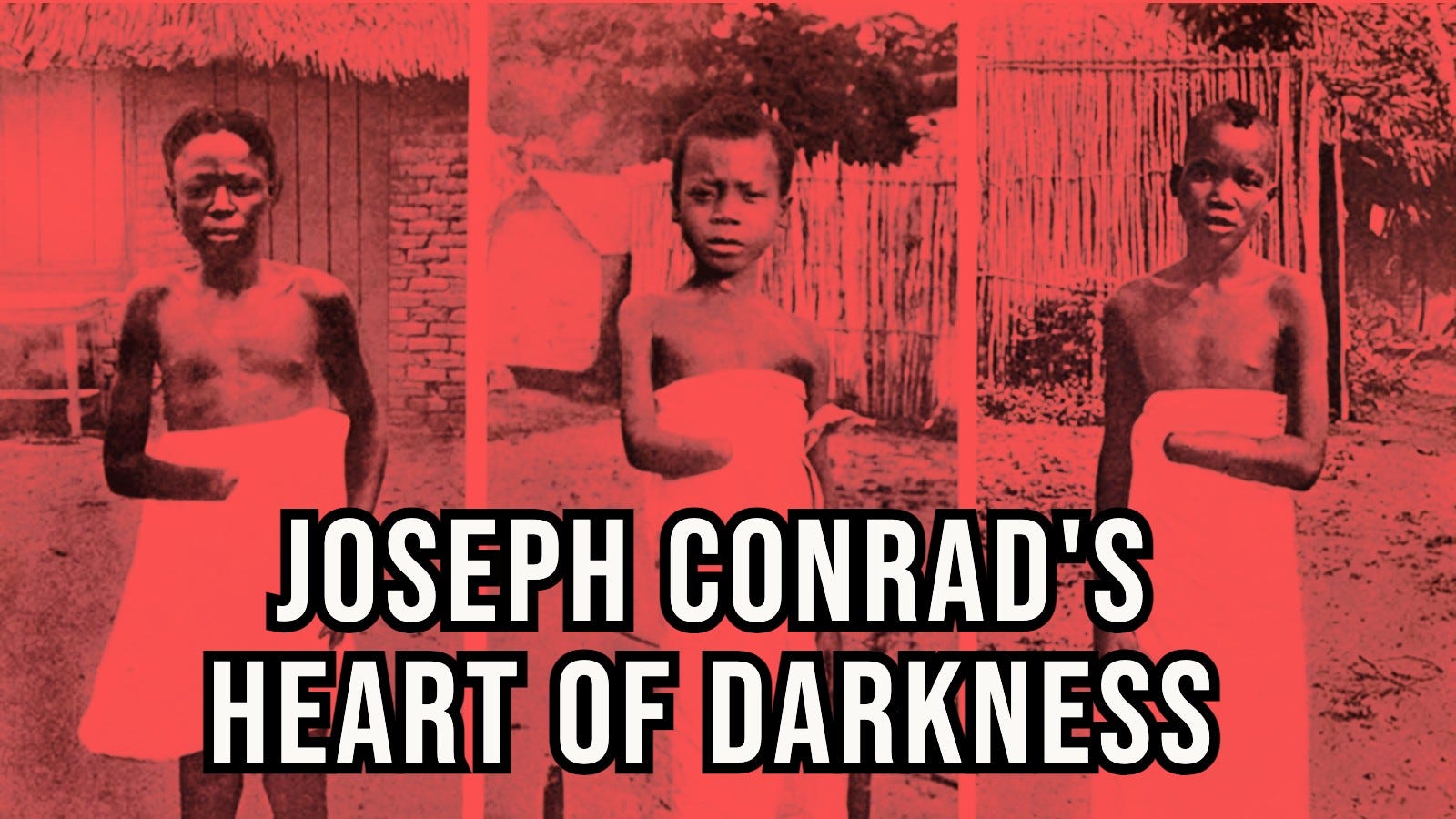
Supplies were scarce, expensive, and difficult to transport into the African interior. Belgian officers expected every bullet to be accounted for. For every shot fired, native troops were required to present a severed hand to prove the bullet had killed its intended target. This “hand quota” was intended to prevent soldiers from wasting ammunition or using Belgian bullets for hunting. But to keep their ammunition books balanced, soldiers began cutting the hands from living victims.
The hand quota later became intertwined with the rubber quotas imposed on Congolese villages. To meet the rubber demand, Belgian authorities demanded forced labor from villagers living near rubber vines. Communities that failed to meet production targets were subjected to mutilation and collective punishment. A trade emerged in severed hands, which were smoked and preserved so they could be presented to colonial authorities when rubber quotas went unmet.
Heart of Darkness was set during the 1880s, when the Congo Free State was trying, and failing, to profit from ivory. If anything, Kurtz is more rational and honest than the administrators and speculators who came to Africa during the rubber boom. He may have cut off heads, but he never got involved in smoking and trading amputated limbs. Kurtz was a madman. The officials who instituted the hand quota were an administration. They told themselves that the Africans were committing the atrocities; they were simply using the hands for bookkeeping.
Diplomats and missionaries had been sounding the alarm for years about starvation, forced labor, and mass murder. Statistics can be ignored. Stories are harder to dismiss. Heart of Darkness transformed those atrocities into a deep and disturbing myth. Conrad’s novel was not a sentimental potboiler like Uncle Tom’s Cabin, but it stirred up interest and concern among Europeans who for years had greeted missionary exposés and diplomatic reports with apathy.
In 1908, after years of international criticism and pressure, the Free State of Congo was annexed by Belgium. King Leopold II was no longer the sole owner of the territory and the new administration curtailed many of the worst excesses. Leopold talked of civilizing Africa; the new Belgian administrators built schools and hospitals for the local population.
But many of the administrators and officials responsible for those atrocities remained in place as the Free State became the Belgian Congo. The colonial charter’s prohibition on forced labor had an exemption clause for “public utility” purposes like bridges, roads, and government buildings. There were still laws against trade unions and working conditions in the mines and railways were often appalling. While it was less overtly brutal than the Free State, the Belgian Congo was still built by Belgians to extract money and raw materials from the native population.
Heart of Darkness was written in response to current political and human rights issues. When Francis Ford Coppola decided to bring it to screen, he changed the setting and time to focus on a recently-ended conflict that was still an open wound for many Americans. The Congo River became the Nùng River. The Free State Congo became Vietnam. Heart of Darkness became Apocalypse Now.
We left the camp after we inoculated the children from polio and this old man came running after us and he was crying, he couldn’t say. We went back there and they had come and hacked off every inoculated arm.
They were in a pile, a pile of little arms and I remember I…I…I cried. I wept like some grandmother. I wanted to tear my teeth out. I didn’t know what I wanted to do. And I want to remember it, I never want to forget it. I never want to forget.
And then I realized like I was shot, I was shot with a diamond, a diamond bullet right through my forehead and I thought my God, the genius of that, the genius, the will to do that. Perfect. Genuine. Complete. Crystalline. Pure.
Then I realized they were stronger than me. Because they could stand that these were not monsters, these were men, trained cadres. These men who fought with their hearts, who have families, who have children, who are filled with love but they had the strength…the strength… to do that. If I had 10 divisions of those men, then our troubles here would be over very quickly.
Today Apocalypse Now is considered one of our greatest war films. During production, many expected it to be an expensive, self-indulgent disaster. Marlon Brando arrived in the Philippines grossly overweight and unfamiliar with the source material. Martin Sheen struggled with serious alcoholism and suffered a near-fatal heart attack during filming. Expensive sets were destroyed in a hurricane. What was supposed to be a five-month shoot stretched out to over a year and generated more than one million feet of film footage.
The movie was supposed to be released in the spring of 1977. On May 19, 1979 an unfinished cut entitled Apocalypse Now (A Work in Progress) premiered at the Cannes Film Festival. Reviews were mixed. Some critics hailed Coppola’s film as a masterpiece, while others dismissed it as an overlong and self-indulgent spectacle. The jury was leaning towards awarding the Palme d’Or to Volker Schlöndorff’s The Tin Drum. But after much argument, the jury declared that both films would receive the festival’s highest honor.
The movie opens with Captain Willard (Sheen) drunk in a Saigon hotel room. His latest mission has him seeking out a rogue Special Forces colonel, Walter E. Kurtz (Brando). Kurtz has set up a private kingdom in eastern Cambodia, surrounded by Khmer, Montagnards, and AWOL American soldiers. There he has been waging a brutal, highly effective war against NVA, Viet Cong, and Khmer Rouge forces.
Like Conrad, Coppola first introduces Kurtz through legends, myths, and fragments of information. Kurtz is clearly an excellent tactician—far more capable than the men currently directing the war. But he has stopped responding to orders and is no longer communicating with his superiors. Unsure of what Kurtz might do next, the Army has ordered Willard to “terminate his command…with extreme prejudice.”
Coppola also gives us a memorable character who did not appear in Conrad’s book, Lt. Colonel Bill Kilgore (Robert Duvall). Kilgore helps escort Willard and his team with an air assault and “Ride of the Valkyries” blasting on speakers. He also gives us one of the film’s most famous lines: “I love the smell of napalm in the morning. It’s the smell of victory.” Viewers watching the film four years after the fall of Saigon would have caught the irony immediately.
He also has ulterior motives for helping the crew. Lance (Sam Bottoms) is a former professional surfer; Kilgore is a talented amateur. He conquered the beachfront so the crew could set sail safely—and so Kilgore could get a chance to surf with one of his heroes. Kilgore’s dream of surfing with Lance, like his dream of an inevitable American victory, goes unfulfilled.
Twenty-first century audiences often remember Kilgore as a charismatic if eccentric hero. Audiences in 1979 remembered friends who came back in wheelchairs or body bags. For those theatregoers, Kilgore was a satire of the idea that bigger explosions, more helicopters, and greater firepower could compensate for a flawed strategy. They knew the cost America had paid for that error. Like Conrad’s officials, Lt. Col. Kilgore clings to myths despite clear evidence to the contrary.
At a Khmer temple turned jungle fortress, Willard finally meets Kurtz. He is surrounded by people who adore him. Colby, the first soldier sent out to terminate Kurtz, has joined his team. He may be equal parts prophet and madman, but Col. Kurtz has recognized the Vietnam war for what it is and has acknowledged something that generals and politicians refuse to admit. He believes he has discovered a workable plan for victory in Vietnam. All it requires is the will to do whatever must be done, no matter how cruel or brutal.
His famous speech about the pile of severed arms is not an attempt to justify an atrocity. Kurtz knows very clearly what it represents. But he is also aware that the US military cannot defeat men who are willing to sacrifice their humanity in service to a cause. American leaders remain trapped in the old myths of freedom, morality, and just wars. Kurtz has looked into the heart of darkness and he has seen the truth. He does not hate his enemy. He simply wants to win the war no matter the cost.
Nietzsche believed that in a world without inherited certainties, the new man would have to create new values for himself. Kurtz has rejected the certainties he inherited, the comforting myths of progress, patriotism, and morality. Nietzsche hoped this confrontation would produce stronger, more honest humans. Conrad was less optimistic. The abyss has not merely stared back into Kurtz. It has spoken, in his final dying words, of the horror.
Every generation produces new ideologies and new promises of redemption. The names, geography, and technology may change. But we still tell ourselves that we are acting in the name of some convenient myth, ideal, or slogan. We pretend the heart of darkness is located in a distant jungle, and we are only there for the most noble of reasons. Some of us can distract ourselves with our illusions. A few can no longer bear the lie. They walk in terror and they walk in blood. But they also walk without delusion. Every generation also produces its Kurtzes.
The Congo and the Nùng are separated by continents, oceans, and nearly a century of history. Yet Conrad’s tale still inspires pity and terror. Marlow and Willard looked into the heart of darkness and became people set apart; the myths that once brought them comfort now only inspired revulsion. Willard saw the heart of darkness in a Cambodian temple. Marlow saw it in an African outpost and at the mouth of the Thames. Both knew that the darkness did not make its home in Africa or Vietnam or anyplace else. It made its home in us.
[1] Joseph Conrad, Heart of Darkness. (1899). At Project Gutenberg, https://www.gutenberg.org/files/219/219-h/219-h.htm.
[2] David Van Reybrouck. Congo: The Epic History of a People. (Sam Garrett, Tr). New York: Harper-Collins, 2014. 39.