Kindertotenlieder
Sandy Hook and the end of shared reality
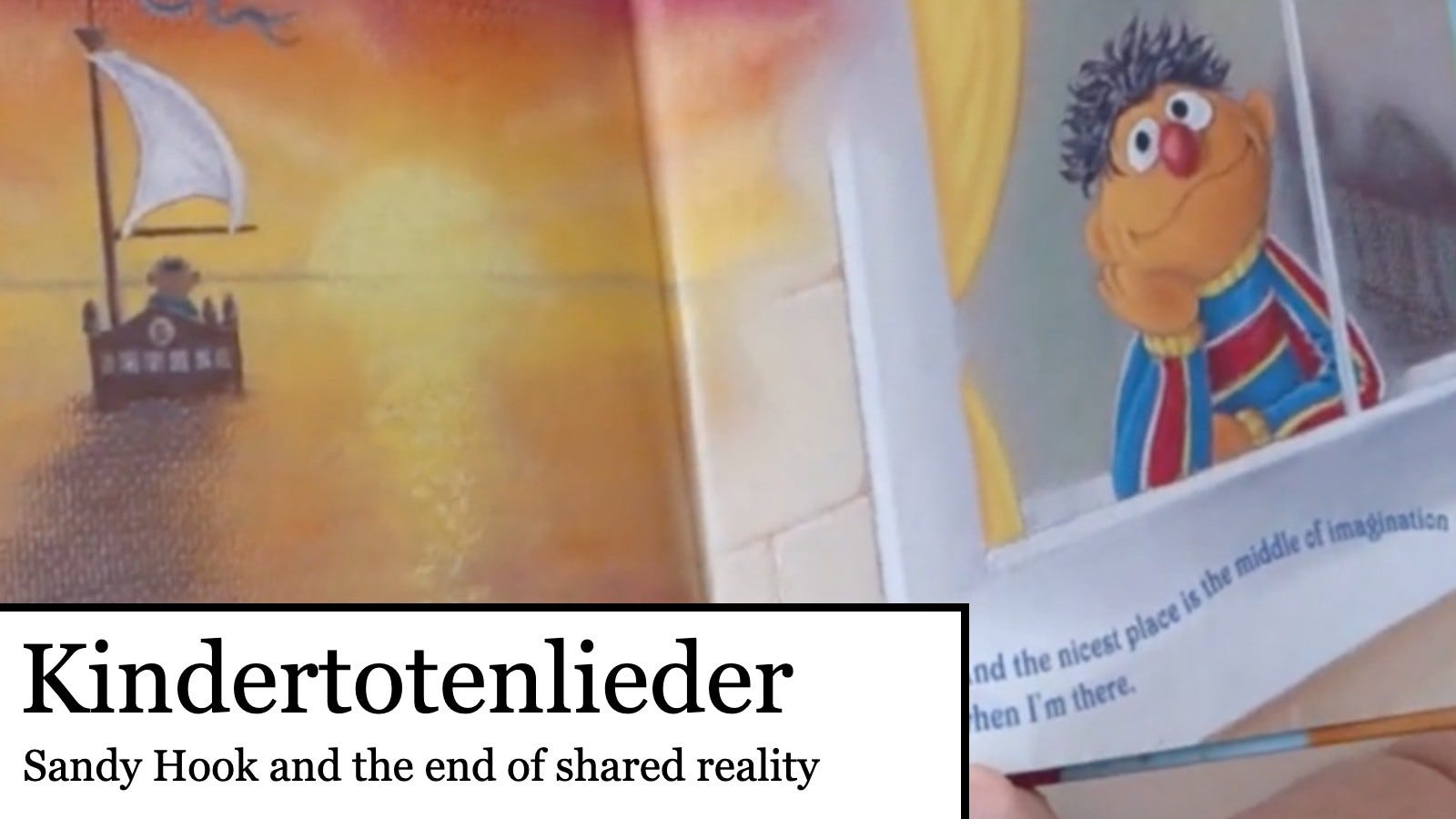
One-year-olds have very strong feelings about their bedtime stories. Annamaria’s current favorite is The Imagination Song. It’s based on a Sesame Street tune Ernie sings to overcome his fear of the dark. It’s a great song for the Winter Solstice on a clear cold night when you can see your neighbor’s Christmas decorations glowing through the bedroom window.
Or it would be, if I could stop thinking about the twenty first-graders who were gunned down in Connecticut a few days ago. And if the book didn’t end with Ernie sailing off in an imaginary boat into an imaginary sunset, singing:
I close my eyes and the night isn’t dark
And the things that I lose, I find
Time stands still and the night is clear
And the wind is warm and fair
And the nicest place in the middle of imagination
When I’m there.[1]
Tonight I make it through without choking up, without pausing, without imagining my daughter screaming behind a closet door. She is here in her crib, and her eyes are heavy as I kiss her goodnight; she is not clinging tightly to her classmates as bullets rip through her.
That was in December 2012, a week after Adam Lanza walked into Sandy Hook Elementary School and killed twenty children and six adults. I was still grappling with the atrocity. I don’t know if I ever stopped. Others insisted, and continued to insist, that it never happened at all.
The “Sandy Hoax” craze was hardly America’s first dance with conspiracy theory. The aptly named Know Nothing Party became a major political force in the 1840s and 1850s by “exposing” secret Roman Catholic shenanigans. In 1920 Henry Ford serialized an English translation of the Protocols of the Elders of Zion in his Dearborn, Michigan newspaper as part of his series entitled The International Jew. A few days after 9/11, people were already insisting that jet fuel doesn’t burn hot enough to melt steel girders.
Conspiracy theories are as American as apple pie, baseball, and robber barons. But those theories usually sought to expose the hidden hands behind events. The Sandy Hook deniers weren’t arguing that Adam Lanza was coerced into shooting children by FBI agents, Communist infiltrators, or Zionist operatives. They claimed that the entire event was staged. The victims, parents, witnesses, police officers, teachers, and even the school itself were recast as part of an elaborate plot to push through new gun control laws.
A traditional conspiracy theorist would look at Sandy Hook and suggest some secret government cabal or foreign spy ring groomed Lanza into committing the massacre. The theory would involve many leaps of faith, alternative interpretations, and questionable conclusions. But it would still be an attempt to explain a horrible tragedy. The Sandy Hook theory did not attempt to explain reality so much as deny it.
Alex Jones was the first major media figure to call Sandy Hook a crisis actor event. He certainly deserves criticism for his years-long campaign to discredit the grieving families and eyewitnesses. But there is another, more important question, to consider. How did a bombastic talk radio host and political entertainer who sold vitamins and sexual enhancement drugs between rants about aliens, conspiracies, and frikkin’ gay frogs become more credible to a wide audience than teachers, parents, law enforcement officials, and eyewitnesses?
You’ve got parents laughing — ‘hahaha’ — and then they walk over to the camera and go ‘boo hoo hoo,’ and not just one but a bunch of parents doing this and then photos of kids that are still alive they said died? I mean, they think we’re so dumb.
Alex Jones[2]
Alex Jones was not America’s first political entertainer. Morton Downey, Jr. and Rush Limbaugh had won wide audiences for their loud and inflammatory commentary decades earlier. Nor was he the first celebrity conspiracy theorist. Art Bell was discussing aliens, government cover-ups, and secret conspiracies on Coast to Coast AM while Alex Jones was still in middle school.
Art Bell was more playfully curious than Jones. He might make outlandish claims about Roswell or secret alien bases, but always with a sense of wonder and speculation. He was more interested in creating a strange, fascinating world and expanding listener horizons. Limbaugh and Downey were provocative, partisan, and pugnacious. But they generally operated within conventional political frameworks.
Alex Jones started from a different place. He built his worldview around the idea that our political system was largely a façade. Republicans and Democrats argued in public, but they were part of a show put on for public consumption. Behind the scenes secret elites, bankers, globalists, and intelligence agencies pulled the strings and ran the show. These secret elites were behind everything from Waco to 9/11.
His message was not “there are aliens among us” or “bad people are running the government into the ground.” It was something far more radical: the government itself is not to be trusted.
By 2012, Americans had lived through Watergate and the many deceptions and cover-ups surrounding the Vietnam War. We had learned that Iraq possessed no stockpiles of weapons of mass destruction. We had watched Enron collapse despite the assurances of the smartest guys in the room. We had witnessed a series of intelligence failures before 9/11. And while the worst of the 2008 financial crisis was behind us, much of the recovery seemed to favor investors and multinational corporations more than the working and middle classes.
It’s not surprising that Jones found an audience that shared his distrust for the establishment. We had little reason to trust the government, academia, or multinational corporations in 2012—and many reasons not to. But many Jones followers, like Jones himself, turned justified skepticism into a worldview. They no longer argued about whether a particular official statement was true. Instead, they assumed immediately that anything that came from official sources was false.
According to Pew Research, 39 percent of Americans were getting their news from their smartphones and tablets in 2012.[3] The information gatekeepers were still there, and most Americans still relied on newspapers and television. But the internet gave many alternative thinkers a voice and a megaphone. Cranks, kooks, and conspiracy theorists who would have been confined to zines, public-access television, and photocopied newsletters twenty years earlier now had websites and Facebook pages.
Most Americans kept their institutional distrust in check. They had no problem believing the government lied about a war; corporations concealed financial problems; intelligence agencies made catastrophic mistakes. But when twenty children were murdered in an elementary school, they still accepted the reality of what they were seeing. For Jones and many of his followers, these limits no longer applied.
The Sandy Hook “crisis actor” theory is unfalsifiable. The death certificates and school records might be forged, and so Sandy Hook deniers assume they must be forged. If a grieving parent smiles when recollecting a happy moment with their child, that is proof they are faking their grief. If they cry, as parents who have just lost a seven-year-old to an assassin’s bullet are wont to do, that is proof they are trained actors. If witnesses describe the event, they are lying. If they refuse to speak, they are being silenced by powerful interests.
Skepticism demands evidence. For Sandy Hook deniers, every piece of evidence proves their theory, and every contradiction proves the querent is either unwilling to see the truth or actively working to suppress it. This is not skepticism; it is a closed belief system. No evidence can ever count against the conclusion. It is an idée fixe. One can no more debate it rationally than one can reason with a man convinced the CIA has installed microphones in his teeth.
Why was the Sandy Hook shooting staged? The most common response is that it was an effort to build support for gun control laws. But no major federal gun control legislation was passed after Sandy Hook. By that standard, this elaborately constructed hoax failed spectacularly. Not only did a sexual health supplement salesman and his followers see through it immediately; it never achieved its goal. Of course, deniers would tell you that their backlash prevented those gun confiscations from taking place.
Adam Lanza was a disturbed young man. Grooming him into slaughtering a classroom full of elementary school students would be easier and less expensive than staging an elaborate crisis event. A staged shooting requires hundreds of participants, thousands of silent witnesses, and fabricated records. What did they gain from a staged shooting over a real one involving a troubled twenty-year-old and a few handlers?
Deniers would tell you that a staged massacre gives conspirators total control over the narrative. George R.R. Martin could tell them that the more complicated the plot, the more likely it is to collapse under the weight of its own moving parts. If a man of Martin’s obsessive talents can’t keep Westeros running smoothly, how have a bunch of bureaucrats managed to coordinate over a decade of flawless deception?
The Sandy Hook hoax theory arose as part of a broader shift in how Americans evaluate evidence and authority. In 2018 a YouGov survey of over 10,000 respondents found that around 17.5 percent of millennials and 19.2 percent of those ages 25-34 agreed with the statement “I have always believed the world is round.”[4] In fairness, only 2 percent expressed a firm belief in a flat earth. Even so, the survey suggests a willingness to entertain ideas that earlier generations—meaning anyone born after the eleventh century or thereabouts—would find absurd.
In 2024 Will Duffy, a Colorado pastor, took four flat-earthers to Antarctica, along with some “globers” who accepted the Round Earth hypothesis. He intended to show them the 24-hour sun during the Antarctic summer—a phenomenon that is easily explained by the tilt of a round earth but difficult to explain on a flat earth.
The flat-earthers acknowledged that the 24-hour sun was real but remained unconvinced that the earth was round. Other flat-earthers claimed that the shadows left by Duffy and his team proved their “expedition” was filmed in a studio. One Alabama pastor, Dean Odle, suggested that Satan accompanied Duffy to Antarctica and then created a fireball in the sky to deceive unbelievers. Only one flat-earther, a popular YouTuber named Jaren Campanella, acknowledged that after the trip “the flat Earth doesn’t work for me.”[5]
In 1976 former rocket engineer Bill Kaysing published a booklet entitled We Never Went to the Moon: America’s Thirty Billion Dollar Swindle. In 1978 the science fiction film Capricorn One depicted a fake Mars mission staged in a Hollywood studio. In the era of Vietnam and the Pentagon Papers, this skepticism felt understandable. Today the available evidence makes it untenable.
When Apollo 11 landed on the moon, the crew brought retroreflectors—small mirror arrays that can be used as targets for laser beams. With these retroreflectors, scientists were able to get precise measurements of the Moon’s orbit and shape. Scientists still use these lunar retroreflectors today. We could claim that those ongoing experiments are fakes designed to prop up our standing in the “space race” with the Soviet Union. Except, of course, for the awkward fact that the Soviet Union no longer exists.
The Antarctica trip doubters and moon landing denialists are products of our post-epistemological world. The scientific worldview begins with true skepticism; what evidence supports this claim, how was it acquired, and are there alternative explanations for this phenomenon? Skepticism is not a set of conclusions but a method for reaching them.
What we increasingly see today is not skepticism but distrust. Skeptics are open to contrary evidence and willing to change their worldview when new facts emerge. Those who dismiss contrary evidence as fraud, manipulation, or deception cannot make that move. Their beliefs are insulated from correction. Their question is not “What is true?” but “Who do I trust?”
Most of us have a strong negative reaction to people who harass grieving parents, and rightly so. Sandy Hook deniers led many to fear and mistrust alternative media sources and conspiracy-oriented thinking. But often their reaction was simply Sandy Hook denialism inverted. Deniers claim that government and official sources were lying by definition. The warriors against “misinformation” and “fake news” assumed the opposite: government and official sources were trustworthy by definition.
Skepticism evaluates claims, not tribes. Blind distrust and blind trust are mirror images of each other. As John Michael Greer often says, the opposite of a bad idea is generally another bad idea. True skeptics take all claims with a grain of salt and verify facts from alternate sources, even if they disagree with some of their conclusions. They are willing to live with a certain degree of uncertainty and to shift course when they discover an error. The desire for absolute certainty is understandable, but reality rarely grants us that luxury.
[1] Joe Raposo, Imagination Song. New York: Random House, 2001. 32.
[2] Elizabeth Williamson, “Here’s what Jones has said about Sandy Hook.” New York Times, September 22, 2022.
[3] Pew Research Center, “In Changing News Landscape, Even Television is Vulnerable.” (September 27, 2012). https://www.pewresearch.org/politics/2012/09/27/section-2-online-and-digital-news-2/.
[4] Craig A. Foster and Glenn Branch, “Do People Really Think Earth Might Be Flat?” (August 21, 2018) at Scientific American. https://www.scientificamerican.com/blog/observations/do-people-really-think-earth-might-be-flat/.
[5] Noelle Phillips, “A Colorado pastor thought he could make flat-Earthers see the light in Antarctica. It didn’t work.” Chicago Tribune, January 17, 2025.