
Leo Frank and the Methodology of Murder
An Introduction and an Explanation

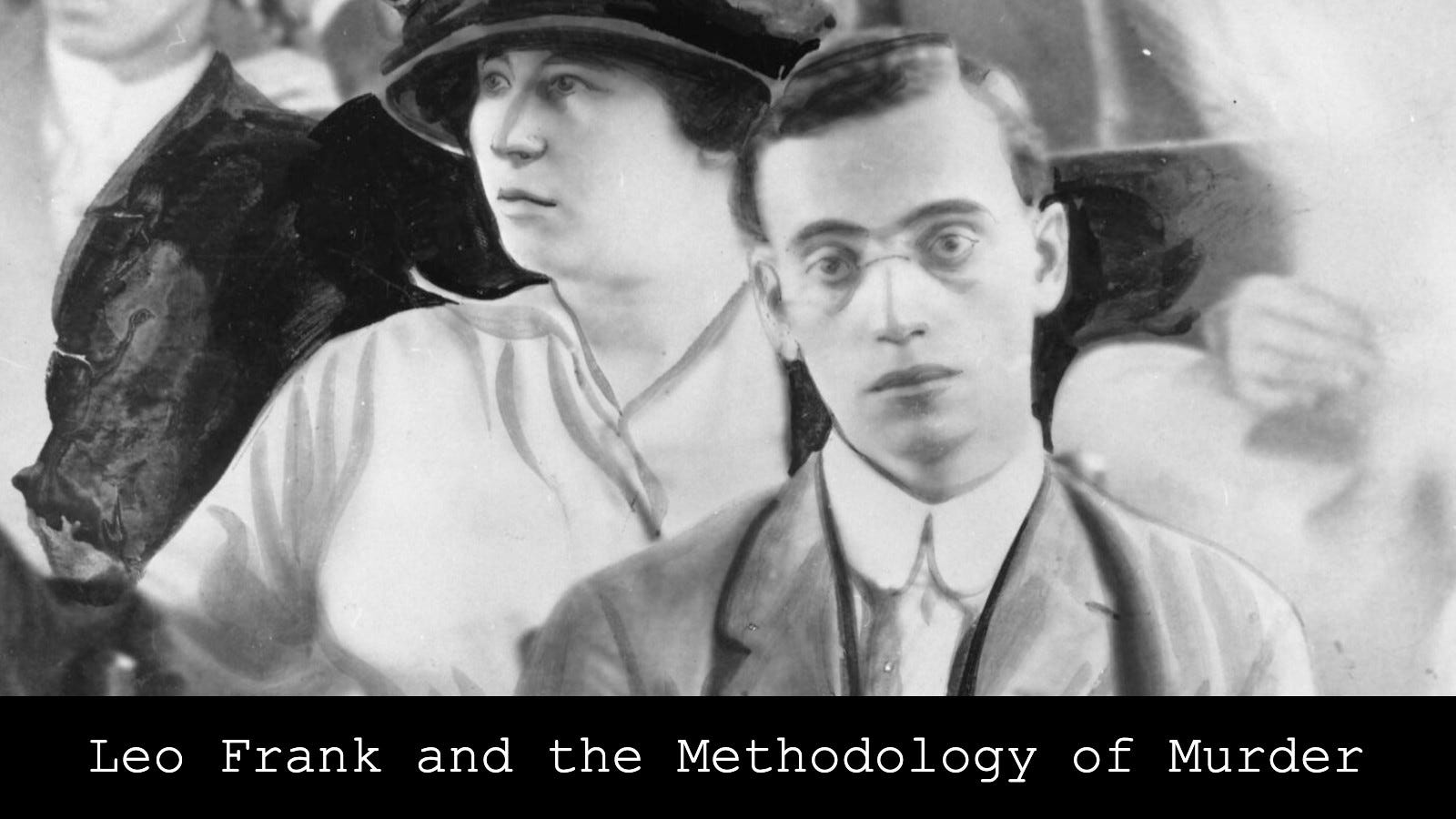
Was Leo Frank guilty?
Absolutely. A jury of his peers found him guilty of the murder of Mary Phagan on August 25, 1913. On February 17, 1914, the Georgia Supreme Court denied his request for a new trial. An extraordinary motion before the Supreme Court to raise facts not available at the original trial was denied on November 14, 1914. On April 19, 1915, the United States Supreme Court denied his appeal in Frank v Mangum. By all standards of jurisprudence then and now Leo Frank was convicted of his crime, and that decision was upheld in multiple courts.
But that’s not the definition of “guilty” you had in mind. You were asking whether Leo Frank killed Mary Phagan. We’re all aware that courts sometimes get things wrong. It’s entirely possible for an honest jury, after a completely fair trial, to come up with a reasonable but completely wrong verdict. Innocent people are convicted regularly of crimes they did not commit. Guilty people regularly walk free on procedural errors, unreliable witnesses, or lies.
The conviction should be taken into account. It was reached by a jury after a lengthy trial and upheld repeatedly on appeal. But it is not irrefutable proof that Frank was either a martyr or a murderer.
Many have already made up their minds on that question. Wikipedia opens its Leo Frank entry with:
Leo Max Frank (April 17, 1884 – August 17, 1915) was an American lynching victim wrongly convicted of the murder of 13-year-old Mary Phagan, an employee in a factory in Atlanta, Georgia, where he was the superintendent. Frank’s trial, conviction, and unsuccessful appeals attracted national attention. His kidnapping from prison and lynching became the focus of social, regional, political, and racial concerns, particularly regarding antisemitism. Modern researchers agree that Frank was innocent.[1]
But there is no such unanimity among modern researchers. Many researchers have asked hard questions about the dominant Leo Frank narrative. Mary Phagan-Kean, great-niece of Mary Phagan, has written about the Frank case and discussed its impact on her family in her book The Murder of Little Mary Phagan. Other Frank skeptics have compiled the court documents and pointed to evidence that suggests those proceedings arrived at the right conclusion.
Quite a few Frank experts dismiss Frank skeptics as antisemites who see the Leo Frank case as a convenient club for Jew-bashing. In fairness, many of the loudest skeptics are indeed proud antisemites who see Frank as yet another example of Jewish perfidy. But it is equally true that one of the loudest defenders of Leo Frank’s legacy, the Anti-Defamation League, was founded in the wake of Frank’s arrest and that Leo Frank is at the heart of its founding myth.
So who’s right?
Short answer: it’s a long story.
Leo Frank isn’t just an integral part of the ADL’s origin story. He has become an important part of American mythology. To many Americans, he is an innocent victim of antisemitism and Southern bigotry. To others, he is proof that Jews will stop at nothing to save one of their own from just punishment. Yet all these competing narratives simplify a very complicated reality—one that is not so easily reduced to heroes and villains.
Like every mythic figure, Leo Frank’s story happens in a particular place (Atlanta, Georgia) and a particular time (1913-1915). The Atlanta of today looks very little like Leo Frank’s Atlanta though it has preserved many of the contemporaneous buildings—including the Temple, the synagogue where Rabbi David Marx officiated and Leo Frank and Lucille Selig were married.
The judicial system of today has changed even more dramatically. Police have access to technology that 1913 detectives could not imagine. If Mary Phagan were murdered in 2026, police would rely on DNA analysis, surveillance cameras, digital records, fingerprint records, and other forensic methods to determine when, where, and how she was murdered. Those resources were not available to Atlanta detectives examining the Phagan killing.
In 2026 Leo Frank’s reluctance to answer questions without a lawyer present would be expected. In 1913 it was seen by many as evidence Frank was trying to hide something. The defense’s racial appeals and the prosecution’s allegations of sexual depravity would be sharply limited or excluded altogether under modern rules of evidence. Many of the objections raised by Frank defenders and Frank skeptics would never have arisen in a modern courtroom. Yet even today judges and juries sometimes arrive at the wrong conclusion.
My purpose is not to judge a 1913 trial by 2026 standards. At best, this would be a thought exercise that told us very little about why twelve 1913 jurors arrived at their conclusions. We cannot say conclusively that Leo Frank murdered Mary Phagan, nor can we say conclusively that he did not. But we can say with certainty that a 1913 jury, based largely on the testimony of a black laborer with a criminal record and a history of lying about the case, decided that he did.
Jim Conley’s role in convicting Leo Frank is one of the most glaring anomalies in the case. In Jim Crow South, the word of a black man carried far less weight than a white man’s word. Frank was a prosperous factory manager with a college degree and a spotless criminal record. Conley was a notorious black drunk with a long history of petty crime. One would expect prosecutors and jurors to reject out of hand the testimony of a Negro criminal against a respectable (albeit Jewish) white man.
And yet they did not.
For some, the answer is simple: Leo Frank was convicted by Southern Jew-haters who despised his dual status as a Jew and a Yankee, and who were inclined to believe the worst about him simply because of his ethnicity and religion. Any questions about that narrative are simply efforts to justify an unjust trial and a lynching.
Others offer a different but equally simple answer: Leo Frank was so clearly guilty that even Jim Crow Atlanta found the black eyewitness more trustworthy than the obvious rapist and murderer. Any questions about their narrative come from Jews who are still trying to blame an innocent black man for a fellow Jew’s heinous crime.
Both these answers are easy to digest. If you buy into their preconceptions, they feel like a complete, reasonable explanation of the event. There’s no need to take any contradictory evidence into account, no need to challenge your own preconceptions, no need to worry about inconvenient facts or counterarguments.
If you are beholden to either of these easy explanations, you will likely find this book frustrating. I have no interest in catering to preconceptions. Leo Frank has become a myth. I want to look at what scraps of reality I can find and see how the facts on the ground match up to the stories. Many modern readers come to the Frank case with a certainty that is strikingly absent from the often-conflicting primary sources.
There are two primary suspects in the Mary Phagan killing: Jim Conley and Leo Frank. Other suspects were held for a greater or lesser time, but they were freed when it became clear they were not involved in the murder. If an unknown third person murdered Phagan unbeknownst to Conley and Frank, why would they become entangled in concealing the crime?
Jim Conley testified to moving Mary Phagan’s body. He also admitted to writing the notes that were found near Phagan’s body, though he claimed Frank dictated them. Conley was, at best, an accessory after the fact and served a year on the chain gang for that crime. In today’s dominant narrative, he is the man who murdered Phagan and pinned the crime on Leo Frank.
Leo Frank admitted that he gave Mary Phagan her pay shortly before she was killed. It is difficult to imagine how he could not have heard Phagan’s murder in the nearby metal room, or how he did not notice Jim Conley moving the body through the factory. More difficult still is the idea that Frank helped Conley conceal the crime until he himself became a prime suspect.
You can make a plausible case for each man’s guilt. You can also make a plausible case for each man’s innocence. Each explanation raises as many questions as it answers. That was the dilemma facing Frank’s jurors. Ultimately, they decided Frank was more likely to be the killer than Conley. Today that narrative has shifted. We speak of their guilt or innocence with an easy certainty, while the jurors who held Frank’s life in their hands reached their verdict in fear and trembling.
History rarely gives us certainty. Instead, it provides a series of competing explanations. It is up to the historian, or the reader, to decide which explanation best accounts for the evidence. We do not come to those explanations with blank slates. We view the past, like the present, through our prejudices and preconceptions. They help determine what we look for and what we see when we find it.
Leo Frank plays many roles in the American myth. He is a hard-working young Jewish martyr who represents American antisemitism. He is a lecherous Jewish villain who represents all the crimes of his race. He is a bigot who tried to frame two black men for his misdeeds. He is everything but a smart, awkward, hard-working factory manager who may or may not have committed a terrible crime. Myths are simultaneously larger than and smaller than life.
[1] “Leo Frank”, Wikipedia (June 30, 2026). https://en.wikipedia.org/wiki/Leo_Frank