
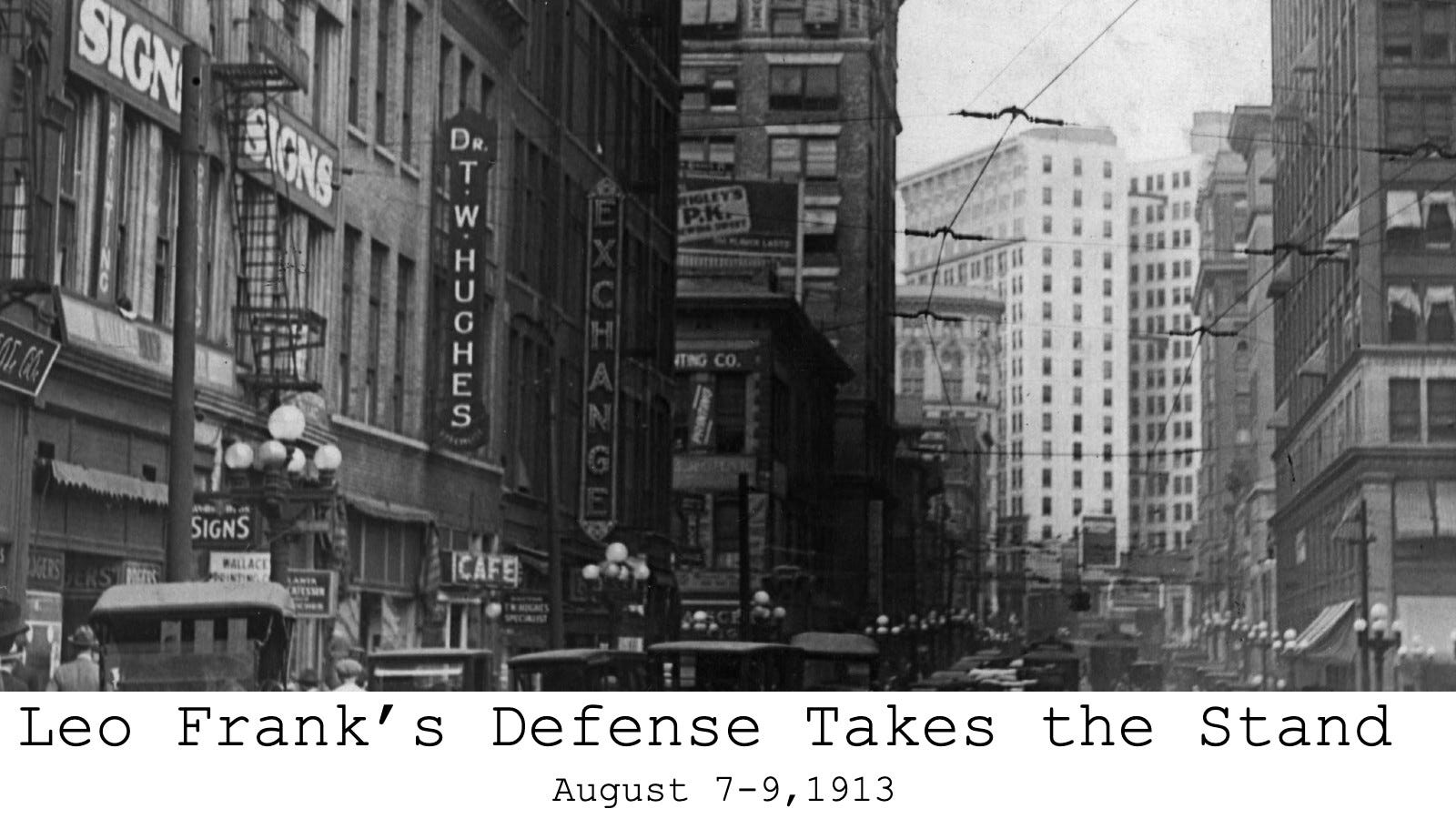
Leo Frank's Defense Takes the Stand
August 7-9, 1913

They call it a chain that the State has forged, or has tried to forge, to hold Leo Frank to the murder of Mary Phagan.
But isn’t it a rope?
A chain, you know, is as strong as its weakest link. Take one link apart, and the chain comes apart.
With a rope, it’s different.
Strand after strand might be cut or broken, and the rope still holds a certain weight. Then might come a time when the cutting of one or more strands would cause the thread to break.
And that is what the various bits of circumstantial evidence might better be called—strands or threads.
O.B. Keeler[1]
In 1913 Atlanta, like today, the jury was expected to find the defendant guilty only if the evidence proved their guilt beyond a reasonable doubt. Luther Rosser immediately set out to instill as much doubt as possible in the minds of the jurors.
His first witness, Dr. Leroy Childs, called into question Dr. Harris’s assertion that Mary had eaten her breakfast between 30 and 45 minutes before meeting her death. Upon viewing the vial of undigested cabbage, Dr. Childs said “I have seen cabbage less changed by the digestive juices than that which had been in a person’s stomach for 12 hours.”[2]
In his cross-examination, Hugh Dorsey showed a surprising knowledge of medicine and chemistry.
Dorsey: You say you can find free hydrochloric acid in the stomach without the presence of food?
Childs:Yes…
D: Do you know the Eihwald test breakfast?
C: Yes.
D: Of what does it consist?
C: A slice of apple, a slice of bread, and six ounces of water.
D: “After this breakfast has been given, can any hydrochloric acid be found in the stomach?
C: It depends entirely upon the glands.
D: I’m not talking about the glands. I’m talking of a perfectly normal stomach.
C: The acidity would be about two-tenths of a dram.
D: Give me the total acidity in degrees, doctor.
C: You are getting out of my line and into the realm of chemistry or laboratory work. I am not familiar with the degrees…
D: Suppose, doctor, that this cabbage I have here in this vial was taken from a normal stomach with no part of the cabbage in the smaller intestine, and, upon removal of the stomach, it was found that combined hydrochloric acid was present in 32 degrees, what would you say as to how long the substance had been in the stomach before death?
C: I couldn’t tell within an hour and a half of the time.[3]
Dorsey spent some time learning the finer points of medical forensics because he recognized the importance of Harris’s testimony. According to several eyewitnesses, Leo Frank was home for lunch by 1:30 p.m. on the day of the murder. If Mary Phagan died between 12:30 and 12:45, that would place Frank in the building during her murder. By his own admission, he left the National Pencil Company shortly before 1:00.
Few modern forensic scientists would estimate the time of death so narrowly based on a single vial of undigested cabbage. In addition to stomach contents, they could check for potassium levels in the eye, body temperature, rigor mortis, lividity, and toxicology and histology reports. Dr. Harris had nothing to rely on but stomach contents which he tested rigorously to the highest medical standards of 1913.
We think ourselves scientifically advanced. The residents of 1913 Atlanta also felt that way. Leo Frank got back to his home in an electric streetcar. The Franks had not yet bought an automobile because, like many young Atlanta couples, they were living on a modest income. But Henry Ford’s recently released Model T used assembly line production to lower the cost and make automobiles affordable even to middle-class homeowners. Earlier in the year, the U.S. Army established the 1st Aero Squadron, a unit dedicated solely to aviation.
On the Sunday before Childs gave his testimony, another trial witness, Deputy Sheriff W.W. “Boots” Rogers, was attacked by a rabid dog while riding his motorcycle. A generation earlier, Rogers would have died a horrible death. But thanks to the Pasteur Treatment, a ten-day series of injections, Rogers survived. Frank’s jurors lived in a world that their grandparents could scarcely have imagined. Dorsey knew they would take a medical specialist’s word very seriously and fought tenaciously to defend Harris’s conclusions.
Rosser’s second witness, Pinkerton detective Harry Scott, was one of the men responsible for interrogating Conley during his various affidavits. As the Atlanta Georgian described Scott’s time on the stand:
Scott said that he had grilled and badgered Conley repeatedly about seeing Mary Phagan enter the factory. Even after the negro had made all his incriminating statements, he steadfastly denied seeing the girl victim go up the stairs to the second floor.
He denied also to Scott, the detective said, that he had ever seen the girl’s mesh bag or parasol, or that he ever had heard a girl’s scream while he was sitting on the first floor. He told the detectives that he did not see Lemmie Quinn or Monteen Stover enter the factory, although he later declared he had seen them both and so testified on the stand.[4]
The State’s case rested on a man who provided four different affidavits. As Rosser walked Scott through the different versions of Conley’s story, he reminded the jury that the prosecution’s star witness only came to his final affidavit after long hours with detectives and investigators—and that his most shocking claims against Leo Frank only came out after prolonged questioning.
Rosser was well aware that Jim Conley came before the jury with several disadvantages. He might not have been able to trip him up during cross-examination, but he was going to keep hammering on Conley’s credibility.
Friday’s session opened with Daisy Hopkins, a woman Jim Conley reported seeing in the company of Leo Frank and C.B. Dalton. Hopkins acknowledged that she had worked at National Pencil Company from October 1911 and June 1912. But she testified that she only knew Frank and Dalton by sight; she had never spoken with Frank and only knew Dalton because he was at the house where she stayed once.
On cross-examination, Dorsey noted that Miss Hopkins had previously been married and that she had been jailed for “immorality.”
Dorsey: You’ve never been in jail, in this county or anywhere else?
Hopkins: I said I’ve never been in jail anywhere.
D: Do you see this man here? [points to Deputy N.A. Gardner]. Didn’t he get you out of jail recently?
H: No, he never got me out of jail; I’ve never been in jail.
D. Do you mean to say that this man, N.A. Garner, never got you out of jail?
H: No, he never got me out of jail!
D: Well, who did, then?
H: Mr. Smith.
D: Who is Mr. Smith?
H: He’s the lawyer, W.H. Smith.
D: You mean the one who is representing James Conley, the man sitting right over there?
H: Yes, sir; he’s the man.
D: What were you there for; wasn’t it for immoral actions.
H: No, people told tales on me and that got me in jail.
D: Weren’t you there for reasons of immorality.
H: That’s what they said.[5]
Rosser had better luck with W.M. Matthews, the motorman who brought Mary Phagan into downtown Atlanta. Matthews explained to the jury that on April 26, 1913:
Mary Phagan got on my car at Lindsey Street at 11:50. Our route was from Bellwood to English Avenue, down English Avenue to Kennedy, down Kennedy to Gray, Gray to Jones Avenue, Jones Avenue to Marietta, Marietta to Broad, and out Broad Street. From Lindsey Street to Broad Street is about a mile and a half or two miles. We make frequent stops. We were scheduled to arrive at Marietta and Broad at 12:07(1/2). We were on schedule. We stayed on time all day…
I was relieved at Broad and Marietta by another motorman but sat down in the same car one seat behind Mary Phagan. Another little girl was sitting in the seat with her. We got to Broad and Hunter about 12:10. Mary and the other little girl both got off and walked to the sidewalk and they wheeled like they were going to turn around on Hunter Street, both of them together. The pencil factory is about a block and a half from where they got off at Hunter and Broad.[6]
Matthews also testified that “the little Epps boy” was not sitting with Mary and verified that he recognized Mary Phagan as the girl who got in his car when he saw her body at the undertaker’s. George Epps said he was riding with Mary Phagan on April 26 and claimed that she said she was afraid of Leo Frank. If he was lying about the day of the murder, that would go a long way toward discrediting his testimony about Frank’s character.
Matthews’ testimony also complicated the prosecution’s timeline. If he was correct, Mary did not step off the streetcar until about 12:10. Since the National Pencil Company was another block and a half away, she could not have reached the factory until several minutes later. Dorsey questioned Matthews strenuously about his memory and tried to shed doubt on his claims. But Matthews held as steadfast to his testimony as Jim Conley had to his. The next witness, conductor W.T. Hollis, confirmed Matthews’ testimony.
Rosser then moved on to Albert Kauffman, an Atlanta architect who came carrying blueprints. Albert McKnight, the cook’s husband, had claimed that he was in the kitchen when Leo Frank came into the living room in a state of panic. But based on the blueprints of the Frank home, he could not have seen into the living room from the kitchen. Kauffman then showed the layout of the National Pencil Company’s second floor and stated it would be almost impossible for Frank to see or hear people coming in or out of his office.
But perhaps the most significant comment in his testimony was his note that there was a five-foot-wide chute to the basement on the first floor. Its opening was just a few yards from where Mary Phagan’s body was found. Conley had stated that he, with Frank’s assistance, had dragged Phagan’s body to the elevator and took it to the basement. But there were already questions about this part of the story.
Conley also claimed that he defecated in the shaft earlier that morning. When investigators took the elevator down to the basement to see the body, they were greeted with the unmistakable smell of crushed feces. While the investigators shrugged it off, many later analysts have noted that the “shit in the shaft” suggests that Conley did not bring Phagan down to the basement with Frank’s assistance. This raises legitimate issues about testimony that was used to convict Leo Frank and later cited to justify his lynching.
It is entirely possible that Frank called on Conley to get rid of Mary Phagan’s body and he did so through the chute. Conley would have known very well that his choices were cooperation or hanging for the crime after Frank reported he saw one of the company’s negroes strangle a little girl. He would have every incentive to go along and, later, to tell his story in a way that minimized his culpability.
But it is also possible that Conley was indeed a very skilled liar who managed to get away with murder by pinning it on the boss. This is the great question that faces every Leo Frank researcher. We are left with court records where many of the most important witnesses are almost certainly not telling the truth, the whole truth, and nothing but the truth. We are left to determine which parts of each account withstand scrutiny and to argue among ourselves where those lines should be drawn.
N.V. Darley, the assistant plant superintendent, noted that the door leading to the chute had been nailed shut since the first of January. That door was found broken open shortly after Mary Phagan’s murder. Darley also noted that there was a second trap door in the hallway to that chute, which opened onto a steep stairway to the basement. And he further stated that the door was nailed up again a few days after the crime by persons unknown.
After challenging the State’s reconstruction of the crime scene, the defense returned to Frank’s alleged conduct toward women. E.F. Holloway, the day watchman, testified that he had never seen any women in Frank’s office besides Mrs. Frank and her mother. He refuted a claim from Conley that Frank had a woman in “white shoes and white stockings” in the factory last Thanksgiving; Reuben Arnold added further that this seemed inappropriate garb to wear on a day when it was snowing.
Dorsey started his questioning by claiming Holloway had earlier sought to influence witnesses. He claimed that Holloway had asked Kendrick, the former night watchman, to swear that Frank regularly called the night watchman as he had called Newt Lee. Dorsey also claimed that L.P. Whitfield, a Pinkerton operative, found a bloody club at the factory the day after Holloway said, “to come around the next day and he was sure the detective would find something.”[7]
Holloway denied both allegations indignantly, but the Georgian still felt that portions of his testimony were “badly shaken.” It is impossible to know how the jurors felt about the exchange. What is clear is that Dorsey considered Holloway important enough to attack his credibility rather than simply accept his testimony.
Saturday’s half-day session opened with George Epps. Reuben Arnold asked Epps why, when he was interviewed by John Minar of the Georgian on April 26, Epps said that he had seen her Thursday last, then later said under oath that he rode with Mary Phagan on the train. Epps denied talking to the reporter, claiming that his sister Vera did all the talking for that interview. The defense then brought Minar to the stand. He insisted that George and Vera were both in the room during the interview and that both had answered his questions.
If Minar was correct, and he had no reason to lie, Epps had changed his story about one of the central facts of his claim. Could the jury rely on George’s claim that Mary Phagan told him she was afraid of Leo Frank? The defense team hoped they would not.
Herbert Schiff, the assistant superintendent at National Pencil Company, was the final witness of the day. Frank contended that he was doing the week’s financial sheets on the day of Mary Phagan’s murder, and remained engrossed in that task until he left. Schiff identified the figures and notations on that day’s sheet as Frank’s handwriting, and noted that it appeared identical to the writing on every financial sheet for the prior year. Reuben Arnold, to prove the point, brought out each of those sheets.
Schiff also showed the complex calculations required to fill out the sheet properly. The implication was clear; no man who had just committed a heinous crime could complete this work without error or irregularities. After getting confirmation that Schiff, like Holloway, had never seen any women in the factory on Saturdays except Mrs. Frank, Arnold then asked, “Do you know Jim Conley?”
When he replied yes, Arnold asked “What sort of negro is he?”
Schiff said, “There isn’t much to him.”
Assistant prosecutor Frank Hooper objected to these questions and moved they be stricken from the record. Arnold then changed his line of questioning.
A: What work did he do?
S: Truck and ran the elevator.
A: Do you know his character and was it good or bad?
S: Very bad.
A: Would you believe him under oath?
S: I would not.[8]
After a bit more bantering between Schiff and Dorsey, the proceedings adjourned until the next Monday. Rosser had not produced a dramatic confession or exposed a fatal contradiction in the prosecution’s theory. Instead, he had chipped away at witness after witness. The timeline looked less certain. The forensic evidence less conclusive. The reconstruction of the crime scene more complicated. Whether the defense had cut enough strands from the State’s rope to create reasonable doubt would soon become apparent.
[1] O.B. Keeler, “State Sees Bits of Evidence as Rope Strands,” Atlanta Georgian, Saturday, August 9, 1913.
[2] “Scott Hits Conley’s Story,” Atlanta Georgian, Thursday, August 7, 1913.
[3] “Dorsey Forces Childs to Admit Certain Portions of His Testimony Could Not Be Considered Expert.” Atlanta Constitution, August 8, 1913. 2.
[4] “Conley’s Story Put in Peculiar Light When Defense Calls Scott,” Atlanta Georgian, August 8, 1913. 3.
[5] “Hopkins Woman Denies Charges Made By Dalton and Jim Conley; Is Forced to Admit Untruths.” Atlanta Constitution, August 9, 1913. 3.
[6] “Leo Frank Murder Trial Testimony” at Leo Frank Case Archive. https://www.leofrank.org/trial-and-evidence/murder-trial-testimony/.
[7] “Foreman of Factory Gives Startling New Evidence for Frank,” Atlanta Georgian, August 8, 1913. 1.
[8] “Financial Sheets Are Shown To Prove Frank’s Composure; Herbert Schiff, Office Assistant, Tells of Intricacies of Work on Tragic Day.” Atlanta Georgian, August 9, 1913. 2.