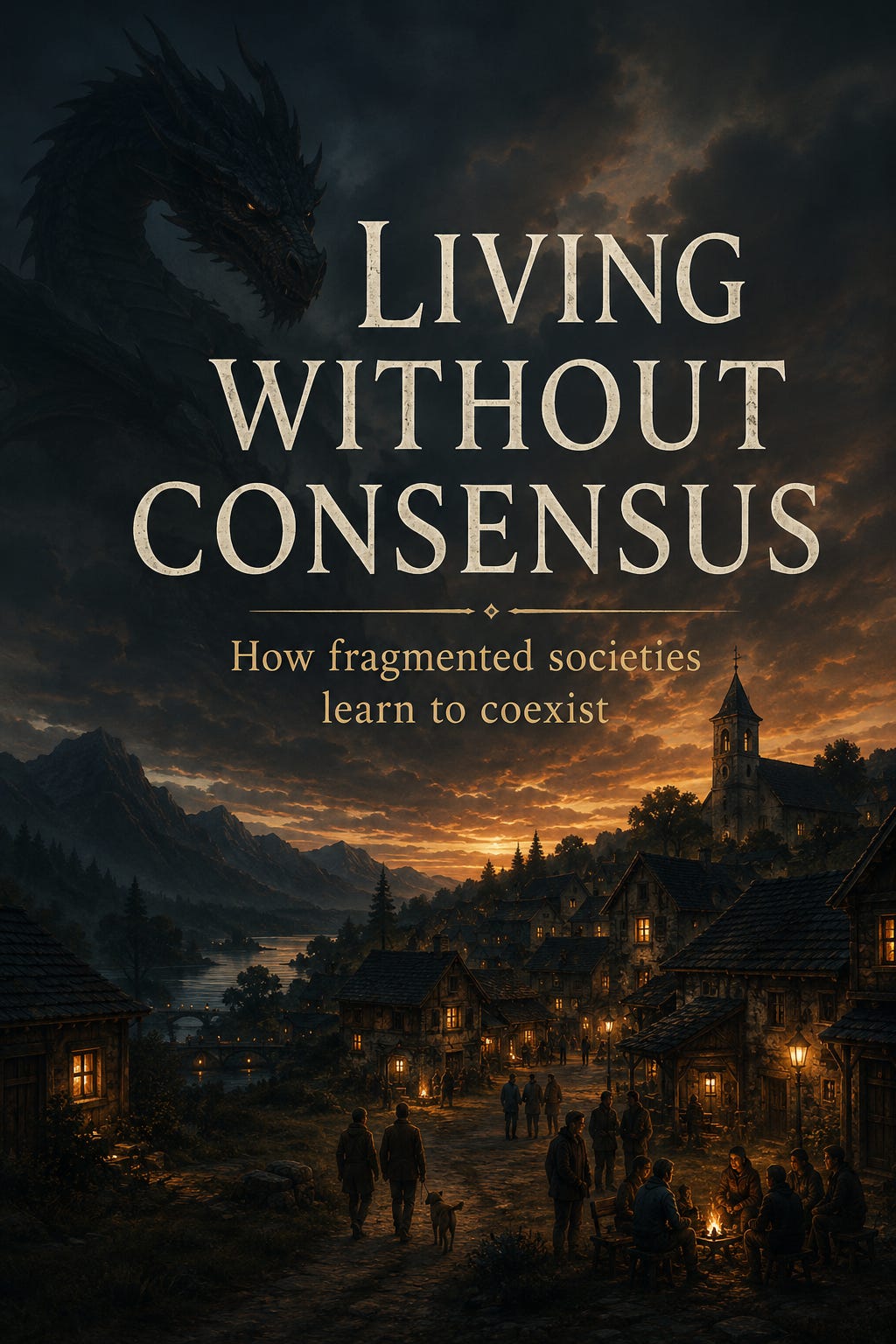
Living Without Consensus
How fragmented societies learn to coexist
Mass media gave us an illusion of shared consciousness. When we all read the same newspapers and watched the same news broadcasts, we all drew from a communal store of information. When we discussed a news event at work or the pub, we could expect that most of our peers knew what we were talking about. If not, we would fill them in with our version of the story.
While we generally accepted the facts, we often disagreed about their meaning. Interpretations were colored by religious beliefs, political ideology, socioeconomic class, ethnicity, and many other factors. Mass media did not eliminate fragmentation; it simply masked it.
What stabilized society was not unanimity, but procedural trust, local relationships, civic habits, and mutual restraint. Pluralistic America survived not by total agreement but through negotiated coexistence. We didn’t have to like each other; often we did not. But we had accepted standards of discourse and behavior that served as norms to keep our mutual ill feelings from spilling into open conflict.
Today many seek a single universal framework through which they can bring order out of chaos. Institutional authority no longer commands automatic trust. We no longer trust the news because “the news” no longer exists. Instead, we must choose between a myriad of competing information sources. Many have sought comfort and security in conspiracies that promise a coherent pattern that explains who runs the world and why they are responsible for everything. The villains change depending on the theorist; the emotional structures remain the same.
We are now forced to pick and choose our information sources. We now decide what information we consume. We also choose whom we trust and what we call “truth.” Our world was always socially mediated, layered, and contextual; our information was always provisional and subject to correction. But the walls within which we live and engage have grown increasingly higher and our social circles increasingly smaller.
Online life encourages ideological sorting and symbolic combat. Digital spaces reward outrage and moral performance. Algorithm-optimized news feeds make our realities increasingly personal. But even amidst this sense of ontological collapse, we should remember one thing; human beings do not live exclusively online.
Everyday interaction forces negotiation, compromise, and coexistence. Local relationships carry more weight than ideological identity. People can disagree about politics, morality, or history while still cooperating in ordinary life. Abstract realities may fragment into increasingly tiny shards. Material reality remains stubbornly shared. Whether or not we agree on the world’s meaning, here we are and here we must remain.
The first thing we must remember: online discourse rewards emotional escalation and performative conflict. It reduces individuals to slurs—MAGAt, libtard, pervert, transphobe, retard, or any of several libraries worth of insulting terms. Spend a while dodging those slurs, or throwing them, and you might get the idea that the world is an angry, violent place.
But despite your feed, ordinary life continues outside your scroll. No matter how divided we become, roads must be maintained; businesses must operate; children must be raised; neighbors must co-exist. We may inhabit different realities, but the reality we all must live in constrains our abstractions. People may despise each other’s politics or lifestyle choices; we still depend on each other socially and economically. Human beings are more pragmatic offline than online.
Physical proximity restrains ideological separation. It’s easy to get caught up in purity spirals, outrage escalation, and identity performance. That adrenaline rush of argument and approval can become an addiction. Offline, you share fences with your neighbors and offices with your coworkers. Reality forces compromise and moderation no matter how much you might want to shout rude names. And when you’re face to face with someone you’ve known for years, shouting rude names doesn’t seem like a viable option.
Practical reality acts as a stabilizing force for competing ideas. Societies depend more on toleration and coexistence than on emotional harmony. In times of shared vulnerability, cooperation becomes possible even amid distrust. Even longtime foes find themselves with overlapping interests and mutual dependence. Collapse narratives revolve around people driven to war with their neighbors. But while this is a common occurrence in zombie movies and online arguments, outside of cinema people under stress are more likely to bond together.
Restraint and courtesy will slow your message’s spread and bore your online readers. But societies are held together by humility, bounded disagreement, and a recognition of shared humanity. This does not mean you have to agree with each other; it simply means that, when necessary, you both agree to disagree. You do not need emotional harmony to achieve a mutually tolerable coexistence.
In our own time we have invaded foreign lands and the moon with the high-toned patriotism of the conquistadors, and with the same mixture of fantasy and avarice.
That is too simply put. It is substantially true, however, as a description of the dominant tendency in American history. The temptation, once that has been said, is to ascend altogether into rhetoric and inveigh equally against all our forebears and all present holders of office. To be just, however, it is necessary to remember that there has been another tendency: the tendency to stay put, to say, “No farther. This is the place.” So far, this has been the weaker tendency, less glamorous, certainly less successful.
Wendell Berry[1]
As national consensus weakens, local trust becomes increasingly important. When the federal government becomes ineffective, the state steps in. When the state is ineffective, local communities step in. People begin to rely on churches, local businesses, and families. Neighborhood groups keep an eye out for trouble; ethnic and religious communities band together for defense and mutual support.
This is not necessarily separatism, though it can occasionally manifest that way within marginalized communities. More often it is a local response to a local problem. People see a problem within their community and step in to help. Under stress, proximity becomes identity. What was once a band of strangers living near each other becomes a neighborhood. Large systems are replaced by smaller circles of reciprocal trust.
This will not be a peaceful utopia. The small-town camaraderie that was so popular on 1950s television was an idealized version of a rural life that was fast losing ground to suburbia. There will be cliques and outcasts; there will be arguments and fights; there may even be violent conflict over resources or boundaries. The human condition includes a penchant for conflict and violence. The Internet made that reflex profane and performative; it did not create it.
Parallel realities and competing interpretive systems will not disappear. The atheist will look up to the sky and see stars; the believer will look up and see heaven. Consensus will remain partial, temporary and fragile. Fragmentation will not be solved, but it will become manageable. Conflict will cease to be an entertaining hobby when it becomes sufficiently dangerous.
Reconstruction can create a conditional stability. But in difficult times, people will still be drawn toward certainty. They may search for a strong leader who will bring back the good times; they may circle their wagons around a belief or an ideology; they may seek redemption through a convenient scapegoat. Negotiated coexistence can be stressful; tolerance is less satisfying than power over your opponents and competitors.
An exhausted society can become vulnerable to certainty merchants. Some want to restore order in times of chaos; others want to use it as a ladder. Charismatic leaders can use ideologies to provide the semblance of coherence and order. Bureaucracies can use difficult situations as an excuse to expand their power. Communities exhausted by uncertainty can become mobs with alarming speed.
Reconstruction requires restraint, patience, and peacekeeping through social pressure and, if necessary, defense. Restoring a barn seems boring when someone else is promising to restore an empire. Easy solutions will always seem more attractive than grinding labor. The greatest threat a post-American community faces will not be division. It will be the promise that division can finally be erased.
It is no doubt impossible to live without thought of the future; hope and vision can live nowhere else. But the only possible guarantee of the future is responsible behavior in the present. When supposed future needs are used to justify misbehavior in the present, as is the tendency with us, then we are both perverting the present and diminishing the future. But the most prolific source of justifications for exploitive behavior has been the future.
Wendell Berry[2]
After every collapse, people look back longingly on the “Golden Age” that has passed. The 1950s were remembered twenty years later as Happy Days; in a 1975 episode, Fonzie fought segregation by traveling south to protest, though he never noticed that Milwaukee was and remains one of America’s most segregated cities. We remember the past less as it was than as we wish it to have been.
When you’re living with less and remember a time when you had more, that period can seem golden. A country looking back on the postwar Boom from the vantage point of Vietnam and Watergate could downplay segregation by sticking up their thumb and saying “Ayyyyyy!” They could acknowledge the bad times existed while assuring themselves they would have been on the good side.
An aspiring strongman can sell you those constructed memories as a blueprint for the future. He can point to that Golden Age and tell you what went wrong and who was responsible. He can turn stock characters and sitcom plots into a parable. He can make you feel like a hero and give you the courage to do what heroes do.
He can convince you that memory is destiny.
We want to find meaning even in bad times. Sometimes we find that meaning by blaming ourselves. The strongman knows how to play in that register too. We fell because we turned away from our roots; we embraced sin; we followed the wicked into wickedness. Once he’s convinced you of the disease, he sells you the cure; follow us and be saved. He sells you redemption in exchange for power.
We know the past only in fragments and reinterpretations. We can predict, guess, or fear the future; we can never know it. It is a blank slate that we draw on in our dreams. In times where certainty is scarce, among people who desperately want something solid and sure, the future can become a repository for our dreams and a justification for our sins.
We are seekers of meaning. Give us something uncertain—and nothing is more uncertain than the future—and we will play with it like a Rubik’s Cube until we make it make sense. We are also seekers after patterns. A strongman can take ambiguous smears, transform them into a face, then call it your enemy. He can shift the image a bit and make it a wall that separates you from what you deserve. Then he can shift it again and convince you it’s the mighty castle you can build if only you can come together and follow his directions.
As social animals, we seek community and status. This is especially true in times of chaos and stress. Internet culture gave us both. It promised that we could change the world if we simply spouted the right slogans and cast out the right foes. It gave us the illusion of power, then showed us what we become when given anonymity and a license to attack. Strongmen rely on those same instincts to transform their followers into a militia.
Our lives are not situation comedies. We enter and exit in media res; there will be many loose threads left unwrapped after our closing credits roll. We can discover or create guidelines that help us live together peacefully despite our differences. We can look to other thinkers to shape our own thought and to other doers to shape our actions. But it is up to us to write our own script.
The strongman gives us a script. He frees us from the tyranny of choice and gives us stage directions. That simplification can be very seductive. We’re inclined to take the easy way as surely as we are inclined to turn facts into stories. We’re tempted to put on thrones without the effort of winning a kingdom. Look at how quickly we reshaped our minds to win likes and affirmations on a scrolling feed.
The road to our new communities will be winding and often rough. We will see many tempting shortcuts along the way. Those who can resist those temptations will be the ones who endure. Those who fall prey to the old lies may find themselves reframing atrocity as destiny. I cannot say there will be no dragons. But I will tell you that, with luck and determination, even dragons can be defeated.
[1] Wendell Berry, The Unsettling of America. Sierra Club Books: San Francisco, 1977. 3-4.
[2] Ibid, 58.