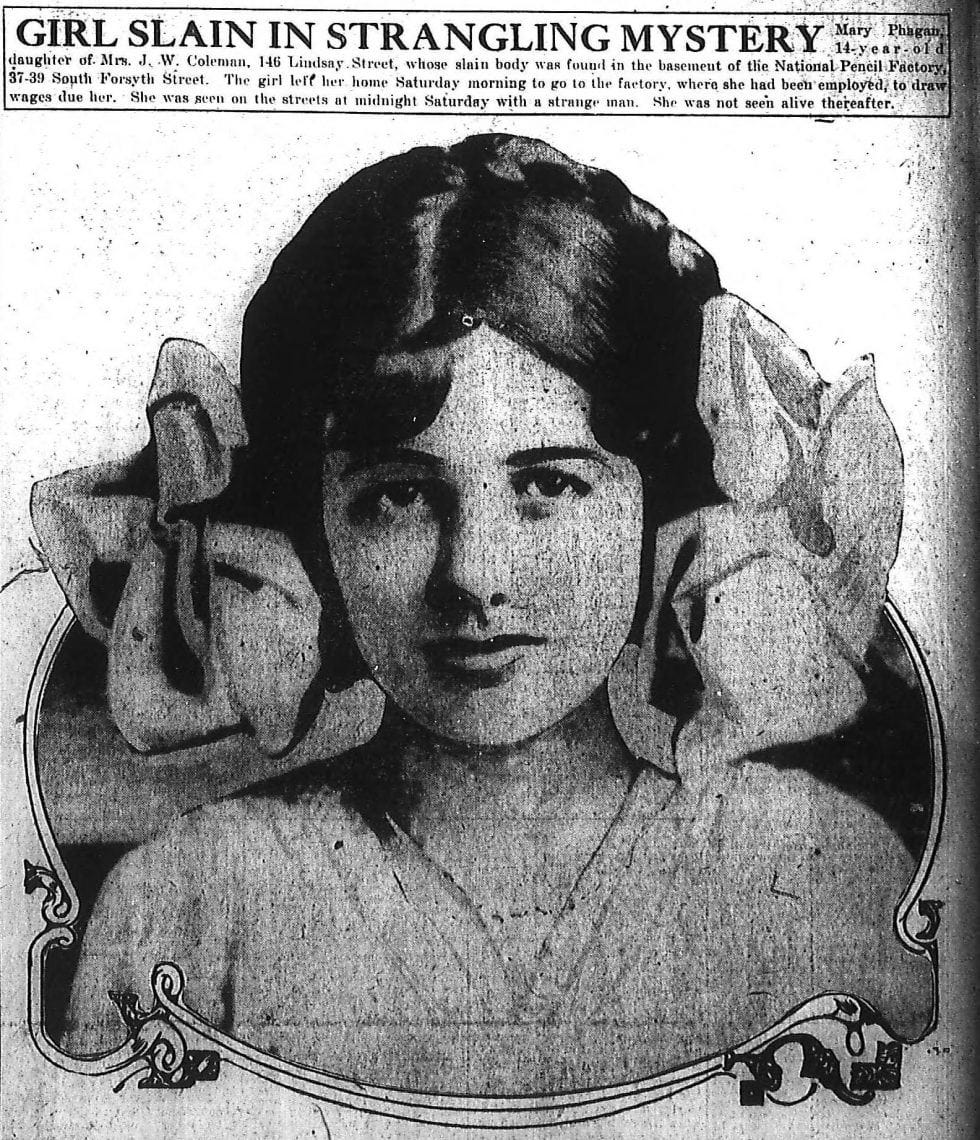
Mary Phagan's Murder, Leo Frank's Arrest
April 1913
On April 29, 1913, Rabbi David Marx learned that one of his congregants had been arrested for murder. We do not know how he reacted to this news: Rabbi Marx was a man of action, not introspection. He spoke little about his emotions and wrote even less. We can reconstruct the world in which David Marx lived. We can document what he said and what he did. His feelings remain hidden from us.
Newt Lee, the night watchman who discovered Mary Phagan’s body on the 26th, had been jailed on suspicion of murder soon after the police arrived. Two notes were found by the body which made him an immediate suspect:
he said he wood love me land down play like the night witch did it but that long tall black negro did boy his slef
mam that negro hire down here did this I went to make water and he push me down that hole a long tall negro black that hoo it was long slim tall negro I wright while play with me
Certainly, no one would mistake the small, slight Leo Frank for a “long tall black negro.” Newt Lee fit that description. Detectives reported that Frank seemed nervous and jumpy when they visited him at home on April 27th, even before they mentioned the murder. But any respectable citizen visited by police on a Sunday morning before 6 o’clock would feel the same way.
The detectives expressed suspicions at Frank’s long-winded answers. But Frank’s tendency for extraneous details was documented years earlier in the 1906 Cornell College Book, which stated:
Leo Max Frank … soon gained the reputation of being the champion hot-air artist of the University by his happy faculty of talking all day and saying nothing. His services as a debating coach for the Congress debate teams have made him a fame hard to equal. This proficiency as an air shooter will doubtless win Max success as a gas jet.[1]
Rabbi Marx had spent years building relationships with Christian leaders and Georgia government officials. He sat in the Amen Corner alongside evangelicals when famous preacher Billy Sunday came to town. His career had been dedicated to strengthening the place of Atlanta’s Jews within the civic life of the city. Now one of his congregants stood accused of a horrible crime. Marx had every reason to give Frank the benefit of the doubt. He also had every reason to worry about how this arrest might harm his decades of interfaith work.
A few hours after the police concluded their interrogation of Frank, they picked up a former train conductor named Arthur Mullinax. An eyewitness claimed he had seen Mullinax with a tired, angry Mary Phagan sometime after midnight on the 26th. While the police were booking Mullinax, Frank was paying his respects to Mary Phagan at Bloomfield’s Rest Home.
On Monday, the 28th, a National Pencil Company employee discovered a suspicious red stain on the floor of the Metal room on the second floor. Chief James Litchfield Beavers personally tested the stain and determined that it was dried blood. Police now believed that Mary Phagan had died on the second floor of the factory, only a short distance from Leo Frank’s office.
This discovery transformed the investigation. By his own testimony, Frank was the only other person in the office. How did he not hear the commotion? Who else could have been in the factory? If he had stepped away from his desk, where was he when the crime took place? Earlier, investigators wondered about his odd behavior. Now they were looking at Frank as a suspect.
Then yet another suspect entered the picture: a bookkeeper named James Milton Gantt. Gantt had been fired earlier after the cash box came up $2 short. He had arrived at the factory on Saturday the 26th at around 6 p.m. to claim two pairs of shoes. When police picked him up on Monday, he was carrying a suitcase packed for a long trip. His alibi—that he had been home in bed on Saturday by 10 p.m.—was refuted by his sister, who hadn’t seen him in over a month.
But the suspect list soon grew narrower. The witness who claimed he had seen Mullinax and Phagan together had just been discharged from the Navy for nearsightedness. Gantt’s sister had lied to officers for reasons which remain unclear; he was indeed at home at the time he stated. Mullinax and Gantt were released and investigators called on Frank yet again. But this time he had retained one of Atlanta’s most prominent lawyers, Luther Rosser.
Today this would hardly raise an eyebrow. After the Supreme Court’s decision in Miranda v. Arizona (1966), Americans are well aware they have the right to remain silent and to have an attorney present during questioning. In 1913, Frank’s decision was highly unusual. Most Americans at that time felt that an innocent man had nothing to fear from speaking openly with the police. Why did Leo Frank want a lawyer present before he had been charged with a crime?
Frank had also called on the Pinkerton Detective Agency concerning the case. He told Pinkerton detectives that Gantt knew Mary Phagan well. But Harry Scott, the detective assigned to his case, had read the police files and was a good friend to one of the Atlanta investigators. He wondered why Frank told police that he didn’t know Mary Phagan by name yet told him that his bookkeeper knew her well.
Scott’s friend on the force, John Black, let himself into Newt Lee’s residence on the morning of the 29th, not long after Mullinax and Gantt were released. He discovered a bloody linen shirt in the house. But upon a closer examination, he realized the blood stains were on the inside of the shirt. Black concluded that the shirt had been planted there to implicate Lee.
Black also recalled that when Frank examined Newt Lee’s time card on Sunday, he told detectives it was “in order.” The next day he changed his story and gave detectives a time card with missing punches. An April 30, 1913 article in the Atlanta Constitution notes an unnamed source saying:
The theory is advanced by some that the prisoner is a victim of planted evidence. They say that the watchman’s clock evidence is flimsy and openly crude. The date, April 27, is apparently stamped upon the register sheet with a stamp detached from the timepiece’s mechanism. Lee did not touch the clock after his arrest. Customarily, he never affixed the date until the hour he was relieved from duty each morning.[2]
Black dropped the shirt off at police headquarters before visiting the National Pencil Company again. The bloodstains near his office had aroused suspicion. Several other suspects had been eliminated. Now someone was trying to frame Newt Lee for the murder with a bloody shirt and a forged time card. They had no other suspect with comparable access to Lee’s address and time card. With this information before them, Black and two other detectives arrested Leo Frank at his office on suspicion of murder.
On April 30 the Coroner’s Jury began its own investigation. One witness, Nellie Pettis, declared that Frank had made improper advances on her when she came to the factory to get her sister-in-law’s pay:
When I went into the office of Mr. Frank I asked for her. He told me I couldn’t see her unless “I saw him first.”
“I told him I didn’t want to ‘see him.’ He pulled a box from his desk. It had a lot of money in it. He looked at it significantly and then looked at me. When he looked at me, he winked. As he winked he said: ‘How about it?’
Coroner Donehoo asked her sharply: “Didn’t you say anything else?”
“Yes, I did! I told him to go to h—l! and walked out of his office.”[3]
George Epps, a 15-year-old newsboy who rode the trolley with Mary Phagan on the day of her murder and who waited in vain for her at their prearranged meeting place, testified:
When she would leave the factory on some afternoons, she said, Frank would rush out in front of her and try to flirt with her as she passed. She told me that he had often winked at her and tried to pay her attention. He would look hard and straight at her, she said, and then would smile. It happened often, she said. She told me she wanted me to come down to the factory when she got off as often as I could to escort her home and kinder protect her.[4]
These firsthand and secondhand allegations do not prove that Frank was a murderer. If they are true, they describe inappropriate behavior that today would be called sexual harassment. This conduct reflects poorly on Frank’s character and his treatment of female employees. But Frank’s behavior was hardly unique. Many female factory workers complained about lecherous bosses. We can acknowledge that this behavior is appalling while also noting that it does not by itself establish that Leo Frank murdered Mary Phagan.
But for working-class families who had endured this kind of behavior for many years, Frank became a symbol of everything wrong with industrial authority. He was a Yankee and a carpetbagger who came down South to seek his fortune. Like many wealthy Atlanta newcomers, he was Jewish. And like many of those newcomers, he had a reputation for making sexual advances toward young women who depended on him for their pay. To them, the only difference between Frank and other factory bosses was that he now sat in jail, accused of murdering one of those young women.
David Marx worked quietly behind the scenes throughout Frank’s trial. He used his many Georgia connections to organize support for his congregant. But he did not offer fiery speeches or denunciations. That silence is telling. So too is the marked decline in his interfaith work. Before 1913, Marx was one of Atlanta’s most active advocates for Jewish/Christian cooperation. He spoke regularly before Christian audiences, civic organizations and public gatherings. From 1913 to 1921, those efforts slowed to a trickle.
As throughout his career, Marx spoke most clearly during that time with his actions. He concentrated his efforts on the Temple and on his congregation and moved away from the public interfaith work that had defined his work for nearly two decades. We cannot say whether that pause was caused by the emotional toll of the Frank case, growing hostility toward Atlanta’s Jews, a personal crisis, or some combination of these things.
Marx left few clues other than what he did—and what he chose not to do. All we know is that he resumed his efforts in 1921 and continued until his retirement 25 years later.
[1] Cornell Senior Class Book. Ithaca: Cornell University, 1906. 79.
[2] “Factory Clock Not Punched for Hours on Night of Murder,” Atlanta Constitution, April 30, 1913. https://www.leofrank.org/factory-clock-not-punched-for-hours-on-night-of-murder/.
[3] “Coroner’s Inquest” at Leo Frank Case Archive. https://www.leofrank.org/trial-and-evidence/coroners-inquest/.
[4] Steve Oney, And the Dead Shall Rise, New York: Pantheon Books, 2003. 73.