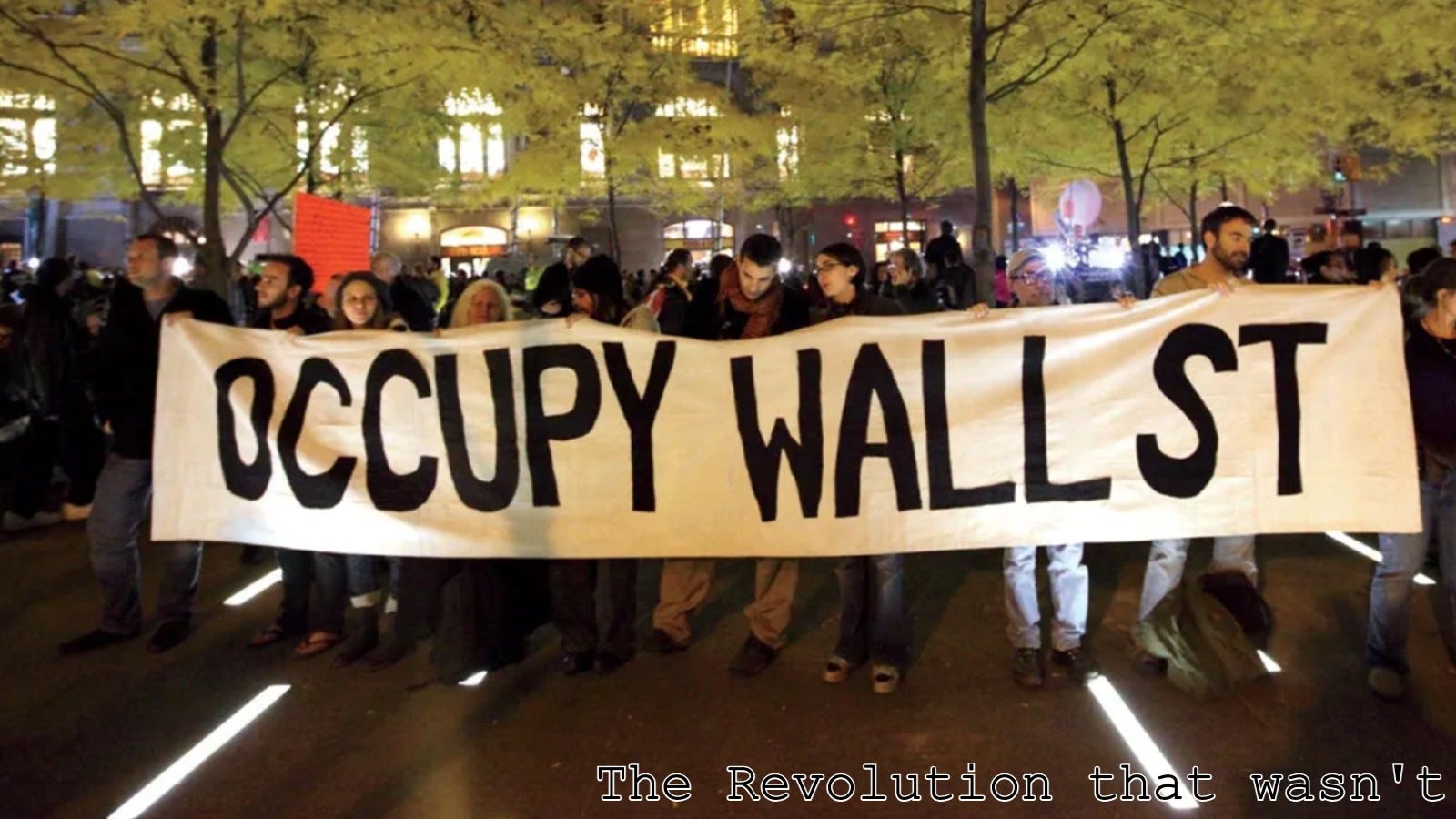
Occupy Wall Street
The Revolution that wasn't
Occupy Wall Street is a leaderless resistance movement with people of many colors, genders and political persuasions. The one thing we all have in common is that We Are The 99% that will no longer tolerate the greed and corruption of the 1%. We are using the revolutionary Arab Spring tactic to achieve our ends and encourage the use of nonviolence to maximize the safety of all participants.[1]
Between 2000 and 2006, U.S. home prices nearly doubled. Interest rates were low and credit was easy to come by; many people turned to real estate speculation as a second income and others used their homes as cash machines through easy equity loans. In early 2006 prices began to cool. Most assumed it was just a temporary lull, but the price declines continued throughout the year and into 2007. As 2007 came to a close, that lull showed no signs of stopping. By 2008 it had become the worst financial crisis since the Great Depression.
Homeowners found themselves hopelessly underwater, especially as unemployment rates climbed. Banks foreclosed on millions of properties, often reselling homes for less than the outstanding mortgage balance. Mortgage-backed securities had offered higher yields than US government bonds and had been marketed to investors around the world. As more homeowners defaulted, those securities collapsed in value. The American housing downturn became a global financial crisis.
While it has gone down in history as the “Great Recession,” it might more accurately be called the “Lesser Depression.” We never reached the 25% unemployment levels of the 1930s, but many Americans lost their homes, jobs, and retirement savings. Consumer bankruptcies spiked 32% in 2008.[2] Relief was harder to come by after the 2005 Bankruptcy Abuse Protection and Consumer Protection Act (BAPCPA). Many debtors were forced into extended repayment plans even as their jobs, income, and housing remained uncertain.
By 2011, consumer bankruptcies were down from 2010’s record 1,538,033 high, but they were still nearly twice the 2007 numbers. The 2008 Troubled Asset Relief Program (TARP) injected hundreds of billions of dollars into institutions that were deemed “too big to fail.” But many of these institutions had created the overheated housing market that led to the crash. For Americans who were still struggling, it seemed like the companies that helped create the crisis were being rescued from their bad decisions while taxpayers footed the bill and bore the consequences.
On September 17, 2011—six days after the tenth anniversary of 9/11—several hundred protestors gathered in Zuccotti Park in Lower Manhattan’s Financial District. They were angry about foreclosures, unemployment, and a political system that seemed to care more about wealthy donors and corporations than ordinary citizens. They wanted to see those rescue efforts extended to struggling Americans. And they were here, in the belly of the beast, to make sure the 1% heard the voices of the other 99%.
The original protest was called for by Micah White, Kalle Lasn, and other members of Adbusters, a Canadian anti-consumerist publication. They had called for protests against income inequality and the growing influence of large corporations. But they could not have anticipated just how widely that message would resonate. By October 3 the protests had spread to Boston, Los Angeles, and Chicago.
Americans were divided on the Zuccotti Park protests. Jeremy Varon of the New School For Social Research declared the protests were “the Obama generation declaring their independence from his administration.”[3] Dan Gainor at Fox News opined that the anarchists and hippies of OWS were showing America what democracy smells like. But even as he criticized the “socialists, Code Pinkers, anarchists, and more,” Gainor noted that “these protests do reflect the genuine economic fears that many Americans feel.”[4]
In The New Republic, Ruy Teixiera noted:
As close to a consensual view as you get in America is that “everyone in America should have equal opportunities to get ahead.” A whopping 97 percent agreed with that statement in a 2007 survey by political scientists Lawrence Jacobs and Benjamin Page.
But Wall Street and powerful allied economic and political interests are making a mockery out of this commitment and, indeed, raising questions about whether anyone else besides them can get ahead, period. That’s the source of the populist anger—call it aspirational populism—that is driving this movement and will continue to drive it in the future, if it picks up steam.[5]
Occupy Wall Street identified a grievance that resonated far beyond the political left. Americans across the political spectrum shared OWS concerns about economic power, political influence, and the growing divide between America’s wealthiest citizens and the rest of us. Many of us assumed this was the beginning of a new populist movement in America. I certainly did. Yet within a few years Occupy Wall Street had largely disappeared.
We could blame Occupy Wall Street’s decline and fall on powerful and wealthy interests who felt threatened by their message. But even the wealthiest and most powerful plutocrats would have a hard time convincing the public that equal opportunity was a bad thing. Occupy’s core grievances reflected concerns shared across the political spectrum. Screaming “pay no attention to those men behind the curtain” should be no more effective for a secret society than it was for the Wizard of Oz.
And yet within a few months, we were paying no attention to them.
What led to OWS’s failure may have more to do with a changing media than with a shadowy conspiracy. The Occupy movement was designed for a world of mass politics. But in 2011 America was fast becoming a land of niches, tribes, and algorithmic outrage.
On September 21, 2012, brothers Omar and Rafael Rivero started a Facebook page they called “Occupy Democrats.” This page soon became one of the Left’s leading sources for news and information.
The information provided wasn’t always correct: Politfact rates eight of the 22 Occupy Democrats claims it checked as “False” and four as “Pants on Fire.” (Two were “Mostly True” and seven “Half-True”). But despite widespread criticism for its fast and loose approach to facts, in May 2020 nearly half the top-performing Facebook videos which mentioned “Trump” were from Occupy Democrats.
While it borrowed Occupy’s language and imagery, Occupy Democrats operated very differently. It was a centralized media brand rather than a decentralized protest movement. It shifted its focus from the 1% to the Republican Party and quickly became one of the Left’s most influential social media outlets. It was less interested in building a broad coalition than in mobilizing a partisan audience. Occupy Wall Street tried to unite the 99%. Occupy Democrats focused on building a loud and angry tribe.
In terms of staying power and reach, Occupy Democrats was unquestionably more successful than Occupy Wall Street. The Rivero brothers built one of the Left’s most successful and influential social media operations. Yet neither movement substantially altered the economic and political climate that inspired the original protests. Occupy Wall Street captured parks. Occupy Democrats captured viewers. Neither captured power.
In the late 80s and early 90s, what we would come to call “Cultural Marxism” or “Political Correctness” was largely confined to universities, big cities and graduate students. Hip writers might name-drop Foucault or Marcuse, but few had the time or interest to slog through dense tomes of political theory. It was a language for eggheads and by eggheads, and far less than one percent of the population understood it. Yet those abstruse and verbose texts proved far more durable and influential than the simple, largely accurate slogan “we are the 99%.”
When the encampments closed, Occupy Wall Street had little to show for them. As a leaderless resistance movement, there was nobody there to tell participants what came next. They shared a few broad principles, most of which remain popular today. But there was no common strategy for turning those principles into policy. They were still the 99% and the 1% remained firmly in charge.
Occupy Democrats remains active today; Trump’s second term gave them a new lease on life. But the social media landscape it helped pioneer has become increasingly crowded. Many partisan organizations and influencers now compete for eyeballs and engagement. Younger audiences get their political information from online personalities and podcasters, while older audiences are more likely to seek out traditional outlets. Occupy Democrats no longer dominates the space because there is no longer a single conversation to dominate.
While these mass movements struggle, or fail, to remain relevant, cultural political theory remains remarkably durable. It occupies much the same status as Marxism occupied during much of the 20th century. Some embrace it, others reject it, but few can avoid engaging with it entirely. We never seized the means of production, but we’re still speaking in the language of the Sexual Revolution and the Long March through the Institutions. Identity, privilege, systemic power, and representation now shape debates much as the proletariat and the capitalist once did.
Occupy Wall Street attracted sympathizers. Occupy Democrats attracted subscribers. Cultural theory, like the Marxism from whence it came, attracted specialists. The seminal texts are difficult to read and appeal primarily to highly committed intellectuals. Those intellectuals create institutions and interpret, apply, and argue about these arcane texts.
This kind of engagement is more rarefied than protest movements, but it may also be more durable. Over time an obscure preoccupation of intellectuals can acquire institutional power. The process is slow, almost imperceptible. You never notice the long march until it reaches its crescendo. Then it becomes deafening.
Evolution makes its changes by anti-Socialistic ways. The “abnormal” man who foresees the trend of the times and adapts circumstance intelligently, is laughed at, persecuted, often destroyed by the herd; but he and his heirs, when the crisis comes, are survivors.
Aleister Crowley[6]
Aleister Crowley believed that history unfolded through a succession of Aeons, each governed by a different principle. The old Aeon of Osiris, the Sacrificed God, was now giving way to the Aeon of Horus, the Crowned and Conquering Child. Whether or not you accept his cosmology, it may be useful for understanding why Occupy Wall Street failed.
My reading of Crowley is admittedly idiosyncratic. To avoid controversy, I should note that many Thelemites would disagree with my ideas, just as they disagree with each other. It’s “Do What Thou Wilt,” not “Do What We Do.”
The Aeon of Osiris gave birth to the World Religions. In the Aeon of Isis and times past, worship was firmly grounded in time, place, and ethnicity. Empires might subsume an alien religion into their own practices; the Romans had temples to Zeus Ammon-Ra in Egypt and Grannus Apollo in Gaul, while the Victorian English used Hinduism as a jumping-off point for Theosophy. But Christianity, Islam, Buddhism, and Marxism all claimed universal truths that transcended the boundaries of tribe, nation, and kinship.
Aeons, like all historical transitions, are porous. World religions incorporated local cults and traditions as often as they displaced them. Pilgrims who once traveled to Eleusis later journeyed to Jerusalem, Rome, or Mecca. Marxism, the last great faith of Osiris, sought to subsume the individual into the class. It provided the foundation on which the new faiths would arise, just as Greco-Roman paganism and philosophy helped shape early Christianity.
Occupy Wall Street was largely influenced by the language and traditions of early labor and socialist movements. It focused on solidarity, collective action, and a movement dedicated to “the 99%,” a broader and more inclusive vision of Marx’s “workers of the world.” In an earlier time, that message might have proven more successful. There was certainly a great deal of anger to channel and a growing suspicion about impending plutocracy. But Occupy was ultimately an Old Aeon movement in a New Aeon world.
Occupy Democrats used the trappings of OWS but aimed for a smaller audience and gave it bigger, more personal targets to hate. OWS’s broad critique of concentrated power became an extended partisan attack on Republicans and conservatives. Occupy Democrats memes garnered scorn and praise in nearly equal quantities. But to the Facebook algorithms, engagement was engagement. People who reposted the memes with the comment “Truth!” and those who replied “Get a load of these idiots” both spread the message.
The language of cultural theory continued to seep into the broader culture. Few read Kimberlé Crenshaw’s legal scholarship directly, but many understood intersectionality as a call to recognize overlapping forms of oppression and solidarity among marginalized groups. Judith Butler’s dense ideas on gender performance inspired gender flags and manifestos of new sexual identities and demands for recognition.
These ideas became simpler and more accessible than the academic texts and often differed widely from the source material. This is nothing new; ideas change as they move from scholars and institutions into the wider public. What matters for our purposes is the shift from Osirian Marxism to the Cultural Theory of Horus. Individuals no longer saw themselves as part of a greater class so much as intersections of multiple identities, each of which could be emphasized, negotiated, or foregrounded depending on circumstance.
Occupy Wall Street’s concerns remain valid. We are still dealing with the effects of concentrated wealth, institutional distrust, and political alienation. OWS did not fail because its message was wrong. Most of its tenets were widely accepted even by those who looked askance at the protest camps. Its weakness lay in its methodology. Occupy Wall Street tried to organize people around a universal identity at a time when culture was moving toward narrower, more personal identities.
Today we can see the fragmentation of media and politics more clearly. Citizens have become audiences and identities have become the building blocks of new tribes. The institutions and influencers who have come to power in this new Aeon have mastered its focus on self-definition, self-development, and self-discovery. We create and recreate ourselves within our media bubbles; we are content to belong to the right factions and have little concern for the other 99%.
The Age of Horus has brought us a new sense of selfhood, but it has also led to polarization, exhaustion, distrust, and an inability to act collectively. Many of us have channeled our efforts at bettering the world toward the fantasies of online discourse rather than the dirty and difficult business of changing things on the ground. Where once we might have camped out in protest, today we make our displeasure known by memes and insults. There is no “identity” without “I.” But civilization is not first-person singular.
The 99% has not disappeared. It has simply stopped imagining itself as a “we” in favor of a loose conglomeration of competing identities. The questions Occupy Wall Street asked remain largely unanswered and the 1% are fast losing ground to the 0.1% and the 0.01%. The grievances remain, but the will to organize collectively against them has largely been subsumed into small groups that take pride in their isolation and alienation. It remains to be seen what new vision, creed, or catastrophe will transform our squabbling bands of Crowned and Conquering Children into the New Aeon’s imperial religion.
[1] Occupy Wall Street Manifesto, September 17, 2011.
[2] United States Courts, “Just the Facts: Consumer Bankruptcy Filings, 2006-2017.” (March 7, 2018). https://www.uscourts.gov/data-news/judiciary-news/2018/03/07/just-facts-consumer-bankruptcy-filings-2006-2017.
[3] Todd Gitlin, “The Left Declares its Independence.” New York Times, October 8, 2011.
[4] Dan Gainor, “Occupy Wall Street—More Than Just Another Loony Protest Movement from the Left,” (October 23, 2011). Fox News, https://www.foxnews.com/opinion/occupy-wall-street-more-than-just-another-loony-protest-movement-from-the-left.
[5] Ruy Teixera, “Why a Majority of Americans Are Getting Behind Occupy Wall Street,” The New Republic, October 20, 2011. https://newrepublic.com/article/96459/occupy-wall-street-income-inequality.
[6] Aleister Crowley, The Book of the Law (Liber AL vel Legis), 1904. Introduction V: The Next Step.