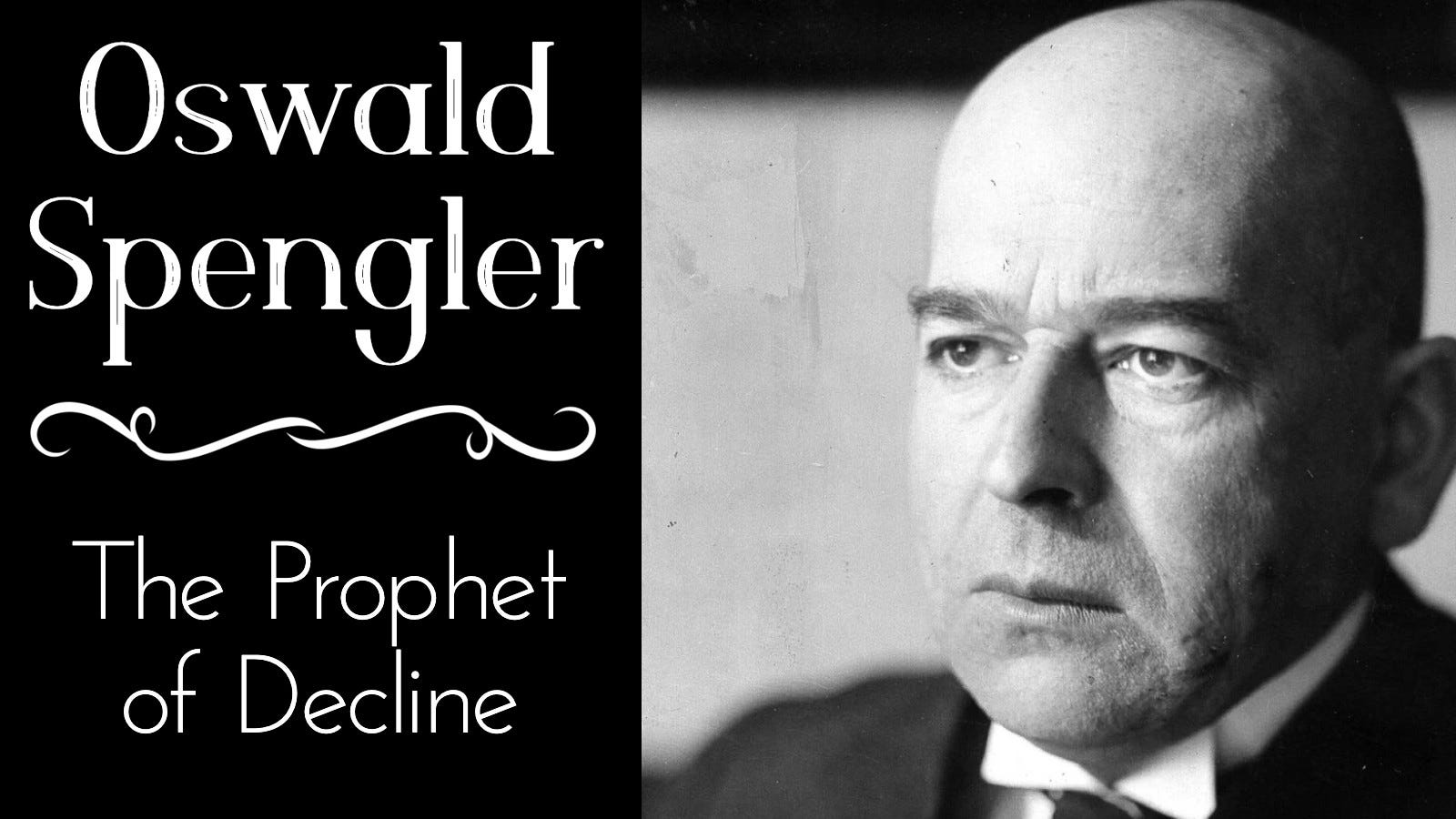
Oswald Spengler: The Prophet of Decline
The end of endless progress
Who amongst them realizes that between the Differential Calculus and the dynastic principle of politics in the age of Louis XIV, between the Classical city-state and the Euclidean geometry, between the space-perspective of Western oil-painting and the conquest of space by railroad, telephone and long-range weapon, between contrapuntal music and credit economics, there are deep uniformities? Yet, viewed from this morphological standpoint, even the humdrum facts of politics assume a symbolic and even a metaphysical character, and—what has perhaps been impossible hitherto—things such as the Egyptian administrative system, the Classical coinage, analytical geometry, the cheque, the Suez Canal, the book-printing of the Chinese, the Prussian Army, and the Roman road-engineering can, as symbols, be made uniformly understandable and appreciable.[1]
While he is often remembered as a political theorist, Spengler is better described as a cultural diagnostician. Politics interested him only insofar as it revealed a civilization’s inner character. He wanted to understand the worldview that produced its art, religion, mathematics, architecture, and institutions. Elections, constitutions, and revolutions were important to Spengler as evidence that revealed the condition of the culture beneath them.
Spengler began working on the first volume of Decline of the West in 1914. It was largely finished by 1917 and published in 1919. The book was forged amidst the slaughter of the Great War and published for a civilization that had seen its faith in progress collapse alongside several great empires. The Victorian era looked forward to a future shaped by science, industry, reason, and democracy. Those ideals died in muddy trenches to the sound of gunfire and the sweet stink of chlorine gas.
Nietzsche declared God dead. Conrad exposed civilization’s conscience as a fraud. Spengler diagnosed Western civilization as terminally ill. Our dreams of endless progress—the cornerstone of our Faustian worldview—were doomed to fail. Like the Apollonian civilization of Greece and Rome before it, the West had passed from Culture to Civilization. Our age of faith, creativity, and expansion was now giving way to bureaucracy and mass politics. The decline and fall that overtook every previous high culture now awaited us as well.
No civilization wants to hear of its own decline. For the West, the prospect feels particularly terrifying. Faustian cultures are drawn toward the infinite in the way that Apollonian civilizations sought the mysteries of form and proportion. We are driven to look toward the horizon and wonder what lies beyond it. Faustians build Gothic cathedrals reaching to heaven; tall ships that sail across oceans and discover a New World; science that measures the weight of the atom and the breadth of the universe. Our worldview is based on the idea of limitless frontiers.
Spengler’s ideas of inevitable decline seemed positively quaint in a postwar era of computers, moon landings, and a burgeoning middle class. The Decline of the West was largely dismissed as the gloomy predictions of a defeated generation. Then the late twentieth century brought us Vietnam, Watergate, oil shocks, and the end of the Space Age’s grand ambitions. As Americans grappled with rising crime, stagflation, and declining trust in institutions, they began to notice ever-encroaching limits to their limitless frontiers.
Readers today continue to wrestle with the questions Spengler raised. What if civilizations, like people, grow old? What if history is cyclical rather than linear? What if progress is not inevitable, but decline is?
For every Culture has its own Civilization. In this work, for the first time the two words, hitherto used to express an indefinite, more or less ethical, distinction, are used in a periodic sense, to express a strict and necessary organic succession. The Civilization is the inevitable destiny of the Culture…
Civilizations are the most external and artificial states of which a species of developed humanity is capable. They are a conclusion, the thing-become succeeding the thing-becoming, death following life, rigidity following expansion… They are an end, irrevocable, yet by inward necessity reached again and again.[2]
You may assume that civilization is a culture’s highest expression. For Spengler, civilization is what happens after culture begins to die. Culture is youth; civilization is old age. Culture creates; civilization administers. Culture believes; civilization organizes. Civilization is not the flowering of culture. It is culture’s autumn and will soon give way to winter.
Hellenic culture arose in a world filled with gods, monsters, and heroes. Homer wasn’t analyzing courage when he sang about Achilles; he was telling a beloved tale about a great warrior. Hesiod wasn’t analyzing the gods as symbols or literary devices. For him those divine forces were immanent. Later generations would preserve, debate, and explain these myths. Homer and Hesiod simply believed them.
Plato and Aristotle examine these traditions rather than living wholly within them. Homer sang of heroes. Aristotle explained why people enjoyed hearing about heroes, and Plato worried that poets like Homer might undermine the social order. These thinkers emerged from a Greece that had grown wealthier, more sophisticated, and increasingly self-conscious. Homer preserved the memories of a historic age. Sophocles used that memory as raw material for art. Classical Hellenic culture was no longer creating its foundational myths. It was reflecting upon them.
We see the same pattern in the Arthurian tradition. The legend of Arthur begins in early Welsh tales and stories of a warlord who held back the Saxons at Badon after Roman Britain’s collapse. Centuries later, Geoffrey of Monmouth combines those stories with material gleaned from histories, chronicles, and his imagination. His Historia Regum Britannae (History of the Kings of Britain) was widely distributed into Latin and vernacular languages and introduced the world to King Arthur and his trusted advisor Merlin.
Later Chrétien de Troyes and the troubadours add courtly romance and the Grail Quest. Malory synthesizes those tales into a national epic at a time when England is wracked by the Wars of the Roses. Tennyson transforms them into a meditation on Victorian morality. John Boorman’s Excalibur recasts the Arthurian legend into a modern myth about sex, power, and spiritual decay. Each used those memories as raw material for literature, philosophy, and social commentary.
The earliest storytellers preserved the memories of a heroic age. Their successors interpreted it. Culture created the myth. Civilization reflected upon it.
Faustian culture gave us Gothic cathedrals reaching toward the sky; Dante’s journey through heaven and hell; Shakespeare’s probing of the human soul; Mozart and Bach’s soaring music; the scientific revolutions of Copernicus, Galileo, and Newton. Each reflected a shared culture, a shared faith, and a restless desire to push beyond limits.
Faustian civilization gave us megacities, bureaucracies, multinational corporations, mass politics, and global empires. The same impulse that once drove us to build cathedrals now produces skyscrapers and office towers. Our stories are increasingly adaptations, sequels, reboots, and reinterpretations of inherited legends. We no longer create myths; instead, we reflect on them.
As civilizations become larger, wealthier, and more bureaucratic, they also become more difficult to govern. Spengler notes that declining civilizations often turn toward strongman rule. As a civilization enters its period of decline, faith in traditional institutions declines while pressing problems multiply. Parliamentary debates, constitutional procedures, and political parties come to seem slow, ineffective, and detached from reality. An increasingly disillusioned populace begins looking for leaders who can restore a sense of purpose and direction.
People do not initially seek a ruthless tyrant, the stock villain of modern political imagination. They search instead for a capable, charismatic figure who can get things done. The strongman promises action where others offer procedure. He offers certainty where other politicians hedge their bets and promises results where they deliver excuses.
The late Roman Republic was wealthy and powerful. But the Senate was increasingly ineffective and political factions paralyzed government. Civil wars, corruption, and economic inequality undermined public confidence. When Julius Caesar, a popular military hero, crossed the Rubicon and promised to restore order and competence, the people rallied around him. They saw him not as an aspiring tyrant but as the Republic’s savior.
The French Revolution promised liberty, equality, and fraternity. It delivered war, guillotines and political factionalism. When a young and brilliant soldier named Napoleon Bonaparte presented himself as the defender of the Revolution, many French citizens welcomed him. In place of the Terror and political squabbling, he promised order and unity. And when he crowned himself emperor, he did so with broad public support from people who just a few years earlier had cheered at the death of a king.
Caesar and Napoleon were separated by nearly two thousand years, but their rise followed a remarkably similar pattern. Citizens lost faith in legislatures, parties, and governing institutions. A charismatic military leader emerged promising competence, unity, and action. For Spengler, this is a recurring feature of civilizations entering their final phase. Caesar and Napoleon were not historical accidents. They were symptoms.
We select a single bit of ground as the natural centre of the historical system, and make it the central sun. From it all the events of history receive their real light, from it their importance is judged in perspective. But it is in our own West-European conceit alone that this phantom “world-history,” which a breath of scepticism would dissipate, is acted out.[3]
Spengler may have seemed out of touch in the postwar world. But those who read through his notoriously dense prose found remarkable parallels between his views of a civilization at the edge of decline and the postwar West. They would see that our society had become increasingly cosmopolitan, sophisticated and rootless. Local traditions and regional identities were being subsumed into the culture of the world-city. To Spengler New York and Los Angeles would be, like Rome and Alexandria before them, symptoms of a civilization entering its final phase.
They would have been surprised to note that Spengler saw growing irreligiosity as a sign of decline rather than sophistication. As traditional faith weakened, people continued searching for meaning, purpose, and belonging. Buddhism, Stoicism, Christianity, and Socialism each arose and flourished during the later phases of great civilizations. Inorganic or dead forms wither away. Beliefs change. The need for belief endures.
Readers in the post-Soviet world might have raised an eyebrow at Spengler’s prediction that liberal democracy would eventually give way to stronger, more centralized forms of rule. Communism had collapsed across Eastern Europe. China was becoming integrated into the global economy. History appeared to be moving toward free trade, democratic institutions, and international cooperation.
These readers were not so optimistic as their postwar predecessors. But for a brief decade or so it appeared that strongman politics had finally become passé. The idea that voters would willingly embrace powerful leaders who challenged liberal norms seemed as implausible as the notion that terrorists might fly passenger jets into skyscrapers.
Globalization and free trade survived September 11, 2001. Optimism did not. Two decades of wars and financial crises shook public confidence in politicians and institutions. Voters across the developed world turned toward populists, nationalists, and political outsiders who vowed to challenge the existing order, to return their battered nation to glory, to drain the swamp. Many who had once cheered for liberalism now called for “saving democracy” by non-democratic means. Some were shocked by this turn toward authoritarianism. Spengler readers saw it coming.
Civilizations are not trees; history does not always move in predictable cycles. The West may yet find solutions to problems that earlier generations thought insoluble. New technologies may create opportunities that Spengler could never have imagined.
Or they may not.
Spengler did not get everything right. He predicted a Russian-led civilization that has not yet emerged. He underestimated the resilience of liberal institutions and the transformative power of technology. But we keep coming back to him because he forces us to confront questions we would rather avoid. No civilization imagines itself in decline until it is forced to consider the possibility. Whether Spengler was a prophet, a pessimist, or merely an observer with an eye for uncomfortable patterns, his questions remain difficult to ignore.
[1] Oswald Spengler, The Decline of the West. (Charles Francis Atkinson, Tr). At Project Gutenberg,
[2] Ibid.
[3] Ibid.