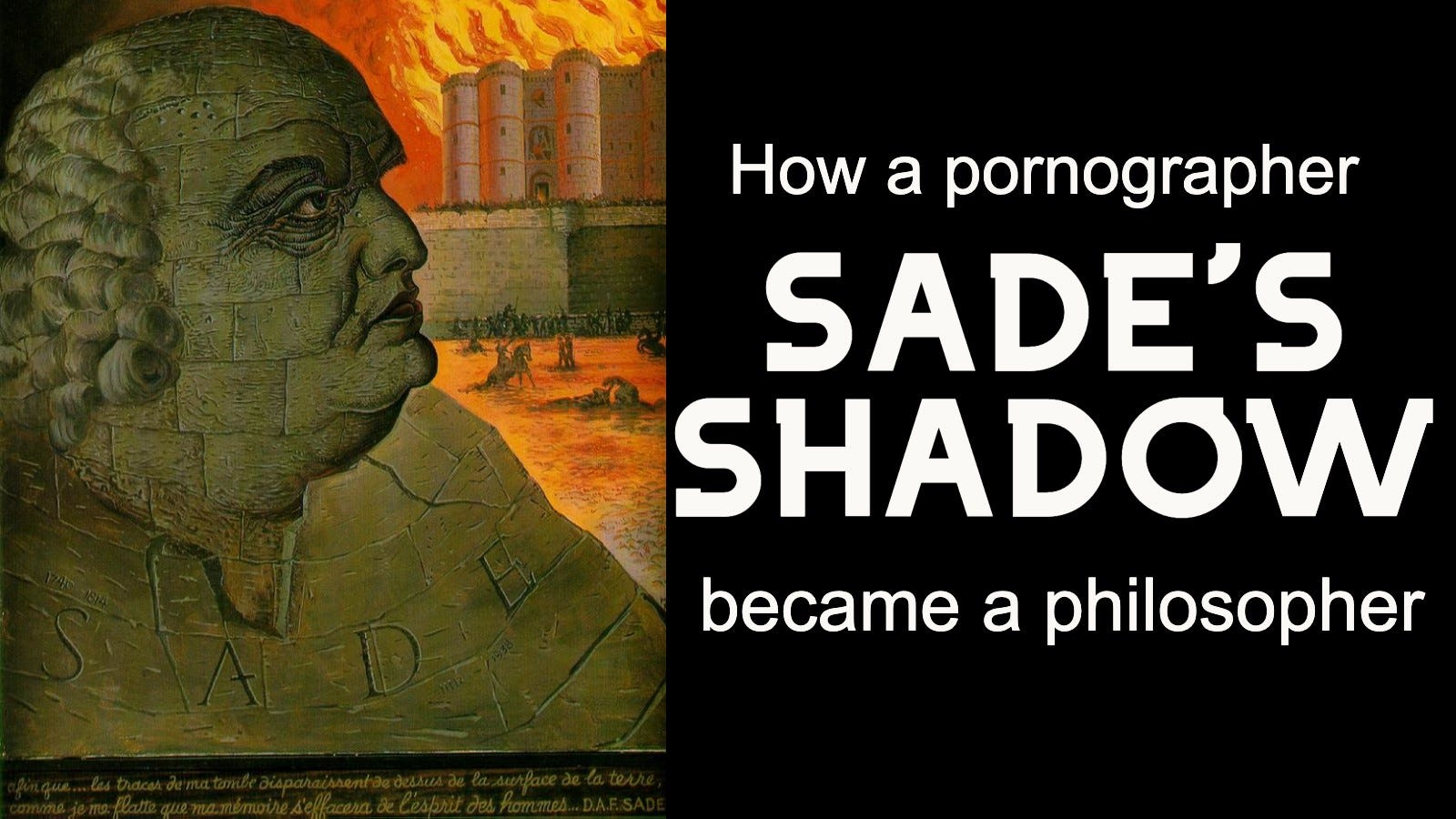
Sade's Shadow
How a pornographer became a philosopher
It is not only because it is given out as a testimony of atheism that transgression must not and never can find a state in which it could be resolved; the energy must constantly be surpassed in order to verify its level. It falls below the level reached as soon as it no longer meets an obstacle. A transgression must engender another transgression.
Pierre Klossowski[1]
As an increasingly angry Paris protested against a decadent and corrupt clergy and nobility, Donatien Alphonse François de Sade watched from the window of his Versailles cell. The Marquis had already spent over a decade in captivity for his libertine excesses. But on that 2 July 1789 evening, Sade decided that he would once again break the rules that bound him.
Using part of his chamber pot as a megaphone, Sade screamed to the crowd that the guards were killing the prisoners. But despite his escape efforts, the rioters were unconvinced and the guards unamused. Two days later Sade was moved to an insane asylum at Charenton on the Paris outskirts. He was there on 14 July when the revolutionaries finally stormed the Bastille.
Sade had been held under lettres de cachet, a royal order of confinement. Under the ancien régime the king had the absolute power to enforce actions and confine individuals simply by writing a letter and sealing it with the royal seal (cachet). On March 1790 lettres de cachet were abolished by the National Constituent Assembly and Sade was released a few days later.
Given his noble lineage, one might expect that Sade was jumping out of the frying pan and on to the guillotine. But the Revolution’s militant atheists appreciated Sade’s attacks on the clergy and on Christian morality. They saw his debauched libertines as satirical attacks on the corrupt elite.
For his part Sade was happy to play the persecuted freethinker. But since “noble” was no longer an occupation, he needed a job. He had spent long years writing to amuse himself and was still mourning the manuscripts he lost when he was transferred from the Bastille. Pressed for money and fearful of going back to prison, the erstwhile Marquis reinvented himself as a man of letters.
Theatre was particularly popular in Revolutionary France, and it was easier to make quick money with a hit play than with novels that might take years to become popular. But try as he may to bowdlerize his writing for audiences, few playhouses were willing to risk Sade’s plays. When he was finally able to stage Oxtiern, or The Misfortunes of Libertinage, it was canceled after two performances and a review describing the lead character as a “revolting atrocity.”
As his career as a playwright crashed and burned, Sade turned the manuscripts he had been able to save. Revolutionary France was caught up in la foutromanie (fuckomania) and pornographic pamphlets were all the rage. But even the Revolution’s most ardent coomers weren’t ready for Sade. A review of his anonymously published 1791 Justine, or the Misfortunes of Virtue noted that “the imagination that produced such a monstrous work … is rich and brilliant in its kind” but went on to recommend:
You, mature men, whom experience and the calming of the passions have placed out of danger — read it to see how far one can go in derangement of the human imagination. But throw it into the fire immediately thereafter.[2]
As the Revolution entered the days of the Terror, Sade’s noble lineage became increasingly unpalatable. In 16 September 1792 Sade’s family chateau at La Coste was ransacked by the locals. And foutromanie was giving way to a new Puritanism as the sans-cullotes looked askance on libertinage.
On 8 December 1793 (18 frumaire II of the Revolutionary Calendar) Citoyen Sade was arrested. Robespierre was a deist who proposed a Cult of the Supreme Being and a state which would allow men to be free only insofar as they were good. Sade’s militant perversion and atheism were everything he opposed.
Robespierre’s men arrived on 9 thermidor II (27 July 1794) at the hospital where Sade was being held. They left with 23 of the 28 persons listed on their warrant. Sade was on that warrant but marked “absent.” That night 21 of Sade’s fellow convicts went to the scaffold. The next day Robespierre joined them. Sade had evaded Mme. Guillotine but would spend several more months in jail before his release.
For the next six years a free Sade would eke out a living in grinding poverty: by 1799 he was registered as an indigent. With the 1800 rise of Napoleon, Sade’s situation improved a bit: he was confident enough to publish Crimes of Love under his own name. But that led many outraged readers to connect his style with earlier anonymous works like Juliette and Philosophy in the Bedroom. By 1801 Sade was back at the Charenton asylum, where he would reside until his 1814 death.
Upon his death Sade’s works were largely suppressed as the vilest sort of pornography. But, as Sade might have guessed, suppression only served to spark underground interest. Nothing is quite so alluring as that which is forbidden, and so Sade’s texts continued to circulate among libertines and literary decadents. Yet it would be decades before his writings became an object of philosophical inquiry rather than private entertainment.
[Sade] repudiates man and his morality, because God repudiates them both. But he repudiates God even though He has served as his accomplice and guarantor up to now. For what reason? Because of the strongest instinct to be found in someone who is condemned by his hatred for mankind to live behind prison walls: the sexual instinct. What is this instinct? On the one hand, it is the ultimate expression of nature and, on the other, the blind force which demands the total subjection of human beings, even at the price of their destruction.
Albert Camus[3]
Jean-Jacques Rousseau believed that humans were inherently good in their natural state, and only turned evil once they became civilized. His vision of a society governed with the consent of the governed rested on that belief. Rousseau’s Social Contract was an enormous influence on America’s 1776 Declaration of Independence and France’s 1789 Declaration of the Rights of Man and of the Citizen.
Sade, in contrast, argued that humanity’s real natural drives were pleasure, self-interest, and cruelty. Christians who accept mankind’s fallen state would agree, though they would posit a workaround that Sade rejects out of hand. For Humanists, Sade’s claim is a blasphemous rejection of the very idea that humans can be enlightened.
Humanists thought we could make better people through social justice, education, compassion, and cooperation. But while they waxed rhapsodic about the natural man, Sade noted that in nature the strong eat the weak. Sadeans indulge their cruelty on whom they will and enjoy the pleasure of a victim’s pain. The fully liberated Sadean does not transcend cruelty but embraces it, finding pleasure not only in satisfying his desires but in exercising power over others.
It is not surprising that the revolutionaries who freed Sade ultimately found him as distasteful as the Ancien Régime had before them. They saw him not as the fulfillment of Enlightenment ideals but as their negation. You may, however, note that both Rousseau-inspired revolutions had a decidedly mixed record for encouraging good behavior and improving human morality.
Later thinkers have questioned the goodness of men. Looking at humanity from prehistoric to present times, they find precious little evidence of humanity’s inherent goodness. Many have turned away from Rousseau’s sunny optimism and found themselves wandering in the dark forest of Sadean thought. Few have accepted his answers, but all have found they could no longer ignore his questions.
In 1886, Sigmund Freud opened a clinic in Vienna. Freud’s clinical work developed into the Freudian school of psychoanalysis. Like Sade, Freud focused on the sex drive and considered sexual repression to be the root of many psychological and sociological ills. Human beings, Freud concluded, were driven not only toward pleasure and creation but also toward destruction, repetition, and self-annihilation.
In 1900 Freud recognized the Lustprinzip (Pleasure Principle) in his The Interpretation of Dreams. In the wake of World War I, he came to recognize the Todestreib (Death Drive) in 1920’s Beyond the Pleasure Principle. For Freud and those who came after him, Sade became not a libertine but a case study.
Sade’s fascination with cruelty suggests aggression turned outward; his themes of degradation, humiliation, and destruction hint at aggression turned inward. His recreation of scenes suggests Freud’s repetition compulsion—the mind’s tendency to return endlessly to unresolved conflicts and traumas. Sade’s works were now read not as sin but as pathology, as evidence that the civilized Self imagined by the Enlightenment was driven by darker impulses.
Albert Camus discussed Sade at length in his 1951 book The Rebel, which described the Marquis as an early supporter of totalitarianism in the name of unbridled freedom. Simone de Beauvoir expressed similar misgivings in her long essay, though she ultimately gave a qualified no to her question “Must We Burn Sade?” Yet not everyone approached Sade as a warning. While Camus and Beauvoir treated him as a problem to be explained, others celebrated him as a prophet to be embraced.
Francophones consider Guillaume Apollinaire (1880-1918) one of France’s greatest poets. You may recognize two words he coined: cubisme and surréalisme. Apollinaire numbered André Breton, Marcel Duchamp, Erik Satie, Pablo Picasso, Henri Rousseau, and many other luminaries among his circle of friends.
Like many other creatives then and now, Apollinaire supported himself with a day job. His position as a librarian at the Paris national library gave him access to the enfer (forbidden) section. There he discovered and compiled selections from many of Sade’s works in a 1909 anthology entitled L’Œuvre du Marquis de Sade.
In his introduction, Apollinaire praised Sade for transcending his lengthy imprisonment and becoming “the freest man who ever lived” through his writings. His prediction that Sade would become a major influence on 20th century literature proved self-fulfilling. Apollinaire’s work introduced the great pornographer to the Surrealist movement.
Freud saw the subconscious as the primitive, savage id that lurked beneath our rational mind. The Surrealists envisioned the subconscious as a wellspring of creativity and freedom held captive by reason and social constraints. As Bréton put it in his 1924 Manifesto of Surrealism:
[T]he realistic attitude, inspired by positivism, from Saint Thomas Aquinas to Anatole France, clearly seems to me to be hostile to any intellectual or moral advancement. I loathe it, for it is made up of mediocrity, hate, and dull conceit. It is this attitude which today gives birth to these ridiculous books, these insulting plays. It constantly feeds on and derives strength from the newspapers and stultifies both science and art by assiduously flattering the lowest of tastes; clarity bordering on stupidity, a dog’s life.[4]
The Surrealists believed that bourgeois morality, conventional art, religion, and common sense restricted creativity. They wanted to shock audiences out of complacency and liberate the imagination from the prison of reason. Sade became a Surrealist icon of transgression taken to its furthest extreme, of a mind unwilling to accept any imposed limits. Freud looked at Sade’s writings and saw pathology; the Surrealists saw his work as liberation.
Man Ray, Hans Belmer, and René Magritte are just a few of the many Surrealists who drew inspiration from de Sade’s work. Whatever else you might say about the Marquis, you could hardly deny that he had broken free of mediocrity and dull conceit. He might have been a degenerate, a pederast, and a sex criminal, but nobody could call him a poseur. Freud catalogued perversions; Sade collected them.
Surrealism became passé after World War II. There were still Surrealist exhibitions and Surrealist artists like Salvador Dali remained famous. But, like everything in a capitalist society, Surrealism had become commodified. Images that once shocked were now used in movie dream sequences. Efforts to tie the movement to Stalinism and later Anarchism did more damage to Surrealism than to the Establishment. But while Surrealism became passé, a new group of revolutionaries looked to Sade for guidance.
The totalitarian state manipulates nations. “Just so,” replies the Prince in Sade to the speaker just quoted, “the government itself must control the population. It must possess the means to exterminate the people, should it fear them, or to increase their numbers, should it consider that necessary. And nothing should weigh in the balance of its justice except its own interests or passions, together only with the passions and interests of those who, as we have said, have been granted just enough power to multiply our own.”
The Prince points the path which imperialism, reason in its most terrible form, has always followed. “Take away its god from the people you wish to subjugate and you will demoralize it. As long as it has no other god than yours, you will always be its master ... Grant it in return the widest, most criminal license. Never punish it, except when it turns against you.”
Theodore Adorno and Max Horkheimer[5]
The Enlightenment promised that liberation would free us from superstition and tyranny. Yet instead of ushering in an age of reason and freedom, we saw new and ever more virulent forms of oppression. In Sade’s libertines, Adorno and Horkheimer saw reason stripped of every moral restraint. Like Freud, they saw Sade as a case study. By exploring his work, they hoped to discover how a civilization founded on the Rights of Man gave way to trench warfare, atomic bombs, and concentration camps.
Sade’s characters are not irrational, but they are ruthlessly efficient. They see other human beings as objects to be manipulated, exploited, and discarded at will. They use reason not to restrain desire but to serve it more efficiently. For Adorno and Horkheimer, Sade’s philosophy foreshadowed a modern world in which human beings became raw material to be organized, managed, and consumed in pursuit of power.
Wilhelm Reich, their fellow Frankfurt School thinker, synthesized Sade and Rousseau. Like Sade, Reich believed that restrictions were bad and repression was pathological. But he also thought that by removing repression and “letting it all hang out” we could fornicate our way to a new utopia. Reich felt that sexual freedom would lead to political freedom; Sade felt it would simply lead to more sex.
The distinction proved easy to overlook. Many of the Sexual Revolution’s devotees embraced Reich’s optimism while indulging Sade’s appetites. In public they celebrated liberation, authenticity, and personal growth. In private, they honored Sade as a philosopher but treated him as a pornographer—an approach that would have brought him great pleasure. Michel Foucault had a deeper, darker understanding.
So we have four propositions of nonexistence: God does not exist, the soul does not exist, crime does not exist, and nature does not exist, and it is these four propositions that, in all their variety and with all their consequences and assumptions, are continuously repeated throughout Sade’s work. Yet these four propositions exactly define what could be called irregular existence for Sade.
What is an irregular individual in Sade’s sense? It is someone who, once and for all, presents the quadruple principle of this quadruple nonexistence; it is an individual who recognizes no sovereignty above himself: not God, not the soul, not the law, not nature.
Michel Foucault[6]
For Foucault, Sade was important not as a pornographer or a pervert but as a man who took the rejection of external authority to its logical conclusion: I will be my own god and my own law. The Sadean recognizes no sovereignty above himself and has no concern beyond self-interest and the fulfillment of desire. But where Reich and the foot soldiers of the Sexual Revolution felt this would lead to freedom, Sade saw only a more honest form of domination. The strong would continue to prey upon the weak. The difference was that nobody would pretend otherwise.
Many see Sade as an icon of whips, leather, and naughtiness. Very few accept his philosophy and live as true Sadeans. Yet modernity keeps coming back to his questions. What restrains power when all authority is suspect? What grounds morality in a godless world? What happens when we realize that commandments are merely social constructs? And what happens to a transgressive philosophy when it runs out of boundaries to violate and authorities to disobey? Two centuries after his death, the Marquis remains less a philosopher than a philosophical problem—one that modernity has never quite managed to solve.
[1] Pierre Klossowski, Sade My Neighbor. (Alphonso Lingis, Tr.). Evanston, Illinois: Northwestern University Press, 1991. 21.
[2] Maurice Lever, Sade: A Biography. (Arthur Goldhammer, Tr.) New York: Farrar, Straus & Giroux, 1993. 385.
[3] Albert Camus, The Rebel (Anthony Bower, Tr.). New York: Penguin Books, 1982. 34.
[4] Andre Breton, “Manifesto of Surrealism” (1924) at The Anarchist Library. https://theanarchistlibrary.org/library/andre-breton-manifesto-of-surrealism.
[5] Theodore Adorno and Max Horkheimer, The Dialectic of Enlightenment: Philosophical Fragments. (Edmund Jephcott, Tr). Stanford, California, Stanford University Press, 2002. 70.
[6] Michel Foucault, Language, Madness, and Desire: On Literature. (Robert Bononno, Tr). Minneapolis: University of Minnesota Press, 2015. 120.