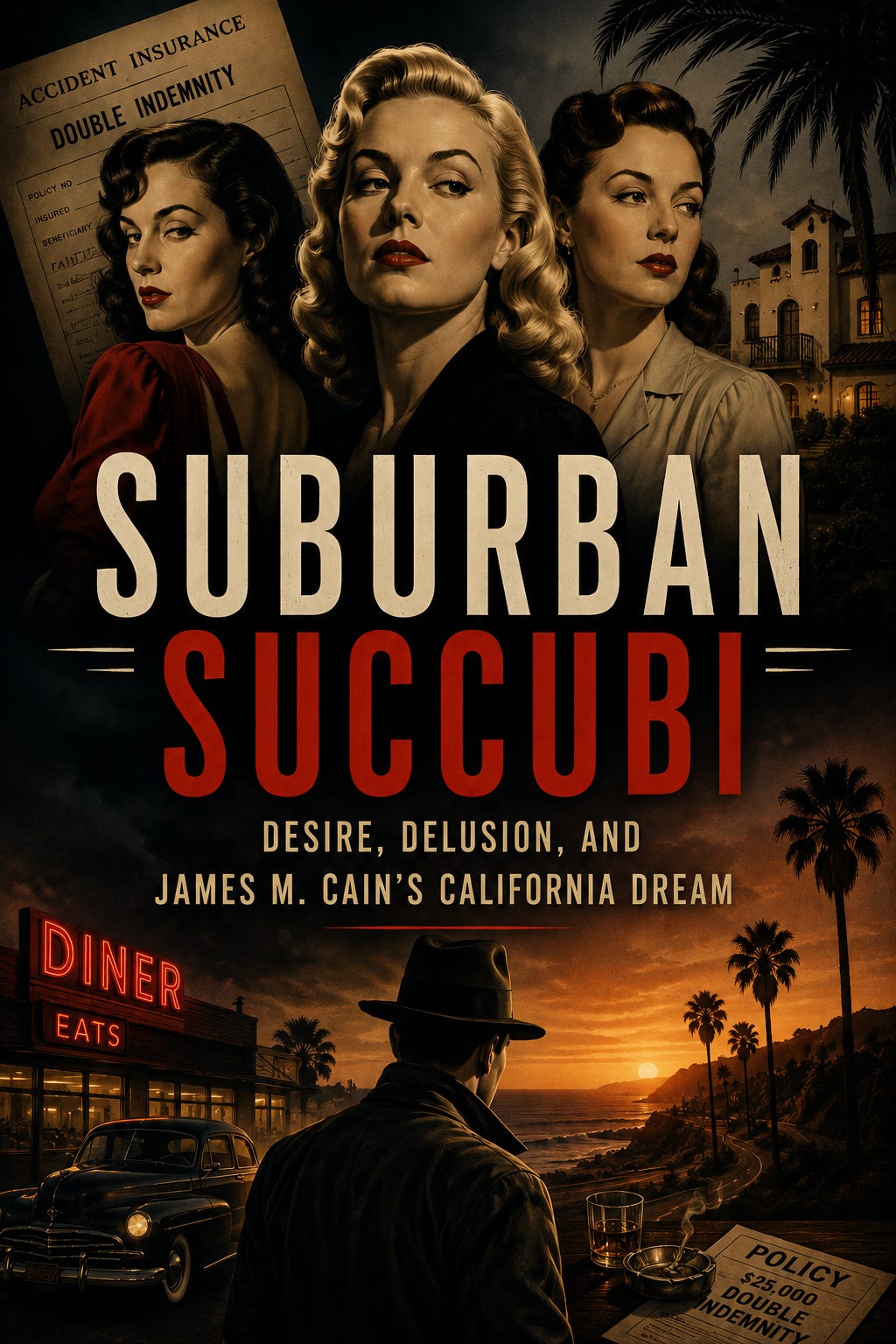
Suburban Succubi
Desire, Delusion, and James M. Cain's California Dream
“Why couldn’t they leave us alone? Why couldn’t they let us fight it out together? I wouldn’t have minded that. I wouldn’t have minded it even if it meant—you know. We would have had our love. And that’s all we ever had. But the very first time they started their meanness, you turned on me.”
“And you turned on me, don’t forget that.”
“That’s the awful part. I turned on you. We both turned on each other.”
“Well, that makes it even, don’t it?”
“It makes it even, but look at us now. We were up on a mountain. We were up so high, Frank. We had it all, out there, that night. I didn’t know I could feel anything like that. And we kissed and sealed it so it would be there forever, no matter what happened. We had more than any two people in the world. And then we fell down. First you, and then me. Yes, it makes it even. We’re down here together. But we’re not up high any more. Our beautiful mountain is gone.”[1]
When James M. Cain published The Postman Always Rings Twice in 1934, critics dismissed it as lurid, sensational, and lowbrow. Readers loved it. The novel became a bestseller; decades later, it would inspire Albert Camus’ The Stranger. Cain, then best known for his human-interest stories and satires in publications like the New York World and American Mercury, suddenly found himself branded as America’s pre-eminent “tough guy” writer—a label he disliked, though not enough to stop producing the hard-boiled crime thrillers that made him famous.
Frank Chambers and Cora Papadokis are not hardened killers. Frank is a drifter who stumbles into a diner owned by Cora’s husband Nick and finds himself with a job. Cora came to Los Angeles with dreams of stardom. After two years at a hash joint, she married Nick out of a desperate hope to escape. Now, married to a “greasy Greek” she finds physically repulsive, she seeks escape in Frank’s arms. What begins as a torrid affair soon turns to a conviction that murder is their only way out.
Nick loves Cora and trusts Frank, never thinking that they have any ill intentions. Even when their first attempt to kill him leaves him with a fractured skull, he accepts the explanation given by Cora, doctors and police: he simply slipped in the bathtub. Cora finds him loathsome, but most would look at him and see something different—a cheerful, optimistic, decent man married to a woman who does not love him.
Frank has a long history of petty crimes, but he has never been involved in a murder attempt. He skips town while Nick is still in the hospital, but his attraction to Cora is stronger than his fear. Ultimately, he returns, and Nick welcomes him back to the diner with open arms, never suspecting that Frank helped crack his skull with a weighted blackjack.
Cora is less thrilled to see him—she was just as rattled by their failed killing as he was and had decided that she was going to make the best of her marriage. Frank’s return ruined that fragile resolve. Their affair resumes, and they begin planning a second attempt on Nick’s life.
Their second effort—a quick blow to the head with a wrench, followed by pushing their car into a ravine—is initially successful. They run down to the ravine to stage the accident, but then the car tips over and Frank is badly injured. They arrive at the hospital after a stop at the mortuary, but Frank’s alibi becomes increasingly shaky under interrogation. Their perfect crime has begun to unravel. To avoid death row, each signs an affidavit declaring the other at fault.
Fortunately for Frank and Cora, the legal system is as corrupt and compromised as they are. Katz, a shrewd attorney, realizes the case hinges on economics rather than justice. If the insurance companies declare the crash a homicide, they owe Frank $25,000 for his injuries. If they declare it an accident, they only owe Cora a $10,000 payout.
Faced with that choice, the insurance companies conclude that Nick died accidentally. The prosecutor realizes that if the insurance companies reject the murder theory, a jury will be unlikely to convict. The case collapses. Cora receives a six-month suspended sentence for manslaughter, and both walk free.
But under the glare of an interrogation lamp, self-preservation proved more important than love. The beautiful mountain is gone and $10,000 won’t bring it back. Cora is once again trapped. Frank starts wondering if he could get away with murder a second time. But he resolves to stay just as Cora once resolved to make her marriage to Nick work, and with much the same success. The story ends on death row, after an accident that not even Frank can say was truly accidental.
Frank’s final punishment is not his death sentence. It is his realization that he will go to the gallows without fully understanding his own motives. In Cain’s fiction, murder is rarely the beginning of a character’s downfall. It is merely the moment when the downfall becomes visible.
Crimes provide the plot for Cain’s crime novels. The drama is fueled by psychological unraveling. His protagonists are brought down not by brilliant detective deduction but by lust, greed, and ambition. Cain would return to these themes throughout his career. In his 1943 novella Double Indemnity, insurance contracts, actuarial tables, and the promise of easy money become the machinery of another murder—and another descent into self-destruction.
Maybe that don’t mean to you what it meant to me. Well, in the first place, accident insurance is sold, not bought. You get calls for other kinds, for fire, for burglary, even for life, but never for accident. That stuff moves when agents move it, and it sounds funny to be asked about it. In the second place, when there’s dirty work going on, accident is the first thing they think of. Dollar for dollar paid down, there’s a bigger face coverage on accident than any other kind. And it’s the one kind of insurance that can be taken out without the insured knowing a thing about it. No physical examination for accident. On that, all they want is the money, and there’s many a man walking around today that’s worth more to his loved ones dead than alive, only he don’t know it yet.[2]
Walter Neff is a very good insurance agent, with a keen nose for fraud and malfeasance. When Phyllis Nirdlinger, a client’s wife decides she wants accident insurance, he senses something is wrong. As Walter and Phyllis begin a clandestine flirtation, he makes his suspicions known. She storms out of his house. Then, when she returns, Walter lets her know he’s willing to help her get rid of her husband.
Frank and Cora were bumbling amateurs. Walter and Phyllis know exactly what they are contemplating. Walter methodically explains how insurance adjusters spot foul play, and how to maximize payout. If the policy holder dies on a train, railroad insurance provides double indemnity; a $25,000 policy becomes a $50,000 windfall. And where Frank was driven solely by lust, Walter has another motivation:
You spend fifteen years in the business I’m in, maybe you’ll go nuts yourself. You think it’s a business, don’t you, just like your business, and maybe a little better than that, because it’s the friend of the widow, the orphan, and the needy in time of trouble? It’s not. It’s the biggest gambling wheel in the world.[3]
Phyllis offers him something more tempting than money or sex: the chance to prove he is smarter than the system itself. Like many of Cain’s protagonists, Walter mistakes intelligence for immunity. He believes that because he understands the game, he can beat it. Frank Chambers stumbled into murder; Walter Neff calculates it. He is more dangerous than Frank, but no less vulnerable—and no less doomed.
There is an unspoken rule of noir fiction: the more calculated your plan, the more certain it will fall apart. Walter dresses as Nirdlinger, down to the crutch and the cast. He breaks Nirdlinger’s neck, boards a train in his place, jumps off at a prearranged checkpoint, and—with Phyllis’s help—dumps the body beside the tracks.
Walter and Phyllis begin bickering almost as soon as they leave the crime scene, and the tension only grows when Barton Keyes, the best claims adjuster on the West Coast, reviews the case. Nirdlinger did not fall from the train. He did not commit suicide. Someone murdered him. Keyes has spent his career studying fraud without succumbing to the temptation to commit it. He knows every trick because he has investigated thousands of claims. Walter understands how to commit the crime. Keyes understands the people who commit crimes.
As he continues to dig, Phyllis and Walter continue to drift apart. Soon another suspicious snooper starts examining the case—Lola, the victim’s daughter. In Lola Walter encounters honesty, something notably lacking in his relationship with Phyllis. When he realizes that the investigation may ultimately turn toward her, he confesses everything. Walter may not be able to save himself, but he refuses to let Lola become a scapegoat for crimes he committed.
The insurance agency realizes this scandal could destroy their business and covers it up. Phyllis and Walter get one-way tickets to Mexico, on the same ship. Walter now knows that Phyllis, a former nurse, has been linked to multiple suspicious deaths; he had learned from her firsthand that she considers herself an angel of death. Yet when Phyllis suggests that they jump from the ship together, he agrees. Whether he still loves her, fears her, or cannot imagine life without her remains unclear.
Walter Neff believes he is committing the perfect crime because he understands the system better than anyone else. He knows how insurance fraud works because he has spent years studying criminals. Keyes understands criminals because he has spent years catching them. In Cain’s world intelligence cannot save you from consequence. Walter realizes too late that he has mistaken knowledge for wisdom.
When little Ray came home from school, and scampered back for her cake, he stepped over and locked it. In a moment she was out there, rattling the knob, but he kept still. He heard Mildred call something to her, and she went out front, where other children were waiting for her. The child’s name was really Moire, and she had been named by the principles of astrology, supplemented by numerology, as had the other child, Veda.
But the practitioner had neglected to include pronunciation on her neatly typewritten slip, and Bert and Mildred didn’t know that it was one of the Gaelic variants of Mary, and pronounced Moyra. They took it for a French name of the more exclusive kind, and pronounced it Mwaray, and quickly shortened it to Ray.[4]
Mildred Pierce is not a crime novel; it is a story about social class in California. Like the Nirdlingers, the Pierces live in a Spanish Revival home with red velvet drapes and wrought iron furnishings. But while the Nirdlingers remain prosperous, the Pierces are struggling in the Great Depression. Once a prosperous land developer, Bert Pierce lost his shirt in the 1929 crash. He ultimately walks out of his marriage and moves in with his mistress.
Mildred, his wife, has taken charge of the family finances, selling pies, taking in boarders, and accepting work as a waitress job even though it is beneath her perceived social position. If Mildred is uncomfortable with the family’s declining financial position, her older daughter Veda is mortified. Mother and daughter share the same ambition: both believe they belong among California’s social elite. Mildred hopes that hard work and sacrifice will get them there. Veda believes beauty, talent, and breeding should be enough.
Many people read Mildred Pierce as the story of a dedicated, loving mother exploited by her ungrateful, sociopathic daughter. There’s a good bit of truth to that reading, but it misses a very important point. Both Mildred and Veda are intensely class-conscious, and both believe they deserve more than what they have. Bert Pierce’s prosperity played a significant—perhaps critical—role in Mildred’s decision to marry him, just as Veda later pursues affluent men who can fulfill her dreams of wealth.
The difference between mother and daughter is not their ambitions but the limits they place on themselves in pursuing them. The tragedy of the novel is not that Veda rejects her mother’s values. It is that she embraces them while discarding everything that tempers them. Mildred is the embodiment of the California dream—to make something better of your life and yourself. In Veda, that dream becomes nightmarish. Mildred sees Veda in herself and is inspired to obsessive love. Veda sees Mildred in herself and views her with contempt.
After her youngest daughter Ray dies, Mildred’s attachment to Veda grows even more obsessive. She spares no expense for musical training. Her relationship with Monty Beragon, an old-money Californian, makes her feel simultaneously awestruck and small—even when his stocks crash and he becomes financially dependent upon her.
Mildred sacrifices everything for Monty and Veda. She embezzles from her own businesses, overlooks repeated betrayals, and continually convinces herself that the next sacrifice will finally earn the love and approval she craves. Ultimately, she loses her restaurants, then comes home to find Monty and Veda in bed together.
Mildred is as besotted by the aristocratic life as Veda is, and as willing to go to great lengths to get a semblance of it. She supports Monty and Veda because they embody the world she has spent her life admiring. In the end, however, she discovers that neither considers her up to their standards. The only thing they needed her for was the money she earned by the hard work they loathed.
For years Mildred Pierce worked tirelessly to build a fortune big enough to win acceptance into a world she admired from a distance. Instead, she learns that money can buy neither happiness nor social status. In the end, she loses her fortune, her husband, and her daughter. Success bought her comfort and parasites. It did not buy her belonging.
Frank Chambers mistakes desire for destiny. Walter Neff mistakes knowledge for wisdom. Mildred Pierce mistakes success for belonging. Each becomes obsessed with an idea of happiness and sacrifices everything else in its pursuit. The tragedy lies not in murder or betrayal, but in their stubborn insistence on clinging to an illusion that ultimately destroys them.
Cain’s women are less temptresses than mirrors. Cora reflects Frank’s longing for escape. Phyllis reflects Walter’s pride and desire to outsmart the system. Veda reflects Mildred’s obsession with status and social advancement. These women do not create the protagonists’ flaws. They expose them. The protagonists mistake them for salvation and, in doing so, find themselves damned.
Each of these protagonists pursues a distinctly Californian dream. Frank arrives as a drifter looking for something undefined. Walter thinks he is smart enough to game the insurance industry and win. Mildred thinks that her hard work and her daughter’s talent can open the gate to higher social status. Each turns their dream into an obsession, with tragic results.
Cain’s status as a genre writer obscures his true talent. His novels are certainly suspenseful, but their lasting power comes from his keen psychological insight. His characters build elaborate stories about who they are and what will make them happy. They build those stories into great towers that come crashing down on their heads. Cain’s fiction is not about murder, fraud, or adultery. It is about the human tendency to mistake desire for reality. The crimes are not the tragedy. They are the moment when the tragedy can no longer be ignored.
[1] James M. Cain, The Postman Always Rings Twice (1934) in Three Complete Novels. New York: Wings Books, 1994. 64-65.
[2] James M. Cain, Double Indemnity (1943) in Three Complete Novels. 94.
[3] Ibid, 106.
[4] James M. Cain, Mildred Pierce (1941) in Three Complete Novels. 185.