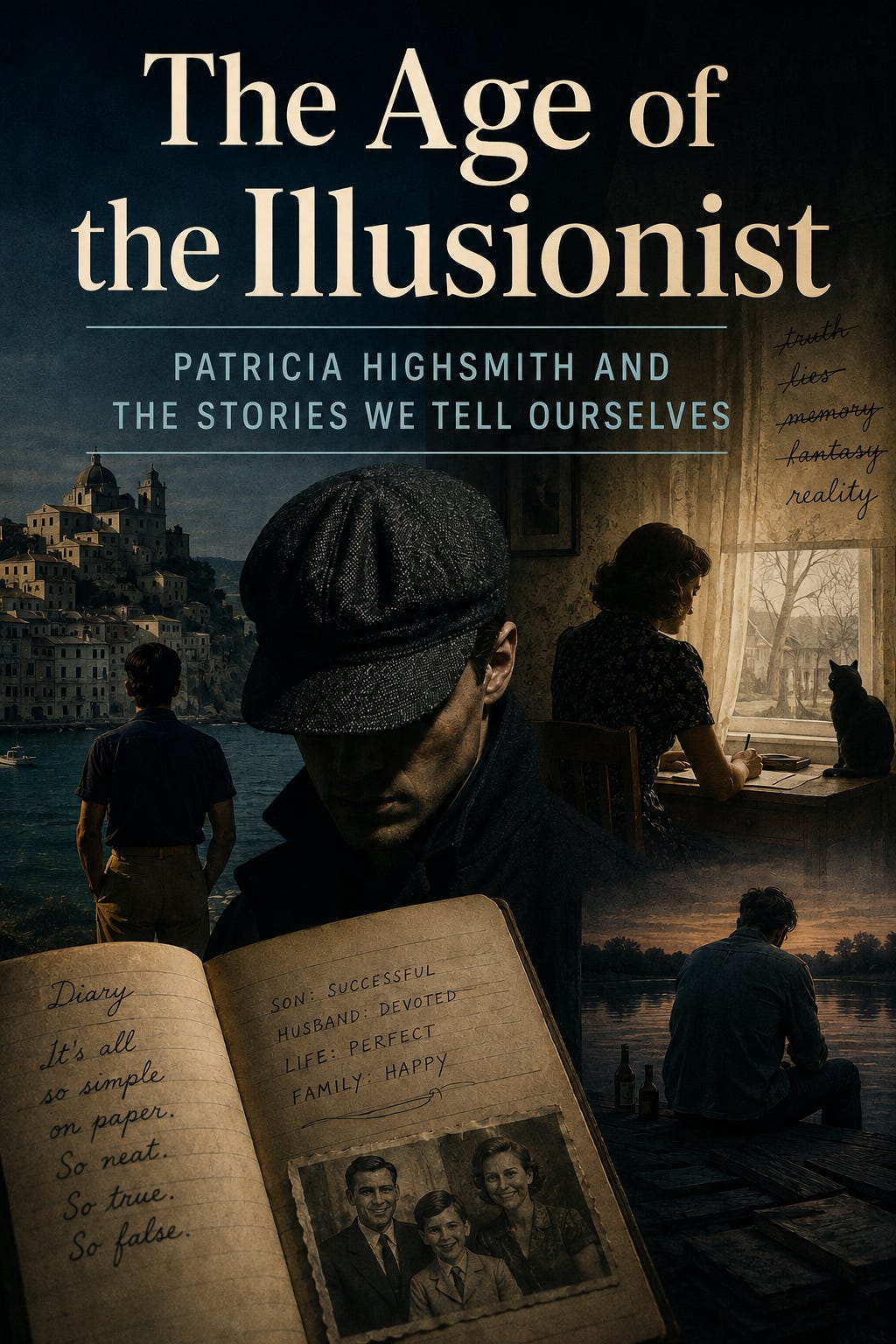
The Age of the Illusionist
Patricia Highsmith and the art of becoming someone else
He had a sudden whim for a cap and bought one in the haberdashery, a conservative bluish-gray cap of soft English wool. He could pull its visor down over nearly his whole face when he wanted to nap in his deck chair, or wanted to look as if he were napping. A cap was the most versatile of headgears, he thought, and he wondered why he had never thought of wearing one before? He could look like a country gentleman, a thug, an Englishman, a Frenchman, or a plain American eccentric, depending on how he wore it. …
It gave him a country air, Greenwich, Connecticut, country. Now he was a young man with a private income, not long out of Princeton, perhaps. He bought a pipe to go with the cap.[1]
Most great crime drama heroes have clear, distinctive, memorable personalities. Sam Spade, Philip Marlowe, Jack Carter, Tony Soprano—you know who they are and what they stand for. Patricia Highsmith’s Thomas Ripley is a protagonist who creates memorable characters to suit the occasion. You watch him with a horrified fascination and root for him despite your revulsion. Yet at the end of the story you know no more about Thomas Ripley unmasked than you did when you began.
When we first meet Tom in the 1956 novel The Talented Mr. Ripley, he is sharing a furnished room with a friend, running a tax fraud scheme, and looking over his shoulder for police. Then he meets Richard Greenleaf, Dickie Greenleaf’s father. Tom was recommended through a friend of a friend; Dickie is in Europe and does not wish to come home, and Richard hopes that Tom can persuade him to return to the family business.
It is a simple errand that might lead to a decent paycheck and a free trip to Europe. But Tom is more interested in the possibilities than the money. He has reasons to be out of New York, though we never discover precisely what those reasons are. What is abundantly clear is that he considers his current circle of acquaintances to be a bunch of “crumbs,” and hopes to create a different life across the sea.
Tom’s ocean voyage takes him to the fictitious southern Italian resort town of Mongibello. He ingratiates himself with Dickie through charm, wit, and a few white lies. Marge, Dickie’s girlfriend, distrusts Tom and suspects he’s “queer.” But Tom’s attraction to Dickie is more than simply sexual. He admires Dickie’s wealth, confidence and bearing and wishes not to sleep with Dickie so much as to become him. When Tom senses that he is wearing out his welcome, admiration gives way to desperation. He murders Dickie and assumes his identity.
With Dickie’s body safely weighted and underwater, Tom takes his clothes and purchases a fake passport in his name. He continues corresponding with Marge and the Greenleafs as Dickie, while scrupulously avoiding anyone who knew both of them. This works until Frederick Miles tracks down Dickie and discovers Tom living in Dickie’s apartment. Tom solves the problem with several ashtray blows to Frederick’s head, disposes of the body, and spends the next several chapters trying to mollify detectives who want to know who killed Frederick.
Ultimately Tom reluctantly realizes that Dickie must depart. Police have found the boat where Tom killed him. They know where Dickie is, but they can’t find Tom—and they are beginning to suspect that Dickie murdered him. While they are closer to the truth than they might imagine, Tom surprises them. He shows up as himself and clears Dickie of suspicion. He does, however, note Dickie seemed depressed when he last saw him, and hopes he hasn’t done anything rash.
But Tom becomes Dickie one more time when he creates a last will and testament that Tom later “discovers.” He can no longer withdraw money from Dickie’s bank account, so there is likely a bit of desperation behind his act. But Highsmith leaves open another interpretation: in turning over his trust fund to his dear friend Tom, the Dickie persona is re-establishing their friendship. The forgery is both financial and emotional. And, despite Tom’s fears, it works.
As the story ends, Tom has not only gotten away with two murders. He has enough income to spend the rest of his life as a man of leisure. He no longer needs to become Dickie Greenleaf, because he has inherited Dickie Greenleaf’s life.
But that wasn’t the way to look at it. He wouldn’t have killed someone just to save Derwatt Ltd or even Bernard, Tom supposed. Tom had killed Murchison because Murchison had realized, in the cellar, that he had impersonated Derwatt. Tom had killed Murchison to save himself. And yet, Tom tried to ask himself, had he intended to kill Murchison anyway when they went down to the cellar together? Had he not intended to kill him? Tom simply could not answer that. And did it matter, much?[2]
In 1971’s Ripley Under Ground, Ripley is now married to a beautiful French heiress and living in a charming country estate outside Paris. Between Dickie Greenleaf’s trust fund and his wife’s inheritance, he enjoys a comfortable life supplemented by Ripley’s participation in an organized art fraud.
Several years earlier an obscure painter named Derwatt went missing. His disappearance sparked a new fascination with the reclusive artist and dramatically increased the price of his surviving works. Ripley and a few associates capitalized on that interest by creating new “Derwatt” paintings that were supposedly painted in Derwatt’s studio in an obscure Mexican village. Derwatt has only been seen once since his withdrawal from society. On that occasion, he was played by Thomas Ripley in a fake beard.
Duchamp gave us a urinal; Patricia Highsmith gives us the murder of an art collector who has discovered the later Derwatt works were forgeries. Both ask the same question: why is this not art? Bernard Tufts, the artist who has produced the Derwatt forgeries, does such a good job that critics praise the natural evolution of Derwatt’s style. People pay large sums of money for the new Derwatts; some even prefer them to Derwatt’s earlier work.
For Thomas Murchison, an art collector, authorship means everything. He is less concerned with the quality of the painting than with the fact that “Derwatt” didn’t use his signature straight cobalt violet paint. When Tom confesses and tries to explain, Murchison promises to bring law enforcement into the matter. And so once again Ripley finds himself in an unfortunate situation—unfortunate, that is, for Mr. Murchison.
To make matters worse, Bernard, the painter, is having an existential crisis. He refuses to make any more Derwatt paintings because he feels like he is becoming Derwatt. Tom, who has made a life out of becoming other people, can’t understand why this is a problem. Still, he genuinely likes Bernard and worries about his mental state. Even after Bernard tries to kill him twice, Tom remains more concerned with Bernard’s well-being than his own safety.
Once again Tom is forced to rely on his talents. Derwatt makes a brief public appearance to reassure everybody that those forgery rumors are entirely untrue. Tom takes advantage of Bernard’s suicide by cremating his corpse, then passing it off as the body of the suicidal Derwatt. The sequel ends on a more ambiguous note than the first novel; police are still asking questions, but Ripley is confident that he will make it through this awkwardness. He always does.
In the dream, she had closed the refrigerator door, into which Mildew had been poking her head, and cut the cat’s head off. Either she had fainted in the dream or not realized what had happened, because later she had seen the cat walking around the house headless, and when she had rushed to the refrigerator and opened it, the cat’s head had been in there, eating the remains of a chicken, eating everything. Often Mildew stuck her head into the fridge, and Edith had to push her away with her foot before closing the door.
Would Cliffie some day slam the fridge door on Mildew’s neck and say it was an accident? Edith found herself clenching her teeth. It hadn’t happened. It wasn’t true. But in her dream, she had done it.[3]
Thomas Ripley is an illusionist who reshapes the truth to get what he wants. Edith Howland is an illusionist who creates alternate truths when reality becomes too painful. Ripley may be a con artist and sociopath—OK, he is a con artist and sociopath—but he never falls for his own lies. Edith Howland defends her lies desperately even as they carry her into madness.
Edith’s Diary opens in 1955, with Edith and her family leaving New York City for the suburbs. This is a typical mid-20th century American dream, and the Howlands appear at first to be a typical family. Until you notice Cliffie, their 10-year-old son, trying to suffocate Mildew the cat.
Cliffie’s delinquent behavior continues as he steals a football within a few days of arriving at his new school. When he’s scolded for damaging the Christmas turkey, he runs out of the house and jumps off a bridge. Ten years later, he is a shiftless alcoholic. His father, Brett, has left the family to move in with his secretary, a woman barely older than Cliffie. Their suburban dream has come crashing down around them.
As her life comes crashing down, Edith takes solace in her diary. Cliffie is not an occasional waiter who steals his great-uncle’s codeine; he is an engineer in Kuwait with a wife and a child. The worse Cliffie’s behavior becomes in real life, the greater his accomplishments in Edith’s diary. And when Brett’s great-uncle George dies of a codeine overdose at Cliffie’s hands, Edith retreats further into her fantasy.
The diary begins as a refuge; she tries to forget her disappointment and heartbreak by imagining a more comfortable alternate timeline. But as pressures continue to mount, she finds it increasingly difficult to distinguish between fact and fantasy. Cliffie the successful businessman and his loving family become more real to her than the drunk sleeping downstairs. Political arguments become dumping grounds for emotional toxic waste.
By the time she begins typing bizarre screeds about President McUlp and imaginary conspiracies, the diary has ceased to be a record of reality. Instead it has become a replacement for it. The final chapters of Edith’s Diary chronicle her slow descent into hell. Cliffie spends years mourning a woman he met on one awkward date; Edith creates statues of Diary-Cliffie’s wife and children. Efforts by neighbors and family to intervene are only met with hostility.
The story ends with Edith dead in the basement after she slips on the stairs while trying to escape imaginary guards who have come to take her to a mental hospital. In what may be the closest thing to hope in this story, Cliffie acknowledges that his mother is dead and his lost love is not coming back. Unlike Edith, he still has the power to distinguish between reality and fantasy.
Highsmith was notorious for angry political screeds about Jews, race, politics, and international affairs. Numerous friends and acquaintances cut her off for her sharp and loud opinions. Like Thomas Ripley, she took their reactions and her emotions and asked “where does this road go if you follow it to the end?”
Many writers praise brutal honesty: few have the courage to turn that honesty on themselves. Patricia Highsmith did. She neither used Edith as a mouthpiece nor as a caricature. Instead, she followed Edith’s fears, resentments, disappointments, and fantasies to their logical conclusion—and the result is one of the most unsettling portraits of self-deception in modern fiction.
Tom Ripley survives because he knows his performances are illusions. Edith mistakes her illusions for reality and dies. Cliffie, the drunken fail-son, is the hinge between them. He stands on the brink of the abyss that claimed his mother but finds the strength to turn away. He may keep drinking; he may continue to drift between menial jobs; he may have a long string of dates that turn out no better than his first and, to date, last one. But Cliffie can still recognize the truth, and that is as close as you get to redemption in a Patricia Highsmith novel.
[1] Patricia Highsmith, The Talented Mr Ripley • Ripley Under Ground • Ripley’s Game • The Boy Who Followed Ripley. London: Chancellor Press, 1994.18
[2] Highsmith, 217.
[3] Patricia Highsmith, Edith’s Diary. (1977) London: Little Brown, Company, 2015. E-book.