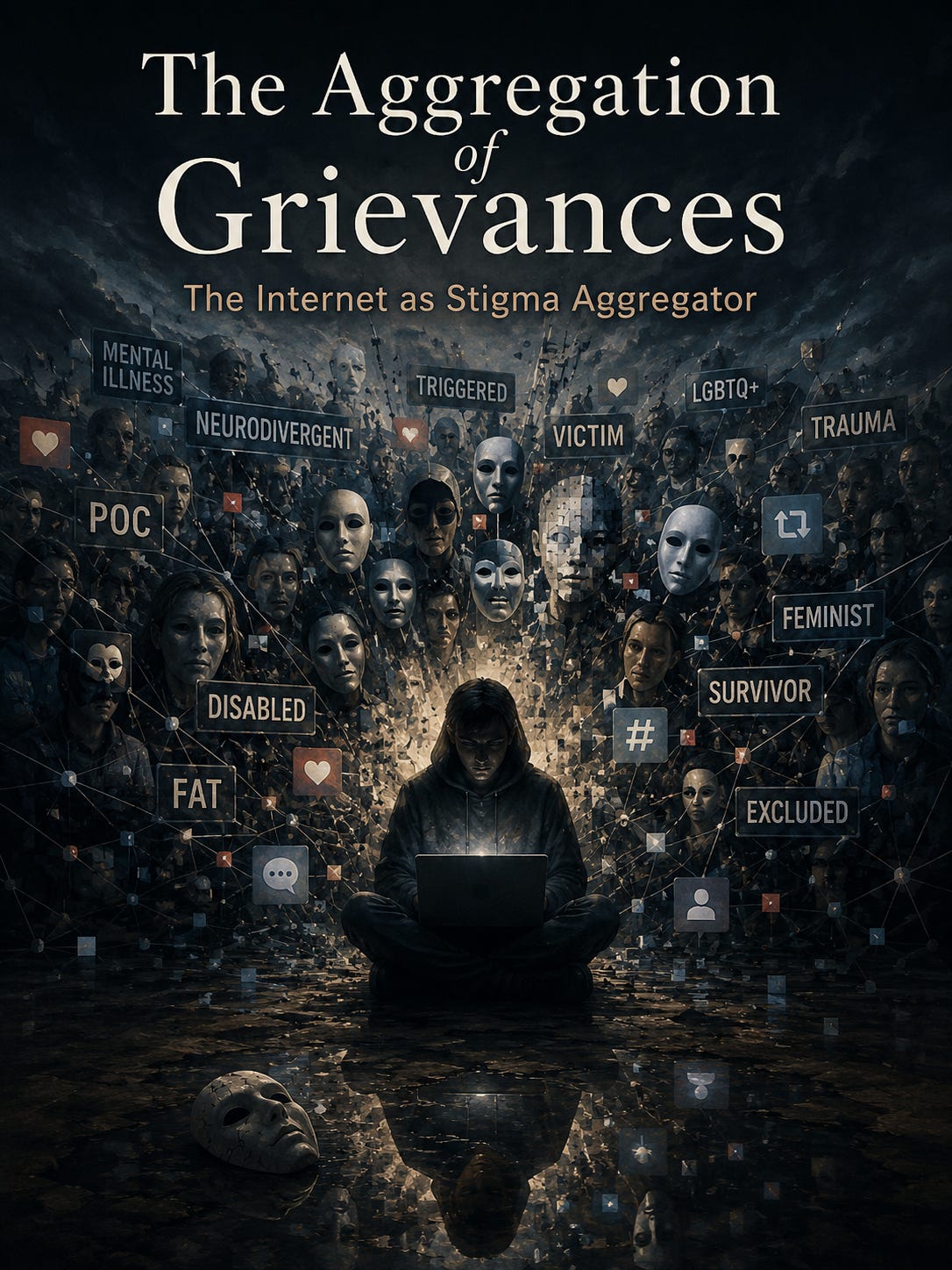
The Aggregation of Grievances
The Internet as Stigma Aggregator
In 2019, a German clinic saw a sharp spike in the number of young people showing symptoms of Tourette Syndrome. But the doctors, who were specialists in the disease, noticed that these patients’ symptoms did not fit a typical Tourette diagnosis.
A closer analysis revealed that their behavior most closely matched that of Jan Zimmerman, a popular German YouTube celebrity with Tourette Syndrome. Instead of the eye-blinking and throat-clearing that is the most common manifestation of Tourette’s, they commonly repeated Zimmerman “tics” like “Heil Hitler” and “Du bist häßlich” (you are ugly).
While Zimmerman has over 3 million followers, Germany’s leading Tourette organizations have distanced themselves from his Gewitter im Kopf (storm in my head) because of his dramatized portrayals.[1] Yet the clinicians found that Zimmerman—and several patients displaying these dramatized symptoms—had mild cases of Tourette’s. None of them were lying or malingering. All were suffering from a socially reinforced disorder inspired by Zimmerman’s exaggerations. Almost all recovered rapidly after the doctors declared they did not have Tourette Syndrome.
Tourette’s is one of the most stigmatized and misunderstood brain disorders. Yet Zimmerman became Germany’s second most-watched YouTuber thanks to his disease. And when he added some dramatizations to create better videos, some of his regular viewers unconsciously adopted Zimmerman’s exaggerated tics until the performances hardened into persistent symptoms.
Digital communities reinforce emotional interpretation through repetition, symbolic narratives, and collective validation. Extreme conclusions can begin to feel emotionally inevitable even when they remain logically implausible. Fear can spread as quickly as symptoms.
After 2016, we saw the rise of “QAnon”—an anonymous poster who claimed to have a high security clearance. Many QAnon followers believed, with perfect sincerity, that a significant number of Hollywood celebrities were being held in Guantanamo Bay for crimes against children; body doubles were filling in for them until Q announced their executions.
In July 2015, a small Georgia group called “Respect the Flag” drove around black neighborhoods waving Confederate flags and shouting racial slurs. At one point, the group pulled up to a birthday party for an 8-year-old black child. The group’s members allegedly threatened to kill the partygoers. In February 2017 Joseph Torres, who pulled the gun, was sentenced to 20 years in prison. His wife Kayla Norton, who loaded it for him, was sentenced to 15.[2]
One of my Facebook followers, whose name I do not recall but whose claim I remember vividly, stated that Trump was soon going to pardon them and make them part of his personal bodyguard. Several people, myself included, noted that the President could only pardon federal, not state, crimes. He was unmoved, stating repeatedly that he had a feeling that Trump would get them released and make them part of his administration.
Like Zimmerman’s viewers, many people found their fears amplified and stabilized through online communities. There were many people reposting QAnon material, and many people claiming that Trump was “literally Hitler.” When your world is run by Satanic pedophiles, it’s easy to imagine that Hollywood is part of the conspiracy. When your country has been taken over by a Nazi, it only stands to reason that he will free Nazis from prison. In digital realms, it has become increasingly difficult to talk about politics without tics.
Erving Goffman subtitled his book Stigma as “Notes on the Management of Spoiled Identity.” It is a vivid reminder of how the stigmatized were treated in 1963. They were socially tainted; their presence threatened the norms and stability of respectable society. Stigmatized individuals were locked away in institutions, kept hidden at home, or shunned by their community.
In the pre-digital world, stigma was local. Your neighbors knew—or might discover—that you were not like everybody else. If you were able to hide your mark of Cain, you could choose between isolation and concealment. Otherwise, you were simply isolated. Stigma was a point of shame, not pride. It was a burden to manage, not an identity to perform.
Some with hidden stigmas were able to find community with hidden sufferers. They might have a local Alcoholics Anonymous group, similarly stigmatized pen pals, or a hidden network of fellow deviants. At best, they led a solitary existence punctuated by occasional communications with like-minded people or a double life that left them in constant fear of exposure.
Stigmatized individuals had little way of knowing how many others shared their burden. A transvestite could think himself uniquely perverse—and within the context of his small town, there might be some truth to that idea. He had no language for what he was experiencing, only a pervading sense that he did not fit within his world.
Local norms set apart those who did not conform. To be a pervert, a jailbird, or a commie was painful, lonely, and often dangerous. At best, one might be tolerated as a local eccentric who was seen as loony but harmless. At worst, one could expect shunning and violence.
Few stigmatized people had the luxury of making their stigma a primary public identity. Those with recognizable stigmas struggled to be seen as more than their disability or their skin color. Homosexuals, alcoholics, or people with a history of mental illness or incarceration found themselves forced into a closet. Their goal, and their only choice, was to seek normalization over public visibility.
This disconnection led to shame, self-doubt, and alienation. Public declaration carried a heavy social cost. Making one’s identity public could mean loss of employment and community standing. The fear of exposure, or the impossibility of concealment, left many emotionally exhausted and miserable. Yet even under these conditions, limited underground networks emerged and people found community in the traits that alienated them.
These hidden communities were difficult to access, fragile, localized, and often socially risky. Many found comfort in gay bars, underground magazines, or support groups like AA. Others joined fan clubs, occult communities, or radical political circles. These groups provided relief from constant alienation, but finding them often required luck, secrecy, or personal introduction, and they rarely expanded beyond local circles or coordinated across distance.
Modern digital systems collapsed geographic isolation and communication barriers. They transformed stigma from an isolating social condition into a foundation for community. The stigmatized could now discover each other instantly.
From their virtual communities, they could compare experiences and create shared vocabularies. Like gay men reinterpreting themselves decades earlier as “lavender” or “friends of Dorothy,” the disabled and marginalized gave themselves new labels, interpretive terminology, and symbolic shorthand. What was once private suffering became a socially organized experience, complete with signs and passwords known only to fellow initiates.
Along with community, the internet gave the stigmatized new opportunities for political organization. They could transform their life narratives from stories of weakness and dependency to tales of triumph over struggle. They could demand that their voice be heard and their rights honored. They could work with others on letter-writing campaigns, create websites that explained their conditions, and have a say in how the outside world saw them.
Their private pain and social alienation became the foundation for new, empowered identities. Digital systems transformed not only how marginalization was experienced, but how the self was constructed.
The internet freed stigmatized people from the tyranny of geography. They might be the only BDSM enthusiast in their hometown or the only wheelchair user in their school, but once they came online, they could find many more who shared their experiences. BBSes, Usenet, and social media became gathering places where the marginalized could find companionship with their peers.
In 2007 David Karp introduced Tumblr, a microblogging site that allowed pseudonymous users to produce or curate all sorts of content. Topic tags let users find even the most obscure interests; repost buttons let users share their favorite posts, videos, and images to their followers. While its earliest adopters were fandoms—groups dedicated to celebrities or television shows—Tumblr soon became a favorite site for young people exploring their gender and sexual orientation.
Micro-communities banded together over vocabulary, labels, and symbolic systems. They created profile pictures, flags, and symbols that served as identity markers. They also used acronyms and vocabulary to organize their experiences and mark their affiliations. Young people could declare themselves members of various neogenders and sexual identities shaped on Tumblr. New flags and pronouns helped them shape their identities and understand their transitions into adulthood. They not only claimed new genders—they created and shared them.
The site also gained a reputation for strident identity politics. Members from disadvantaged groups, like “people of color” or sexual minorities, received interpretive authority derived from their “lived experience.” These “safe spaces” were as prone to disagreement and infighting as any other online community. There were frequent arguments and callouts as individuals sought to gain status and power within these groups. But there was also a great deal of community for people who would have been written off and isolated just a few years earlier.
Tumblr users took these political ideas to other forums. Ideas that had once been confined to academic journals fast became mainstream, if sometimes misunderstood, on sites like Reddit, TikTok, and Twitter. As the ideas spread, so did the site’s penchant for callout culture and heated debates. This helped create an “anti-woke” counterculture. It also provided many people who had spent most of their lives feeling disempowered their first chance to turn the tables on the society that had little use for them.
The Tumblr generation was well-schooled in identity-first interpretation, symbolic affiliation, and public callout rituals. They had spent their formative years learning networked moral enforcement and collective complaint mobilization. Professors who came up when academia had hierarchies and public cordiality was expected encountered students who were raised on dogpiling and moral condemnation.
Academia was also moving away from the tenure model at the time the Tumblr generation was writing its doctoral theses. Going with the flow and kissing up to your advisors was more appealing when there was a lifetime position waiting at the end of the process. Adjuncts who were barely pulling in minimum wage—and college administrators in entry-level jobs—had much less to lose from confronting senior faculty.
Perhaps the greatest radicalizing moment came in November 2016. The Tumblr generation grew up at a time when the worst of the AIDS epidemic had passed, Barack Obama was in office, and gay marriage had just become legal across America. There was a sense of liberal optimism; it was taken for granted that the future would be increasingly progressive and our first Black president would be followed by our first female president. But when Hillary Clinton lost to a man who had questioned Obama’s citizenship, that sense of inevitability vanished.
Obama and Hillary were symbols of hope, the Black President and the Woman President who would mark a decisive break with our racist, sexist past. Donald Trump became proof that America’s racial and cultural tensions remain unresolved. If liberalism was not inevitable, that meant that fascism was not only possible—it might be just over the horizon. And if Hillary Clinton’s mainstream leftism couldn’t stop Trump, then perhaps a more potent brand of leftism was necessary.
Tumblr culture became increasingly mainstream as left-leaning newspapers began focusing on issues like white supremacy and institutional racism. They had already been leaning in that direction thanks to the rise of social media; black-and-white dynamics and slogan-driven politics, they had learned, drive more traffic and more subscriptions. But this new interest was driven as much by fear as by bottom lines. With Trump in the Oval Office, many liberals felt that America’s lingering historical problems had come back to haunt us again.
The Internet rewards stigma. Stigma attracts both sympathetic supporters and loud detractors. That feeds engagement. It also rewards the stigmatized with new audiences and new identities. What once was a social handicap has now become a way to win both friends and arguments. What was once hidden as a shameful fault is increasingly sought after as an accessory.
I remember yet another 2017 discussion where I was castigated for my social status. The only reason I thought that anti-Trump criticism was becoming overblown, my adversary insisted, was because of my white privilege. As a white person with several stigmatizing identities, she was far more vulnerable to fascism than I was. Stigma was now a political tool that you could use both as an organizing device and as a weapon.
The stigmatized have incentive to show their stigma and even, as we saw with Jan Zimmerman, to foreground it. Those who are free of stigmas have incentive to find applicable stigmas. And under the current formulation of “Intersectionality,” it is not enough to focus on your own stigmas; you must also show solidarity with other stigmatized persons. Coming out with a stigma gives you both rewards and responsibilities.
Some stigmas remain marginalized. Pedophilia and bestiality are widely condemned, as is open support of Nazism and racism. Yet even these boundaries are regularly tested. You’ll find debates about whether loli (sexually charged drawings of children) or AI-generated child pornography should be banned. You’ll see zoophiles arguing that animals can consent, and “ironic Nazis” who use swastikas and racist memes to get a rise out of their audience. The more shocking or forbidden a position, the more attention it can attract from both supporters and outraged critics.
Stigmas were once taken for granted. They were a deviation from the norm, and hence the stigmatized were lesser members of society. Today they are seen more as oppressive obstacles than boundaries marking social limits. That approach has freed many people from unjust oppression. But it has also created tension as the stigmatized struggle to find their place in the oppression hierarchy and find themselves lumped together with others whose causes they do not necessarily share.
Many current interpretations of intersectionality are based on the idea that stigmatized people need to support those with different stigmas. But the stigmatized are not a political monolith. It is entirely possible to be a black conservative, a gay Republican, or a devout blind Christian who questions the LGBTQ+ movement. The modern expansion of identity groups has provided many new models for selfhood yet increasingly pressures these identities to align within a single political framework.
The Internet has given rise to many new identities built around pain and exclusion. These frameworks can transform alienation into community, but they can also create new forms of alienation. These outsider groups can become as conformist and intolerant as the outside world they fear and mistrust. Never-ending conversations about outside threats can leave members feeling exhausted rather than acknowledged.
When identity is rooted in the affirmation of others, it is contingent upon others. To lose the group is to lose a sense of selfhood. Members must be cautious in their words and thoughts if they wish to remain who they are. As groups become increasingly insular, the pressure to conform grows ever stronger. Soon the new identity starts to feel as constraining and ill-fitting as the last one did.
When identity is a performance, one is constantly onstage. Memes become props; profile pictures become costumes; slogans become scripts. But this Sartrean “bad faith” only serves to deepen the identity crisis. A performance is always a fiction or a re-enactment. Putting on a Superman suit does not make you bulletproof.
In the 1970s, we were tasked with finding ourselves. Existentialists encouraged us to choose ourselves. But while labels may help us find meaning and companionship, they cannot give us a new self. As Thomas á Kempis reminds us, “You cannot escape it, wherever you flee; for wherever you go, you bear yourself, and always find yourself.”[3]
[1] Kirsten R Müller-Vahl , Anna Pisarenko , Ewgeni Jakubovski , Carolin Fremer, Brain, Volume 145, Issue 2, February 2022, Pages 476–480, https://doi.org/10.1093/brain/awab316.
[2] Enjoli Francis and Steve Osunsami, “Duo gets prison time for racial slurs, death threats at black child’s birthday party.” (February 27, 2017). ABC News. https://abcnews.com/US/duo-prison-time-racial-slurs-death-threats-black/story?id=45788918.
[3] Thomas á Kempis, The Imitation of Christ, Chapter 37. At World Invisible, https://www.worldinvisible.com/library/akempis/imitation/chapter%2037.htm.


I have mixed thoughts. As someone with a Traumatic Brain Injury, I remember trying to find others like me locally. We had a monthly lunch group that we did until Covid shut it down. I enjoyed being with others like me. After Covid, on-line was not the same. We were flat phantoms instead of flesh and blood people.
As a Deaf person, the Deaf community is very active on-line since print is the primary form of communication. Not everyone knows Sign, and there are variations within Signing. But writing is clear.
As for the internet in general, I have noticed the dogpiling of people. It seems that mobs are more easily formed complete with total group think. Social media does segregate people into hard groups to the point that they do not engage in anyone outside of the group. So they conform to the group, whatever the group may be. It distorts the thinking when engaging with people.
I also noted how identity of gay - LBG...... has subsided since it seems to drop from social media. Young people no long see themselves as binary as much as they did.