The Apparatus
Stalinism and the People Who Made it Run
Before he was the Führer, Hitler was just another radical agitator in the Vienna streets. Stalin began as an obscure seminarian on the Russian Empire’s margins. Neither was unique. Europe had no shortage of political extremists, nor Russia of revolutionaries.
What distinguished them was not their ideas or their ambition. It was the apparatus that formed around them. Both rose to power with the help of loyal supporters. But they consolidated power through an expanding network of officials, clerks, and enforcers who simply did their jobs. Their authority rested on compliance at every level below.
The strongman is a symbol and a focal point. The apparatus is the mechanism that puts his ideology into practice. Hitler spoke of the Jewish problem. Eichmann and his underlings provided the solution. We frequently hear that Stalin murdered tens of millions. But those victims died at the hands of apparatchiks, guards, and bureaucrats who redistributed grain, guarded prisoners, and rubber-stamped sentences.
Aleksandr Solzhenitsyn spent eight years in Soviet prisons and labor camps, followed by years of internal exile. In 1974, he was expelled from the Soviet Union and sent to West Germany. Not until 1994 would he be allowed to return to his homeland.
The Gulag Archipelago, written between 1958 and 1967 and smuggled out of Soviet Estonia, became a worldwide bestseller. It remains one of the most powerful records of life in Stalinist Russia—and of the mechanisms that made such a system not only possible, but sustainable.
The Fall of the Faithful
And what did Bukharin fear most in those months before his arrest? …[A]bove all he feared expulsion from the Party! … And [Stalin] had played magnificently on this trait of his (as he had with them all) from the very moment he had himself become the Party. Bukharin (like all the rest of them) did not have his own individual point of view.
Aleksandr Solzhenitsyn, The Gulag Archipelago
Nikolai Bukharin feared exclusion more than death. To be cast out of the Party was to lose not only status, but identity itself. Stalin understood this and used it with precision. The system did not rely on force alone. It relied on the need to belong.
Bukharin was not an opponent of the regime—he was one of its architects. A longtime Party loyalist, he helped develop the doctrine of “socialism in one country,” which distinguished Stalin’s vision from Trotsky’s call for permanent revolution. He was, in every sense, an insider.
It was precisely that position that led to his arrest on February 27, 1937.
As Stalin ignored his former friend’s anguished letters, Bukharin wrote a “Letter to the Future Central Committee” from his cell. He swore his loyalty to the Party and affirmed his support for everything it had done.
For months, Bukharin resisted his interrogators’ efforts to force a confession. When he finally broke, he soon withdrew it. But threats against his family succeeded where sleep deprivation and torture had failed. At his trial, he ended his statement with:
[T]he monstrousness of my crime is immeasurable especially in the new stage of struggle of the U.S.S.R. May this trial be the last severe lesson, and may the great might of the U.S.S.R. become clear to all.
From prison Bukharin sent one last plea to Stalin: “Why do you need me to die?” Stalin did not respond and on March 15, 1938 Nikolai Bukharin was executed.
The Folly of Resistance
At what exact point, then, should one resist? When one’s belt is taken away? When one is ordered to face into a corner? When one crosses the threshold of one’s home? An arrest consists of a series of incidental irrelevancies, of a multitude of things that do not matter, and there seems no point in arguing about any one of them individually—especially at a time when the thoughts of the person arrested are wrapped tightly about the big question: “What for?”—and yet all these incidental irrelevancies taken together implacably constitute the arrest.
Solzhenitsyn, Gulag Archipelago
By the early 1930s, Soviet doctrine had begun to dismiss concepts such as guilt and innocence as “rightist opportunism.” The accused were not convicted of crimes; they were subjected to administrative penalties that could include exile, confiscation of property, and decades of imprisonment.
A peasant who taught his children about Orthodoxy could receive a ten-year sentence under Article 58-10 for “counterrevolutionary propaganda.” A satirical comment in a private letter led to Solzhenitsyn’s own arrest under the same provision.
There was not only no clear moment to resist. There was no clear basis for a defense. Detainees rarely knew what they were being charged with, and even if they had, it would have made little difference. What mattered was not whether one had violated a known rule, but whether one could be placed within a category.
While most people had little access to the laws and statutes that governed them, they quickly learned that association could be dangerous. In Stalinist Russia, anyone could be condemned for arbitrary reasons. Once arrested, they were often forced to name others who participated in the imaginary conspiracy.
Under Article 58-12, “failure to report anti-Soviet activity” was itself a crime. Turning in a neighbor or friend might protect you—until that same person named you in return. Everyone you knew—friend, family, neighbor—was a potential witness, informant, or suspect.
The Stalinist system did not need to monitor every conversation. It conditioned people to monitor themselves. Speech became calculated, cautious, and conditional. Because there were no clear boundaries on safe speech, what was permissible today might be forbidden tomorrow. Comrades learned to avoid not only dangerous speech, but anything that might later be interpreted as dangerous.
Relations with suspect persons were fraught with peril. Prisoners were frequently served with divorce papers while in custody. Children changed their last names to avoid suspicion. Traditional ties of blood and community weakened as the Party rose to take their place.
The safest position was not loyalty. It was isolation.
The Interrogator and the Lie
[I]t was clear to the interrogators at least that the cases were fabricated…They understood that the cases were fabricated, yet they kept on working year after year.
How could they? Either they forced themselves not to think (and this in itself means the ruin of a human being), and simply accepted that this was the way it had to be and that the person who gave them their orders was always right. . . But didn’t the Nazis, too, it comes to mind, argue that same way?
Aleksander Solzhenitsyn, The Gulag Archipelago
Many Soviet citizens believed fervently in Stalin and saw the mass arrests as a justified, if harsh, response to a real threat. Those who did not generally stayed quiet or were quickly silenced. In such an environment, there was little public outcry as the purges continued.
The interrogators did not rely on rumor or propaganda. They knew that many of the confessions they recorded were false. In many cases, they had helped construct those lies and then forced the accused to repeat them. Yet most remained active participants in the system for years or decades.
It is easy to dismiss them as sadists or monsters—aberrations from the norm. But in 1957, Solzhenitsyn discovered that his closest friend from the war, Ovsyannikov, had joined the Organs of state security—the very offices responsible for interrogations. His explanation was simple:
[T]hey offered me work in the Organs, and it seemed to me I would be just as successful there. I cannot say that I have prospered remarkably in my new walk of life. There are some things I did not like, but I work hard, and, if I am not mistaken, I shall not let my comrades down.
I no longer think about the future.
Ovsyannikov is not a fanatic or a sadist. He admits that there are aspects of his work he dislikes. But he continues. He does not justify the system. He does not defend its outcomes. He simply narrows his field of vision until those questions no longer demand an answer.
“I no longer think about the future” is not an expression of ignorance. It is a decision to avoid what he already knows. The past cannot be examined, the future cannot be imagined, and the present is reduced to the task at hand. What remains is not belief, but function. The Organs do not require belief—only the willingness to look away.
Internal and External Enemies
Between capitalist and communist society lies the period of the revolutionary transformation of the one into the other. Corresponding to this is also a political transition period in which the state can be nothing but the revolutionary dictatorship of the proletariat.
Karl Marx, Critique of the Gotha Program IV
For Marx and his intellectual descendants, communism represented the final stage of an inevitable historical process. Capitalism would collapse under its own contradictions, the working class would rise, and the dictatorship of the proletariat would give way to a classless, moneyless society.
The Soviet Union had achieved a Marxist-Leninist revolution, yet the population continued to struggle with hunger and poverty. For many, life under the Party was more constrained than it had been under the Tsar. This presented a problem. If history guaranteed success, failure required an explanation.
Stalin’s answer was straightforward: the system was sound, but it was under attack. International capitalism—and its collaborators within the Soviet Union—were undermining progress.
Under Article 58-7, so-called “wreckers” could be prosecuted for “undermining state industry.” Trofim Lysenko’s agricultural policies contributed to widespread famine, yet starving farmers were accused of poisoning the fields. Power failures could result in engineers being shot under Article 58-14, “counterrevolutionary sabotage.”
Show trials did not make life easier for the people, but they made suffering intelligible. They shifted blame away from Stalin and onto enemies who sought to undermine the system. And because the Party controlled the means of mass communication, there were few narratives capable of challenging the official account.
Executions and incarcerations served a second purpose. They reinforced the cost of dissent. Patriotism tends to intensify in times of perceived crisis, and every “spy” or “traitor” carried out of an apartment building served as a warning. To be named an enemy of the people was to place not only oneself, but one’s family, at risk.
These enemies were not simply discovered. They were produced. The system required them to make sense of its own contradictions. Once identified, they had to confess, implicate others, and confirm the narrative. The interrogations and trials that followed were not attempts to uncover truth, but to construct it.
If the system depends on ordinary people, it also requires a figure to represent it. Stalin became the face of Soviet Communism, just as Solzhenitsyn became the face of Soviet tyranny. But Stalin did not sign the papers that led to Solzhenitsyn’s arrest. Neither did he read the letters that sealed Solzhenitsyn’s fate. Those actions were carried out by long-forgotten men acting in Stalin’s name.
The strongman functions much like a corporate logo. If you see the familiar Golden Arches, you immediately think of McDonald’s. But placing a similar sign above a restaurant does not make it McDonald’s. The brand depends on a supply chain, standardized processes, and a network of managers, trainers, and employees who ensure that the product is consistent from one location to the next.
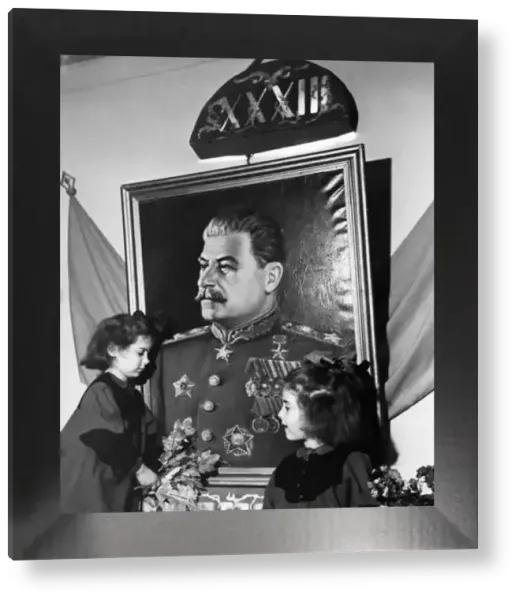
Images of Stalin served as shorthand for the systems he represented. Stalin possessed real power, but that power was exercised through an extensive apparatus of officials, functionaries, and enforcers. His greatest importance was not as an individual but as a symbol.
The strongman gives the system a face; the system gives the strongman power. Remove the figure, and the apparatus remains. Remove the apparatus, and the figure becomes irrelevant. These systems do not depend on extraordinary individuals. They depend on ordinary ones—on people very much like us.