
The Banality of Memory
How the Holocaust became a moral lens—and what was lost when it did

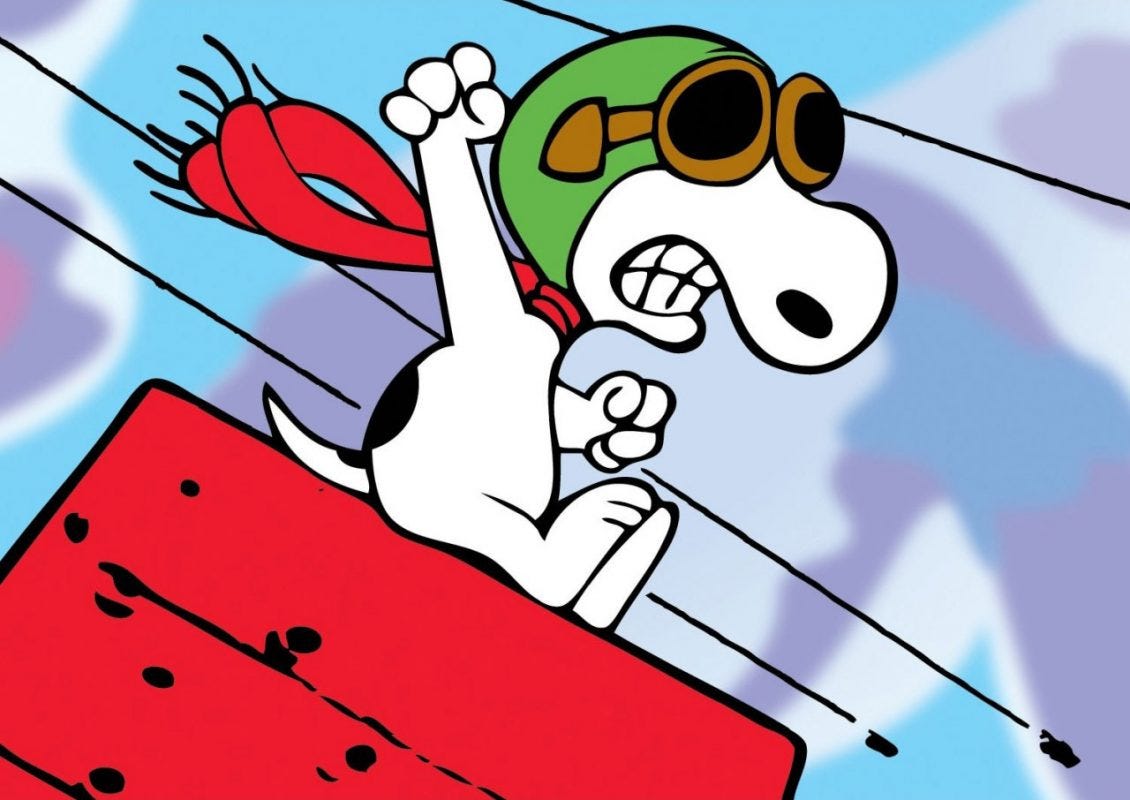
When I was young, my mother told me about a deceased uncle I never met. Loud noises gave him wartime flashbacks. A backfiring car or a plane flying low could send him diving behind the couch, aiming an imaginary rifle.
She didn’t talk about her uncle much. She hadn’t known him well, and he died when she was still a girl. Though she never said so outright, I later realized he spent much of his postwar life in mental hospitals. In the 1930s and 40s, that carried a stigma. It was easier to keep things calm and quiet—for his sake and for everybody else’s.
I always assumed her uncle was a veteran of World War II. That was the war I associated with trauma. To a child in the early 1970s, World War I looked like Snoopy flying his Sopwith Camel against the Red Baron.
Only later did I realize my great-uncle was almost certainly a badly damaged veteran of the First World War. The images I inherited quietly reshaped the story I thought I was hearing—and recast his trauma in a war he was too broken to fight.
I was fourteen before I saw a serious World War I film—a television version of All Quiet on the Western Front, starring Richard Thomas, whom I knew as John-Boy Walton. It was a good film, in hindsight, but it didn’t leave much of an impression on me. By 1979 I had seen lots of movies with antiwar messages.
The Vietnam War had left many Americans feeling deeply ambivalent about combat. I saw The Deer Hunter and Apocalypse Now in the Montrose Theatre. I remember the bayonet scar my father got in Korea—but not as clearly as I remember watching M*A*S*H. The country was battle-weary and more interested in war’s horror than its heroism.
World War II was the exception. We were still divided about Vietnam, but everyone agreed on the Second World War: a triumph of good (us) over evil (Germany and Japan). There were no My Lai Massacres in that story, no trenches, no wars in countries we didn’t recognize for reasons we couldn’t explain. World War II vets were the “Greatest Generation,” warriors who had secured a better life for their children.
The Dirty Dozen was a television favorite. It told the story of a group of American convicts who earned redemption by blowing up a gathering of the Reich’s top commanders. Some died nobly in battle; others survived and were recognized as heroes. It was classic myth, complete with an all-star cast. Even the lowest American criminal, it suggested, was made of sterner stuff than the Nazis.
Our reception for NBC was spotty and Montrose didn’t have cable, so I missed Holocaust on its first run. But our library had The Diary of Anne Frank. On the playground I heard lurid tales of Nazi medical experiments; our CBS reception was better, so I also saw Vanessa Redgrave’s Auschwitz movie Playing for Time.
All of it reinforced my belief that Nazis were bad people who did bad things.
I also learned that Nazism was a thing of the past. In the Cold War era villains spoke with a Russian accent. Rocky Balboa squared off against Ivan Drago in Rocky IV; Rosa Klebb took on James Bond in From Russia with Love; twenty years later Bond foiled General Orlov’s plot to start a nuclear war in Octopussy. Even cartoons followed the pattern: The Rocky and Bullwinkle Show gave us Boris Badenov and Natasha Fatale.
Nazis were a historical anomaly. The Soviet threat was very much alive, while the Third Reich had been decisively defeated. Even 1978’s The Boys from Brazil had to resort to ninety-five cloned Hitlers to make Nazism feel like a contemporary threat.
The Holocaust remains the moral core of World War II memory. But Nazis are no longer a dim, distant stain on history. Today, Nazism is often invoked as a looming danger, and political opponents are regularly labeled as “literally Hitler.”
We now have strong diplomatic ties with Germany, while our relationship with Russia remains tense. Yet there is no cultural fixation on Stalinism, and little of the pervasive fear of Russian saboteurs and spies that characterized the Cold War. Nazism has become a cultural bugbear, while more immediate geopolitical concerns do not generate the same kind of diffuse anxiety.
One issue is ambiguity. During the Cold War, Soviet espionage was a genuine threat and fears of nuclear annihilation were not unfounded. But nuclear war never came, and our fears of infiltration led us to embarrassing excesses like the Red Scare and the McCarthy hearings.
There is no Joe McCarthy in our cultural memory of World War II. The Japanese American internment camps are widely acknowledged as a grave injustice, but they are treated as an exception rather than the defining image of the war. The Cold War invites self-critique; the Second World War offers moral certainty.
The Holocaust gives us a clear image of evil: monstrous men committing monstrous acts. That clarity is part of its power. It is also part of its danger.
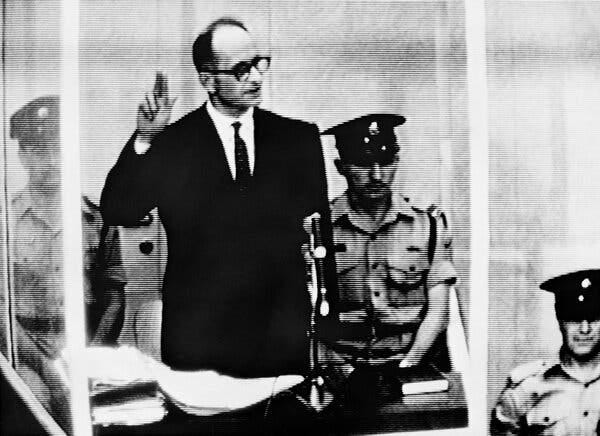
On April 11, 1961, an Israeli court charged Adolf Eichmann with:
four counts of Crimes Against the Jewish People
eight counts of Crimes Against Humanity
one count of War Crimes
two counts of Membership in Criminal Organizations.
To each of these charges, he pleaded “not guilty in the sense of the indictment.” Hannah Arendt describes his later attempts to explain himself:
The indictment implied not only that he had acted on purpose, which he did not deny, but out of base motives and in full knowledge of the criminal nature of his deeds. As for the base motives, he was perfectly sure that he was not what he called an innerer Schweinehund, a dirty bastard in the depths of his heart; and as for his conscience, he remembered perfectly well that he would have had a bad conscience only if he had not done what he had been ordered to - to ship millions of men, women, and children to their death with great zeal and the most meticulous care.
Eichmann saw himself as a functionary. He obeyed orders, followed procedures, and advanced his career—and believed this absolved him of responsibility. For Arendt the horror lay not in his demonic wickedness, but in his terrifying normality.
Arendt’s portrait of Eichmann disrupted the comforting image of the Nazi as a monster. But a similar need for clarity shaped the way many people thought about the victims. In 1961, being a Holocaust survivor could carry a burden of shame. David Ben-Gurion is quoted by Hannah Arendt as complaining that “the Jews had degenerated until they went to their death like sheep.”
This kind of reaction is not uncommon in the aftermath of catastrophe, when survivors and observers alike search for explanations that restore a sense of agency. Even Aleksandr Solzhenitsyn, for all his knowledge of oppression, struggled with survivor guilt and later lamented that he had not resisted his captors more forcefully.
Reducing victims to cowards and perpetrators to villains serves a similar psychological function. Both provide a sense of meaning and closure. To say that a man loaded bodies into ovens because he was weak, or designed those ovens because he was evil, is to feel that you have grasped the atrocity. And these explanations carry a further comfort: they let us believe that we are fundamentally different.
One function of the Eichmann trial was to restore a sense of power and purpose—to replace the image of the Jewish victim with that of the Jewish avenger. It offered the possibility that, by bringing a perpetrator to justice, something of that lost agency could be recovered. It also reminded Jews in the Diaspora that what had happened once might happen again.
Arendt warned that such an emphasis risked sustaining an older mentality of separation, at odds with the realities of modern statehood. In the postwar world, she believed Israel would have to exist as “a nation among nations, a state among states.” The danger was not memory itself, but the possibility that it might distort the present.
What followed suggests that her concerns were not misplaced.
By 2026, the Holocaust has nearly passed out of living memory. Those who entered the camps as children are now in their late eighties and nineties. In response, institutions and communities sought to preserve both the historical record and the moral lessons associated with it through memorials, museums, and educational programs.
But as memory was preserved, it was also simplified. The Holocaust shifted from a historical event to a lens through which other events were understood. “Nazi” became a shorthand and ultimately a general-purpose insult. And as that analogy expanded beyond its original context, the meaning those museums and memorials sought to preserve grew increasingly diluted.
Today, one no longer has to sport swastikas, advocate genocide, or goose-step to be labeled a Nazi. In online discourse, even heated disagreement can make you literally “Literally Hitler.”
In 1990, American attorney Mike Godwin observed that every online discussion that goes on long enough will eventually produce comparisons to Nazis or Adolf Hitler. He hoped that by naming the tendency, he might discourage it. His observation came to be known as “Godwin’s Law.”
Writing in 2016, Godwin reflected on the phenomenon:
The internet has been shaping an increasingly international culture and collective memory — with the Holocaust, just as with other countless human atrocities, we have a moral obligation to “never forget“. My view, which I’ve held for many decades now, is that glib and frivolous invocations of Hitler, or Nazis, or the Holocaust, are a kind of forgetting.
The memorials and educational programs hoped to create a shared moral structure that would discourage both genocide and anti-Semitism. But not all audiences experience that education the same way.
For those with a personal or inherited connection to the Holocaust, it can reinforce a sense of historical vulnerability and a need to defend their community. Others see the Holocaust primarily as a universal moral lesson about the dangers of hatred and genocide. That education has helped produce a radical split over views of the ongoing Palestine conflict.
Before we go any further: this is not a “Jew vs Gentile” split. Many of Zionism’s most vocal critics are Jewish. Many of Israel’s strongest supporters come from outside the Jewish community. Simplifying complex issues to “us versus them” may provide the illusion of certainty, but it rarely leads to understanding.
The lines here are drawn not between fixed groups, but between different ways of interpreting the past. Those without a personal connection to the Holocaust encounter it largely through contemporary imagery. Like early medieval painters dressing first-century Christians in the garb of their time, or children seeing World War I through Peanuts cartoons, we envision the past through our own experiences.
Images from the ongoing Israel–Palestine conflict—starving children, armed soldiers, devastated neighborhoods—are often interpreted through the moral framework of genocide. For those with a more direct or inherited connection to the Holocaust, such comparisons can feel less like moral reasoning and more like a distortion of history, or even a continuation of the hostility that memory was meant to guard against.
Which interpretation is correct? Both reflect real concerns, but neither is complete. There are those who invoke the language of genocide in bad faith, and others who use it to express genuine moral alarm at civilian suffering. In polarized environments, attempts at nuance often satisfy no one. The result is a cycle of mutual misunderstanding, in which the same images reinforce opposing conclusions and deepen distrust.
Within the next fifteen years, the last living Holocaust eyewitnesses will pass away. Their stories will be remembered through secondhand accounts, recorded testimony, and inherited fragments of memory. Old films and historical texts will become the primary frame of reference. What was once an open wound will fade into a scar.
Seventy years after the Civil War ended, Margaret Mitchell used her family stories as material for Gone with the Wind. Her book, and later the movie, transformed a horrific conflict into a sweeping epic about a lost Antebellum culture. They also helped popularize a vision of happy, loyal slaves living peaceful lives on bucolic plantations.
Today we recognize that Gone with the Wind reflects deeply problematic ideas about slavery and race relations. It is less clear what future generations will see when they look back at our own representations of the Holocaust. Like Mitchell, we work from testimony, images, and inherited narratives. But we shape that material through our own assumptions and needs.
The question is not whether our representations will be judged incomplete or flawed. It is what we currently fail to see.
A generation taught that the Holocaust must be treated with solemnity and reverence has, in many cases, responded with “oven memes” and Holocaust jokes. This shock humor is often read as anti-Semitism and hate speech. It may also be understood as testing the boundaries of what can be said.
These younger audiences encountered the Holocaust through cultural rather than living memory. Confronted with efforts to enforce seriousness, some respond with “sick” humor that derives its power from the very gravity it undermines. Their memes are not unlike the long hair and “hippie” garb of the 1960s counterculture. Where one generation rejected convention through appearance, another tests it through language.
Hannah Arendt rejected easy ideas of monstrosity and depravity. Those oversimplifications ignored a deeper, more disturbing truth: evil was not ontological, it was procedural.
Much of modern discourse has moved away from Arendt’s insight, returning to a more familiar image of the Nazi as a monster whose actions require no further explanation. Atrocity has been reduced to cliché and ultimately to memes.
Today we often use “myth” as a synonym for fraud, for lie, for old wives’ tale. But myth is the survival of memory. It can preserve wisdom and become a cultural framework. But it can also obscure reality.
We are not outside that process, we are a part of it. We reshape the stories we inherit and pass them on to the future. But we miss things we cannot see, just like those who came before us and those who will follow in our footsteps.
The danger is not that we will forget what happened. It is that we will come to believe we understand it completely.