
The Coming of the Ubermensch
The Strongman is knocking ... will you let him in?

American boots are now on Iranian soil. So are American planes. That “four-day fight” we were promised is fast becoming a major war, and Trump’s ratings are dropping like a flaming F-15.
The Never Trumpers are telling the same story they’ve spun since 2016. This is the beginning of the end. Orange Julius Caesar is about to meet his long-delayed Ides of March. Things will return to normal. We can finally start rebuilding our democracy.
Two words: Weimar Republic.
You thought Donald Trump was Hitler.
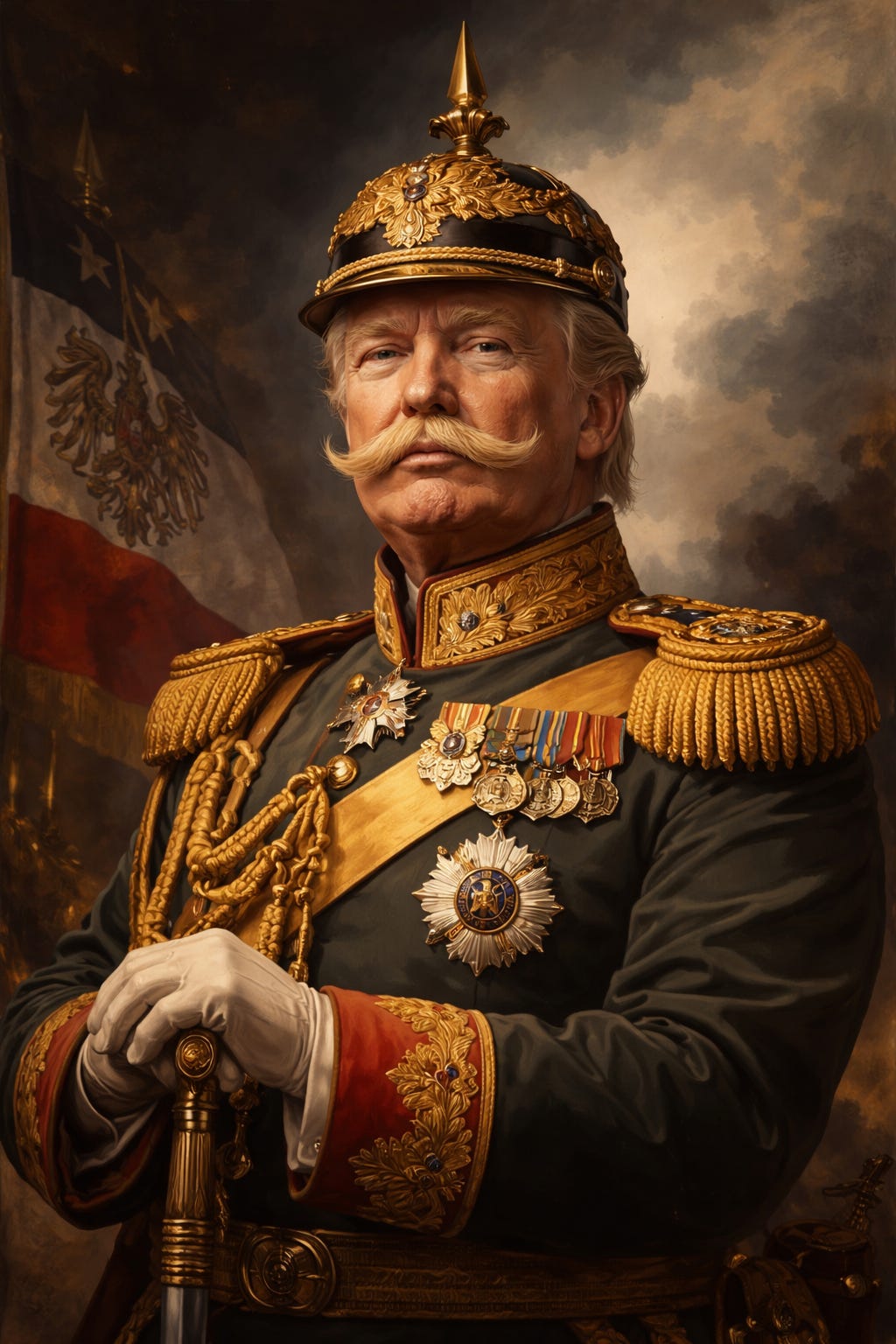
What if he’s Kaiser Wilhelm?
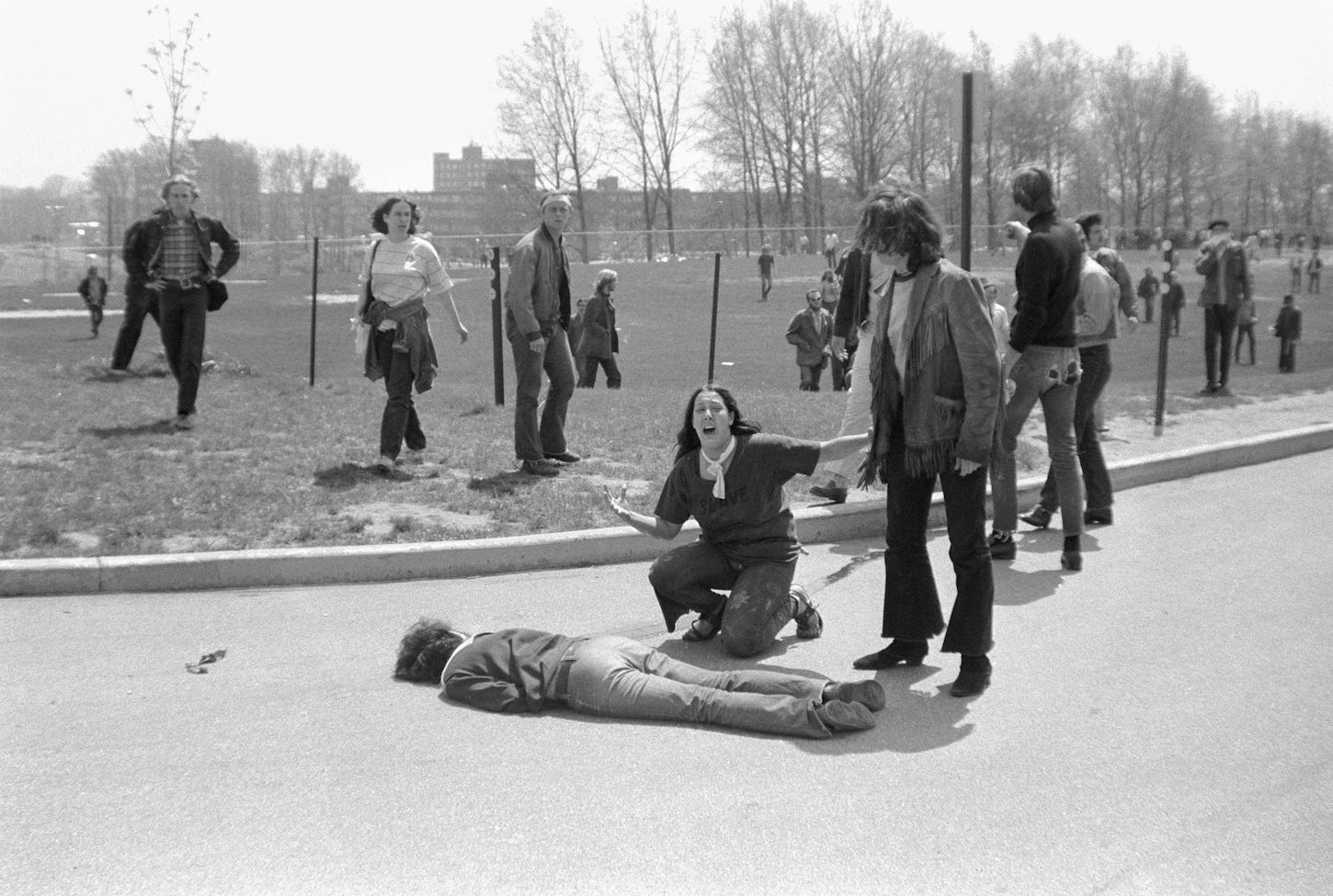
The threat is nearly invisible in ordinary ways. It is a crisis of confidence. It is a crisis that strikes at the very heart and soul and spirit of our national will. We can see this crisis in the growing doubt about the meaning of our own lives and in the loss of a unity of purpose for our nation. The erosion of our confidence in the future is threatening to destroy the social and the political fabric of America.
Jimmy Carter, July 15, 1979
President Carter was describing the quiet despair many 1979 Americans felt.
Not anger, not revolution.
Nihilism.
Vietnam ended in a haze of stagflation, unemployment, and gas lines. The superpower that saved the Free World had become an overextended empire humbled by a country it barely understood.
Americans didn’t revolt. They checked out.
The 1970s ran on disco, Quaaludes, and casual sex. Political passion gave way to cynicism, hedonism, and a creeping sense that nothing really mattered. The Left had won and we were out of Vietnam. But the Establishment was still in charge, and politics started to feel like a rigged game.
Jimmy Carter talked about malaise. His opponent, a genial former actor best known for co-starring with a chimpanzee, offered optimism.
It worked.
Cheap credit and deficit spending pulled the country out of its slump. Or, more precisely, part of the country. The Reagan boom never really reached the Rust Belt, and plenty of Americans were left behind. But that didn’t matter. The Left was exhausted and the Right was energized.
Reagan didn’t need to be a strongman. The country wasn’t ready for one. What it needed was reassurance. That option may not exist this time.
In the 1970s, we brought oil prices to heel by building the petrodollar system and locking global energy markets into the dollar. If Iran takes Hormuz, the petrodollar is dead. Oil won’t move in dollars because it won’t have to. It will move in yuan, rials, rubles, gold — whatever buyers and sellers agree on.
Iran has no reason to care about the dollar. Once that precedent is set, other countries won’t have to either.
Here’s why that matters:
The petrodollar system created global demand for American currency. It allowed us to run massive deficits at low interest. Take that away, and the math changes fast.
Demand for dollars falls.
Interest rates rise.
And a country carrying nearly $40 trillion in debt must suddenly live within its means.
Social Security and Medicare depend on a government that can borrow cheaply. Without the petrodollar, that credit becomes much more expensive.
Higher borrowing costs put pressure on everything else. Inflation makes it worse. Benefit payments rise with it. Promises get trimmed, delayed, redefined. People feel the loss before they see it. Sooner or later, something has to give.
And once it becomes impossible to pretend everything is fine, the argument shifts.
It’s no longer “what should get cut?”
It’s “who gets cut?”
When groups start fighting for pieces of a shrinking pie, trust in the system breaks down. When people stop believing the system can deliver, they start looking for someone who can make it work by any means necessary.
They’re no longer concerned with justice.
They want control.
![r/HistoryPorn - German children playing with bundles of worthless money thanks to hyperinflation, 1923. [922x1250]](https://substackcdn.com/image/fetch/$s_!PJfW!,f_auto,q_auto:good,fl_progressive:steep/https%3A%2F%2Fsubstack-post-media.s3.amazonaws.com%2Fpublic%2Fimages%2F228110c4-9dc7-4d53-95f5-e2188cb474fe_640x867.jpeg "r/HistoryPorn - German children playing with bundles of worthless money thanks to hyperinflation, 1923. [922x1250]")
Scan social media and you’ll find no shortage of comparisons between America and the Weimar Republic.
“Godless” might be a stretch, but America is certainly more secular now than ever. “Sexually degenerate” is a matter of opinion, but the 2020s are undeniably more tolerant of deviance than even the Swinging ’70s. And both modern America and 1919 Germany are imperial powers in decline.
All of that is true.
And none of it explains what actually brought Weimar down.
Let’s step back and put things into perspective.
When the smoke and chlorine gas cleared, the old world was gone. The Russian Empire had collapsed. The German monarchy was finished. The Austro-Hungarian Empire had shattered into pieces. The Ottoman Empire was in its final days.
Soldiers were returning from the bloodiest war the world had ever seen. Millions were dead. Entire regions were gutted. They had gone to war believing in honor and empire. Many came back believing nothing at all.
That was the world the Weimar government was supposed to stabilize.
From 1919 to 1925, Friedrich Ebert served as the Republic’s president. He was neither a radical nor a revolutionary. He was a moderate socialist trying to hold a broken and deeply polarized country together. Joe Biden served a similar function in a far less dire context.
Many draw a straight line between Weimar’s antifascists and modern-day Antifa. The rhetoric is often similar, and some participants see themselves as heirs to earlier generations of political street fighters. But the comparison breaks down quickly.
Postwar Germany was a country where political violence was routine. Armed groups fought in the streets. People died. American Antifa operates in a far more limited and fragmented way, inside a state that still controls the streets. It borrows Weimar aesthetics, but not its scale or consequences.
You’ll also hear comparisons between today’s economy and Weimar’s hyperinflation. Currently US inflation is in the low single digits. Here’s a chart showing the value of one gold Mark in paper Marks from 1918-23.
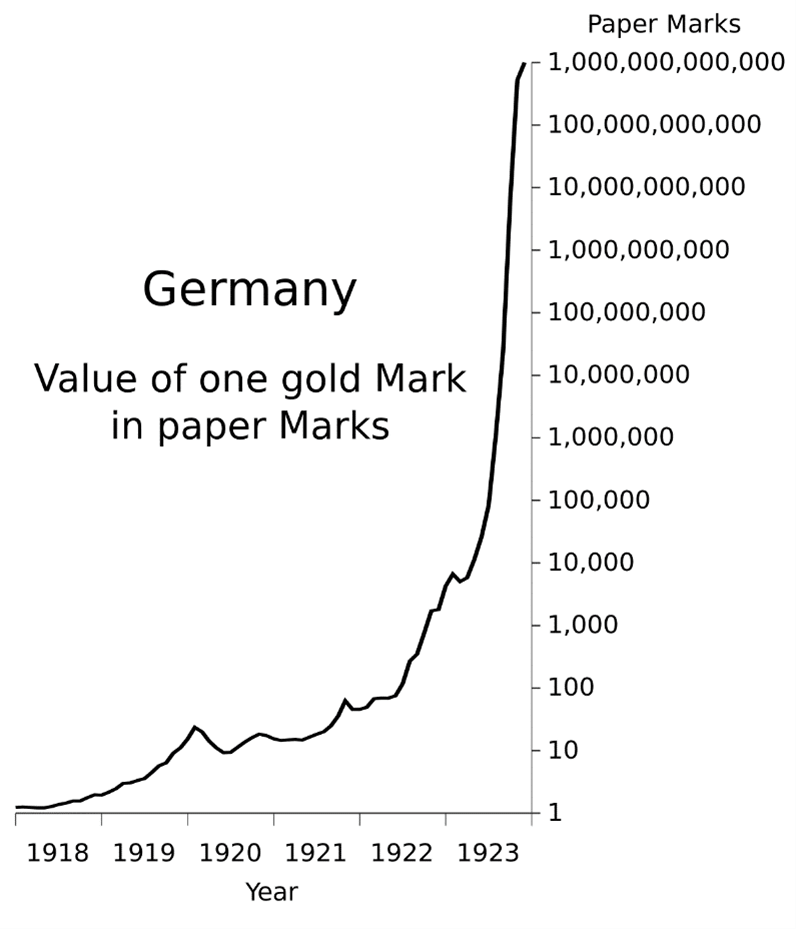
Savings were wiped out. Salaries were paid twice a day so workers could spend their wages before they lost value. Money stopped functioning as money. This is what monetary collapse looks like.
We are nowhere near that.
A prolonged closure of Hormuz would drive up energy prices. It would push inflation higher. It would strain supply chains and squeeze households already living close to the edge.
But the dollar isn’t about to become worthless overnight. American institutions, for all their flaws, are still capable of responding. Markets would adjust. Painfully, but they would adjust.
Weimar fell because the currency stopped working, and when money stops working, everything else follows. That’s not the risk we’re facing.
America faces not collapse but erosion. Not a single catastrophic event, but a steady accumulation of pressures: higher costs, weaker growth, rising debt, and a government increasingly forced to choose who absorbs the loss.
You don’t need hyperinflation to break confidence in a system.
You just need people to realize that the promises they were counting on won’t be kept.
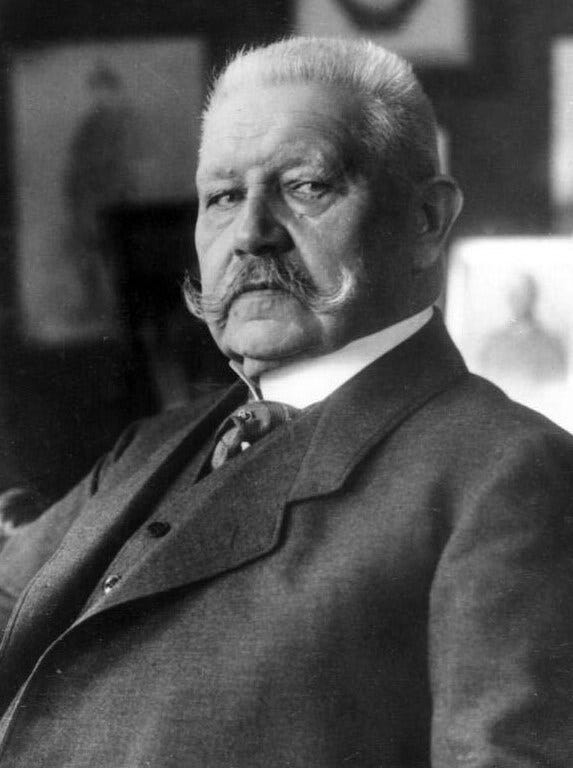
President Friedrich Ebert died on February 28, 1925. The squabbling parties were unable to unite behind a single candidate. In the end, the right rallied behind a national hero: General Paul von Hindenburg. On the second round of voting, he won the presidency with the support of voters who longed for stability.
Ebert was a party man and a negotiator. Hindenburg was something closer to an uncrowned king. He saw himself as a guardian of German tradition, come to lead his people through the storm. Where Ebert was a gray bureaucrat, Hindenburg was a widely-revered hero.
For the first few years, Hindenburg’s presidency appeared successful. He reassured those who missed the monarchy while working with elected officials well enough to maintain broad support.
That changed after 1929.
The Great Depression hit. Unemployment surged. Tensions mounted. Finding consensus in an increasingly polarized parliament became nearly impossible.
Hindenburg began to rely more heavily on Article 48, which allowed him to govern by emergency decree. By the early 1930s, his personal authority was one of the last things holding the system together.
In 1933, facing mounting pressure and political deadlock, Hindenburg appointed a popular political leader as chancellor: Adolf Hitler. He did not fully trust him. But he believed he could be brought into the system and contained.
Hindenburg was wrong.
Within a month, Hitler used the Reichstag Fire to justify sweeping emergency powers, curtailing civil liberties and sidelining opposition. In August 1934, following Hindenburg’s death, he merged the offices of president and chancellor and declared himself Führer. The Weimar Republic was finished.
The American system did not collapse in the same way.
But the pattern is worth paying attention to.
After a disastrous debate, Joe Biden was pushed aside, and Kamala Harris ran against former president Donald Trump. Harris, like Biden and Ebert, was a bureaucratic figure with limited natural magnetism.
Trump, by contrast, remained a charismatic and polarizing presence. He became the second president in American history to return to office after losing a previous election.
Trump’s war record was, of course, nothing like Hindenburg’s. And where Hindenburg commanded near-universal respect, Trump inspired loathing and adulation in roughly equal measure.
But his appeal followed a familiar pattern. “Make America Great Again” resonated with voters who felt talked down to or dismissed.
Like Hindenburg, Trump mattered less as a policy technician than as a figure people could project strength, order, and national renewal onto. Both men enjoyed periods of success. And both ultimately found themselves presiding over systems under increasing strain. Hindenburg faced the Great Depression. Trump faced a widening and increasingly unpopular conflict in Iran.
So does the decline and fall of Orange Hitler lead inevitably to Literally Hitler?
Let’s unpack that.
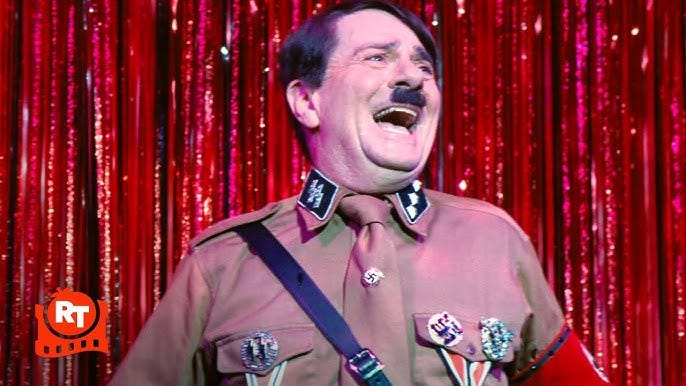
“Nazi” is an abbreviation for “National Socialist.” It’s not a synonym for “authoritarian,” “evil” or “Republican.” There are many ways for regimes to become oppressive and violent. National Socialism is just one of them.
Today “Nazi” is what S.I. Hayakawa called a “snarl word.” It does not describe, it condemns. Snarl words function as shorthand for “this is beyond the pale,” rather than any precise historical comparison.
That has consequences.
The point of any political movement is, or should be, to gain influence and power. Dressing the part of a twentieth-century villain doesn’t help achieve that. Neither does reducing your opponents to a cartoon bad guy.
Aspiring politicians need to understand the forces they’re dealing with. Turning those forces into caricatures may feel satisfying, but it obscures how power actually accumulates and how it is ultimately used.
My friend John Michael Greer wrote an excellent article on American Fascism and the rise of “Fred Halliot”. As he notes:
It’s easy, comfortable, and (for the manufacturers and distributors of partisan pablum) highly profitable to approach every political conflict in the simplistic terms of good versus evil. The habit of seeing political strife in those terms becomes a reliable source of problems when the conflict in question is actually between the good and the perfect—that is, between a flawed but viable option that’s within reach, and a supposedly flawless one that isn’t.
The hardest of all political choices, though, comes when the conflict lies between the bad and the much, much worse—as in the example just sketched out, between a crippled, dysfunctional, failing democratic system riddled with graft and abuses of power, on the one hand, and a shiny new tyranny on the other.
So how does an Adolf Hitler — ahem Fred Halliot — come to power. An economic collapse helps, but it’s not necessary. All you need is enough people convinced the system no longer works. And every day more Americans come to that conclusion.
A prolonged closure of Hormuz won’t just raise prices. It will change expectations. Energy costs spike. Supply chains tighten. Inflation returns just as growth slows. People who were already stretched start to feel it in ways they can’t ignore.
Meanwhile, politicians talk about resilience and patience.
They point to statistics that “prove” things are improving.
They imply their critics are misinformed, impatient, or worse.
That’s where Fred Halliot enters the picture.
Fred doesn’t talk about managing the crisis. He talks about ending it.
Not in technical terms, but in moral ones.
Someone is responsible. Someone made decisions that led to this. Someone needs to be held accountable.
He simplifies what others complicate.
He tells people the problem isn’t scarcity. It’s weakness.
Not constraints, but bad leadership.
Not trade-offs, but betrayal.
And he offers something the system no longer can.
Clarity.
Close the gap. Break the bottleneck. Reassert control.
The details don’t have to be fully worked out. That’s not the point.
The point is that, after sustained pressure and perceived inaction, people stop asking whether a plan is realistic. They start asking whether it feels decisive.
Especially if the alternative is more of the same.
The strongman is like a vampire. He can’t come in unless he’s invited.
And every day, more people of all political stripes are ready to make that invitation.
Each side increasingly sees the other not as wrong, but as dangerous. Not opponents, but threats. Not misguided, but actively evil.
You can see it in the language.
Politicians argue that extraordinary measures are justified because the other side is already using them. Gerrymandering becomes necessary because the other side is doing it. Investigations become retaliation. Norms become optional.
And once that logic takes hold, it spreads.
If the other side is illegitimate, then stopping them becomes more important than following the rules. If the system can’t deliver acceptable outcomes, then the system itself becomes the problem.
That’s the point where something changes.
People stop asking for better process. They start demanding results.
By any means necessary.
That doesn’t produce a strongman overnight. But it creates a market for one.
A strongman doesn’t ask for patience. He doesn’t promise compromise.
He takes control. And he gets things done.
Whether that figure actually appears, and what happens if he does, are still open questions.
What isn’t in question is the direction of the pressure.
The longer a system struggles to deliver results, the more attractive that kind of leadership becomes.
Cooling that pressure would require something we seem increasingly unable to provide: shared legitimacy, restraint, and a willingness to lose without treating defeat as catastrophe.
Those aren’t policy changes. They’re cultural ones.
They’re much harder to engineer.
And once the invitation is made, it’s very hard to take back.
Hindenburg didn't get elected because the mark was collapsing. He got elected because enough Germans decided the men running Weimar didn't deserve to. The economic pressure matters, but the actual threshold is moral — people don't invite the strongman when things are bad, they invite him when they decide the suffering is someone's fault.
Good, correct history. Good prognostication. It’s almost like you know what you’re talking about(😆), which you obviously do, Mr. F.