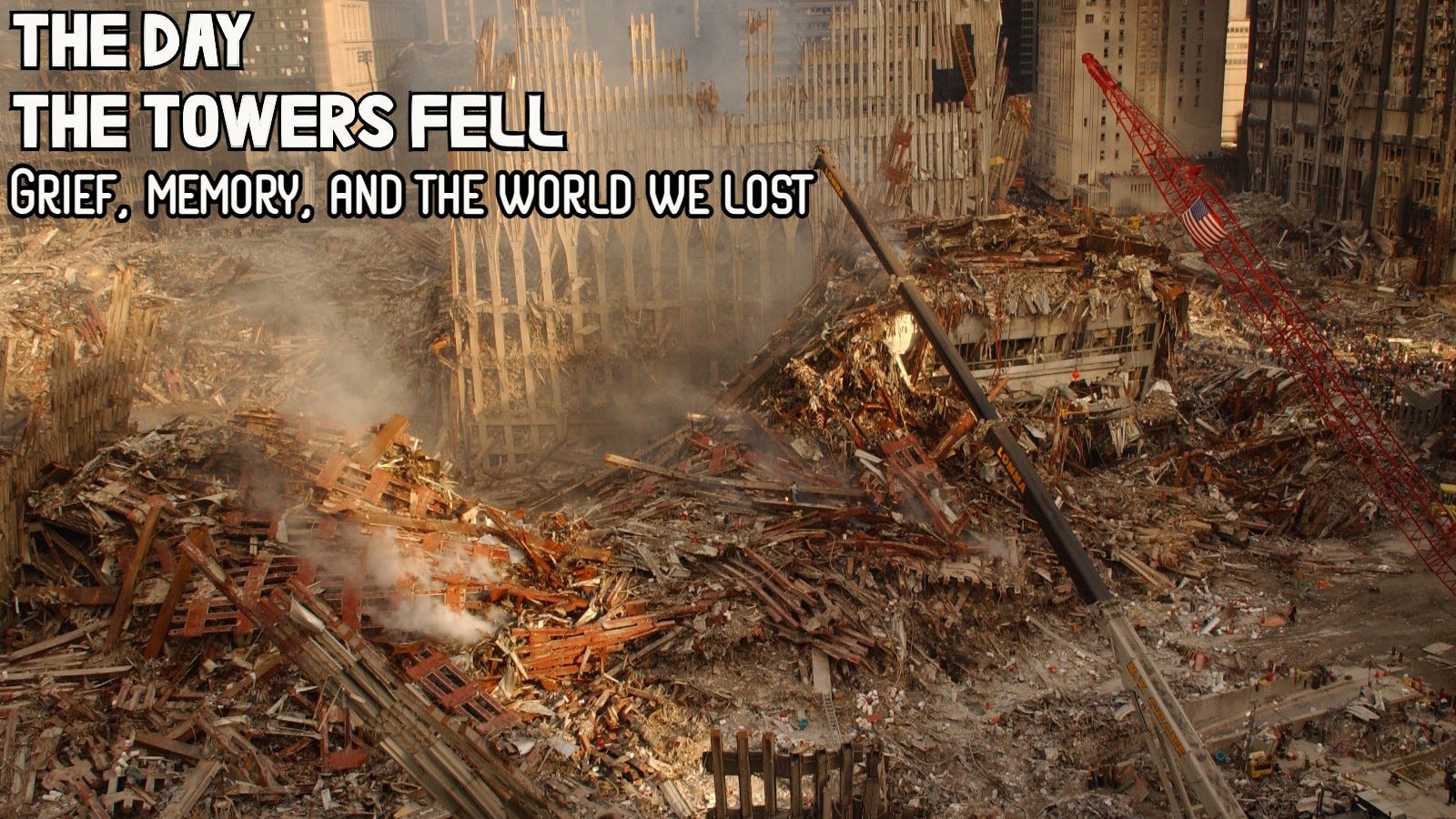
The Day the Towers Fell
Grief, memory, and the world we lost
Four days ago, a group nobody had ever heard of knocked down the World Trade Center. Today we know who Al Qaeda is. We also know how a destroyed skyscraper smells: sharp and metallic, with hints of aerosolized toner cartridge, melted nylon carpet, burning hair, and other things you try hard not to identify. The stink is bad in Brooklyn. Here in Manhattan, it’s worse.
The subway is running again. Several stops are closed because they are now full of rubble. I was on the last train out of New York, on my way home from my third shift job. A stony-faced man got on the E train at City Hall and said two planes had crashed into the World Trade Center. At the next stop, closer to the towers, the new riders were weeping. I had my head between my legs, trying not to faint, trying not to think about my girlfriend, who had just come into lower Manhattan for her first shift job.
Voltaire is taking the stage. It’s a Goth benefit. Lots of people are drinking, including Voltaire. I’m not. I’ve been sober for six years, and I know a drink won’t make me feel better. I keep telling myself that. Voltaire puts down his drink, picks up his guitar, and starts playing “Feathery Wings.” It’s one of his signature songs. So is “When You’re Evil,” but he isn’t going to be playing that one tonight.
Kathy isn’t here. She saw the second tower get hit and felt the Brooklyn Bridge sway with its collapse as she walked home. We usually go out every weekend, but she didn’t feel up to it tonight. I didn’t feel up to staying home.
Voltaire chokes back a sob at the second line, “And you, there on the wall, where will you go to once you fall?” He stops, tunes his guitar, and begins again. I’m choking back sobs myself. I haven’t cried since she got back to our apartment and I knew for certain Kathy was still alive.
I was back at the office yesterday. I spent my entire shift going through Outlook contacts and removing any with World Trade Center addresses. Every deleted address meant somebody had to find a new office. Or that they no longer needed one. I couldn’t stop thinking of Kafka. A dominatrix friend of mine is here. She told me over half her clients worked in the WTC and she’s still not sure how many she lost.
Voltaire gets all the way to
The taste of tears
The sting of pain
The smell of fear
The sounds of crying
before the song breaks down to the sounds of crying. He pauses for a moment to catch his breath. On the third try he makes it through the song without bawling. Most of the audience does not. We stand in the dark mourning. For one brief moment, there is no history, there is no politics, there is no War on Terror. There is only grief.
In hindsight 9/11 seems inevitable. At the time it was unthinkable. The Soviet Union had been gone for a decade; America was now the world’s sole superpower. Business was booming in New York and jobs were plentiful. The Internet was redefining free speech; Usenet was home to Nazis, Communists, and everything in between. We had won the Gulf War handily; the 1993 World Trade Center blast was unnerving, but less bloody than the homegrown 1995 bombing in Oklahoma City. On September 10, 2001, the future seemed brighter than it has since.
It’s difficult to explain how confident we were at the dawn of the 21st century. We believed progress was inevitable as certainly as postwar SF writers believed we would soon be building cities on the moon. We expected that tomorrow would be better than today because, for years, it had been. There was plenty of cynicism among New Yorkers, as always. But on September 10, 2001, it was the cynicism of prosperity and comfort, more affectation than conviction. On September 15, we no longer had those soothing illusions.
Mayor Rudy Giuliani had never been popular among liberal New Yorkers. But on 9/11 he presented himself as a strong, assertive leader who helped guide us through the chaos. The club kids and limousine liberals didn’t necessarily like Rudy more, but they gained a certain degree of grudging respect for him.
The Big Apple continued, however, to look unfavorably on George W. Bush. In the weeks that followed, many Americans embraced the PATRIOT Act’s expanding security state as the price of safety. Left-leaning New Yorkers feared that the powers created to fight terrorists would eventually be turned on political opponents. But across the political spectrum we all agreed on one thing: the world no longer felt like a safe place.
The entertainment industry’s response to 9/11 was at first notable by absences. Spider-Man’s November 2001 release was postponed so producers could remove images of the Twin Towers. The Simpsons pulled its 1997 episode “The City of New York vs Homer Simpson” from syndication because it took place at the World Trade Center. Clear Channel circulated a list of “lyrically questionable” songs that included Paul McCartney’s “Live and Let Die,” AC/DC’s “Dirty Deeds Done Dirt Cheap” and Simon & Garfunkel’s “Bridge Over Troubled Water.”
Buildings disappeared from films. Television episodes vanished from rotation. Songs acquired meanings their authors had never intended. The country was still trying to decide which reminders were comforting and which were unbearable. For months, America seemed afraid of its own reflection. We could not make 9/11 go away, so we tried not to look at the empty space they left behind.
According to Elisabeth Kübler-Ross’s Stages of Grief, Denial gives way to Anger. By October 7, 2001, we were at war with Afghanistan. Operation Enduring Freedom led to two decades of insurgency while American troops kept a tenuous hold on Kabul. On March 20, 2003 we launched a “Shock and Awe” bombing campaign against Iraq that culminated in an eight-year occupation.
Whether these wars made Americans safer remains a matter of debate. What they unquestionably did was transform grief into action. We could not strike back at the nineteen hijackers, but we could invade countries, topple governments, and convince ourselves we were still in control.
By 2008, Americans were mired in a financial crisis and tired of the Iraq and Afghanistan War. Bush’s approval ratings had collapsed, and many Americans felt we had taken a wrong turn after 9/11. If Anger had failed to heal us, perhaps Hope could. Barack Obama made “Hope and Change” his slogan. Many Americans hoped that by electing the first Black president, we could close the books on both our troubled racial history and the politics of the post-9/11 era.
Kübler-Ross’s third Stage of Grief is Bargaining. Terminally ill patients desperately try to negotiate or make deals in an attempt to regain predictability and avoid pain. They promise to change their lives if only they can live to see their children graduate; they promise to be better people if only they can get through this crisis.
Nations bargain too. For many post-9/11 Americans, Obama was our promise to do better: by electing the first Black president, we hoped to move beyond the ongoing wars. Perhaps we could heal our racial divisions; perhaps we could recover from the financial crisis; perhaps we could repair what the post-9/11 years had broken.
But, as Kübler-Ross reminds, Bargaining is often futile. Under Obama’s watch the wars continued. Guantánamo remained open. The surveillance state continued to expand. The recovery from the financial crisis largely benefited corporations and high wealth investors, while working Americans continued to struggle. And so Bargaining gave way to the fourth Stage of Grief, Depression.
In 2001, the suicide rate was 10.7 per 100,000 Americans. By 2016 that number had risen to 13.5, a 30% increase.[1] In 2024 it was between 13.7 and 14.1. In 2015 Anne Case and Agnus Deaton, two Princeton University economists, coined the term “deaths of despair” to describe deaths by suicide, drug overdoses, and alcohol-related liver disease and cirrhosis. The phrase resonated because millions of Americans felt trapped between a future that had failed to arrive and a past that could not be recovered.
By the end of Obama’s presidency, the legislative branch was plagued by gridlock and the electorate had become largely polarized. Trump’s 2016 victory kicked those trends into overdrive. His voters hoped he would Make America Great Again; his opponents remembered his role in perpetuating the “fake Obama birth certificate” myth and his calls to execute the Central Park Five. That split has not healed to this day.
September 11 did not “cause” the victories of either Barack Obama or Donald Trump any more than JFK’s assassination led to Watergate and the Nixon resignation. Historical events rarely have any single cause. But September 11, 2001 and November 22, 1963 both marked the death of an era and the birth of another. Both shattered assumptions America had come to take for granted and created the conditions for new cultural movements to arise.
There were many conspiracy theories floating around well before Lee Harvey Oswald carried his rifle to Dealey Plaza. Americans had spent decades worrying about Communist plots, and those fears were often justified. We knew the Soviets lied. But after the Warren Commission report, many Americans came to believe that our government was lying as well. Combined with mounting evidence that officials had misrepresented the course of the Vietnam War, this pervasive distrust set the stage for Nixon’s fall.
There had been questions about the role “hanging chads” played in George W. Bush’s 2000 victory. I remember seeing images Dubya’s head in crosshairs and the caption “Who Would Jesus Assassinate?” both online and in the East Village streets. 9/11 did not create political polarization; if anything, it briefly interrupted it. For a few weeks, grief overshadowed politics.
There were people who believed 9/11 was an inside job from the beginning, although not so many as today. Great catastrophes create a powerful temptation to find simple, easily digestible answers. The possibility that nineteen men with box cutters and determination can alter history is more frightening than a vast conspiracy. Conspiracies imply control. Randomness, incompetence, and vulnerability do not.
So when do we move on to Kübler-Ross’s final Stage of Grief, Acceptance? As often happens with grief, we have circled between the earlier Stages for years. We may come to terms with 9/11 only after we face down a new catastrophe, or after the World Trade Center fades from living memory like Pearl Harbor. Collective grief is part of our cultural birthright as much as collective joy. It never goes away; it simply changes shape.
You’re gone from here
Don’t leave from here
Don’t leave me here
I hate it here
You’re gone from here
Don’t leave me here
I need you here
I need to see you smile[2]
[1] Holly Hedegaard, M.D., Sally C. Curtin, M.A., and Margaret Warner, Ph.D. “Suicide Rates in the United States Continue to Increase.” NCHS Data Brief No. 309, June 2018. At National Center for Health Statistics, https://www.cdc.gov/nchs/products/databriefs/db309.htm.
[2] Aurelio Voltaire, “Feathery Wings.” (2000)