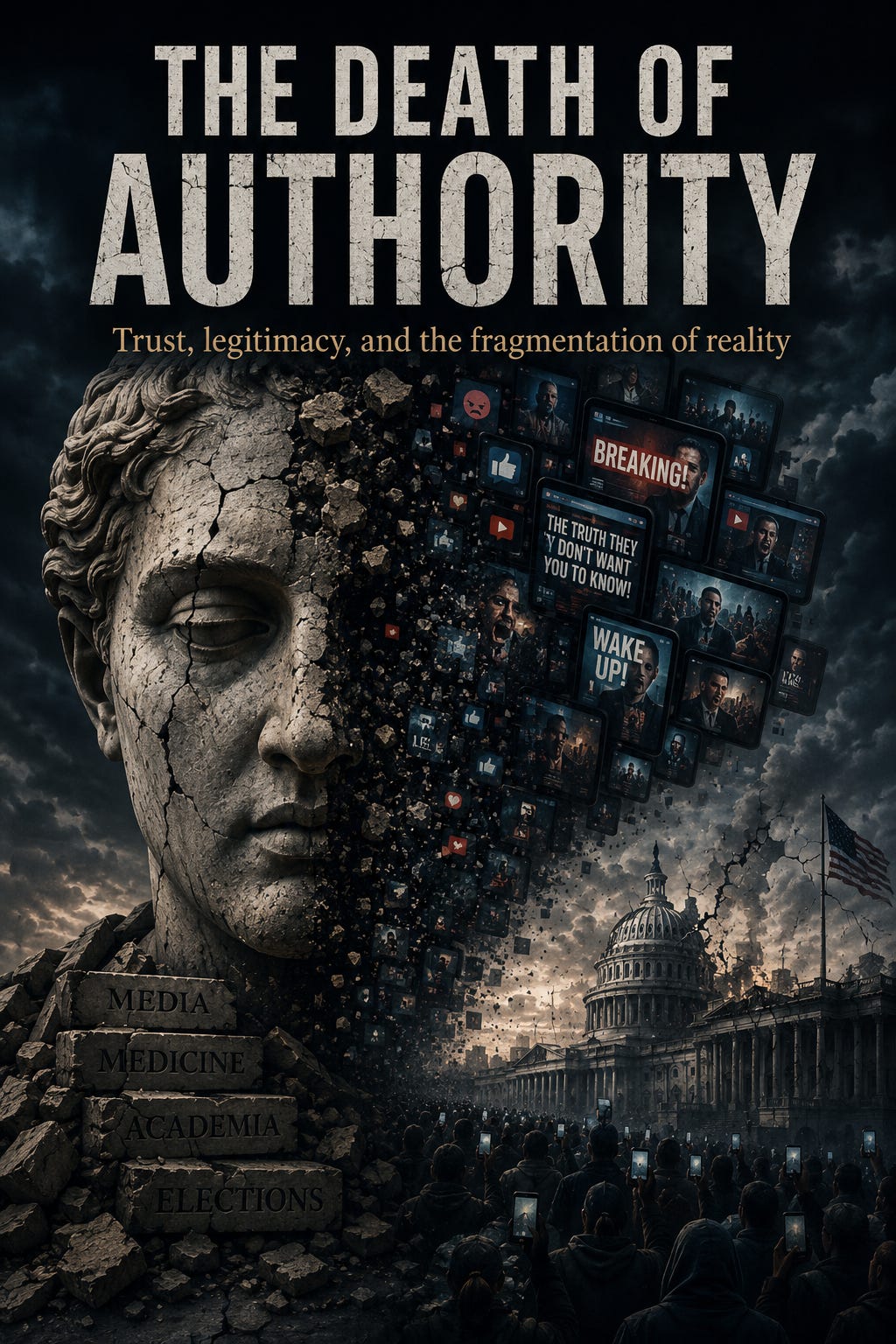
The Death of Authority
Trust, legitimacy, and the fragmentation of reality
I was 16 years old when Walter Cronkite retired in 1981. He had been the anchorman of the CBS Evening News throughout my life. I vaguely recall his narration of the Apollo 11 and Apollo 13 moon missions. I remember with certainty his daily signoff: “And that’s the way it is.” And while I was not born at the time, I repeatedly saw the clip of Cronkite wiping tears from his eyes as he informed the nation that President Kennedy was dead.
For Americans in the 1960s and 1970s, Cronkite was more than an anchorman; he was a voice of authority. Americans across the political spectrum trusted Cronkite to tell the truth, the whole truth, and nothing but the truth. As the broadcast ended, we really believed that was the way it was. No anchor since his retirement has had the gravitas of Walter Cronkite, or of Edward R. Murrow before him.
In 1981, television viewers had a choice between a handful of channels. All the nightly news broadcasts came on at 6:30 pm, following the local news broadcast. If you had cable, you could watch the new 24-hour news channel, CNN. Our township did not have cable. We did, however, subscribe to both the Montrose Independent and the Binghamton Press. I could also walk to the town library to read the Scranton paper and the Sunday New York Times.
Modern users scrolling through their smartphones can access news outlets from around the world. They can find Substack writers, TikTok explainers, YouTube analysts, and anonymous accounts with strong opinions. If they are in a hurry, they can rely on an AI summary. Yet while our access to news information is at a historical high, our institutional trust is lower than ever. We have somehow managed to mix skepticism and gullibility, only to come up with Alex Jones.
News has become decentralized, and with it, authority. Instead of a trusted news anchor or a nationally recognized newspaper, we can choose between a wide range of authorities. And we often choose those authorities not so much because of their knowledge or credentials, but because they tell us entertaining stories that help us make sense of our world.
An October 2025 Pew Research poll found that around 52% of Americans under 50 have a lot of or some trust in the national news media. Among Americans under 30, 51% trust the national news and 50% trust social media.[1] Those who were not born in the era of centralized authority and editorial gatekeeping see little difference between journalists and influencers. To them, both are information salespeople competing for their attention.
In the pre-Internet world, we knew what we did not know. Most of us finished our science education in high school, so we trusted credentialed scientists. We never shouted, “I trust the science!” because that was taken for granted. Today we can find alternative sources of medical and scientific information with a quick search. You can trust the science that best suits your argument. You may not understand what the paper is saying, but you can quote the data that seems to validate your ideas. In a world of clips, out of context statistics barely raise an eyebrow.
This is not to say that we thought scientists infallible. By the 1970s magazines regularly made jokes out of 1950s ads proclaiming, “4 OUT OF 5 DOCTORS RECOMMEND OUR CIGARETTES.” Mad scientists had been stock figures in horror films since the silent era—and in horror literature since Mary Shelley wrote Frankenstein. But we could recognize human fallibility while acknowledging scientific expertise. Today, the public’s view of science and academia has grown increasingly distrustful.
Peer-reviewed journals were once the gold standard for academic information. In 2018, several academics published peer-reviewed articles like “Going in Through the Back Door: Challenging Straight Male Homohysteria, Transhysteria, and Transphobia Through Receptive Penetrative Sex Toy Use” and “Who Are They to Judge? Overcoming Anthropometry and a Framework for Fat Bodybuilding.”[2]
These works challenged the field of what James Lindsey, Helen Pluckrose, and Peter Boghossian called “grievance studies.” They were taken by many outside the ivory tower as proof that academia had been taken over by lunatics and ideologues. A few decades earlier, this controversy would have been of interest only to a handful of scholars. The Internet brought it to mainstream attention and widespread scorn.
Pluckrose, Lindsay and Boghossian tricked a few journals in a niche field into publishing satirical and silly material. In academic circles, their prank likely would have been seen as an entertaining joke shared among professors. Outside those circles, it became evidence that academia was rotten to the core.
In April 2020, COVID-19 lockdowns had just begun around the world. 71.5% of Americans said at that time that they trusted physicians and hospitals. By January 2024, that number was down to 40.1%.[3] Doctors, once among America’s most trusted professionals, came to be seen as lackeys of big pharma and big government—not just incompetent but actively taking money to promote dangerous and toxic vaccines.
The split between pro-vaccination people and vaccine skeptics played out largely along a liberal/conservative fracture line. In the late 20th century, the alternative medicine community had a largely left-leaning slant; conservatives were more likely to trust their local doctors. COVID turned that long-standing distinction on its head. And once the COVID vaccine became a tribal symbol, the split was irreparable.
Heavy-handed suppression of COVID “misinformation” and public shaming from pro-vaxxers and celebrities only served to convince skeptics that they were under attack—which meant that they were right and their opponents were hiding something. The vaccine was recast not as an effort to stop an epidemic but as a depopulation plot to destroy America from within. Those who supported the vaccine were dupes and those producing it were complicit in a pending genocide.
The COVID vaccine was created on short notice by frightened epidemiologists working with limited data. There were reasons to be concerned about the potential danger, and about the economic and social costs of lockdowns. But once the battle lines hardened, any kind of reasoned discussion was impossible.
Nearly three months after the first lockdowns, George Floyd died in the custody of Minneapolis police. Protests began in Minneapolis and soon spread to other locations. Many of the people protesting were unemployed and had been cooped up for weeks. The iconic image of a police officer kneeling on Floyd’s neck triggered outrage—and gave lockdown-weary Americans a chance to go out in the streets.
The comments from public health officials were mixed and unclear. Some urged protesters to stay home lest they create a “super-spreader” incident. Others claimed that racism was also a health hazard and protesting would be acceptable so long as protesters stayed masked and tried to keep their social distance as much as possible. Ultimately law enforcement agencies in most cities realized that there would be no way of keeping protesters off the streets without a violent response that might very well trigger a civil conflict.
The ensuing media coverage of protests, riots, and unrest was widely criticized. In one infamous incident, a CNN reporter discussed the Kenosha riots while a building burned behind him and a chyron announced, “Fiery but Mostly Peaceful Protests.” CNN had enjoyed a “Trump bump” during the first administration. Its coverage cemented CNN’s reputation among conservative viewers as ideologically hostile and anti-American. The riots marked the beginning of a precipitous decline; by 2025 its primetime audience was down 45% from its 2017 peak.[4]
America came into the 2020 presidential election with academia, media, and medicine in delegitimization spirals. After the election, we could add our electoral process to the wounded list. A week after the election, the overwhelming majority (93%) of Biden voters said they were confident that the election was conducted fairly and accurately, but only 29% of Trump voters said the same.[5]
We saw a similar pattern in 2016. After that election, 42% of Democrats polled by YouGov believed the election was rigged; 57% either said they would not accept Trump as the legitimate president or they were unsure.[6] An electoral democracy must have a trusted electoral process and an understanding that everybody involved will honor the results even if their candidate does not win. This is no longer a given in America.
After Clinton’s 2016 loss, many political cartoonists drew Trump and Putin together in compromising positions; Putin walking Trump on a leash, Putin controlling Trump with a joystick, Putin as a puppeteer pulling Trump’s strings. The message was clear: Trump is beholden to foreign interests and is not to be trusted. Most Democrats did not reject the election results outright, but they made it clear that they did not consider him the man in charge at the White House.
On May 9, 2017, Trump dismissed former FBI Director James Comey, who had been investigating links between Trump associates and Russian officials. Eight days later, the FBI launched an investigation against Trump for obstruction of justice; Robert Mueller began an investigation into possible Russian interference in the 2016 election.
For the Democrats, this was proof that Trump was a traitor. For the Republicans, it was proof that the Democrats would stop at nothing to remove Trump from office. This divide only deepened after the Report was released in 2019.
The Mueller Report found that Russia had interfered in the elections through “disinformation and social media operations within the United States” and that it had hacked computers to gain access to emails from the 2016 Clinton campaign. But it also noted that the “investigation did not establish that members of the Trump Campaign conspired or coordinated with the Russian government in its election interference activities.”
This report provided both sides with ammunition for their cause. Democratic Rep. Ayanna Pressley said, “What we have seen today does not exonerate the occupant of the White House from obstruction of justice nor abuse of power.” Louis Murray, an adviser to Trump’s 2016 campaign, said “The findings could not have been clearer; there was no collusion. It’s time to move forward.”[7]
COVID continued to cast a long shadow over the 2020 election. Controversies over partisanship, accusations of media bias, and conflicting narratives about fraud led to widespread distrust of mail-in ballots, particularly among Republicans. Twitter’s censorship of a New York Post story about the Hunter Biden laptop scandal led many to believe that social media platforms were in collusion with the Democrats to throw the election in Biden’s favor.
Joseph Biden took office under a cloud of controversy as angry Trump supporters stormed the Capitol. News outlets were quick to denounce the “Election Lie” and condemn the protesters. Despite their efforts, many Americans still believed that the election had indeed been stolen. The J6 protesters were seen as treasonous thugs by most Democrats; many Republicans saw them as heroes who tried to stop a coup.
Trump’s 2024 victory over Kamala Harris garnered a slightly more muted reaction from the media and Democratic politicians. Four years of attacking “election denial” left them in a place where disputing the results would look hypocritical. Influencers and online commenters were quick to attack them for “playing nice” with a tyrant. They shared stories of Elon Musk using Starlink to hijack voting machines and of unnamed “election fraud experts” finding evidence of Trumpian tampering.
Decentralized media has allowed many voices to speak; the structure of social media has ensured that the loudest and most confrontational receive the lion’s share of attention; the nature of algorithms helps ensure that viewers primarily see material that confirms their preconceptions and material that insults them. We still seek authority, but increasingly we prefer authority that tells us what to feel over experts that tell us what to think. And because our new authorities must compete for attention, they often tailor their material with virality rather than veracity in mind.
Modern institutions have been forced to adapt to tribal loyalty, attention incentives, emotional engagement, and ideological reinforcement. This is not due to coordinated evil or conspiracy so much as the demands of the attention economy. Emotionally loaded content and outrage bait spread faster and generate greater engagement. Calling a politician a Russian traitor or his opponents Soros puppets will get you more attention than an honest assessment of his strengths and weaknesses. Many news writers now behave more like content creators than journalists.
When you believe your opponents are ontologically evil, even openly anti-democratic behavior becomes justified as necessary self-defense. Gerrymandering—manipulating districts to maximize your party’s representation—has been an issue since Massachusetts Governor Elbridge Gerry drew a salamander-shaped district to benefit his Democratic-Republican Party. Parties historically used it to their advantage but publicly denied deliberate vote manipulation.
Texas and Florida have both recently redistricted their states with the intent of strengthening Republican representation. When the Supreme Court refused to stop the Texas map in December 2025, Governor Greg Abbott said in an official statement:
We won! Texas is officially—and legally—more red…The new congressional districts better align our representation in Washington D.C. with the values of our state. This is a victory for Texas voters, for common sense, and for the U.S. Constitution.[8]
In response to these actions, Democrats have begun a push to gerrymander their districts to reduce Republican representation. One Democratic representative said the party needs “to fight fire with fire.” Another said, “I’m not going to fight with one hand tied behind my back.”[9]
A permanently delegitimized society becomes politically unstable and emotionally exhausted. What results is rising cynicism, a distrust of expertise, a collapse of social cohesion, and a growing sense of apathy punctuated by outrage. There is neither hope of ending the conflict, nor any particular interest in ending it.
Perhaps the best model for our future might be the final stages of the Soviet Union. By the end of the 1980s, it was clear to everyone that the Great Experiment was on its last legs. Politicians continued to make speeches and Pravda continued promising a bright future for its dwindling readership. But they were irrelevant. People shuffled through their days hoping for little more than survival.
In 1996, five years after the Soviet Union’s collapse, Pravda finally closed its doors. A newspaper that once served 11 million readers daily was down to less than 200,000 subscribers. Its owners, two Greek millionaires, complained “the editors and reporters drink too much. They publish nothing worth reading” and replaced the old paper with a new tabloid, Pravda Pyat (Pravda Five), a weekly publication that published leftist articles but specialized in crime, sex, and death.[10]
[1] Kirsten Eddy and Elisa Shearer, “How Americans’ trust in information from news organizations and social media sites has changed over time” at Pew Research Center. https://www.pewresearch.org/short-reads/2025/10/29/how-americans-trust-in-information-from-news-organizations-and-social-media-sites-has-changed-over-time/
[2] Helen Pluckrose, James A. Lindsay, and Peter Boghossian, “Academic Grievance Studies and the Corruption of Scholarship” (October 2, 2018) at Areo magazine. https://web.archive.org/web/20181010131220/https://areomagazine.com/2018/10/02/academic-grievance-studies-and-the-corruption-of-scholarship/.
[3] Roy H. Perlis et al, “Trust in Physicians and Hospitals During the COVID-19 Pandemic in a 50-State Survey of US Adults” at JAMA Netw Open. 2024 Jul 31;7(7):e2424984. doi: 10.1001/jamanetworkopen.2024.24984.
[4] Brian Flood, “CNN ratings down bigly from 2017 ‘Trump bump’ through 2025 amid changing media landscape” at Fox News. https://www.foxnews.com/media/cnn-down-bigly-from-2017-trump-bump-2025.
[5] Robert Griffin, Mayesha Quasem, “Crisis of Confidence: How Election 2020 was different” (June 2021) at Democracy Fund Voter Study Group. https://www.voterstudygroup.org/publication/crisis-of-confidence.
[6] Sean Davis, “Nearly Half of Democrats Think Election Was ‘Rigged’” (November 18, 2016) at The Federalist. https://thefederalist.com/2016/11/18/nearly-half-democrats-think-election-rigged/.
[7] Sean Philip Cotter, “DOJ: Trump campaign didn’t collude with Russians.” Boston Herald, March 24, 2019.
[8] Greg Abbott, “Governor Abbott Statement on SCOTUS Redistricting Ruling” (December 4, 2025) at Office of the Texas Governor. https://gov.texas.gov/news/post/governor-abbott-statement-on-scotus-redistricting-ruling.
[9] Owen Dahlkamp, “House Democrats, California leaders weigh tit-for-tat redistricting if Texas Republicans redraw maps.” Texas Tribune, July 3, 2025. https://www.texastribune.org/2025/07/03/redistricting-texas-california-democrats-retaliation-trump-newsom/
[10] Michael Specter. “Russia’s Purveyor of ‘Truth’, Pravda, Dies After 84 Years.” New York Times, July 31, 1996.