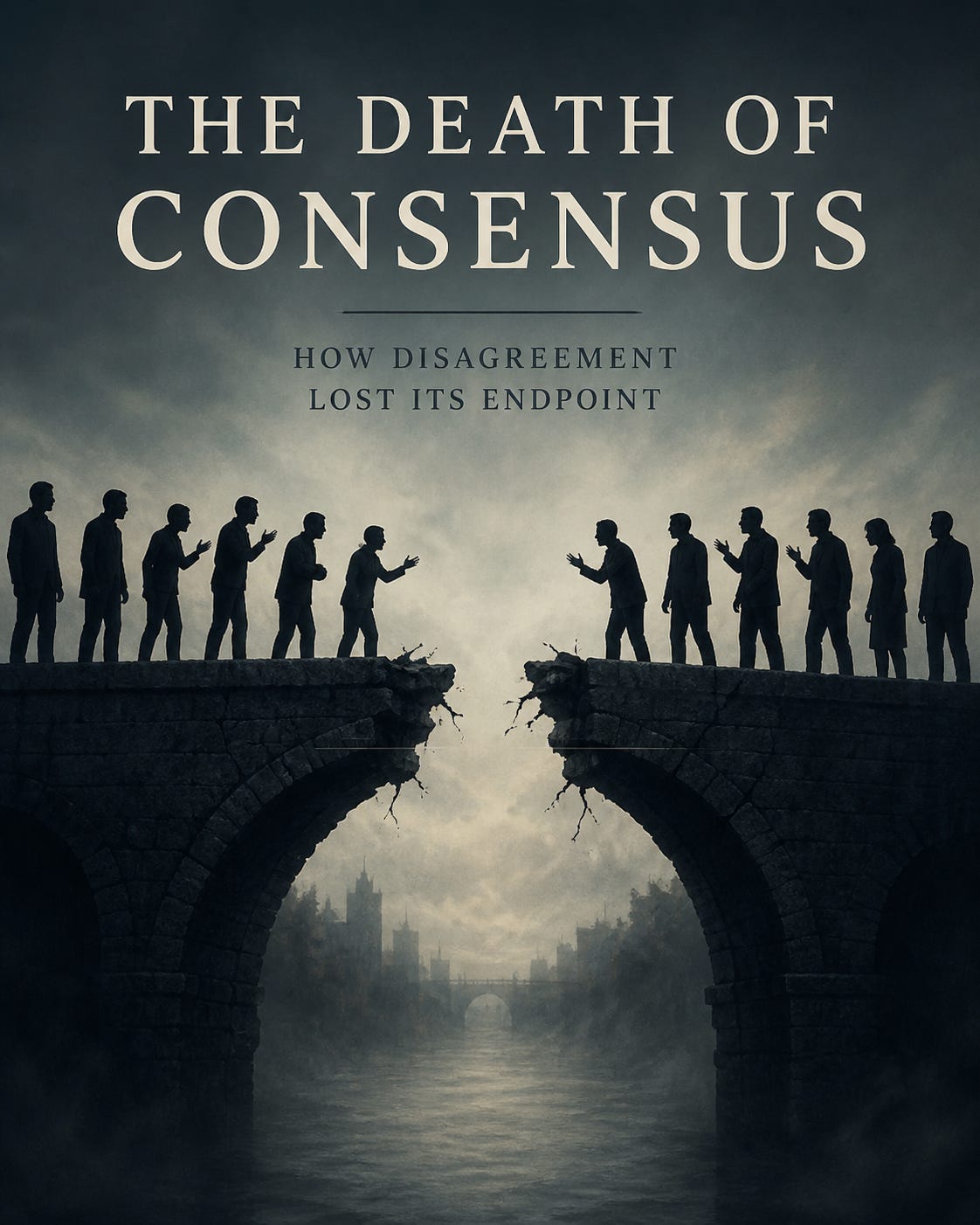
The Death of Consensus
Why we no longer expect to agree
Disagreement is not only tolerated in pluralistic societies—it’s expected. A free society produces many different opinions, including contradictory ones. Even heated but nonviolent disputes are accepted. But these debates traditionally took place within shared constraints. People might differ on solutions, but they agreed on the problem. They might call a politician a scoundrel, but they accepted the election results. These differences could be managed because they operated within a common reality.
Today that common reality is fragmenting. We now disagree on what counts as evidence, how we can verify evidence, and on whether we can trust arbiters like scientists, academics, and election officials. This is a very different kind of disagreement. We are finding ourselves increasingly unable to discuss important matters because we can no longer agree on the grounds of debate.
Without common standards of verification or trusted intermediaries, there can be no agreed process for resolving disputes. Our arguments no longer converge, and disagreements persist because we have no shared method to settle them. We no longer simply disagree on the facts—we operate within different interpretive systems. Consensus was always difficult. Without a mutually accepted framework, it becomes impossible.
We no longer argue about conclusions. We argue about reality itself.
Before you can have shared opinions, you must share conditions for forming opinions. What are we talking about? What authorities do we both trust? What common ground do we have, and where do we disagree? When you answer those questions, you can work together on ironing out your differences.
In our current environment, all these conditions have eroded. We not only struggle to find mutually respected authorities and common ground—we’re not even sure of what our opponents are talking about. In such an environment, relationships become fragile and easily broken.
We no longer watch the same broadcasters or read the same newspapers. We get our information from our chosen sources—from voices that tell us what we want to hear. Events are interpreted through multiple contexts. Disagreements begin not at the level of what should be done; we cannot even agree on what the event means.
The erosion of institutional trust has left media, academia, science, and government more distrusted than ever. These institutions are now seen as biased, captured, or illegitimate—especially when they produce unwelcome conclusions. Our sources are contested and our authorities are no longer respected. This makes it nearly impossible to gather evidence that both sides will respect. You can’t have a debate when your opponent dismisses your sources out of hand as “fake news” or “AI-generated.”
Groups rely on narratives to give their community and their lives meaning. Each narrative is internally coherent and validated within its own network. These narratives are structured, self-reinforcing systems of interpretation. To members they look like obvious truths; outsiders dismiss them outright. Building bridges between competing narratives is nearly impossible—especially since few on any side appear interested in bridge-building.
Competing realities exist not because they are logically resolved but because they are socially maintained. Their stability comes from reinforcement mechanisms. Accepting the group’s reality is rewarded; questioning it is punished. These rewards and punishments may seem innocuous—likes and affirmation vs. criticism and possible exclusion. But even subtle stimuli can have a profound effect with constant repetition.
Algorithms prioritize engagement. They show users content that confirms their suspicions and content that provokes emotional reactions. Viewers rarely encounter opposing opinions in neutral form; they are more often framed with ridicule or hostility. This encourages similar insulting and hostile responses, increasing engagement and retention. Both negative and positive beliefs are repeatedly reinforced, deepening the divide between different interpretive worlds.
Within online communities, “correct” interpretations and beliefs are met with affirmation and agreement. Dissent is discouraged or filtered out. Reality is not tested against external standards; it is validated within the group. As external validity weakens, internal coherence strengthens. Critics are recast as biased, hostile, or malicious persecutors. Challenges are interpreted not as corrections but as threats.
Over time, these systems develop mechanisms to resist correction. Sources that challenge the group’s worldview are dismissed in advance, and conflicting information is dismissed as deceptive. This creates a form of cognitive insulation in which contrary evidence is rendered illegible. Competing realities are not tested against each other—they are sealed off from meaningful comparison.
The longer these communities co-exist in separate realities, the higher the barriers they build against shared truth. Fragmentation becomes self-sustaining, and reality divides into durable parallel systems. As these parallel systems stabilize, the mechanisms that once allowed them to reach agreement begin to fail.
Consensus does not require unanimous agreement, nor does it imply that everyone is satisfied with the outcome. At its core, consensus is a process for resolving disagreement—one that depends on compromise and negotiation. It is achieved not through jointly held beliefs, but through shared methods.
Through consensus, disagreements narrow over time. Old grievances are slowly dropped, and new problems are resolved as they happen. You can expect a certain degree of grumbling before, during, and after the process is settled. But a consensus-based approach distributes power in such a way that every member participates, and all members must iron out their differences together. There can be no consensus without cooperation.
In a world where consensus no longer functions, arguments loop instead of resolving. There is no accumulation of agreement, simply ever-growing divides between warring parties. Doubt becomes a tool, not just a byproduct. Groups amplify uncertainty, heighten inconsistencies, and question motives. This strategic doubt does not prove truth, but it prevents calls for closure. If nothing is settled, then nothing must be conceded.
In the absence of functioning consensus, pressure builds for alternative forms of decision-making. Some turn toward figures or systems that promise to bypass disagreement altogether and impose order directly. When politicians and voters are no longer capable of agreeing to disagree, they frequently find their decisions made by a strongman who does not care about their opinion, their input, or their identity.
Parallel realities can exist and thrive separately. Faith communities—Hasidic Jewish neighborhoods, TLM Catholic congregations, Hindu temples, and Muslim masjids—can be found in many cities. They preserve their traditions and worldviews with little pushback or tension from outsiders. But they share several key features: clear boundaries, stable authority, and limited engagement with opposing perspectives.
By contrast, modern identity-based communities are formed and maintained within a highly interactive digital space. They are constantly exposed to opposing views, but lack the shared standards or authority needed to resolve differences. Under these conditions, parallel realities are less likely to coexist and more likely to collide.
Modern digital communities share the same virtual space and respond to many of the same events. They are not set apart; they are interwoven with neutral and hostile groups. Indeed, many of these identities make persecution and conflict markes of their identity. Were they to separate themselves entirely from their detractors, they would lose a key part of their selfhood.
In digital space, there is no buffering or distance between outsiders. This causes constant friction over the same issues. Virtual proximity does not lead to understanding; it simply produces repetition of conflicts. Disputes are never settled, only revisited. Because the same terms carry different meanings across groups, they often argue past each other. What they see as disagreement is, at its deepest level, interpretive incompatibility. In such an environment, conflict can only become continuous, self-reinforcing, and inescapable.
Those patterns are not confined to small online communities; they have become an integral part of mainstream political identity. The divide between America’s left and right has become epistemic. Liberals and conservatives increasingly operate not only with different opinions, but from different realities.
A growing number of Americans no longer treat elections, public health information, and economic data as definitive. They disagree about what happened and what counts as valid evidence. Competing groups offer radically different interpretations of events and reject out of hand any idea that originated with their opponents. Public discourse has become fragmented and unstable. An electoral democracy can only sustain itself so long as its voters have at least a baseline level of trust in elections and the governing process.
Institutional legitimacy is now conditional. Some shout ardently that they “trust the science;” others believe that science has been corrupted by multibillionaires whose primary goal is keeping the populace sick for profit. Both groups raise valid points. Epidemiology and vaccinations have saved millions of lives; the pharmaceutical industry is highly profitable and has been involved in numerous ugly drug marketing scandals. But when both sides adopt absolute positions, those debates end in noise rather than resolution.
As politics becomes identity, its purpose shifts. There is less room for problem-solving or compromise between colleagues. Questions become struggles between Our Side and Their Side—and the only goal is to take and hold power against the enemy. Systems designed for shared reality struggle to function under fragmentation. Our democracy can handle polarization. It cannot survive the loss of the mechanisms that resolve conflict.
A society divided by opinion can function. A society divided by reality cannot.