The Discipline of Desire
Courtly love and the limits of sexual liberation
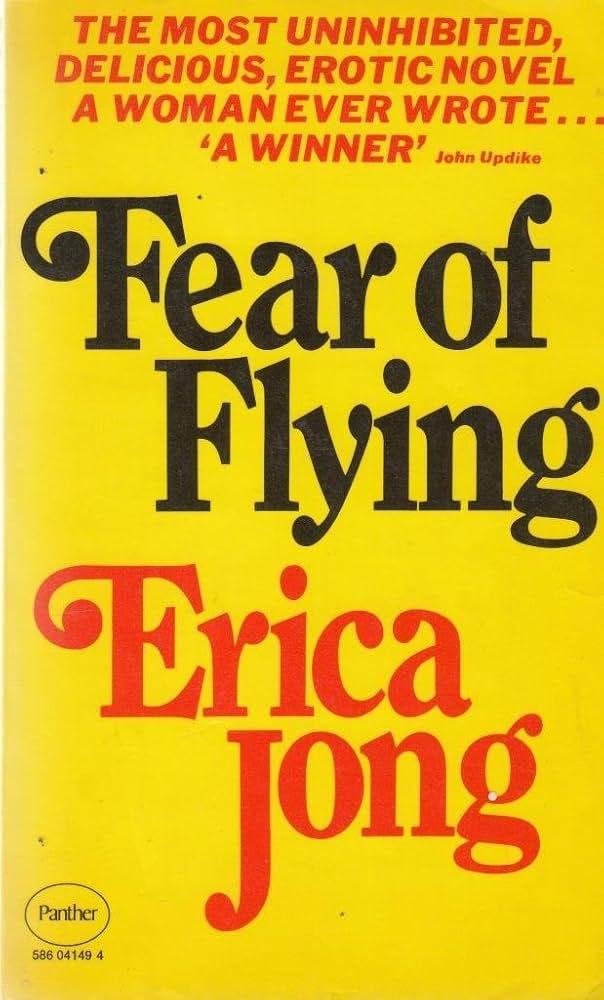
My response to all this was not (not yet) to have an affair and not (not yet) to hit the open road, but to evolve my fantasy of the Zipless Fuck. The zipless fuck was more than a fuck. It was a platonic ideal. Zipless because when you came together zippers fell away like rose petals, underwear blew off in one breath like dandelion fluff. Tongues intertwined and turned liquid. Your whole soul flowed out through your tongue and into the mouth of your lover.
Erica Jong, Fear of Flying (1973)
When Erica Jong published Fear of Flying, it wasn’t simply provocative—it was emblematic of a profound cultural shift. Effortless, unencumbered sexual connection had only recently entered public consciousness as an ideal.
Fifty years later, Jong’s bestselling novel seems almost innocent. She, like many other 1970s thinkers, hoped that sexual freedom would culminate in a spontaneous unity. We would become one with the other and with ourselves as bodies and souls flowed together without friction.
Today, the cultural imagination is far more accustomed to casual sexual encounters. We’ve thrown off the stigma around “bad girls” and accepted homosexuality and many other once-taboo practices as normal expressions of human sexuality. The zipless fuck may remain out of reach, but there’s no denying the Sexual Revolution’s impact on our relationship with eroticism and sexuality.
The world Erica Jong described was shaped in large part by Herbert Marcuse and Wilhelm Reich, who argued that sexual repression lay at the root of both personal and social disorder. By eliminating what Reich called “hang-ups,” they believed we could create a less neurotic, more peaceful world.
For many, the Sexual Revolution was a license for indulgence. For Marcuse and Reich, it was a necessary step in the transformation of both the individual and the society. The Sexual Revolution challenged traditional religious and familial authority, questioned inherited moral frameworks, and rejected the idea that restraint is inherently virtuous.
What it sought was not merely a shift in behavior, but a profound change in underlying assumptions. The Sexual Revolution did not simply alter how people acted on desire—it changed the way we understand it.
The American Revolution turned the colonial world upside down. Two centuries later, we remember that bloody war through familiar images—tricorn hats, Betsy Ross flags, and stories of George Washington chopping down cherry trees. The Revolution remains foundational, but its disruptive force has been softened by distance and myth.
The Sexual Revolution achieved something similar. Its most radical claims have been absorbed into everyday assumptions. Abstinence was once treated as a virtue, continence as an exercise of willpower, and pleasure-seeking as a mark of weak character. We now tend to assume that repression is harmful, that sexual expression is integral to identity, and that sexual fulfillment is something close to a human right.
Those ideas were still hotly debated in the 1970s; in the 80s, many saw the AIDS epidemic as proof they were dangerously wrong. Today they have largely become ambient. As it triumphed, the Sexual Revolution grew less visible. What was once radical has now become the norm.
But if these ideas feel natural today, what ideas did they replace? What alternative models of desire existed? To understand the present, let’s take a look at the past—and at the tension between liberation and discipline.
Marcuse believed that repression was not a necessity; it was imposed to ensure productivity and progress through ongoing toil. For him, Prometheus—the god who steals fire at the cost of eternal suffering—represents our ceaseless struggle for mastery over ourselves and others through reason and domination.
In Eros and Civilization, he turns instead to Orpheus and Narcissus as the gods of the new culture, describing them as:
[T]he image of joy and fulfillment; the voice which does not command but sings; the gesture which offers and receives; the deed which is peace and ends the labor of conquest; the liberation from time which unites man with god, man with nature.
Ioan Petru Culianu describes a very different historical system—one in which repression is not an obstacle to desire, but one of its most powerful instruments. In Eros and Magic in the Renaissance, he explores courtly love as a “vocation of suffering.”
In this process of voluntary withdrawal from the love object, a withdrawal that causes the indefinite postponement of the consummation of desire, is to be seen one of the secrets of Western tradition…
Instead of assuaging his pangs of passion, the faithful lover employs every means to increase them. He has a divine call to be ill and refuses to be cured by the vulgar method of appeasing desire either furtively, like lovers, or legally, like married people.
Here, desire is not fulfilled but cultivated; not resolved, but intensified through delay, distance, and denial.
So long as the love between Sir Lancelot and Queen Guinevere remains chaste, both are elevated. Lancelot’s restraint defines his nobility and his longing gives his actions meaning. Guinevere develops an emotional connection she cannot find in her relationship with a distant and duty-bound Arthur.
Reich and Marcuse believed sexual consummation leads to fulfillment and integration. For Lancelot and Guinevere, it leads to disaster. What was once noble love becomes tawdry infidelity. Their affair leads to Camelot’s dissolution and downfall. Guinevere ends her days in a nunnery, her unrequited love replaced by joyless sorrow and regret. Lancelot withdraws from the world as a hermit, wasting away in grief and fasting until he dies.
They are destroyed not by repression itself, but by its collapse. So long as desire is held in tension, it elevates; once resolved, it begins to corrode. What Marcuse treats as the cure for repression, the courtly tradition reveals as a potential source of ruin.
Ioan Petru Culianu sees courtly love as a system that assumes hierarchy and makes it meaningful. It does not abolish power, but rather refines and channels it. The courtly lover’s devotion, restraint, and willingness to suffer are sublimated. They encourage inward loyalty while directing energy outward toward battle and defense of the realm.
For Wilhelm Reich, that is exactly the problem. In The Mass Psychology of Fascism, Reich presents repression not only as a personal burden but also as a political danger. Extending Freudian psychology, he argues that rigid family structures and repressive sexual mores serve as a bridge to authoritarianism. Courtly love can serve an authoritarian ruler as easily as a just one; it does not distinguish between them.
Reich contends that repression becomes internalized, shaping what he calls the individual’s “character structure.” Sexually constrained individuals come to fear spontaneity and seek order, discipline, and authority. The traits that late medieval Europe considered virtues are recast by Reich as the foundations of authoritarianism.
Both perspectives capture something real. Repression can distort and control—but it can also structure and intensify. The difference between Reich and Culianu lies not only in how they understand desire, but in how they understand authority. Where Reich sees repression as the seed of domination, Culianu reveals it as a tool that can give both desire and authority their form.
The story of Tristan and Isolde highlights these tensions from another angle. Lancelot and Guinevere sustain their love through restraint; Tristan and Isolde are bound by a love potion. Their passion cannot be sublimated and resists structure from the start. King Mark, in many versions, is not a tyrant but a weak ruler who can command neither loyalty nor love.
In such a setting, the passions engendered by courtly love do not stabilize authority—they immediately expose its fragility. Desire escapes its bounds, loyalty collapses, and ruin comes for both the lovers and the kingdom they inhabit.
We should also note that Culianu was a sharp critic of totalitarian systems across the political spectrum. While his 1991 murder remains unresolved, many have speculated that his outspoken views played a role in the shooting. His analysis of courtly love is not a defense of hierarchy, but a description of how desire can be used to sustain it.
What should be done with human desire?
Herbert Marcuse and Wilhelm Reich believed it should be fulfilled, so that we might achieve unity and reconciliation. The troubadours and courtiers thought it should be restrained, so that it might give rise to elevation and meaning. The story of Tristan and Isolde offers a darker warning: left unconstrained, desire can lead to fragmentation and ruin.
The Sexual Revolution adopted the models of Marcuse and Reich. Freeing the world from prudery was a step toward ridding it of tyranny. Sexual liberation fought its war with one-night stands and built its fortresses in bathhouses and swing clubs. It achieved many of its goals, but it has not yet achieved the unity and reconciliation its early theorists envisioned.
The revolutionary model, combined with transgressionist thinkers like Sade and Foucault, introduced a structural tension. For transgressionists—and revolutionaries in general—norms and boundaries exist to be challenged and interrogated. This leaves the heirs of sexual liberation with a difficult question: which limits should be preserved, and on what grounds?
The logic of continual expansion, and new technologies, can make these boundaries harder to articulate. In practice, views that involve harm—particularly toward children or animals—are overwhelmingly rejected across society, including within LGBTQ+ communities.
Yet at the margins, especially in online spaces, fringe groups and arguments continue to appear. These positions are often framed in the language of liberation or identity. While they are broadly condemned, their existence exposes a deeper difficulty: a framework grounded primarily in the critique of norms must still argue why certain norms should be non-negotiable.
Desire cannot be fully repressed, but neither can it be fully liberated; it must be shaped. Even today we still seek form, distance, and tension in our desires.
In When Harry Met Sally (1989), the long-sustained tension between friendship and desire cannot survive consummation in its original form. Yet rather than ending in ruin, the relationship reorganizes itself. Fulfillment does not simply dissolve desire, but transforms it.
Mad Men (2007-2015) explores the unfulfilled relationship between Don Draper and Peggy Olson. Olson idolizes Draper, who recognizes her talent and elevates her from her secretarial role into a copywriting job. As the series progresses, however, the hierarchy between them begins to erode as she challenges him both morally and professionally.
Their relationship is never consummated, but neither does it remain static. In the modern world, the courtly structure persists only in altered form—no longer anchored in fixed roles, but continually renegotiated.
Ultimately, the quest for untrammeled desire may have led the Sexual Liberation movement into the issue Tristan and Isolde highlights. When desire escapes its bounds, it becomes uncontrolled and ultimately corrosive. We have reshaped the boundaries of acceptable behavior. We are still struggling with where we should draw our new ones.