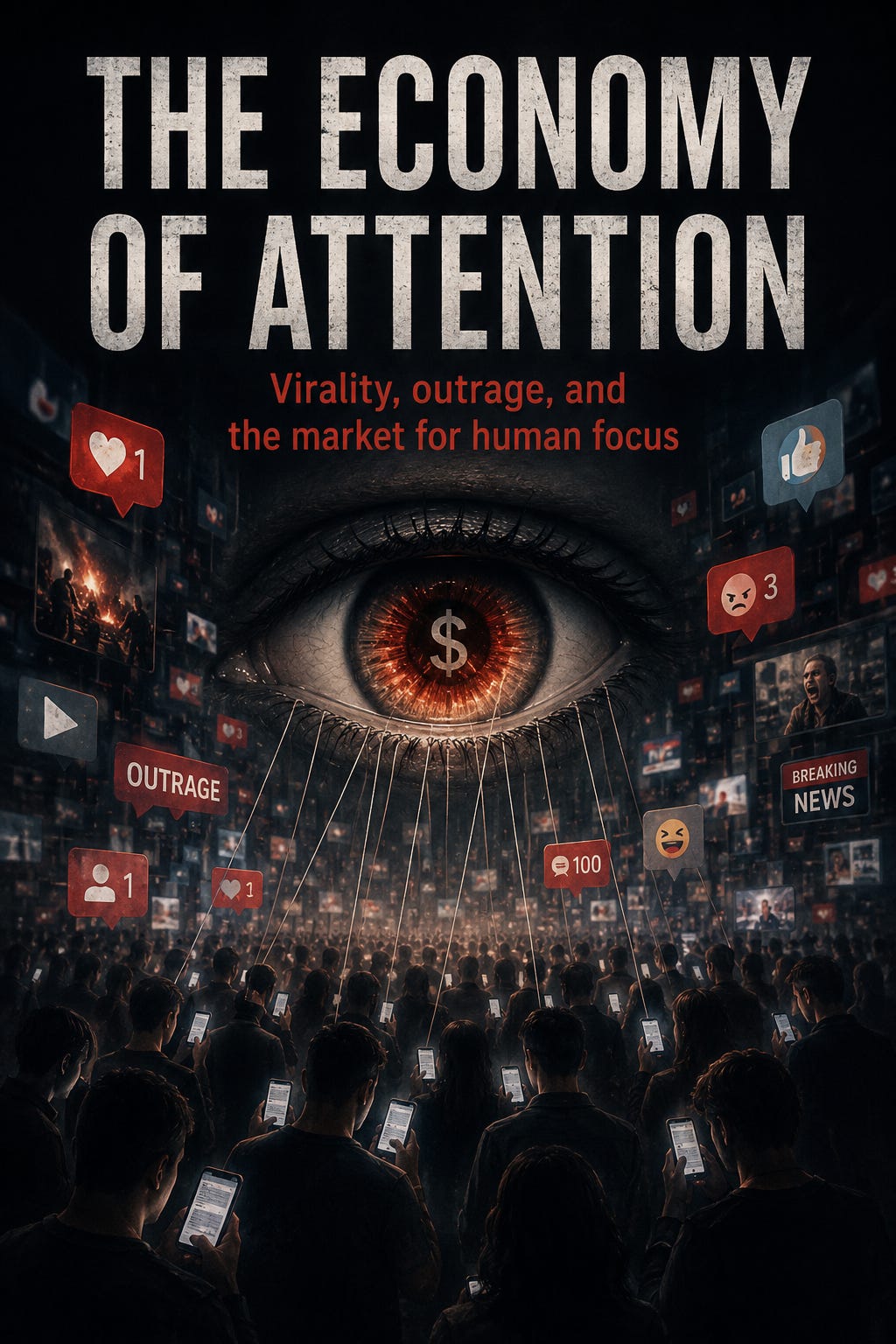
The Economy of Attention
Virality, outrage, and the market for human focus
This new medium is reprogramming us, yet we fail to grasp the radical paradigm shift that is underway. We are hobbling along after the very medium that, below our threshold of conscious decision, is definitively changing the ways that we act, perceive, feel, think, and live together. We are enraptured by the digital medium yet unable to gauge the consequences of our frenzy fully. The crisis we are now experiencing follows from our blindness and stupefaction.
Byun-Hul Chan[1]
In a day, you receive more information than earlier generations encountered in weeks or months. You have instant access to libraries larger than the biggest 19th century book repositories. You can choose between thousands of movies and millions of songs with a simple swipe and a click. You can read news media from around the world and translate it into your own language.
There is a seemingly unending supply of information available. But there are only so many eyeballs to go around. Making your data publicly available is easy. Finding people who want to engage with it is a much greater challenge. In an information-dense society, human focus becomes the scarcest and most valuable commodity.
Industrial economies competed for labor and resources. Digital economies compete for attention. Platforms, influencers, political movements, advertisers, and media companies now shape their behavior around the capture and retention of attention. Audiences who view their information—and the accompanying ads—are crucial to the digital bottom line. Engagement is the metric upon which a digital operation rises or falls.
Outrage, fear, conflict, and emotional stimulation drive engagement. They are the fuel which keeps a digital business running. The bigger the business, the more they depend on dopamine to hold their audiences. Nuance, ambiguity, and open resolution are increasingly confined to niche markets and smaller sites as they cannot make themselves heard amidst the shouting.
In pre-Internet days, information was doled out in small portions. Your newspaper, and later your radio and television, provided local and national news curated by editors and producers. The information that arrived on your doorstep or in your living room was fact-checked and weighed against company standards. If you missed the news or if your paper didn’t arrive, you had to wait until the next day to catch up.
That information was not always accurate. Sensationalist “yellow journalism” arrived not long after Gutenberg. Journalists, editors, and newspaper owners all had biases. Politicians, mob bosses, and wealthy businessmen could buy favorable coverage and sink unflattering stories. But those who consumed those stories, flawed though they might be, shared a common viewing experience and were far less distracted by constant stimuli.
Today our information arrives on an infinite scroll that is algorithmically tailored to our interests. TV and radio broadcasts ended when their time slot was up; when you finished reading your newspaper, you threw it away or used it for cage liner. Your news feed never ends. It is always there for you, waiting to explain the world and your place within it. The limiting factor is no longer production, storage, or distribution. It is human focus. Once media companies struggled to make information available. Today they search for ways to make people pay attention to it.
Modern media companies have access to data that their mid-20th century peers could only dream of. They know exactly how many people view their site and how long they stay; how many readers click their ads; who shares their stories and who comments on their videos. They still have a commitment to truth, accuracy, and civic value. But they know that their ongoing existence relies on continued engagement and ad revenue.
In an attention environment, emotionally stimulating content performs better. Humiliation, vindication, and moral certainty attract more retention, shares, and new viewers. Taking sides in a tribal conflict draws more fans and detractors, both of whom comment on the stories and view the advertisements.
Mainstream news organizations traditionally emphasized norms of objectivity and broad audience appeal. You’d find op-eds from writers across the political spectrum, and stories that provided airtime to both political parties. News outlets now openly slant their coverage to viewer preferences. This is not a sinister plot so much as a response to better information. Given granular access to data about what viewers prefer, editors and journalists now shape their stories accordingly.
Viral content must be optimized for rapid processing. The audience must, within seconds, notice the story amidst the other stories and images around it. The story must provoke an immediate emotional response—typically fear, outrage, or triumph—and give the viewer a clear interpretation of what they will find. Detailed context and careful explanation will only slow this process down, and for virality the smallest delay can send the viewer scrolling off.
This kind of emotional compression turns complicated stories into fragmented units that are optimized for rapid sharing. Interviews are reduced to soundbites and articles to clickbait headlines. The goal is not to pique reader curiosity, but to provide an immediate, carefully tuned payload of feelings—not an exchange of information but a surge of emotion.
Internet mobs shriek at villains and cheer for heroes. The Covington Catholic encounter that turned a high school senior into a target of death threats was found to be taken out of context within a day or two after it went viral. But many people still believe Nick Sandmann was a racist who mocked an American Indian elder with his smirk. Outrage arrived instantly; context arrived later; correction spread slowly; emotional impressions persisted despite contrary evidence.
Emotional reactions encourage comments and shares. They reinforce group identity and prolong engagement. Platforms do not consciously choose to spread falsehoods, division, or hysteria. They simply optimize behaviors that maximize retention and interaction. You might question the ethics of this behavior, but there’s no denying the economic benefits.
Outrage is participatory. Viewers perform outrage publicly and share and comment on it to display their sensitivity and moral alignment. Nick Sandmann became an emblem for white privilege and white racism. People who knew him only from a few seconds of video tried and convicted him—including journalists and media professionals who should have known better. The world was seduced by a toxic blend of outrage and virality.
Theatrical denunciations get rewarded with attention and likes. Moralized disagreements simplify the thorniest problems into a simple good/evil binary. Life in the emotional present tense provides an unending scroll of feelings and certainty. The digital market does not reward those who calm hot heads and soothe troubled minds. Calm people close apps.
Workers and managers adapt to workplaces and markets. Students and teachers adapt to schools. We change our social expectations and our habits to match our environments. Digital creators adapt to engagement metrics, audience reactions, and algorithmic visibility. But unlike the engines of earlier economies, digital platforms provide instant analytics and immediate feedback loops through likes, shares, and comments.
Creators quickly learn what spreads, what triggers outrage, what produces clicks, and what increases followers. Even novice creators who came to the platform as a casual experiment find themselves caught up in the quest for viewers. The data not only provides them with information—it trains their behavior.
Aspiring influencers start thinking of themselves as a brand. They create recognizable personas and repeat the slogans, phrases, and emotional cues that attract followers. They soon discover that while their audience may tell them they watch their shows to think, what they really want is to feel. They like challenging questions, but only so long as they don’t challenge any of the audience’s preconceptions. Intellectual-sounding takedowns of enemies may satisfy; interrogating the audience’s sacred cows will soon lead to accusations of betrayal.
Mainstream media not only competes with influencers for internet attention. For years, it has found itself on the losing side of that battle. Ongoing financial pressures have led to increasingly loaded headlines, outrage cycles, and engagement-driven framing. Institutional neutrality and editorial restraint no longer appeal to a broad audience. Those once-cherished standards are neither desirable nor profitable.
We have also seen this quest for virality in the political sphere. Calm, deliberate thinkers are read by contemporary audiences as weak, indecisive, and, worst of all, boring. Demagogues who offer emotional clarity, performative confrontation, and simple, morally charged narratives have little trouble winning over audiences who have come to politics simply for the entertainment, spectacle, and emotional rush.
In a digital market, visibility is currency. Telling your audience what they want to hear wins more followers than sharing hard truths. Competence is less important than certainty; wisdom does not carry nearly so far as outrage and finger-pointing. Extreme takes activate emotions and rally followers. Those who are unwilling to do whatever it takes to be noticed will be shoved aside in favor of those who are.
For most of human history and prehistory, stimuli meant danger. Loud noises more often signaled trouble than celebration; unfamiliar faces were more likely to be hostile than friendly. The tribe was familiar; the home was safe; the routines of daily life were comforting. The unexpected and surprising were things to be avoided, not sought after.
In the online world, we deliberately stimulate our warning circuits to feel the electric rush of novelty. We see the familiar as gray and dull; we seek the new, the different, the exciting. Our grandparents screamed with joy as they rode on roller coasters. We live in an always-open amusement park.
While scrolling, we might feel outrage at an overbearing police officer caught on camera; fear as he threatens an old lady with a taser; amusement and triumph as he discovers the old lady is his supervisor’s grandmother. From there we might experience pity at starving orphans and anxiety about how we will pay our grocery bills. We might be amused by a cute animal and then morally indignant about some commenter’s insensitive remark. And this would all happen within five minutes or less.
There is no time to process events internally. They happen in an eternal present where the police officer is always angry, the orphans always hungry, and the commenter eternally insensitive. We rely on digital systems for an endless tide of emotional effluvia to tell us what to feel and who to condemn. We build our castles of identity on electrons and screens.
Deep thought requires uninterrupted attention. The thinker must weigh conflicting and contradictory information to move closer to the truth. They must understand the difference between a plausible theory and a proven fact. And they must be willing to put in the time and cognitive effort required for reflection.
Digital thinking provides immediate reward, rapid reaction, and constant engagement. Distraction is not something to be avoided; it is the purpose. One does not build an opinion or a framework from careful thought; they absorb opinions and emotions from a feed. The end result is not meaning but fatigue.
Endless fear and outrage lead to free-floating anxiety. Constant stimulation leaves users blasé and burned out. Images and articles that once carried an emotional payload no longer satisfy; slogans that once held the promise of changing the world now seem increasingly hollow. Instead of inspiring action, the perpetual scroll brings us inevitably to apathy.
But though it brings no joy, burned-out users find it difficult to turn away from the digital sideshow. They have come to rely on it for their emotional orientation and moral interpretation. They have built large portions of their identity on their online communities. Without those constant cues, they face an existential crisis. They have outsourced their self-image to others and no longer know what to do without continuous validation and reinforcement. When identity is performative, the individual cannot exist without a stage.
Any trend that affects individuals must ultimately impact the community. The attention economy has not only eroded personal thinking; it has begun to destabilize democratic culture. An elective government cannot function without patience, compromise, and deliberation. These virtues and coping skills are fast becoming obsolete in a world of immediate stimulation, absolute opinions, and instant emotional gratification.
Democracy also requires a shared reality and institutional trust. The attention economy rewards tribalism. It provides users the information they want to see and puts them in touch with both like-minded and hostile people. The subsequent engagement helps cement the user’s place in their virtual tribe; it is in the platform’s best interest to provide a steady supply of information that feeds their preconceptions and stirs up their outrage.
Political escalation puts democracy in danger. When emotions get overheated, the masses can quickly become a mob. Attention systems reward emotional intensity and conflict. Spectacles get eyeballs and tribal conflicts get ongoing responses. The clarity of certainty and moral righteousness travels more quickly than the moderation of careful compromise.
When your opponents are not only wrong but actively evil, voting becomes an existential risk. Would you let a Stalin, Mao, or Hitler claim power just because they won an election—especially if you know in your heart that they only won through fraud and lies? Certainly, it would make more sense for good people to rise up and take control; to drive back the dictators so we can save our freedom.
Attention economies transform politics into serialized spectacles. The political process is reduced to comic book morality; clean-cut heroes, mustache-twirling villains, dramatic reveals, and a never-resolving emotional cliffhanger. Captain America eternally punches this week’s Hitler; the Red Skull cackles as he unveils his latest nefarious plot. And from the sidelines the audience cheers and hisses at the serial’s latest outrage cycle.
A democratic society requires accepted procedures, peaceful transitions, and shared standards of legitimacy. Attention economies earn their daily bread through tribalization and interpretive fragmentation. The best-performing political commentary paints the other side as partisan, corrupt, manipulated and illegitimate. The fact that it paints its own side as neutral and honest does not serve to calm tensions.
This constant outrage leaves citizens feeling cynical, distrustful, and politically alienated. Politics becomes performance; your party becomes a part of your identity like your favorite football team or musical genre. Governance, problem-solving, and compromise fall by the wayside. The greatest danger of the attention economy is not that platforms will put their thumbs on the scale in favor of their chosen candidates. It is that it will overwhelm democratic culture with stimulation, fragmentation, and emotional exhaustion.
When attention becomes currency, distraction becomes profitable. Outrage is a renewable resource; emotional activation is fuel; identity is a marketing tool. Political movements, media organizations, influencers, advertisers, and platforms adapt themselves to this environment because it is the only way they can stay competitive.
It has become fashionable to cast issues as conspiracies or coordinated malice. But much of what we see on the Internet can be explained by Skinner’s positive and negative stimuli. Attention economics run on visibility, stimulation, certainty, and engagement. Digital businesses that can supply those things are rewarded with a growing, active audience. Those that do not are ignored and ultimately fail. When your paycheck depends on a certain set of behaviors, you’re likely to internalize the most successful approach.
Attention economies reshape both businesses and customers. They transform how we think, how we process information, how we understand ourselves, and how we relate to one another. Citizens become audiences; politics becomes performance; disagreement becomes existential conflict. We are not just information consumers; we have become participants in emotionally curated realities.
We have shaped our digital personas around belief. But the central question of the digital age is no longer what we believe. It is who controls our attention.
[1] Byun-Hul Chan, The Swarm. Boston: Massachusetts Institute of Technology, 2017. ix.