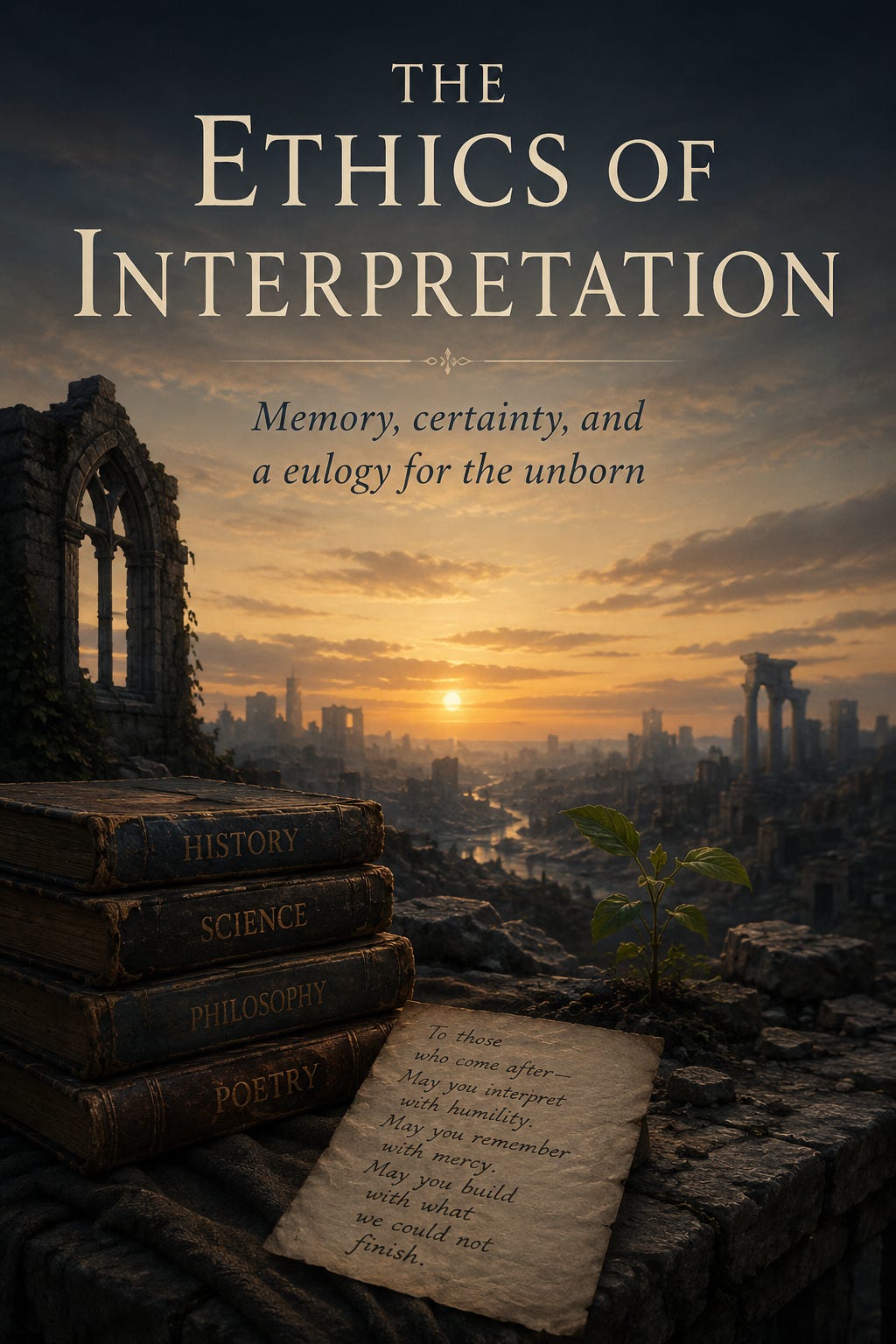
The Ethics of Interpretation
Memory, certainty, and a eulogy for the unborn
On March 16, 2013, Sunil Tripathi walked out of his Providence apartment. He left behind his cellphone, his wallet, and a troubling note that his girlfriend discovered 36 hours later. The Brown student had taken a leave of absence while struggling with depression, and the Tripathi family feared the worst. They posted his flier online and offline in the desperate hope that Sunil might be alive.
On April 15, nearly a month after Sunil’s disappearance, his siblings Sangeeta and Ravi drove to Boston to see the 117th Marathon and cheer for a friend who was running. They hoped their trip would help distract them from the stress of the ongoing search. But minutes after their friend finished the race, two bombs exploded near the finish line.
Three days later, Sunil’s mother posted a photo to the family’s Facebook page, “Help Us Find Sunil Tripathi.” The fortune cookie slip read “Your wish is about to come true.” Hours later, the FBI released photos of two Boston bombing suspects. On Twitter, a former classmate noted that the bomber looked like Sunil. The comment spread to Reddit. From there it went viral.
Over the next twelve hours, “Help us Find Sunil Tripathi” was bombarded with hateful messages accusing Sunil of being a Muslim terrorist. News vans lined the street outside the Tripathi home; reporters knocked repeatedly on their front door. Between 3 and 4 am on Friday, April 19, Sangeeta received 58 calls from the media.[1] Then, at 7 am, the FBI announced that the bombing suspects, Tamerlan and Dzhokar Tsarnaev, were in custody.
On April 23, police dredged a body from the Providence River. Dental records helped them identify Sunil Tripathi. He had been dead for weeks at the time of the Boston bombing.
In an earlier era, Sunil’s former classmate might have called the FBI with her suspicions. Agents would have added his name to the tip list. The Tsarnaev brothers would have been captured before agents investigated further. The Tripathi family would have been spared additional suffering in their time of grief. Today individuals construct and share their own explanatory frameworks in real time. They spread before the facts are known, and often they persist despite factual evidence to the contrary.
Interpretation, like mythmaking, seeks to find meaning in emotionally loaded events. It assigns blame, provides heroes and villains, and assigns guilt and innocence. Interpretation helps us align feelings and reason. But interpretations rooted in supposition and rumors often distort both. And when a casual comment can go viral in a few minutes, we end up building our beliefs on very shaky presuppositions.
We instinctively seek out patterns and coherent narratives. We built ziggurats to watch the heavens so we could predict the future. Later, Muslim and Christian scholars created elaborate tables of correspondences that mapped how herbs, animals, diseases, gems, and other categories related to different stars and planets. Today we check our daily horoscope—or we laugh at those people who still trust superstition over science.
In 1897, William Thomson (Lord Kelvin) reduced his prior estimates of the earth’s age from roughly 100 million years to 20-40 million. By the early 20th century, radiometric dating suggested the Earth was over a billion years old. In 1923, Edwin Hubble used the 100-inch (2.5 meter) Hooker telescope to discover the universe extended far beyond our Milky Way. A world still recovering from the Great War found itself in a universe that was vastly older, larger, and more indifferent than they had imagined.
These discoveries helped inspire H.P. Lovecraft’s cosmic horror. Throughout Lovecraft’s work, we see a nostalgia for the straight lines and clear, provable equations of Newton and Galileo—and a horror of non-Euclidean geometry, relativity, and what those new sciences might reveal. While many pulp readers were consuming stories of heroic space conquerors and busty alien women, Lovecraft presented the horrors of what might lie hidden by abyssal voids and strange aeons.
While Lovecraft feared what was to come, many others embraced the scientific future. Our old folk narratives and myths became “old wives’ tales,” stories to entertain children but certainly nothing an educated person would take seriously. Those who did not understand quantum mechanics or molecular biology—which is to say almost all of us—came to see science in an almost religious light. In a great deal of 20th century advertising, ad spokesmen wore white lab coats to signify their intelligence and trustworthiness.
But as science inspired religious fervor, it also inspired heretics. In Victorian times a gentleman of modest means could perform ground-breaking science experiments in his basement. Bill Gates and Steve Wozniak designed computers in their garage. Today, large hadron colliders and AI datacenters are beyond the budget of all but the largest organizations. That has led a growing number to reject science altogether, from vaccine skepticism to flat earth revivalism.
In a world that is beyond our understanding, we seek ways to make it understandable. Traditionally spirituality served that purpose. When we lost faith in God, we found meaning in politics and science. Some fervently followed the Party; others sought in spaceships an emotional resonance they no longer found in saints and angels. Like religion, these frameworks offered coherence and hope for a better future.
But we cannot understand historical frameworks outside their context. We know our ancient ancestors worshipped different gods. We know a few divine names, and we have some fragments of stories and scraps of rituals. But we have little idea of what those gods meant to their worshippers, or how those devotees experienced their ceremonies.
The stories European students learned in Greek and Latin classes were like museum statues; sanitized, cleaned, and taken from their temples into viewing rooms. If we lose the context of science—and today much science has become arcane scripture available only to a few highly educated scholars—it may become something our descendants display in museums and value highly even though they do not know what it means or how to replicate it.
Some might preserve these artifacts as reminders of a glorious past; others might destroy them as an eldritch evil. Those ruins will be survivors from a time when we poisoned the water, sterilized the land, and brought the great drought. They will need a scapegoat to hold responsible for their straitened circumstances. The dead will become, as they always have been, a blank slate on which the living can project their visions.
If you are reading these words, you are not yet among the dead. You still have some agency in how you will be interpreted by future generations. We know that our world has fragmented, that we have replaced the ambiguous and conditional with the clear and certain. Our world has forgotten G.K. Chesterton’s warning from Orthodoxy:
I know of men who believe in themselves more colossally than Napoleon or Caesar. I know where flames the fixed star of certainty and success. I can guide you to the thrones of the Super-men. The men who really believe in themselves are all in lunatic asylums.…
Actors who can’t act believe in themselves; and debtors who won’t pay. It would be much truer to say that a man will certainly fail, because he believes in himself. Complete self-confidence is not merely a sin; complete self-confidence is a weakness.[2]
We live in a world that has gone mad. Perhaps we have gone mad ourselves. I have seen my own behavior in many of my descriptions. You may have seen yours there as well. How can madmen hope to guide the remnant back to sanity?
We cannot interpret you. But perhaps you can interpret us.
If you have access to this book, you likely have access to many others. Save what you can. Properly stored paper will outlast digital storage. Libraries will become a treasure in the wake of chaos. The printing press threw Europe into decades of religious conflict after its invention. After this decline, the press may be our best hope for bringing us back together.
Technological advances can be lost. Roman concrete demonstrated remarkable durability and self-healing characteristics that modern engineers are still trying to replicate. The resources required for concrete are far less than those required for nuclear physics experiments. We could lose much of our contemporary science within a few generations of decline. Learning basic skills like building and repairing motors—and passing those skills down—could make an enormous difference in the daily lives of our descendants.
Our world became intoxicated with certainty. It was a luxury, and we wore it like a status symbol. We thought ourselves very clever. We had an endless stream of information in our pockets. Surely, we thought, we would become the smartest generation in history. You may have far less access to data than we do, or you may have access to far more. Do not fall into our error. Do not fool yourself into believing that data can make you smart.
Simplicity, morality, and purity are heady stuff when your world is falling apart. When you hope desperately for a strongman, there will be no shortage of those who will play that role for you. Your world may be much different than ours, but the lust for power has been wired into us since before the first king and the first crown.
You may be under a strongman’s rule as you read this. In difficult times, desperate people seek out strong leaders. Your ruler may tell you what you must do, where you must go, what you must say, even what you must believe. He has no control over what you think. There is freedom in interpreting the world even if you cannot change it.
Perhaps you are angry with us. We lived through a period when we tore down statues and recast our history as a great evil. You are certainly within your rights to complain about our generation’s stewardship and what we left behind for you. But the dead are dead; you can dress us up as heroes or villains and trot us out in your play as a good or a bad example. We did what we thought was right. You are doing what you think is right. In time you will join us, and we will stand silently together to be judged before another generation.
[1] NPR Staff, “How Social Media Smeared A Missing Student As A Terrorism Suspect” (April 18, 2016) at NPR. https://www.npr.org/sections/codeswitch/2016/04/18/474671097/how-social-media-smeared-a-missing-student-as-a-terrorism-suspect
[2] G.K. Chesterton, Orthodoxy (1905). Chapter II: The Maniac. Available at Gutenberg: https://www.gutenberg.org/cache/epub/130/pg130.txt.