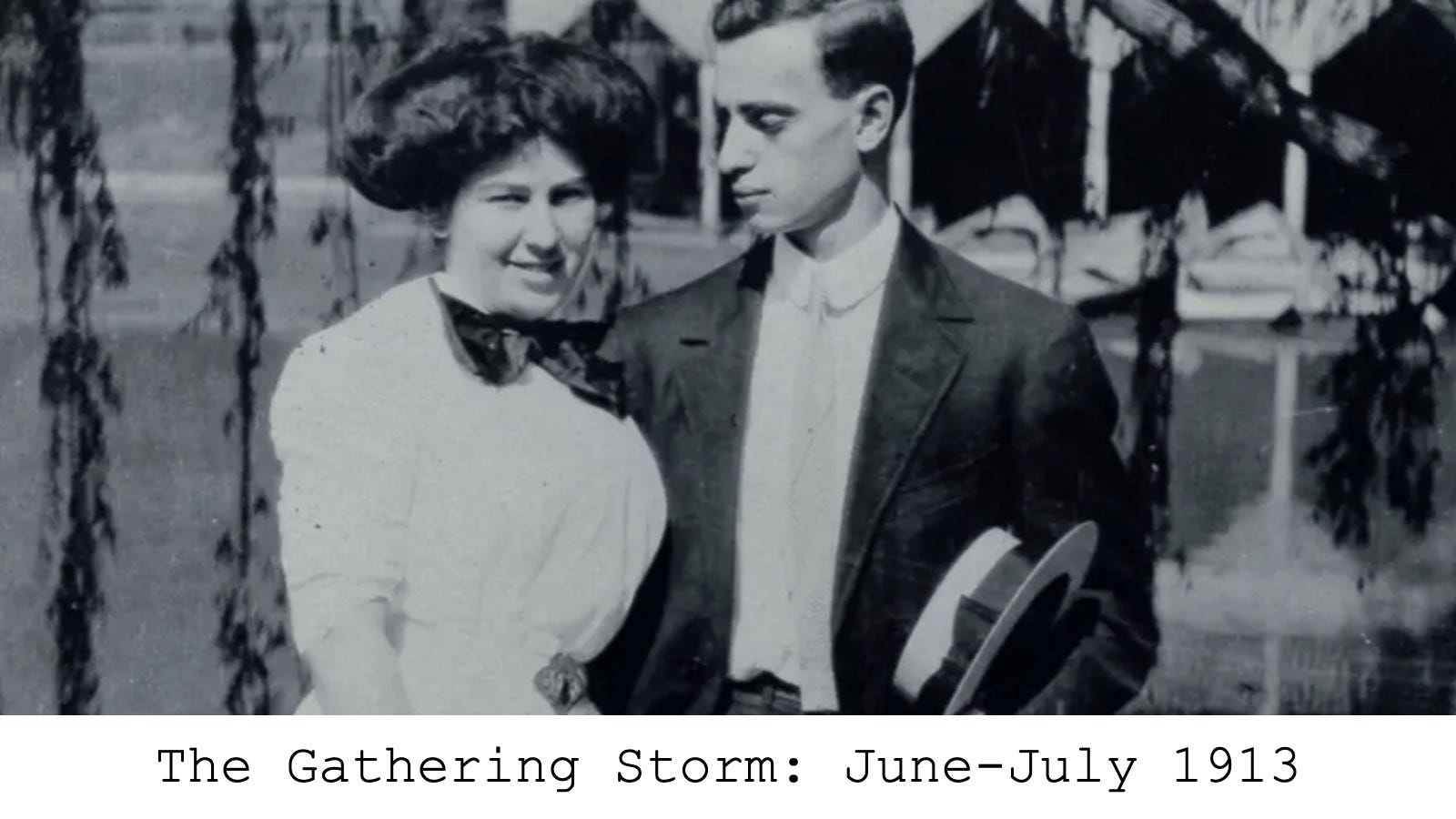
The Gathering Storm
The Leo Frank Case: June-July 1913
“No Man With Common Sense Would Even Suspect That I Did It,” Prisoner in Fulton Tower Tells Attache. “It’s a Negro’s Crime Through and Through.” Asserts His Innocence to Turnkeys and to Fellow Prisoners.
“IT’S UP TO MR. FRANK TO TELL THE TRUTH,” ASSERTS JAMES CONLEY
“I Believe He’d Let ‘Em Hang Me to Get Out of It Himself if He Had the Chance,” Says Negro Sweeper—Chief Lanford Is Pleased With Work of Department and Ready for the Case to Come to Trial Immediately.[1]
James Dorsey certainly understood that he was taking an enormous gamble by relying on Jim Conley’s testimony. So did Luther Rosser, Frank’s defense attorney. He argued that a slight, bespectacled white man was unlikely to perpetrate a brutal sexual murder many white Southerners would associate with Negroes—particularly Negroes like Jim Conley. They portrayed Conley not just as a drunk and a habitual liar but as a violent sexual predator. Rosser assumed those old Southern prejudices were too deeply rooted for Dorsey to overcome.
It wasn’t a foolish strategy. Most white Southerners in 1913 would be inclined to take the word of a white man over a black man. Conley was not an educated preacher, journalist, or member of Atlanta’s small but growing Black middle class. He fit many of the South’s most enduring racist stereotypes—drunk, shiftless, in debt, and untrustworthy. Conley was also tied to Phagan’s murder by notes he acknowledged writing. And he was Dorsey’s principal witness against a respected and respectable white man.
Today this kind of race-baiting would be seen as highly unethical and would likely lead to disciplinary proceedings. “Nigger” has become the most offensive word in American English, and most Americans have a very dim view of racism. In 1913 Atlanta, Rosser’s claims would be seen by most white Atlantans—and most white Americans—as common sense.
Their primary ethical obligation as defense counsel was to advocate zealously for their client, to the best of their ability, within the laws and rules of the Georgia court system. Ignoring one of the most powerful weapons in their arsenal in a capital murder trial would not only be foolish. Measured by a lawyer’s obligation to his client, it would be a dereliction of duty.
Dorsey believed Conley was telling the truth, or at least most of it. But he did not feel comfortable relying solely on Conley. On June 4, the Atlanta Journal dedicated its front page to a “Sensational Affidavit Made by Minola McKnight, Negro Cook at Home of L. M. Frank.” In that affidavit McKnight claimed:
Sunday Miss Lucille said to Mrs. Selig that Mr. Frank didn’t sleep so good Saturday night. She said he was drunk and wouldn’t let her sleep with him, and she said she slept on the floor on the rug by the bed because he was drinking. Miss Lucille said Sunday that Mr. Frank told her Saturday night that he was in trouble, that he didn’t know the reason why he would murder, and he told his wife to get his pistol and let him kill himself.[2]
McKnight’s affidavit provided exactly the kind of corroboration Dorsey was looking for. It lasted less than a day before McKnight publicly repudiated her statement, claiming she had only signed under duress after hours of browbeating and threats from Dorsey and his team. By June 5, detectives publicly stated that they attached “very little importance” to McKnight’s affidavit.[3]
That same day Lucille Frank broke her silence on the front page of the Georgian. In an open letter accusing Dorsey of torturing witnesses, Mrs. Frank denied the allegations in McKnight’s affidavit, insisted her husband was innocent, and stated:
It is to be hoped that no person can be convicted of murder in any civilized country on evidence wrung from witnesses by torture…
It is not surprising that my cook should sign an affidavit to relieve herself from torture that had been applied to her for four hours, according to The Atlanta Constitution, “to a point of exhaustion.” It would be surprising if she would not, under such circumstances, give an affidavit... It is hard to believe that practices of this nature will be countenanced anywhere in the world outside of Russia.[4]
Dorsey’s attempt to obtain new information through third-degree interrogations had become a public relations disaster. The defense seized on the McKnight affidavit and its subsequent repudiation. Rosser would continue to accuse the prosecution of intimidating witnesses and suppressing evidence before and throughout the trial.
In June 1913 many Atlantans believed Frank was the killer. Many others had doubts, or were inclined to believe Frank was innocent. An attack on Lucille Frank risked making Dorsey look ungentlemanly and could lend credence to the defense’s intimidation claims. Failure to respond could be seen as an acknowledgment the defense’s allegations were true. And if Dorsey had fabricated McKnight’s affidavit and coerced her into signing it, how trustworthy were Conley’s statements?
Dorsey did not address Mrs. Frank’s allegations of torture and coercion in his June 6 remarks to the Atlanta Constitution. He noted that as Leo’s wife, Mrs. Frank would, of course, be among the last to know the facts about her husband’s guilt and among those most inclined to assert his innocence. As Dorsey noted sympathetically:
Perhaps the most unpleasant feature incident to the position of prosecuting attorney arises from the fact that punishment of the guilty inevitably brings suffering to relations who are innocent of participation in the crime, but who must share the humiliation flowing from its exposure.
This, however, is an evil attendant upon crime.[5]
On June 7 Lucille, likely with help from Luther Rosser, released a second open letter. This one was even more pugnacious than the first, turning one of Dorsey’s earlier statements against him:
[Dorsey’s] real position, as gleaned from his card, can be stated in the following sentence which he employed:
“I have only to say, without in anywise taking issue with her premises as I might that I welcome all evidence from any source that will aid an impartial jury, under the charge of the court, in determining the guilt or innocence of the accused.”
That is to say, he thinks it unnecessary to waste time in disputing the fact that the detectives are procuring testimony from witnesses by torture. He considers this point immaterial. He believes he is thoroughly justified in using tortured testimony, if it is turned over to him, for he says: “I welcome all evidence from any source.”[6]
It is noteworthy that Dorsey did not continue the exchange after this. Perhaps he recognized that an ongoing argument would only keep the conversation about witness coercion foregrounded. There was little to gain from an ongoing debate with Frank’s loving wife, and a great deal to lose. But the end result was a public relations victory for Leo Frank’s defense team, which wasted no time in pressing its advantage.
Two days after Lucille Frank’s last letter, Rosser responded with another open letter, a blistering note that insinuated detectives and prosecutors had colluded to shape Conley’s testimony, just as, he alleged, they had created McKnight’s affidavit. But their target was not only the Atlanta public; it was Judge Leonard Roan, Rosser’s former law partner, who would be presiding over the Frank trial.
Rosser wanted to see Conley moved back to “the Tower,” the Old Fulton County jail where Frank was being held. While under lockup, Conley was only allowed to speak with the detectives. By putting Conley back into general population, Rosser hoped that he would make incriminating or embarrassing statements that would go public. He also knew that Sheriff Mangum took a dim view of detectives interfering with testimony and that Dorsey’s team would have far less access, and far less chance to coach their primary witness.
Judge Roan agreed that Conley technically belonged in the Tower and began making efforts to have him moved. At this point Dorsey made what seemed a strange offer; he motioned to release Conley from captivity altogether. His argument—that the prosecution no longer considered Conley a material witness—seemed odd, given that Conley was the state’s principal witness.
But what looked at first inexplicable was actually a brilliant, if convoluted strategy. Dorsey planned to release Conley as a material witness, then immediately re-arrest him and hold him as a suspect. Rosser had two choices. He could argue that Conley was a material witness, and that he should be held to testify against Frank. Or he could argue that Conley should not be held as a suspect and thereby acknowledge that he did not believe Jim Conley had killed Mary Phagan.
Conley was released from his cell, arrested again as soon as he left the building, and returned to custody in his old cell. It was certainly a clever maneuver, one suggesting just how determined Dorsey was to keep Conley beyond the reach of the defense and the press. But it was also risky. Dorsey would soon be making his case before Judge Roan, whose order he had just neatly sidestepped.
On June 13 another lawyer joined the Frank defense team. If Luther Rosser was a pit bull terrier in the courtroom, Reuben Arnold was a gentleman scholar with an extraordinary memory and a gift for cultivating relationships with prosperous and influential Georgians, including Rabbi David Marx. He brought an air of gentility to the proceedings, serving as the velvet glove to Rosser’s iron fist. The next day Dorsey left town with his family for a summer vacation.
The Frank trial, which had been scheduled to begin on June 30, was postponed due to summer heat. The court building was undergoing renovations and the stand-in location had poor ventilation, a serious issue during a Georgia summer. Roan rescheduled the trial for July 28, when the renovations were scheduled to be completed.
But though the case was on temporary hiatus, Frank’s defense team was still working hard. On July 9, Pinkerton agents working for Frank found a pay envelope with Mary Phagan’s number on the factory floor. Rosser theorized that Conley saw Phagan coming in for her paycheck and accidentally killed her during an attempted robbery; if genuine, the envelope suggested he had taken the money while she lay on the factory floor. The next day saw reports of two men who claimed to have evidence that Conley was the murderer.
On Thursday, July 10, the Georgian published an exclusive story of an affidavit in the possession of the lawyers for Leo M. Frank made by W.L. Mincey, an insurance agent. In that affidavit, Mincey declared that he met Conley at Electric Avenue and Carter Street on the afternoon of the murder. Mincey claimed that Conley was intoxicated and had no interest in purchasing an insurance policy. When Mincey approached him, Conley reportedly exclaimed “I have killed a girl to-day; I don’t want to kill nobody else.”[7]
Meanwhile, a nationwide search was underway for Will Green, a Negro carnival hand who had reportedly claimed that he saw Conley attack Phagan. Green had purportedly been playing craps with Conley on April 26. Conley was losing. When he saw Phagan come in, Conley announced he was going to steal the girl’s money. When Conley began staggering toward Phagan, Green fled. Upon reading of the murder in the morning paper, he left for St. Louis.[8]
While all these breakthroughs received considerable newspaper coverage, the defense team remained skeptical from the outset. Rosser and Arnold concluded Mincey was an unreliable witness who would not withstand cross-examination. Nobody knew which carnival employed Will Green or where he could be found. Detectives noted that they had searched the same area weeks ago and found nothing resembling Mary Phagan’s pay envelope.
One of the most common claims about the Leo Frank case is that Frank did not receive a fair trial. A quick look at these months leading up to trial reveals little to support that assertion.
Frank not only had competent defense counsel—he was represented by two of Georgia’s finest criminal defense lawyers. Rosser was a master of cross-examination and would display his talent to its fullest during the trial. Arnold was a renowned criminal attorney who worked tirelessly to fight against the state’s case and against mob anger and antisemitism. By the standards of 1913 Georgia, Frank could scarcely have assembled a better defense team.
Dorsey was certainly a dedicated and tenacious prosecutor. But that does not make the trial unfair. A fair trial gives both the prosecution and the defense an opportunity to present their cases. The jury, not the prosecutor, determines guilt or innocence. The prosecutor’s job is to present the strongest lawful case for the defendant’s guilt. Creating fake evidence is forbidden; presenting evidence in the most incriminating light is expected. Dorsey fought hard to prove Leo Frank’s guilt because that was what he was supposed to do.
Both defense counsel and prosecutors are expected to uphold all applicable laws and procedural rules. Both Frank’s defense attorneys and prosecutors acted within the generally accepted standards and guidelines of the period. Each faced pushback from the other side when they overreached. Both sides engaged in behavior that would not be tolerated in a 2026 court. But they were not arguing in a 2026 court. Judging behavior and conduct at a 1913 trial solely by twenty-first century standards is anachronistic.
A trial does not become “unfair” when it does not reach your preferred verdict. Neither does a trial’s fairness or unfairness guarantee the jury will arrive at a correct conclusion. You may think that the police and the jury arrived at an erroneous verdict. Juries and police regularly make mistakes. But there is a difference between a mistaken verdict and a willful, knowing attempt to frame an innocent man.
[1] “Mary Phagan’s Murder Was The Work of a Negro, Declares Leo M. Frank,” Atlanta Constitution, May 31, 1913. 1.
[2] “Sensational Affidavit Made by Minola McKnight, Negro Cook at Home of L. M. Frank,” Atlanta Journal, June 4, 1913. 1.
[3] “Negro’s Affidavit Not Given Much Credence,” Atlanta Journal, June 5, 1913. 2.
[4] “‘I Know My Husband is Innocent,’ Asserts Wife of Leo M. Frank,” Atlanta Georgian, June 5, 1913. 1.
[5] “Dorsey Replies to Charges of Mrs. L. Frank,” Atlanta Constitution, June 6, 1913. 1-2.
[6] “Mrs. Leo Frank Attacks Solicitor Hugh M. Dorsey in a New Statement,” Atlanta Georgian, June 7, 1913. 1.
[7] “I Am Seeking Only To Do My Duty For Truth And Justice,” Atlanta Georgian, July 14, 2026. 1.
[8] “School Teacher Tells Remarkable Story to the Georgian,” Atlanta Georgian, July 14, 1913. 4.