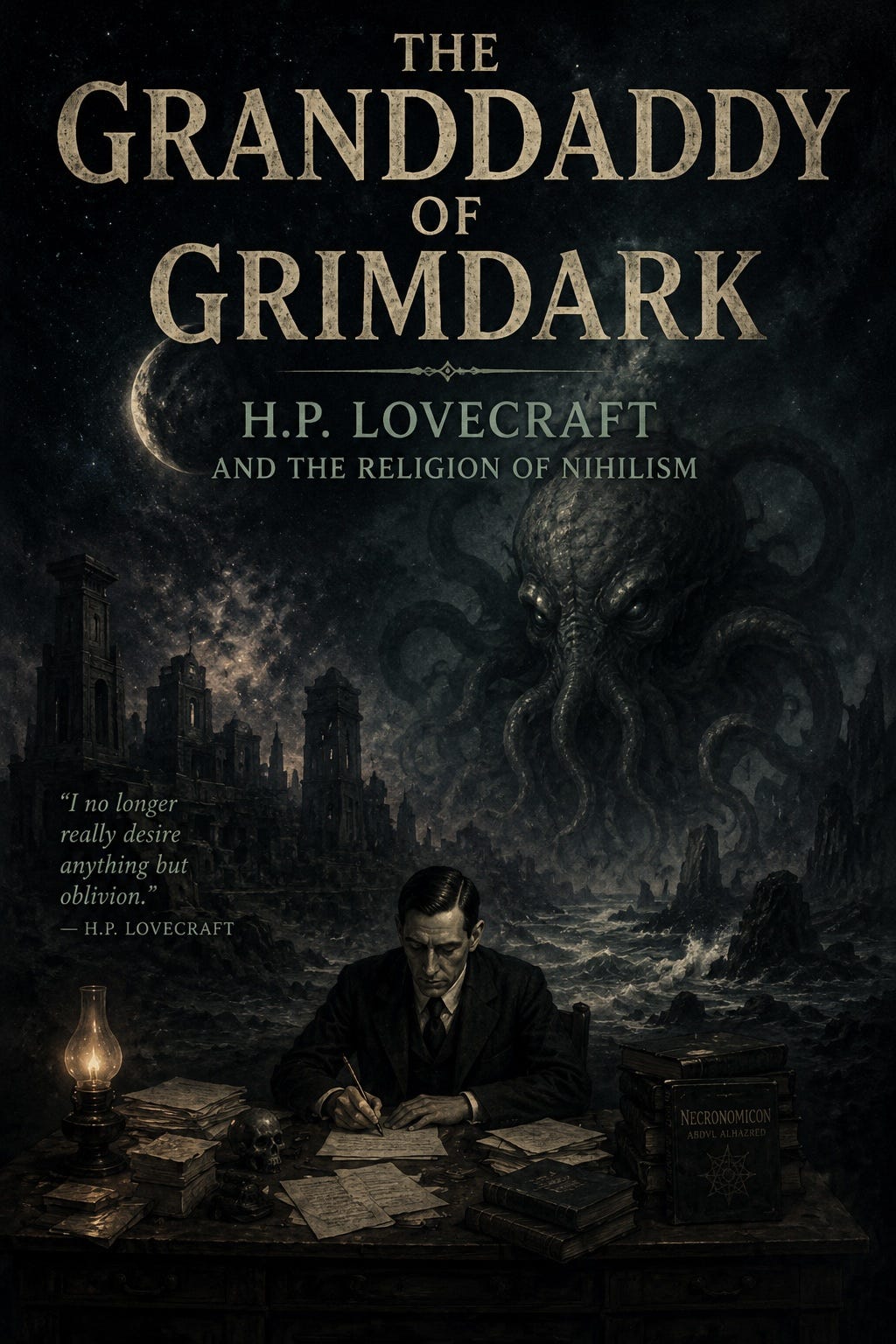
The Granddaddy of Grimdark
H.P. Lovecraft and the religion of nihilism
As I near thirty-two I have no particular wishes, save to perceive facts as they are. My objectivity, always marked, is now paramount and unopposed, so that there is nothing I am not willing to believe. I no longer really desire anything but oblivion, and am thus ready to discard any gilded illusion or accept any unpalatable fact with perfect equanimity. I can at least concede willingly that the wishes, hopes and values of humanity are matters of total indifference to the blind cosmic mechanism. Happiness I recognize as an etheral phantom whose simulacrum comes fully to none and even partially but to a few, and whose position as the goal of all human striving is a grotesque mixture of farce and tragedy.
H.P. Lovecraft[1]
In April 1893, Winfield Scott Lovecraft was committed to Butler Hospital in Providence, Rhode Island. His son Howard was only three years old but already reading and writing. Five years later Winfield Lovecraft died. His death certificate listed the cause as “general paresis,” neurological degeneration caused by the final stage of syphilis.
Before his fifth birthday, Howard was told that Santa Claus was a myth. He had already figured this out for himself, but the open admission led him to another question: is God also a myth? A brief period in the First Baptist Church’s “infant class” Sunday school—a period that ended after he asked too many pointed questions—led him to conclude that was indeed the case.
A brief flirtation with Islam by way of The Arabian Nights led Howard to adopt the pseudonym “Abdul Alhazred.” By seven, he considered himself a “genuine pagan, so intoxicated with the beauty of Greece that I acquired a half-sincere belief in the old gods and nature-spirits.”[2] But by 1902, after “reading much in Egyptian, Hindoo, and Teutonic mythology,” he found himself a complete sceptic and materialist.
In 1897, when Lovecraft was still half-clinging to his Pagan faith, William Thomson (Lord Kelvin) estimated the world was between 20-40 million years old. By 1905, Ernest Rutherford had determined through radiometric dating that the world was over 1 billion years old. Lovecraft found himself reeling within a vast, ancient, and indifferent universe—an experience that would echo throughout his fiction.
Lovecraft owed a great debt to Gothic Horror in both aesthetics and his prose style. But he replaced supernatural monsters with indifferent alien gods and accursed grimoires with ancient texts like the sanity-shattering Necronomicon. Gothic horror writers like Poe, Stoker and Shelley feared the evils hidden within our civilization. Lovecraft asked a more unsettling question: what if civilization itself is meaningless?
In 1905, as Rutherford was plumbing the depths of geological time, Lovecraft wrote “The Beast in the Cave.” In the story, a man separated from his guide wanders through Kentucky’s vast Mammoth Cave. As his flashlight begins to fail, the man hears footsteps. But his relief soon turns to terror as he realizes that these footfalls were not like those of any mortal man.
In the unearthly stillness of this subterranean region, the tread of the booted guide would have sounded like a series of sharp and incisive blows. These impacts were soft, and stealthy, as of the paws of some feline. Besides, when I listened carefully, I seemed to trace the falls of four instead of two feet.[3]
Lovecraft’s narrator picks up rocks and begins throwing them toward the sound. One hits the target, after which he faints. When he comes to the guide is with him, having heard the sound of the rocks. They discover in the light of the guide’s flashlight what appears to be a dying “anthropoid ape of large proportions.” But when the beast turns, and they see its face, he realizes with horror that “the creature I had killed, the strange beast of the unfathomed cave, was, or had at one time been a MAN!”
When he was writing “The Beast in the Cave,” Lovecraft and his mother had recently moved to a small Providence duplex. His beloved grandfather Whipple had a stroke soon after losing the family fortune. In 1908 Lovecraft had a nervous breakdown severe enough to prevent him from receiving his high school diploma. That same year he wrote “The Alchemist.”
In that story Count Antoine de C., the narrator, is the last of his line. After Antoine’s noble ancestor killed a dark wizard the wizard’s son, Charles le Sorcier, swore revenge on him and all his descendants, cursing them to die upon reaching the age of 32.
Since that time, all his ancestors have died in some mysterious way at 32. He is now the last of his line, living in a crumbling tower with his poor servant Pierre. Pierre, the beloved servant who raised him, dies shortly before Antoine’s 32nd birthday. Isolated, he begins exploring the ruined castle until he finds a trapdoor. There he discovers a man who attempts to kill him, but Antoine is victorious and kills the stranger.
With his last dying words, the failed assassin announces that “I tell you, it is I! I! I! that have lived for six hundred years to maintain my revenge, for I am Charles Le Sorcier!”[4]
While still reluctant to submit his writings professionally, Lovecraft was an avid reader who contributed regularly to the letters pages of several publications. By 1914 he had joined the United Amateur Press Association. Decades later, we would call such publications “zines.” In 1916, “The Alchemist” appeared in a UAPA journal; the following year he was elected UAPA President.
America’s entry into the Great War brought out Lovecraft’s patriotism and racial anxieties in equal measures. His efforts to join the Army were stifled by his mother Susie, who used family connections to have Howard declared unfit for service. In 1919 his mother was committed to the same hospital where his father had died. She would die there in 1921. The following year Lovecraft would submit “A Confession of Unfaith” to The Liberal.
After Susie Philips Lovecraft was committed, Howard found himself increasingly troubled by the nightmares that had plagued him since childhood. “Beyond the Wall of Sleep” (published October 1919) and “The White Ship” (November 1919) explored Dunsany-inspired dream worlds. Lovecraft would go on to write many more of these tales, but another November 1919 publication is most remembered as a harbinger of stories yet to come.
The region was putrid with the carcasses of decaying fish, and of other less describable things which I saw protruding from the nasty mud of the unending plain. Perhaps I should not hope to convey in mere words the unutterable hideousness that can dwell in absolute silence and barren immensity. There was nothing within hearing, and nothing in sight save a vast reach of black slime; yet the very completeness of the stillness and homogeneity of the landscape oppressed me with a nauseating fear.[5]
The narrator of “Dagon” is a sailor captured by the German navy during the Great War. Escaping in a lifeboat with a stock of provisions, he drifts for days before finding himself stranded on “a slimy expanse of hellish black mire.” Wandering across the muddy plain, he discovers a “Cyclopean monolith” covered with hieroglyphs of aquatic creatures, including “marine things which are unknown to the modern world, but whose decomposing forms I had observed on the ocean-risen plain.”
Then the narrator sees a great being:
Vast, Polyphemus-like, and loathsome, it darted like a stupendous monster of nightmares to the monolith, about which it flung its gigantic scaly arms, the while it bowed its hideous head and gave vent to certain measured sounds. I think I went mad then.[6]
As the story ends, the narrator is preparing to commit suicide. He has run out of money and out of morphine, the only thing that grants his shattered mind any peace. It ends with “I hear a noise at the door, as of some immense slippery body lumbering against it. It shall not find me. God, that hand! The window! The window!”
At first Lovecraft scorned writing for profit. But as his financial situation deteriorated, his outlook broadened. In October 1923 “Dagon” was republished in a popular pulp magazine. At the bottom of the page was the announcement “This is the First of a Series of Remarkable Stories that H. P. LOVECRAFT is Writing for WEIRD TALES.”
Weird Tales was notorious among literary snobs for its lowbrow fiction. It was notorious among pulp writers for its slow payments. The most popular authors received a penny per word: Lovecraft was never one of the most popular authors, so he received between a quarter-cent and half-cent per word. Yet he continued corresponding in the letters section and building relationships with other Weird Tales writers. To supplement his meager income, he also worked as a ghostwriter for other authors, notably Harry Houdini (“Imprisoned with the Pharaohs”).
The February 1928 issue introduced the world to “The Call of Cthulhu.” This is one of the first examples of “cosmic horror.” Its terror lies in the fact that the universe is unfathomably vast and humanity is very, very small. Cthulhu has lain dormant in his sunken city of R’lyeh for long aeons. Yet when he dreams sensitive people share his visions. Some are driven to create bizarre art; others go mad; still others join his cult and become murderers.
The late Francis Wayland Thurston, of Boston, followed scraps of dissociated knowledge and learned too much. As he tells us:
That glimpse, like all dread glimpses of truth, flashed out from an accidental piecing together of separated things—in this case an old newspaper item and the notes of a dead professor. I hope that no one else will accomplish this piecing out; certainly, if I live, I shall never knowingly supply a link in so hideous a chain. I think that the professor, too, intended to keep silent regarding the part he knew, and that he would have destroyed his notes had not sudden death seized him.[7]
Our world is built on the foundations of the Industrial and Scientific Revolutions. Reason and science have largely taken the place of medieval faith and prayer; knowledge is something to be sought after like virtue or piety. Lovecraft turns that idea on its head. Knowledge does not always bring wisdom or understanding. Sometimes it brings madness and death. We have been given the power of reason, but reason often shows us we are powerless.
Several of Lovecraft’s regular correspondents became forefathers of grimdark and dark fiction. Robert E. Howard’s Conan the Barbarian, a regular feature in Weird Tales, has always served as a counterweight to clean-cut high fantasy heroes. Robert Bloch’s “Shambler from the Stars” (September 1935) inspired Lovecraft’s final completed story, “The Haunter of the Dark:” Lovecraft named the protagonist “Robert Blake” in his honor. Bloch later went on to write Psycho in 1959. You may not have read the book, but you’ve probably heard of the movie.
Due to his lifelong fear of doctors, Lovecraft spent months living with severe untreated pain. When he finally went to the hospital, doctors discovered chronic kidney inflammation and intestinal cancer. A few weeks later, on March 15, 1937, he died. Yet, contrary to his wishes, he did not obtain oblivion.
Grimdark often defines itself in opposition to high fantasy. It may be more accurately be understood through its kinship to Lovecraft. The Lovecraftian universe is indifferent and unassailable. Lovecraft taught that civilization was fragile and human life insignificant. These ideas are the pillars of the grimdark ethos.
Lovecraftian pessimism was transformed into grimdark agency by Robert E. Howard. Lovecraftian protagonists typically go mad. Conan the Barbarian gets even. Howard saw civilization as decadent and barbarism as mankind’s natural state. The same instincts later reappear in Frank Miller and George R.R. Martin. Lovecraft introduced grimdark to nihilism. Howard gave it its warriors.
Lovecraft’s insanity lay hidden beneath endless fathoms. Bloch put insanity behind the front desk at a roadside motel. Norman Bates was neither a hero nor an antihero, just a sad lonely man who had a troubled relationship with his mother. His madness was not cosmic; it was intimate and personal. Bloch’s vision of madness lurking beneath ordinary life helped shape grimdark psychological horror and serial killer fiction.
The world of Warhammer 40k is the Lovecraftian void translated into tabletop gaming. What remains of the human empire is surrounded by twisted monsters and alien gods. Their worshippers and spies would see what is left of humanity burned to ash. But, as Lovecraft could have told them, their prolonged proximity to cosmic corruption has left humanity as twisted and monstrous as the horrors it fights.
Lovecraft was a prophet of his age. He dreamed visions of what the present meant and what the future might hold. What he saw left him screaming in the dark and writing epistles for a quarter cent a word. His stories still resonate because they contain arcane truths. Their shards fascinate those who do not pry too deeply. Those who put the pieces together, those who see the true vision, will understand at last that we dance in the void.
[1] H.P. Lovecraft, “A Confession of Unfaith” in The Liberal (1922). At Brown University Repository. https://repository.library.brown.edu/viewers/readers/set/bdr:709536/#page/1/mode/2up.
[2] Lovecraft, “Confession of Unfaith.” https://repository.library.brown.edu/viewers/readers/set/bdr:709536/#page/4/mode/2up.
[3] H.P. Lovecraft, “The Beast in the Cave” (1918) at Wikisource. https://en.wikisource.org/wiki/The_Beast_in_the_Cave.
[4] H.P. Lovecraft, “The Alchemist” (1916) at Wikisource. https://en.wikisource.org/wiki/The_United_Amateur/November_1916/The_Alchemist.
[5] H.P. Lovecraft, “Dagon” (1919). At Wikisource, https://en.wikisource.org/wiki/Weird_Tales/Volume_2/Issue_3/Dagon
[6] Ibid.
[7] H.P. Lovecraft, “The Call of Cthulhu.” (1928) at H.P. Lovecraft Archive: https://www.hplovecraft.com/WRITINGS/texts/fiction/cc.aspx.


