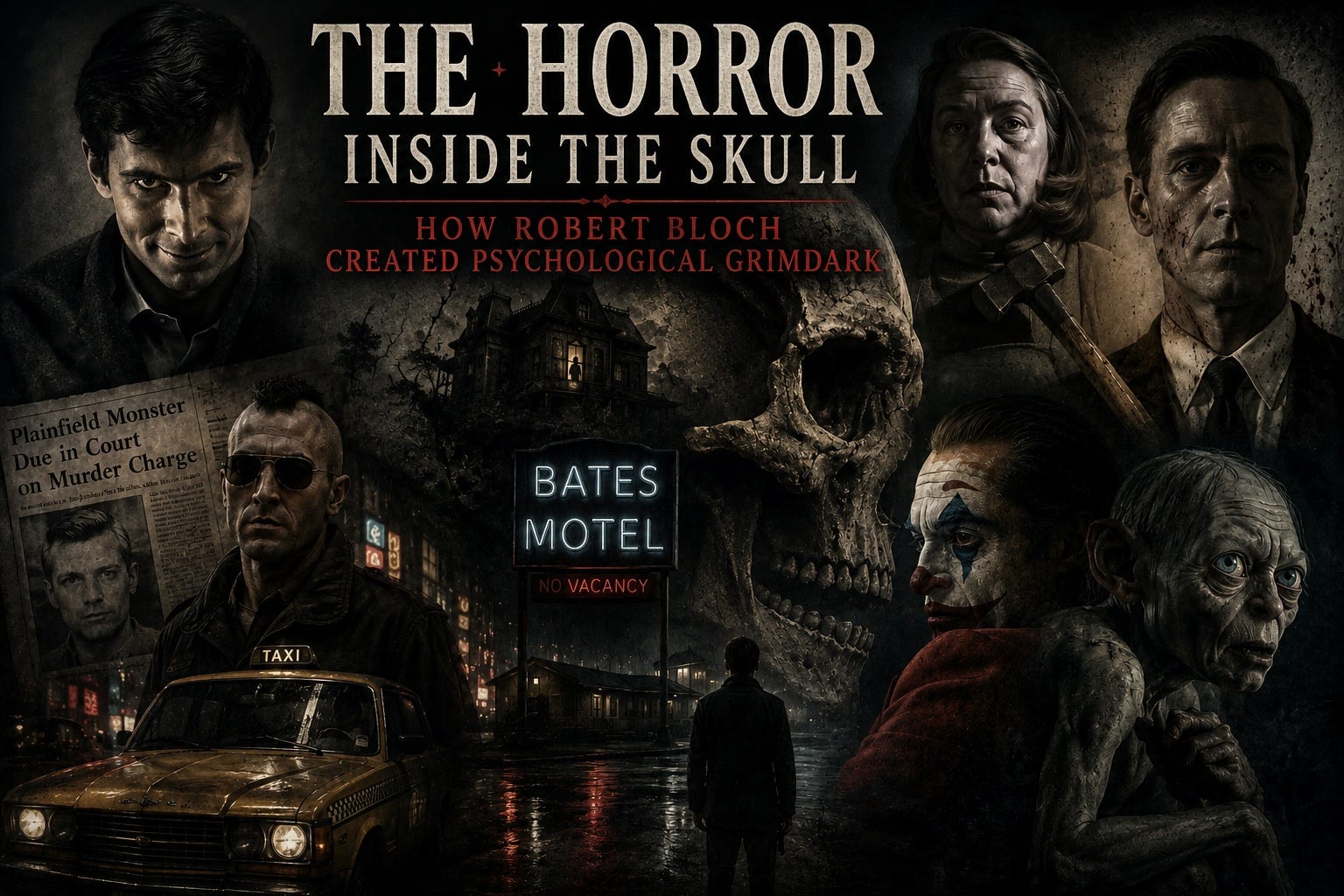
The Horror Inside the Skull
How Robert Bloch created psychological Grimdark
Funny, how differently things work out in real life. None of us really suspected the truth, we just blundered along until we did the right things for the wrong reasons. And right now, I can’t even hate Bates for what he did. He must have suffered more than any of us. In a way I can almost understand. We’re all not quite as sane as we pretend to be.
Robert Bloch[1]
H.P. Lovecraft is one of the grandfathers of cosmic horror; Robert Bloch helped introduce the modern world to psychological horror. Bloch’s terror does not slither from the unfathomable darkness of space across vigintillions of aeons. It sits behind a motel desk and smiles nervously at the guests. If you glance up at his upstairs window, you might see the silhouette of an old lady. Stare a little longer and you’ll notice she is unnaturally still. Stick around a few days and you may see Travis Bickle pull up in the parking lot in his taxi, or Annie Wilkes may stop by to tell you she’s your greatest fan.
Gothic horror externalized evil. Dr. Frankenstein assembles a monster from stolen body parts in his crumbling castle. Dracula brings his ancient bloodlust from sparsely populated Transylvania into the teeming streets of Victorian London. There was a clear division between Henry Jekyll and Edward Hyde, and little danger of mistaking one for the other. With Norman Bates there is no dividing line. He is simultaneously terrifying and pitiful; both monster and wounded man-child. That emotional ambiguity would become one of the foundations of grimdark.
Bloch was inspired to write Psycho after reading about Ed Gein in the Milwaukee newspaper. Elements of Gein appear throughout the novel: an unhealthy attachment to an overbearing mother, cross-dressing, grave robbing. But while journalists portrayed Gein as a grotesque monster, Bloch’s Norman Bates is all too human—and, despite being fictional, perhaps closer to the real Gein than many of the lurid accounts seen in newspapers and detective publications. Newspapers cast Gein as a monster; Bloch made him something more terrifying—a man.
In fairness, we can’t blame the newspapers for seeing Ed Gein as a terrifying aberration. When we hear about somebody keeping body parts and a skin suit in his house, we tend to look at him in an unflattering light. It’s much more comfortable that way. Monsters are frightening, but they are also alien. Bloch asks a more unsettling question: what if the monster is not hiding in your house, but living inside your head?
The December 2, 1957 Life story on Gein included several quotes from neighbors. Some said they had always feared the odd, socially awkward Gein. But there were also accounts like:
Farmer, Elmo Ueeck, though he employed Gein, never grew suspicious. “We always thought he was just plain foolish,” said Ueeck. He also recalled that one of Gein’s favorite subjects was embalming.
Parent, Mrs. George Foster holds her son Howie as she takes rolls from the oven. “Ed Gein baby-sat for me once for about an hour. Just sat there, ate peaches, and watched TV while he watched Howie.[2]
Even many modern grimdark writers fear to go into Bloch’s territory. They make their murderers cool antiheroes like Patrick Bateman or vile beasts like Gregor Clegane. Norman Bates, like Ed Gein, is a socially maladroit but harmless-seeming fellow. At 5’7” and 135 pounds, Ed Gein was hardly a threat to your average strapping Wisconsin farmer. Bloch’s Norman Bates is pudgier but equally inoffensive. Neither is suave or savage; both come across at first glance as strange, perhaps a bit off-putting, but ultimately harmless.
Norman didn’t really object; he had lived in this house for all of the forty years of his life, and there was something quite pleasant and reassuring about being surrounded by familiar things. Here everything was orderly and ordained; it was only there, outside, that the changes took place. And most of those changes held a potential threat.[3]
A few sentences later, we see Norman is reading a passage about the Incas making drums from the bodies of their enemies and allowing himself “the luxury of a comfortable shiver.” But since we’re reading a crime novel, most of us have indulged in that same pleasure. We can tell there is something a little off about Norman, but he still seems well within the boundaries of ordinary human behavior. There are many immature Momma’s boys. Very few of them are killers.
We become even more sympathetic when his mother comes downstairs to belittle him. Mother goes on at length about Norman’s many failures. She knows the inside of Norman’s head as well as she knows the back of her own hand. She knows his fears, his desire for isolation, his dependency, his shame. It’s clear that Norman is also aware of his shortcomings. Before things get overheated, the bell rings. They have a guest.
Mary Crane also feels trapped in her day-to-day life. Unlike Norman, she has decided to change things with $40,000 in stolen money. She is understandably nervous, but the sweet, bespectacled desk clerk helps her relax. That changes when she suggests that his relationship with Mother may be a bit smothering and, perhaps, she belongs in an institution. Norman explodes in red-faced rage. Suddenly embarrassed and uneasy, Mary retreats to her room. Unfortunately, Mother has overheard the argument. What follows would inspire Hitchcock’s famous shower scene.
Mary is now missing, as is her boss’s $40,000. A private investigator stops by the Bates Motel and grills Norman. As Norman grows increasingly flustered, Mother once again steps in. Now there are two bodies in the neighboring pond. Mary’s fiancé Sam and her sister Lila go to the sheriff to report Mary missing. They talk about the private eye and how he told them he saw Norman’s mother in the upstairs window. This catches the sheriff’s attention. He informs them that Norman’s mother died twenty years ago, and that he was one of the pallbearers.
Norman, meanwhile, is growing increasingly panicked. After frantically scrubbing the rooms and recovering everything but a single earring, he moves Mother to the basement. She protests, but he promises he will look after her, visit regularly, and bring her meals. Mother remains unhappy, but Norman knows what must be done. Once this mess is settled, things can go back to the way they were.
Sam and Lila visit the Bates Motel and check in as a married couple. Sam sits down for a drink with Norman while Lila explores. She makes it up to Mother’s bedroom but finds no trace of Mother, only a strange collection of books on witchcraft, abnormal psychology, theosophy, and pornography.
She replaced the volume hastily and stood up. As she did so, the initial shock of revulsion ebbed away, giving place to a second, stronger reaction. There was something here, there must be. What she could not read in Norman Bates’s dull, fat, commonplace face was all too vividly revealed here in his library.[4]
With Mother in the basement, Norman realizes he must handle the situation himself. When Sam turns, Norman strikes him in the head with a whiskey bottle and knocks him unconscious. Then he hears a scream from the basement.
Lila is downstairs with Mother’s corpse as Mother rushes down the stairs, a “fat, shapeless figure, half-concealed by the tight dress which had been pulled down incongruously to cover the garments beneath.”[5] Sam grabs Norman’s wrist as he screams “I am Norma Bates!”
After Norman is institutionalized, his psychiatrist says that after poisoning his mother and her fiancé, Norman’s personality shattered into three fragments: Norman, a little boy who needed his mother; Norma, the mother who protected him; and a third personality who fronted for both when necessary—Normal. Normal no longer leads the triad; it now belongs to Norma, who insists that she is innocent and Norman was to blame. Why, she wouldn’t even harm a fly...
By the mid-1940s, I had pretty well mined the vein of ordinary supernatural themes until it had become varicose. I realized, as a result of what went on during World War Two and of reading the more widely disseminated work in psychology, that the real horror is not in the shadows, but in that twisted little world inside our own skulls.
Robert Bloch[6]
While Bloch got his start in Weird Tales and other pulp magazines, he eventually found the genre constricting. For him, the vast unknowable world around us was less disturbing than the equally vast and unknowable world inside us. He was less frightened by unnamable beasts than by the quiet man next door who might have a torture dungeon in his basement.
At the time Ed Gein was arrested, a communist guerrilla army called the Viet Cong had begun fighting the Western-allied Republic of Vietnam. Three years after Hitchcock’s Psycho was released, the Gulf of Tonkin incident brought an official American military presence to a country that few Americans could find on a map. That war would soon be photographed and televised in all its blood and horror for an increasingly divided nation.
There was still a great deal of optimism in American life, but there was no Adam West waiting in the wings with Vietnam Pacification Bat-Spray. Then came the July and August 1969 Tate-LaBianca murders, and America found itself wondering if those cheery barefoot hippies were as harmless and inoffensive as they appeared. Optimism was increasingly giving way to doubt and skepticism grew as confidence eroded.
In the 1970s, many Americans were on a quest to “find themselves.” But you don’t have to search for something that hasn’t already been lost. The prosperous life of the postwar Boom was not only unfulfilling; it was also increasingly unprofitable. Stagflation and malaise had descended on America, and the utopian dreams of psychedelic rock gave way to punks sneering “No future, no future, no future for you.”
Bloody exploitation films had been making the drive-in circuit for years. 1974’s The Texas Chain Saw Massacre became a cult classic and Wes Craven’s 1977 The Hills Have Eyes revived Wes Craven’s career after his 1972 sadomasochistic flop Last House on the Left. But 1978 brought the film that would kickstart slasher cinema: John Carpenter’s Halloween.
Halloween brought terror to suburbia; Michael Myers has escaped his institution and is on a killing spree. It was soon joined by similar, e qually popular films like Friday the 13th and Nightmare on Elm Street. But where Bloch and Hitchcock explored internal horror, slasher films once again externalized it. Freddy Kruger, Michael Myers, and Jason Voorhees are closer to Frankenstein and Dracula than to Norman Bates. They are clearly Other; instead of pity, the audience greets them with terror—and, ultimately, with cheers of approval.
1976’s Taxi Driver hews more closely to Bloch’s vision than the re-externalized horror of slasher films. Travis Bickle (Robert de Niro) has more agency and can inflict violence without letting Mother handle it. But like Norman Bates, he is a marginal man living in a marginal world. He drives through the dirty, crumbling streets of New York and makes awkward attempts at romance with little success. After his plan to assassinate a presidential candidate fails, he rescues a 12-year-old prostitute (Jodie Foster) by shooting his way in and out of the brothel.
Travis Bickle is one of the first fully modern grimdark antiheroes. He is rewarded for his heroism; had he succeeded in his original goal, he would have been institutionalized as a madman. He is a shard that gives you different reflections; savior, vigilante, loner, assassin. This kind of moral ambiguity would become a central feature of the grimdark ethos. Norman Bates desperately sought order in a frayed old motel; Travis Bickle drives through a city that is collapsing along with his mind.
Slasher villains and cool, hyper-competent psychopaths like Patrick Bateman and Dexter Morgan become icons and mascots because they are externalized. We have met the enemy, and we are relieved to discover that he is not us. Norman Bates remains disturbing because we can recognize his vulnerability, shame, loneliness, and humanity. We see traces of Norman in Travis Bickle, Misery’s Annie Wilkes, Joker’s Arthur Fleck, and Andy Serkis’s portrayal of Smeagol/Gollum as a broken addict searching desperately for a goodness he has almost forgotten.
These broken heroes remain unsettling because they never fully become “Other.” They provide Aristotle’s twin pillars of tragedy: pity and terror. We can sympathize with Norman’s embarrassment, with Arthur Fleck’s alienation, with Travis Bickle’s loneliness. Their suffering is part of the ordinary human experience, even as it drives them outside the bounds of ordinary human behavior. We get no comfortable shiver at their crimes, just the same catharsis we feel for a blinded Oedipus. Like him, they are driven to darkness by forces they can neither understand nor control.
[1] Robert Bloch. Psycho: A Novel. (1959). New York: The Overlook Press, 2010 Edition. E-Novel.
[2] “House of Horror Stuns the Nation.” Life magazine, December 2, 1957. 28-29.
[3] Bloch, Psycho.
[4] Ibid.
[5] Ibid.
[6] Paula Guran, “Behind the Bates Motel: Robert Bloch.” (August 1999). DarkEcho. https://web.archive.org/web/20120204134611/http://www.darkecho.com/darkecho/horroronline/bloch.html.


