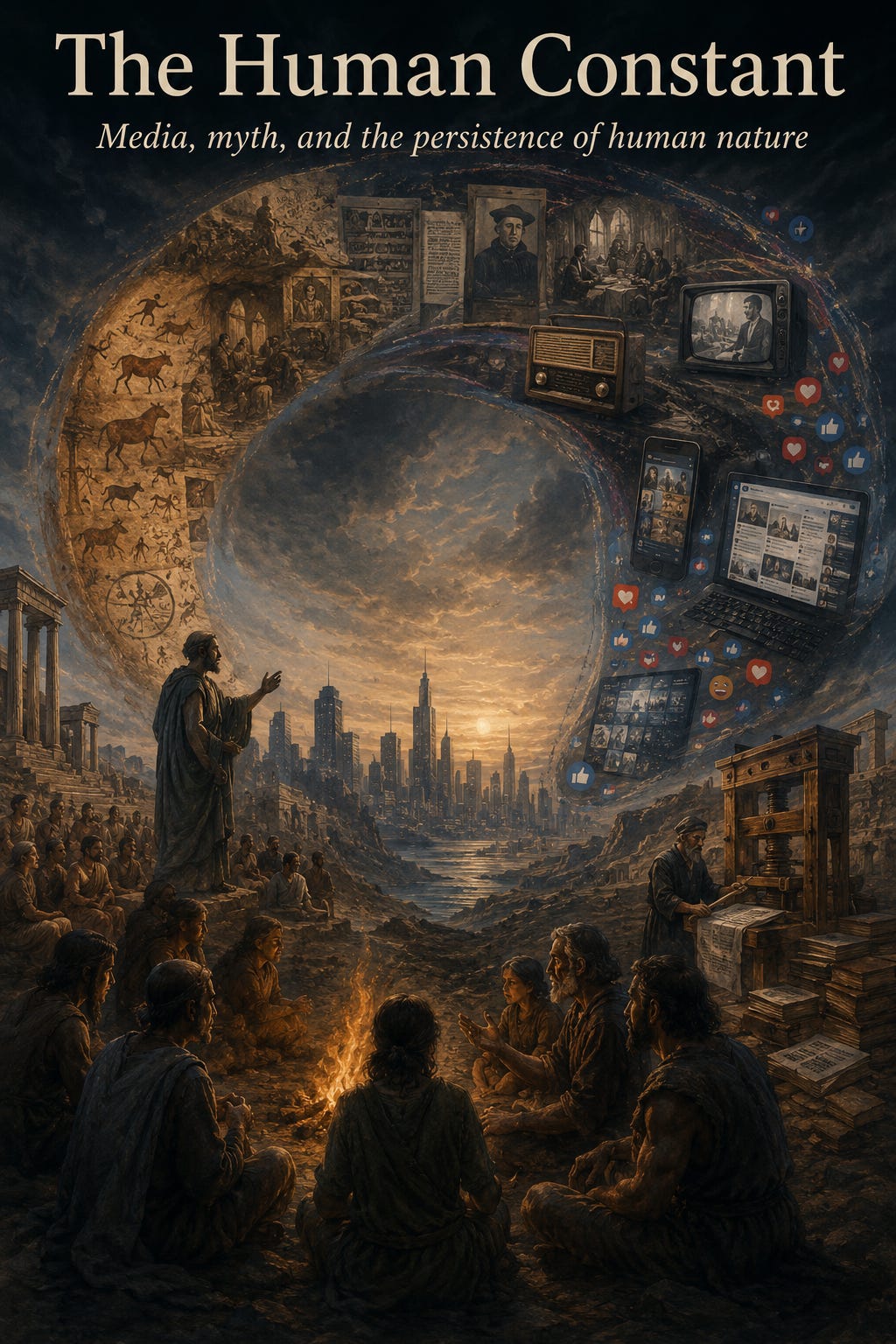
The Human Constant
Media, myth, and the persistence of human nature
A Hutu neighbour came to warn us. “I’ve known you for long and I don’t want to kill you,” he said. But he did want to be the first to loot our house.
After the genocide, we learned that our neighbour had not only looted our house, but destroyed it.
Neighbours were pitted against neighbours. This is what a “genocide of proximity” means.
Claver Irazoke, recounting the 1994 Rwanda genocide.[1]
In the 1990s, Rwanda remained a largely oral society. While most Rwandans over 15 could read and write simple sentences, most got the lion’s share of their entertainment and information from the radio. Televisions were for the wealthy and there were only a few government-controlled newspapers available.
July 8, 1993 saw the birth of Rwanda’s first free radio station, Radio Télévision Libre des Mille Collines (Free Radio Television of the Thousand Hills). Before this, Rwandan listeners relied on government-owned Radio Rwanda and a Tutsi-run station, Radio Muhabura, broadcasting out of neighboring Uganda.
Radio Muhabura was run by exiles who loudly criticized the Hutu-led Rwandan government and called for a return of the Tutsi monarchy that had once ruled the region. But it broadcast primarily in English, a language spoken by few Rwandans. RTLM broadcast in the main languages of Rwanda, French and Kinyarwanda. Listeners could call in to offer their thoughts and request music. The DJs specialized in crude, outrageous “shock jock” commentary. They also indulged in frequent ethnic humor aimed at Tutsis—humor that soon became fuel for hate.
One of the RTLM regulars was a popular singer named Simon Bikindi. Journalist Bill Berkely, who was in Rwanda at the time of the genocide, describes his introduction to Bikindi’s music.
A popular crooner named Simon Bikindi was beseeching his fellow Hutu - the bene sebahinzi, the sons of cultivators - to carry on the slaughter without delay. “Defend your rights and rise up against those who oppress you!” … Bikindi was singing in riddles, addressing mbira abumva - “those who can understand”. His voice was soft, gently cadenced, almost lyrical. He was warning his listeners of the malign intentions of the bene sebatunzi, the sons of pastoralists - the Tutsi.
“The Tutsi are ferocious beasts, the most vicious hyenas, more cunning than the rhino,” he cooed. “The Tutsi inyenzi [cockroaches] are bloodthirsty murderers. They dissect their victims, extracting vital organs, the heart, liver, and stomach.”[2]
On April 6, 1994, an airplane carrying Rwandan President Juvénal Habyarimana and Cyprien Ntaryamira, the Hutu president of Burundi, was shot down as it prepared to land at the Kigali airport. There were no survivors. Within three hours after the crash, RTLM reported that the plane had been shot down by the RPF. Hutus were called to take up arms against Tutsis and moderate Hutus. When the conflict finally ended a hundred days later, over 800,000 Rwandans—around 12% of the population—were dead.
Radio did not create the Rwanda Genocide. Tensions between Hutus and Tutsis had been ongoing for centuries. Yet there was also a great deal of neighborly cooperation and intermarriage. At the time Simon Bikindi was singing about Tutsi cockroaches, he was living with a Tutsi woman and caring for her Tutsi son. But radio synchronized and accelerated old grudges into communal atrocity.
The printing press is often cited as a major cause of the Thirty Years’ War, but there were underlying disputes well before Gutenberg. Nobles and a small but growing middle class were already questioning Church authority; heretical movements like the Cathars and the Hussites had questioned its dogma and structure. In that environment, the printing press served not to create the tensions but to accelerate and synchronize them.
Europe was still a largely oral society for centuries after the introduction of the printing press. In 1643 Scotland, 25 percent of men were able to sign their names; that number rose to 65 percent by the 1750s. From 1686 to 1690, only about 29 percent of French men and 14 percent of women were able to sign their names in parish marriage registers; by 1786–90, the percentage had grown to 48 percent of men and 27 percent of women—still considerably lower than the literacy rates in 1993 Rwanda.[3]
Luther’s pamphlets and broadsheets spread rapidly; they generally included woodcuts and visual propaganda for semi-literate audiences. His vernacular translations of the Bible into German helped Christians to read Scripture and understand it for themselves. But those who could not read relied on preachers and itinerant speakers to translate dense theological texts into language they could understand. Printed ideas spread largely through oral performance, communal ritual, and emotionally charged sermons.
Those pamphlets and books took on an increasingly polemical tone as Protestantism spread. Opponents were demonized; Catholics and Protestants came increasingly to see each other as existential threats. What began as a theological disagreement became mass emotional mobilization. Between 1618 and 1648 Central Europe was wracked by a Thirty Years’ War that would see between 4.5 and 8 million lives lost to famine, massacres, disease, and social collapse.
On the road to the Thirty Years’ War Europe also saw a sharp spike in “witch trials.” When Heinrich Kremer and Jacobus Sprenger wrote their 1487 Malleus Maleficarum, it went through thirteen printings but went out of print in 1520. In 1574, as Catholic/Protestant conflict was intensifying and fears of diabolism and witchcraft were growing, the “Witch Hammer” went back into print and would be reprinted fifteen more times between 1574 and 1669.
Between 1560 and 1630, over 40,000 “witches” were executed in both Catholic and Protestant regions of Europe. Confessions were frequently extracted through torture. Resistance was proof not of innocence but guilt; surely only one possessed by the devil could withstand the agonies of the strappado, rack, or thumbscrews. Confession was also seen as proof of guilt, so the accused faced an uphill struggle in proving themselves innocent unless they were tried by a skeptical judge or inquisitor.
Few peasants were literate, and fewer still were conversant in Latin. But the ideas that appeared in the Malleus Maleficarum were passed down through clergymen and translated into vernacular pamphlets. Neighbors sought out unpopular figures, often old women, and accused them publicly. Many of these cases ended in extrajudicial lynchings.
The printing press did not “cause” the Thirty Years’ War and the witch killings any more than radio “caused” the Rwandan genocide. In both cases, a new media format helped to inflame tensions and provided a means of organizing the populace. The printed word did not eliminate oral culture; it transformed it. Like radio and social media after it, print reshaped how human beings organized belief, identity, and conflict.
Television functioned in many ways like a hybrid of the major forms of the media that preceded it. Like the radio, the television was a piece of furniture in your home. It was ever present and could be turned on and off at any time. Television inherited many radio tropes, while Vaudeville was reborn in endless variety shows. People who once got sports information on the radio could now watch their team’s triumph and defeat in real time.
Like cinema, television gave you moving pictures and created shared reference points; we mourned Kennedy’s death, cheered when our team won the Super Bowl, and got our information from the nightly news. In the 1930s, 65% of Americans visited a movie theatre at least once per week[4]; in 1960 a typical adult watched 3.3 hours of TV daily, while in 2014 that number was up to 5.4 hours.[5]
The Internet shows a similar hybridization. We typically communicate using text. But we often share images and videos with our friends and fans. Apps like Discord offer voice chat with family and strangers, and we can stream videos and movies from a number of services that have replaced VCRs and cassette mix tapes. And our media source is no longer furniture; it’s a phone we carry in our pocket or purse. These pervasive changes have made some think that the Internet is going to transform everything about our lives—and not necessarily for the better.
They are not wrong. But neither are they entirely right.
New media technologies change the way we think. They do not change who we are. We want to understand and we want to belong. New media give us new ways of understanding and belonging. The tools change, but the human drive remains. Wars fought with machetes and clubs require different strategies than wars fought with guns and tanks. But they are still driven by the same lusts, urges, and grudges.
Today social media gets blamed for an increasingly polarized world. There’s certainly some truth behind those accusations. But we’re also living in a world of increasing cultural stratification and economic decline. Those conditions inevitably create tension. We might just as plausibly argue that social media serves as a pressure valve that redirects that anger toward memes and harmless noise rather than active rebellion.
But redirection cannot solve social problems; it can only buy time. Those tensions will continue to rise as income inequality grows and a new generation realizes that the Myth of Progress has died on their watch. Those who have relied on soft power—propaganda, social safety nets, online arguments—may turn once again to costlier and bloodier forms of hard power. This will not be something to celebrate, but it may be something that we cannot avoid. Some say violence is never the answer. But it is the answer we always turn to when all other answers fail.
Whether our decline ends in war or slow decay, we will tell stories. Some we will tell each other; some we will tell ourselves. They will help us make sense of an increasingly constrained and collapsing world. We will see ourselves and our community in those tales as our world begins its long gradual slide from history to myth. They will give us meaning that facts and charts can no longer provide.
As a once-prosperous world sank into the Late Bronze Age Collapse, it preserved fragments of a glorious past. Centuries later those shards served as the foundation for a Hellenic Golden Age and the rise of Rome. Our shards will sparkle once again in a future sunrise. We cannot control whether we will be remembered as heroes or villains. But we will be remembered.
[1] Mia Swart, “‘Music to kill to’: Rwandan genocide survivors remember RTLM.” (June 7, 2020). Al-Jazeera. https://www.aljazeera.com/features/2020/6/7/music-to-kill-to-rwandan-genocide-survivors-remember-rtlm.
[2] Bill Berkeley. The Graves Are Not Yet Full: Race, Tribe, and Power in the Heart of Africa. New York: Basic Books, 2002. 2.
[3] James Van Horn Melton, The Rise of the Public in Enlightenment Europe. Cambridge: Cambridge University Press, 2004. 82.
[4] Nicole Humphrey, “Movie Theatre Attendance Statistics” (2019) at Infogram. https://infogram.com/movie-theater-attendance-statistics-1h0r6roq5dr86ek.
[5] Media Dynamics Inc., “Adults Are Seeing More TV Commercials Than Ever Before.” (October 14, 2014). https://www.mediadynamicsinc.com/uploads/files/PR111414-Adults-Seeing-More-TV-commercials-l2o.pdf.