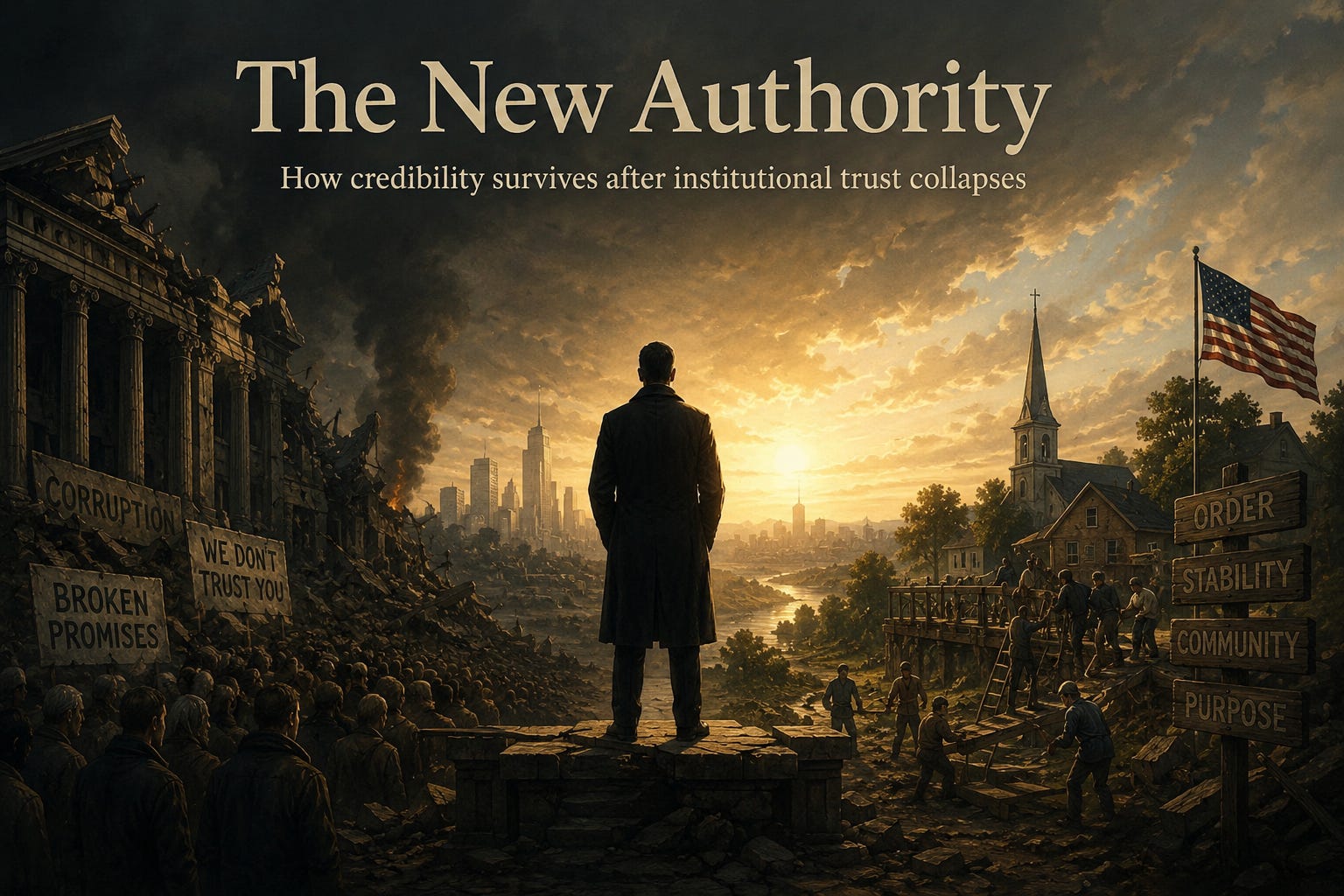
The New Authority
How credibility survives after institutional trust collapses
In August 1996, a few days after Pravda’s last issue, Vladimir Putin moved to Moscow for a position in Boris Yeltsin’s second Presidential administration. The former KGB agent had found some success in St. Petersburg politics, but his mentor, Anatoly Sobchak, had just been voted out of the mayor’s office.
His new appointment—Deputy Chief of the Presidential Property Management Department—was a stepping-stone to bigger things in post-Soviet Russia. By 1998, Putin was director of the FSB, Russia’s security agency. When Yeltsin resigned on December 31, 1999, eight months before the end of his second term, he chose Putin as his hand-picked successor.
Acting President Putin ran a quiet campaign and refused to participate in debates. But he had the support of state television and received more than a third of all television coverage devoted to the 12 candidates. On March 26, 2000, Putin won the Presidential election with 53.4% of the vote. Since that time, he has been the de facto leader of Russia.
In America, Putin is most frequently seen as a tyrant who rules over his people with an iron hand. Russia certainly lacks many civil rights protections that we take for granted. But when we view Russian politics through an American lens, we frequently misinterpret or miss things that Russians take for granted.
Postwar Americans prioritized expressive freedom, procedural rights, and individual liberty because we could take material stability as a given. We had several generations of rising living standards and geopolitical dominance. Our founding myth involves a revolution against an unjust king and a new representative democracy. We support—in theory, if not always in practice—freedom of speech, open debate, and individual self-expression.
In 1942, a decade before Vladimir’s birth, Viktor Putin died of starvation and diphtheria during the Siege of Leningrad. He was two years old. Approximately 420,000 Americans died during World War II; the Soviet Union lost between 24 million and 27 million people. World War II victories are seminal myths for both Americans and Russians. Americans focus on our glorious triumph; Russians remember the terrible cost.
When Americans hear the words “Soviet Union,” they often think of the gulag and Stalinist terror. Russians are more likely to envision a system that took a country that was barely out of feudalism and turned it into an industrial superpower. The Purges are now on the fringe of living memory; very few of the formerly incarcerated are still alive to tell their story. Russians recognize those excesses, although a surprising number will dismiss them as American propaganda. But they also recognize communism’s benefits.
America’s power word is “Freedom.” Puritans sailed to the New World to practice their religion and live as they saw fit. Immigrants escaped poverty and oppression to come to Ellis Island in hopes of a better life. We enshrined the rights to freedom of speech, religion, the press, and arms into our founding document. Our national anthem declares us “the land of the free and the home of the brave.” We place an enormous premium on individual autonomy, freedom of expression, and pluralistic politics.
By contrast, Russia’s power word is “Endurance.” Outside of the southern United States, no American culture has ever experienced defeat on its own soil. Russia has experienced it many times. It has survived invasions by Mongols, Poles, Swedes, Ottomans, Nazis, and Napoleon. In each case it took bloody losses but outlasted its foes and remained after they left. Russians prioritize national sovereignty, collective stability, freedom from chaos, and material security.
Neither of these worldviews is “right” or “wrong.” Each has arisen out of history; each shapes the collective identities of their people. But when we look at each culture through the lens of the other—when we make our priorities theirs—misinterpretations and misunderstandings inevitably arise. To understand how Putin came to power in Russia and why he is widely respected by his people, we must understand how he came to be his country’s new authority.
During the Second World War, the Soviet Union’s national income fell by 20% between 1940 and 1942. It recovered to its 1940 levels by 1944, dropped 20% again as military industry was converted, then rose to 20% above 1940 levels by 1948. The Soviet economy endured severe strain. But it never reached the 30% GDP losses Western countries endured during the Great Depression of 1929-33.[1]
In the 1990s, Yeltsin tried to develop a Russian market economy to replace the Soviet system. He was following in Gorbachev’s path toward perestroika (restructuring). The immediate result was hyperinflation; the inflation rate for 1992 was 2,509%, 840% for 1993, 215% for 1994 and 131% by 1995. Between 1991 and 1998 the Russian GDP contracted an estimated 40%.[2]
Americans were sure the end of communism was the beginning of Russian freedom. Russians experienced its demise as a decade of poverty and humiliation. The Soviet Union’s social safety nets disappeared almost overnight; oligarchs looted the country and took over formerly state-run industries. The Russian people had no reason to love capitalism and every reason to look back fondly on the old system despite its flaws.
During his first year in office, Putin talked a great deal about “strengthening the Russian state” and “catching up with the West.” Russians who had endured the chaos of the 1990s saw continuing economic improvement under Putin. By the mid-2000s Russia’s GDP per capita had returned to 1991 levels; by 2010 the average Russian was wealthier and had access to more goods than during Soviet times.
Russia had a longstanding inferiority-superiority complex about the West. Russian elites frequently felt that their culture was backward next to the more sophisticated Europe. But they also scorned European decadence and moral decay. Putin played on both these beliefs. He acknowledged Western prosperity while calling out Western arrogance and greed. This helped forge a new post-Soviet identity based not on defeat but on strength. The West was ahead of them in many ways, but it lacked Russian piety and endurance.
In 1833 Tsar Nicholas I declared a Triad of Russian Nationality: pravoslaviye, samoderzhaviye, narodnost (Orthodoxy, Autocracy, Nationalism). The Church, the Tsar, and the Nation were part of a unified political unit—a stark difference from America’s “separation of Church and State.” The Communists tried to uproot the Russian Orthodox Church, imprisoning and killing many clergy and believers during their first decades of rule.
They did not succeed.
Soviet estimates from the mid-1930s concluded that around 57% of the population remained Orthodox believers; the results of a question on religious belief were suppressed from the 1937 census. In 1943, Stalin met with Patriarch Sergius of Moscow, one of the first Church leaders to appeal to the patriotic spirit of the Soviet people after Hitler’s invasion. Under their agreement, the Church continued to function under tight state control.[3]
Putin has claimed that his mother secretly had him baptized when he was an infant. In early meetings with President George W. Bush, Putin visibly wore an Orthodox cross that he claimed was given to him as a child.[4] He regularly attends services during Holy days and has used Orthodox theology to criticize liberal democracy and LGBTQ+ rights.
His devotion mirrors Russia’s post-Soviet return to Orthodoxy. According to a 2026 poll taken by the All-Russian Public Opinion Research Center, 73% of respondents considered themselves to be Orthodox, though other sources suggest only 15-20% of people claiming to be Orthodox are regular practitioners.[5] The Russian Orthodox Church is a major social force, and Putin’s affiliation with the ROC strengthens both the Church and his reign.
So could we get a post-American Vladimir Putin in the wake of an American collapse?
Short answer: no. Putin is a product of Russian culture and politics. His rise to power was rooted in his deep understanding of the Russian psyche and his ability to use those preconceptions and expectations to his advantage. Not only do Americans have no interest in a Tsarist state; our origin myths start with our rejection of monarchy after the overthrow of an unjust king.
However, as I have repeatedly noted, short answers often mislead more than they clarify. A more fruitful line of inquiry might be to ask what the leader of a post-American state might share with Vladimir Putin.
While Orthodoxy is growing in America, it is still a smaller sect among our greater Christian community. A post-American leader would more likely emerge from an Evangelical, mainstream Protestant, or Roman Catholic tradition. He need not be particularly devout, but he will need to appeal to America’s Christian roots—especially since a post-American state will likely see the same renewed religiosity as post-Soviet Russia in the wake of our collapse.
He most likely will not rely on classic American “hellfire and brimstone” rhetoric, but he will almost certainly pinpoint our lost faith as the cause of many of our woes. He will work with church leaders on social issues and use churches as a pulpit for political messaging. And just as Putin courts the support of Russia’s 10% Muslim population, our new authority will reach out to those of different faiths as well.
Like Russia, America is a multicultural and multiethnic state. A post-American leader will likely respond harshly to those who foment ethnic tensions. But Putin has also used persecution of ethnic Russians in Crimea and eastern Ukraine to frame land grabs as ethnic defense. It is likely we will see that kind of divided response after an American collapse. Loud ethnic nationalists will be shunned or jailed; ethnic attacks may become a pretext for territorial expansion.
In times of collapse, proximity generally trumps ethnicity. Societal fragmentation does not inevitably become a race war. Neighbors, coworkers, and local community groups are going to become more important than ideological abstractions. Ranting online is easy: shooting someone you have known for years over their ethnicity is much more difficult. Russians and Americans both deal with ongoing ethnic tensions. But they deal, and we deal.
If we are fortunate, our new leader will share Putin’s pragmatism. Lenin and Stalin were idealists who killed millions in the name of a new society. Gorbachev and Yeltsin were idealists who tanked the Russian economy in the name of a free market. Putin has shown a remarkably practical streak. He has kept Russia together and remains popular because, in the eyes of many Russians, he brought continuity and order. He is ruthless when necessary—certainly more ruthless than most Americans would tolerate. But he has ruled this far without mass slaughter.
This is a very real concern in a post-collapse society. As a state falls, its citizens become increasingly desperate for restored order amidst chaos and meaning against confusion. To see how that can end, one need only look to the wreckage of the 1917 Russian Empire. If we are fortunate, we will get a leader who is only ruthless when necessary and who rules without mass slaughter. If we are not, we may get a strongman who presents himself as the new George Washington and promises to rebuild a New America from the ground up.
[1] Vladimir Popov, “Where do we Stand a Decade After the Collapse of the USSR” (2001) at UN University World Institute for Development. https://www.wider.unu.edu/publication/where-do-we-stand-decade-after-collapse-ussr.
[2] Gidadhubli, R. G.; Mohanty, Arun (2002). “Continuing Debate over ‘Shock Therapy’”. Economic and Political Weekly. 37 (50): 4998–5002. JSTOR 4412958.
[3] . Robert D. Potts, “The Triad of Nationality Revisited: The Orthodox Church and the State in Post-Soviet Russia.” (Spring 2016). 4. At University of Maine Digital Commons. https://digitalcommons.library.umaine.edu/cgi/viewcontent.cgi?article=1411&context=honors
[4] Ben Ryan, “Putin and the Orthodox Church: how his faith shapes his politics” (2017) at Theos. https://www.theosthinktank.co.uk/comment/2022/02/16/essay-on-vladimir-putin.
[5] Kirsten Hohenstein, “Russian Orthodoxy and National Identity in Post-Soviet Russia” (2012) at University of Florida Libraries. https://ufdcimages.uflib.ufl.edu/AA/00/05/75/70/00001/hohensteinkr-FINAL%20THESIS%20DRAFT___for%20real.pdf