
The New Tribalism
Signals, Alignment, and Belonging in a Fragmented World

We always had personal realities and realities we shared among our friends and colleagues. Inside jokes, hidden meanings, secrets shared between a small group—they have always been part of the mortar that holds a micro-community together. But those realities existed within a greater reality, one that was broadly recognized by friends and strangers alike.
We accepted a common set of baseline facts: the earth is round, astronauts landed on the moon, vaccinations help prevent epidemics. We looked to institutions for guidance. Ivy League degrees carried weight, medical advice was taken seriously, and the day’s events were mediated through newspapers and evening news broadcasts. This consensus reality was not perfect, but it was sufficiently stable to support trust, coordination, and debate.
Today, we can pick and choose between thousands of news sources. We often turn to our social media feed to discover what our friends are reposting. Where we once depended on a handful of TV channels and our local newspaper, we are now guided by algorithms that prioritize engagement over coherence.
Debate requires common ground; social cohesion requires predictability and trust. As William Butler Yeats reminds us, anarchy is loosed upon the world when the center fails to hold. What we are seeing in the new tribal era is not a descent into chaos or even a return to classical anarchism. It is a fragmentation of authority into loosely connected communities—resembling in form the decentralized structures imagined by 19th century anarchist thinkers like Peter Kropotkin.
Contrary to what has been previously considered good form, we can agree on the fact that reason plays only a small part in the formation and expression of opinions…Whether in the context of the network of tiny convivial cells or at a favourite local pub, the collective emotion becomes concrete, playing on the multiple facets of what Montaigne called the ‘hommerie’: that blend of greatness and turpitude, generous ideas and venal thoughts, of idealism and convinced worldliness - in a word: man.
Michel Maffesoli[1]
Maffesoli wrote that paragraph in 1988. When Time of the Tribes was translated into English in 1996, social media was still confined to Usenet and BBSes. Today the Internet has become a second home for many “tiny convivial cells” of tribes that make collective emotion concrete. What Maffesoli observed locally now operates at a global scale.
Social media replicates and amplifies group emotion, shared mood, and identity reinforcement. Members form and express their opinions through social and emotional cues, not via deliberation. They create divergent realities that are separate and distinct from the common reality which we share—or formerly shared.
These virtual communities contain Maffesoli’s blend of greatness and turpitude. Members form close relationships and provide financial support to their down-on-their-luck fellows through donations via GoFundMe, CashApp, and other money transfer services. Many spend hours creating wikis, artwork, and essays that add to their community’s store of knowledge and information. At the same time, these communities often foster bickering, exclusion, and hostility toward adjacent groups.
Each group develops its own emotional consensus and reinforces it internally. But when emotion is primary and reason secondary, consensus becomes unstable. What results are multiple competing realities. What was once localized tribal thinking is now networked and persistent. Its worldviews become not only a method of tribal cohesion, but a pillar of individual identity. Each group consumes its own information streams and views its world through the collective mindset. Truth is no longer negotiated collectively but selected individually.
For many social media users, identity has become the primary organizing force of their reality. They no longer look at information from a framework of “is this true?” but instead ask “does this align with who I am?” Information is filtered through their identity—which increasingly takes the form of a persona rather than a personality—and accepted or rejected based on how it aligns with who they believe they are or who they wish to be.
The identities are often performed through signals. Many respond to “About Me:” with lists like “24/m/demisexual/ADHD/communist/gamer /pronouns he/him” as well as a “DNI” (Do Not Interact) list of forbidden behaviors, identities, and ideologies. These signals function as shorthand for group members and barriers against hostile outgroups.
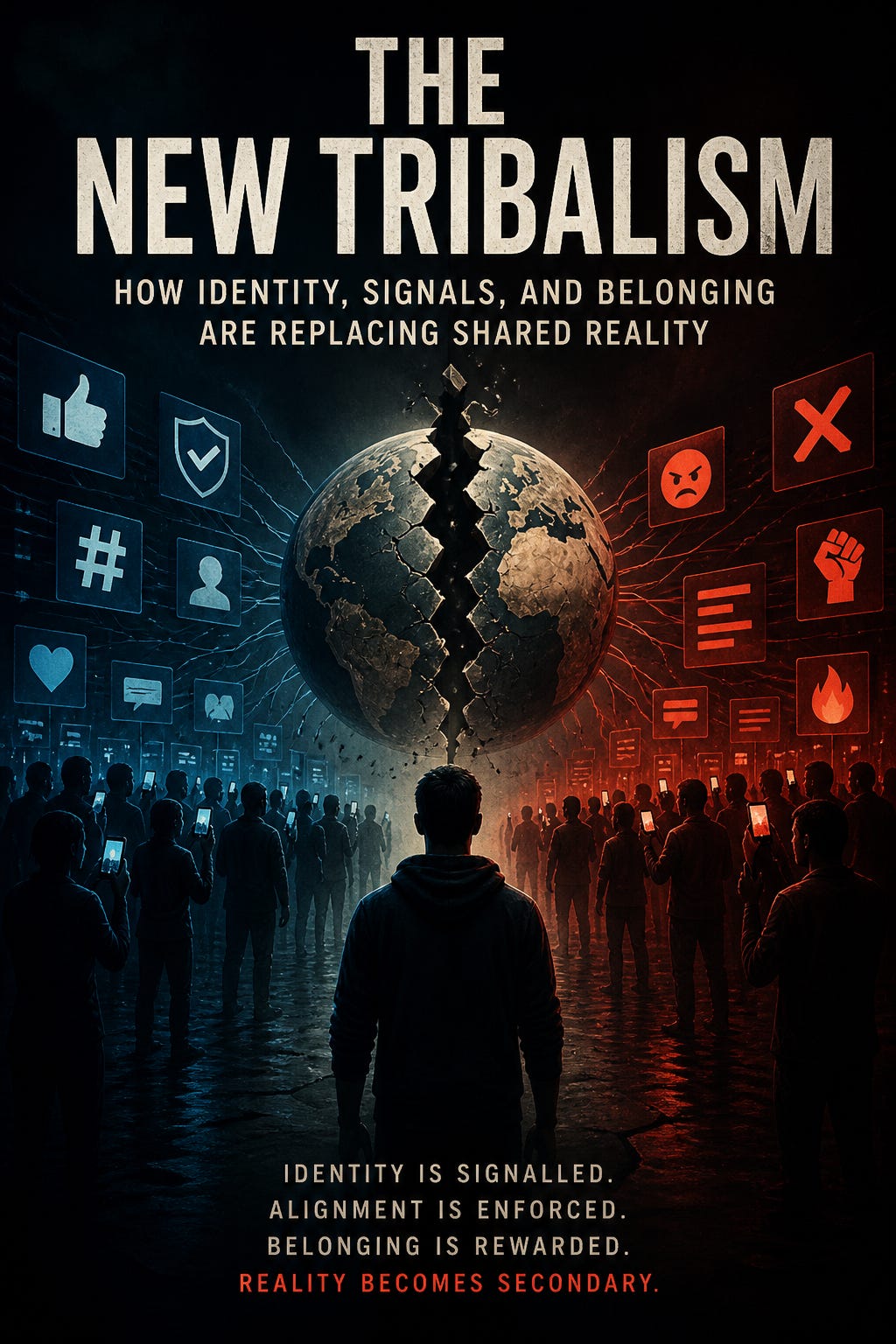
Together, these dynamics form a reinforcing system: identity is signaled, alignment is enforced, and belonging is rewarded.
These groups are held together through ideological consistency. Acceptable behaviors are reinforced with approval; uncomfortable questions or unacceptable actions are punished with backlash and even expulsion. Over time this reduces nuance, hardens positions and narrows the range of acceptable thought. What emerges is an increasingly focused and exclusive shared reality, maintained through continuous signaling and reinforcement.
These parallel realities provide a sense of belonging. They make identity legible, immediate, and enforceable within the social space. For those who struggle with feelings of alienation and loneliness, these groups offer something that is difficult to resist: a caring community. Accuracy is a small price to pay for friendship and a sense of finally knowing who you are.
The identity synthesis is a political trap, making it harder to sustain diverse societies whose citizens trust and respect each other. It is also a personal trap, one that makes misleading promises about how to gain the sense of belonging and social recognition that most humans naturally seek. In a society composed of rigid ethnic, gender, and sexual communities, the pressure for people to define themselves by virtue of the identity group to which they supposedly belong will be enormous. But the promise of recognition will prove illusory for a great number of people.
Yascha Mounk[2]
In his 2023 book The Identity Trap, Yascha Mounk replaces the loaded term “identity politics” with “identity synthesis.” Influenced by postmodernism, postcolonialism, and critical race theory, identity synthesis focuses on categories that include race, gender, religion, sexual orientation, and disability.
Mounk acknowledges that this movement has noble goals. Identity synthesis seeks to remedy injustices and empower the marginalized. But he fears that its emphasis on group identity will strengthen in-group preferences and out-group distrust. He notes that strident identity debates have helped fuel demagogues. And he worries that by focusing on group identity, we start seeing people not as individuals but as labels.
Mounk’s use of “synthesis” also hints at something important about these new identities. They are not just inherited or politically mobilized; they are constructed from cultural, social, and digital inputs. These new identities draw from multiple categories and recombine them into new forms. Hybrid, mixed, and emergent identities are no longer exceptions—they are becoming the norm among virtual tribes.
These identities are fluid and constructed, but they still function as binding and organizing forces. They are defined and redefined in Wikis, Discord chats, and online manifestos. Yet they still produce strong group boundaries and loyal adherents. Their flexibility does not mimic tribalism—it reconfigures it for an online environment.
Identity operates as a system of meaning and coordination. It organizes perception, structures interaction, and defines belonging. These new identities meet all these criteria. They are expressed online, recognized by peers, and reinforced by shared norms and expectations.
These new tribes create their own meanings and their own worldviews. In time overlapping realities emerge. The tribe members differ from outsiders not only in opinion, but in their experience of the world itself. This dynamic results in greater internal cohesion. But it also leads, over time, to fragmentation, polarization, and epistemic division.
These identities do not just describe the world.
They divide it into competing versions of itself.
These dynamics did not emerge in a vacuum. Over the past several decades, identity itself has expanded into new domains.
Kimberlé Crenshaw’s original papers on Intersectionality focused on two common American flashpoints: race and gender. The Gay Rights movement of the mid-20th century, and the AIDS crisis of that followed, helped cement sexual orientation as an axis of identity. What began as a way of understanding specific forms of marginalization has since expanded far beyond its original scope.
Political affiliation, cultural orientation, and ideology have all become identities. Certain disabilities and diseases are increasingly understood as defining aspects of the self. As these categories multiply and expand, identity has become a primary organizing force. It shapes how individuals interpret information, how they relate to others, and where they stand within a broader social landscape.
Identity is no longer something one has; it is a lens through which one interprets the world. Facts and narratives are assessed based on their alignment with sense of self and group affiliation. Information that reinforces identity and confirms the existing framework of meaning is accepted with little scrutiny. Information that challenges that framework is met with skepticism, reinterpretation, or outright rejection.
Many discussions of identity center around real or perceived persecution. This has led to many mocking dismissals. But those underlying emotions appear genuine. The participants frequently express feelings of isolation and alienation amidst an indifferent or even hostile social environment. These emotional states have been examined critically by modern thinkers since the early 20th century and have become a well-known hallmark of industrial and technological society.
The language of persecution provides a framework through which diffuse feelings of anxiety and dislocation can be named and made legible. Whether or not these perceived threats align with external reality, the emotional experience itself is real. Persecution gives shape to their alienation just as identity gives shape to belonging.
Identity becomes legible only when it is externally visible. Without signals, identity is socially invisible. Symbols are a communications system that social media tribes use to display themselves to prospective peers while warning off potential foes.
Digital media moves at high speeds. Signals function as cognitive shortcuts. They allow users to sort allies, hostiles, and neutral parties with a quick glance. Identity flags let lesbians, pansexuals, xenogenders, and hundreds of other groups recognize fellow travelers at a glance. Therians and furries reveal their animal selves with typed cries of “woof,” “yip,” and “mew.” Interactions can be pre-filtered before any conversation begins.
Slogans, hashtags, and labels compress complex ideas into simple, memorable memes. Political discussions often start and end with signals like “I Punch Fascists” and “MAGA.” Controversies about gender rights are reduced to “Trans women are women!” and rebutted with “Urinal cakes are cakes!” These shouts make every participant’s beliefs visible, but they leave little room for nuance or honest debate.
Platforms reward engagement. Signals perform well because they are quickly processed, easily shared, and emotionally charged. Signals attract more attention, followers, and comments than efforts at consensus or compromise. Moderate signals get buried in the feed, while strong signals are amplified. This leads to stronger, clearer, and more emotional signaling over time. In a signal-driven environment, loud misstatements often outcompete complex truths.
Signals also function as tests of loyalty. Users are called out for liking or upvoting problematic content—or even innocuous content posted by the wrong person. Repeated signaling becomes proof of commitment, a continuous demonstration of identity. What one signals, and how consistently one signals it, determines one’s standing within the group.
Over time, signals not only communicate identity—they shape it. Members adapt beliefs, language, and behavior to match what can be clearly and consistently signaled within their community. Clarity and visibility take precedence over complexity. What can be believed becomes limited to what can be easily expressed. Signals do not merely reflect identity; they construct and constrain it.
Signals also create expectations. Alignment requires consistent public expression. Identities must be maintained over time with ongoing signs of commitment and dedication.
“[Slogan], [slogan], [slogan], and if you don’t agree, you can unfollow me now” posts preach to the choir. The complainant neither desires nor expects dissent. Condemnations of scandalous celebrities or exiled community members serve a similar function. They signal loyalty and reaffirm boundaries: you are not like those people. You understand the rules, and you are not afraid to enforce them.
Likes and shares act as rewards; backlash and ostracism punish those who deviate from group norms. This feedback loop reinforces a consistent set of beliefs, but at the cost of internal diversity. Groups become more ideologically rigid over time as members are pressured to stay silent about private doubts and instead perform public conformity.
Members may question aspects of the group’s worldview, but the social cost of dissent discourages open disagreement. Over time, even mild skepticism disappears from view, giving the impression of unanimous agreement. What begins as alignment gradually becomes conformity—not because everyone believes the same thing, but because only certain ideas can be safely expressed.
Humans are social animals. Belonging is a baseline psychological need. Signals and alignment serve this deeper need. They provide membership in a tribe and distinguish members from outsiders. They need not be intellectually coherent, so long as they provide emotional security.
Social media provides instant access to like-minded people from around the globe. Group membership once depended on proximity to a chapter or lodge. Now, anybody with an internet connection can find niche communities for any identity with a simple search, no matter how remote their location. There they can learn that other people like them exist—people who will tell them their experiences are real and meaningful.
But this belonging is conditional. To remain a community member, you must adhere to group norms and narratives. You must repeat the right slogans and avoid uncomfortable questions. To challenge these narratives is to risk being cast out. Many choose the comfort of belonging over the risks and rigors of independent thought.
These communities offer recognition, validation, and a sense of purpose. For individuals who feel isolated or uncertain, this can be profoundly compelling. But it also creates a powerful incentive to defend the beliefs that sustain that belonging. Ideas are not just evaluated for their truth, but for their ability to maintain connection. Beliefs are no longer something one holds; they are something one belongs to.
Group beliefs help maintain identity and group cohesion. Signals express it; alignment enforces it; belonging rewards it. But, over time, this self-reinforcing system begins to shift the purpose of belief. It becomes less an intellectual position than a social anchor. When information is filtered through identity frameworks, evidence is accepted or rejected based on its alignment with group norms. Contradictions are absorbed, reframed or ignored.
What happens next is epistemic fragmentation—a breakdown into multiple, internally coherent but mutually incompatible realities. The same event can produce radically different interpretations; the same dataset can lead to different conclusions. With no shared baseline of facts and no agreed-upon standards of evidence, communication fails. The shortcuts that make membership in the group possible make functioning with the outside world increasingly difficult.
Interactions become signaling contests; the point is not to win but to hold and defend a moral position. Arguments are interpreted not as debates but as a threat to one’s being. Reality can withstand honest disagreement. It fragments when shared truth is replaced with identity-centered meaning systems.
As these identity-centered realities expand beyond niche communities, epistemic fragmentation begins to shape broader public discourse. The reward/punishment cycle that undergirds niche communities is also present on wider communities and in discussions of mainstream topics. We seek out information that confirms our preconceptions and ignore material that questions them. And we absorb many beliefs via osmosis from our online peer group.
What has resulted is moral absolutism, with arguments regularly framed not as “right vs. wrong” but “us vs. them.” Policy debates collapse into identity conflicts and governance becomes increasingly difficult. Should this continue, we could easily see our once-secure if flawed society break down into instability and chaos.
[1] Michel Maffesoli, The Time of the Tribes: The Decline of Individualism in Mass Society. London: Sage Publications, 1996. 13
[2] Yascha Mounk, The Identity Trap: A Story of Ideas and Power in Our Time. New York: Penguin Press, 2023. (E-Book).