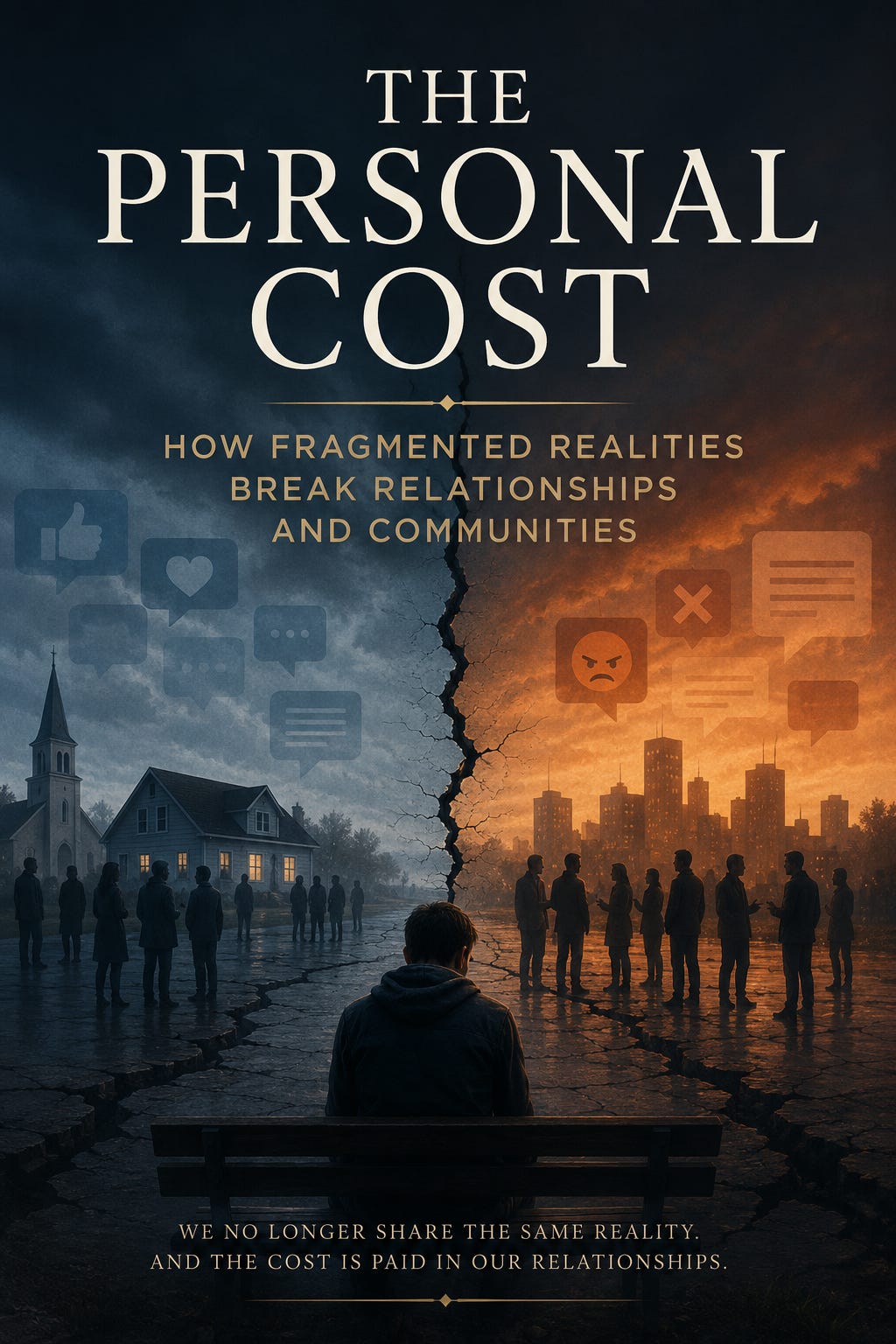
The Personal Cost
How Fragmented Realities Break Relationships and Communities
Cultural fragmentation sounds abstract until it enters your personal life. Family estrangement, divorce, and lost friendships are painfully concrete. They can be weighed in suffering and measured in emptiness. You may no longer comprehend how your former friend sees the world, but you can feel their absence. You may not understand why your parents have become so politically radicalized, but you can anticipate the arguments before every holiday.
Fragmented realities not only divide families and longtime friends; they also erect barriers to forming new acquaintances and relationships. Profiles frequently include DNI (Do Not Interact) lists that exclude political and ideological identities alongside declarations of beliefs you must share before conversation can start. Even seemingly minor disagreements are interpreted as evidence of deep moral incompatibility.
Our parents and grandparents engaged with their neighbors in town squares or at religious services. They talked about the latest episodes of their favorite sitcoms or about stories they read in the local newspaper. Today church attendance has dropped precipitously. We no longer read the same news stories or watch the same channels. We have more media options than ever, but fewer people with whom we can talk about what we read and watch.
In 2023, US Surgeon General Vivek H. Murthy warned Americans:
Loneliness … is associated with a greater risk of cardiovascular disease, dementia, stroke, depression, anxiety, and premature death. The mortality impact of being socially disconnected is similar to that caused by smoking up to 15 cigarettes a day, and even greater than that associated with obesity and physical inactivity. [1]
Dr. Murthy reported that approximately half of U.S. adults report experiencing loneliness, with some of the highest rates among young adults. He noted that loneliness and isolation affect more Americans than smoking, diabetes, and obesity, and carry comparable risks to health and premature death.
What has made America so lonely? Our troubles do not stem from a single politician or an easily identifiable cause. They are rooted in something deeper and more terrifying. We no longer communicate with each other because we no longer share a common language. We use the same words, but we no longer agree on what they mean.
Societies are undergirded by overlapping interpretive frameworks, shared assumptions, common narratives, and institutional and personal trust. We have lost many of the shared religious and civic rituals that once gave us common reference points. Our norms of legitimacy, symbolic language, and factual assumptions now diverge dramatically.
Without those social structures, disagreement becomes unintelligible; contradiction can be understood only as snarling, not as debate. We argue about reality, not policy—and we no longer share common realities. And as we lose our grip on ontology, we cling ever more desperately to politics.
Strong political opinions are nothing new. We fought a bloody Civil War over abolitionism and states’ rights; before that, we had a heated dispute with King George III. But we generally tried to cool tempers down before things got that far. And amidst the shouting matches, you could find a few discussions between men of good faith.
G.K. Chesterton, a conservative Anglo-Catholic, had a lengthy and warm friendship with dedicated socialist George Bernard Shaw. They regularly held public debates where they firmly but politely disagreed on many topics. Chesterton said of Shaw:
You may attack his principles, as I do; but I do not know of any instance in which you can attack their application. If he dislikes lawlessness, he dislikes the lawlessness of Socialists as much as that of Individualists… If he laughs at the authority of priests, he laughs louder at the pomposity of men of science. If he condemns the irresponsibility of faith, he condemns with a sane consistency the equal irresponsibility of art.[2]
Chesterton and Shaw were able to distinguish disagreement from moral delegitimization. They thought each other wrong, but neither ever dismissed the other as evil. That is because, while they might disagree on its applications, both shared a common belief in goodness. This level of intellectual charity is almost unheard of today; to be fair, it was uncommon even in early 20th century England. If they were holding these debates on podcasts today, Chesterton and Shaw would both come under fire for fraternizing with the enemy.
While he was horrified by Oscar Wilde’s sexual behavior, as were most Englishmen of the time, G.K. Chesterton was able to simultaneously recognize both Wilde’s sin and his humanity. In an essay written not long after Wilde’s death, Chesterton wrote:
On the one hand we have the healthy horror of the evil; on the other the healthy horror of the punishment. We have it all the more because both sin and punishment were highly civilized; that is, nameless and secret. Some have said that Wilde was sacrificed; let it be enough for us to insist on the literal meaning of the word. Any ox that is really sacrificed is made sacred.[3]
You might blame Chesterton’s hidebound homophobia on his Catholicism. But, like Shaw, Chesterton was consistent in his beliefs. As a devout Christian, he believed in both sin and mercy. We are no better for rejecting both. Chesterton’s views are very different from our contemporary moral standards. Yet he articulates them brilliantly, and he shows a compassion and greatness of spirit that almost forces readers to engage with him.
21st century culture judges by symbolic cues and ideological markers. Oscar Wilde got a jury trial. We are as quick to cast out those found unworthy as 1895 Britain was to send Oscar Wilde to prison. But our religion has no place for mercy or redemption. Our rituals do not end with our victims becoming sacred.
The Sexual Revolution has made our culture more comfortable with different lifestyles and lovestyles. We now turn our disgust and fury toward ideological sins and political heresy. Sexual liberation has not made us less bloodthirsty. It has simply altered our taste in scapegoats.
After Wilde’s conviction, his wife changed her surname to “Holland.” After she died in 1898, her relatives sought legal counsel to strip Wilde of his parental rights. His sons, Cyril and Vyvyan, were kept from public view and educated as the Holland brothers. They never saw their father again. Today many people cut off contact with their loved ones over far less serious transgressions.
After the January 6, 2021 Capitol Building protests, Rep. Adam Kinzinger (R-Ill) urged Vice President Mike Pence to remove Donald Trump from office under the 25th Amendment. Kinzinger was one of just ten Republicans to do so. Pence rejected the request, and the demand failed.
The next day he received a letter from his family. It opened with:
Oh, my, what a disappointment you are to us and to God! We were once so proud of your accomplishments. Instead, you go against your Christian principals[sic] and join the “devil’s army” (Democrats and the fake news media).[4]
Kinzinger got disowned for criticizing Trump. Others become estranged for supporting him. A 66-year-old woman living in Florida told Buzzfeed:
I’ve cut off three nieces who were so Trump-pilled that they regularly attacked what I would post online. One of those nieces lived with me for several years when she was a teenager, so she wouldn’t be put into the foster system. That one hurt the most…
Just recently, I cut off the daughter of one of the nieces. She’s only 16 but has been fully indoctrinated into the cult by her mother. It is very sad.[5]
Harsh political criticism did not start with the Internet. In the 1884 Presidential election, campaigning heavily revolved around Grover Cleveland’s illegitimate child. After Cleveland’s victory, Democrats took up the popular Republican “Ma! Ma! Where’s my Pa!” chant and added “Gone to the White House, ha ha ha!” But alongside the mudslinging was measured praise and criticism for both Cleveland and his opponent, James G. Blaine (also known as the “Continental Liar from the State of Maine”).
Strong social taboos discouraged estrangement from family members and neighbors. There was plenty of gossip, backbiting, and squabbling behind closed doors. There was also pressure to keep the public peace. You might think Cleveland a whoremonger, but you would still attend church with Cleveland supporters. You might consider Blaine a scurrilous scoundrel, but you would still visit your Blaine-supporting uncle on holidays.
After the interstate highway system, extended families became the exception rather than the rule. The postwar Boom made Americans more socially and geographically mobile. But that new mobility also weakened local continuity. By the 1960s and 1970s, Americans complained about families being torn apart by “cults” and separated by a growing “generation gap.” Today the internet has brought us together across geographical divides, but it has also separated us by fueling political and cultural divides.
Politics has in many ways taken the cultural position that religion once held. We no longer have faith in prayer, but we recite slogans in the hope they will change the world. Instead of getting our meaning from pastors, we rely on political podcasts. Politics provides us with boundaries of acceptable belief and helps us find and punish heretics. And as we once built our identities around religious affiliation, today we increasingly structure them through our political positions.
Romantic relationships require trust, vulnerability, and a shared reality. In a fragmented world, these things are in short supply. Partners are expected to validate each other’s identities because each has nagging doubts that their identity is valid. When you must create yourself from the ground up, your edifice of self will always be shaky. In a world where one’s self-image arrived ready-made, there was less need for constant affirmation—and little risk that a contrary opinion would challenge your very sense of being.
Dating apps allow individuals to filter prospective partners by ideological sorting. Users can reject partners whose politics, ideology, lifestyle identity, and moral outlook are not closely aligned with their own. Once all these things would be discovered gradually through courtship. Today they serve as hurdles that must be cleared before courtship can even commence.
Similarity increases engagement, reduces friction, and minimizes emotional risk. Algorithms, like churches and finishing schools before them, link you to people with shared beliefs and interests. Online relationships increasingly form within symbolic tribes among people who are seeking existential reassurance. Partners become validators, witnesses, and co-authors of each other’s identities—but only if each passes the other’s ideological résumés.
No-fault divorce reduced legal barriers to divorce. Today divorce is much less stigmatized than it once was. Leaving an unfulfilling marriage is not only accepted but encouraged. Marriages are voluntary; a partner may initiate a divorce at any time for any reason or no reason at all. As a result, many partners find that exit is easier than negotiation—or even agreeing to disagree on controversial topics. Others discover that intimacy requires more than affection; it requires a shared understanding of reality that the partnership no longer possesses.
Fragmentation not only changes what we believe. It shapes how we engage with others in ordinary social interactions. Every engagement begins to feel risky. Your conversation might be captured on a smartphone video; your email might be spread across the internet; your thoughts and words might be recast in the worst possible light.
People self-censor to avoid trouble. They steer clear of difficult conversations and conceal their beliefs with silence or slogans. They retreat into ideologically safe environments, but even there they are careful to avoid anything that might be screencapped and reused as ammunition.
Like Havel’s greengrocer, they post the appropriate slogans so that others will accept them as members of the in-group. They perform the appropriate outrage rituals in response to the appropriate targets. Any doubts they may have are swallowed or pushed aside; they know the cost of ambiguity and do not wish to pay it. This constant low-grade anxiety is exhausting. In time, it leads to emotional fatigue, distrust, and endless self-monitoring.
The internet creates constant symbolic proximity. But at the same time it weakens embodied community and shared physical life. Individuals may spend their waking hours online communicating with others, yet unable to shake a feeling of profound loneliness. They have many followers, but few confidants. They know they are wearing a mask for the audience and wonder what is behind the masks that others wear—and behind the mask they wear.
People increasingly live their lives with constant vigilance. In Goffman’s Stigma, “passing” stigmatics feared being exposed as ex-convicts, homosexuals, or mulattos. Today we agonize about losing our reputation for a misrepresented remark or an ideological faux pas. People retreat into smaller circles where the rules and expectations grow ever more stringent. They curate their relationships the way algorithms curate their feeds.
For many people, online affinity outweighs local belonging. They identify more strongly with ideological tribes they know only through posts and profile pictures than they do with their neighbors. Digital identity has supplanted geographically rooted solidarity; ideological conformity has taken the place of civic trust. Shared space no longer guarantees a shared society.
The problem is not pluralism. Different cultural, ethnic, and religious groups have long lived alongside each other. There were tensions, barriers, and even occasional conflicts. But there were also areas of interpretive overlap. We had common interests and common goals, and they helped us hold together a diverse community. We no longer share those interests and goals.
Can a society survive when its members no longer share facts, meanings, institutions, or moral legitimacy? The very thought fills us with existential dread—dread that we express in a frantic search to find like-minded people and wall ourselves off from the rest. The deepest cost of fragmentation may not be political instability, but the gradual erosion of the relationships that make social life meaningful.
[1] Vivek H. Murthy, M.D. “Our Epidemic of Loneliness and Isolation: The U.S. Surgeon General’s Advisory on the Healing Effects of Social Connection and Community.” (2023). 4.
[2] G.K. Chesterton. Heretics (1905). At Christian Catholics Ethereal Library. https://www.ccel.org/ccel/c/chesterton/heretics/cache/heretics.pdf. 21.
[3] G.K. Chesterton, “Oscar Wilde” at The Society of G.K. Chesterton. https://www.chesterton.org/oscar-wilde/.
[4] New York Times, “Kinzinger Family Newsletter.” https://int.nyt.com/data/documenttools/kinzinger-family-letter/db2b92ae5f4fabc0/full.pdf.
[5] Victoria Vouloumanos, “People Are Getting Brutally, Brutally Honest About What It’s Like to Cut Off MAGA Family Members.” Buzzfeed, March 19, 2026. https://www.buzzfeed.com/victoriavouloumanos/why-people-cut-off-maga-family-members-estrangement.