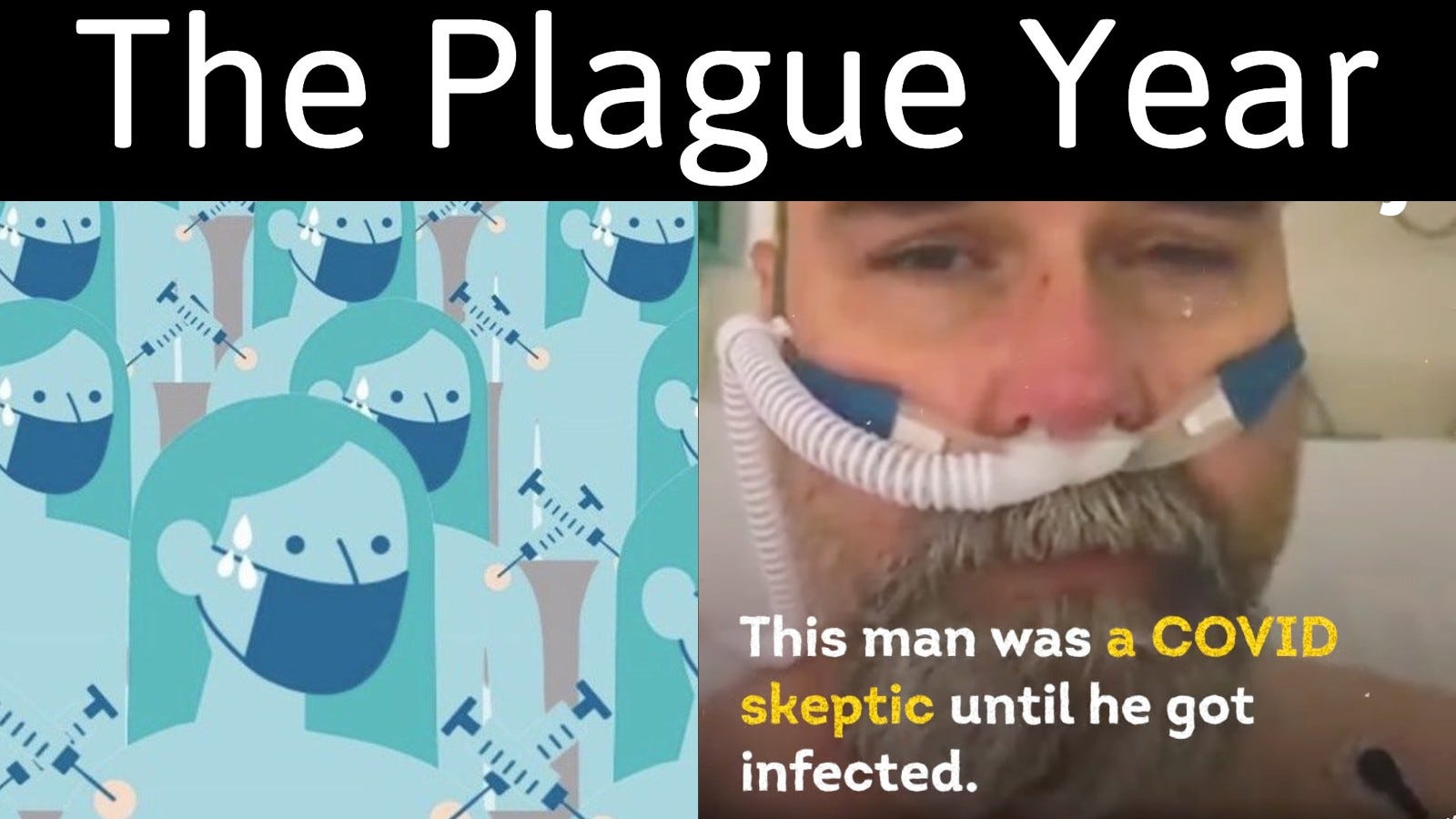
The Plague Year
COVID-19 and the crisis of trust
The first reports came from far away. In December 2019, doctors in the Chinese city of Wuhan reported a cluster of twenty-seven patients suffering from an unusual respiratory illness. This new disease did not respond well to standard treatments, and seven patients were critically ill with a “viral pneumonia of unknown etiology.”
On January 7, 2020, Chinese scientists isolated the cause: a previously unknown coronavirus later designated 2019-nCoV. Americans generally paid little attention. A few made jokes about “Kung Flu” or “Wu Han Flooey.” Others criticized the jokers for their anti-Asian bigotry. But for the overwhelming majority of Americans, the outbreak was somebody else’s problem.
On January 20, the CDC reported the first confirmed case of the new coronavirus in the US. On January 24, they reported a second infection in Illinois. The WHO declared COVID-19 a Public Health Emergency of International Concern on January 30. We began hearing debate about travel restrictions. Those critical of immigration tended to support shutting down our borders; those who supported immigration were generally opposed to these measures.
But at that moment, America’s primary axis of polarization remained the Left/Right split. The presidential primaries were underway, and Americans were more likely to argue about Trump’s impeachment trial and Jeffrey Epstein’s suicide than an epidemic in China. Some who watched videos of Wuhan’s seventy-six-day lockdown and the makeshift hospitals erected to care for the sick worried that we might soon see a similar epidemic. Others dismissed the lockdown as typical strong-arm behavior by Chinese authorities.
Throughout February, we heard reports of outbreaks in South Korea, Iran, and Italy. When we saw footage of overflowing hospitals in northern Italy, it became harder to dismiss COVID-19 as China’s problem. Then, on February 29, we received word that a man in his 50s had died of COVID-19 at EvergreenHealth Medical Center in Kirkland, Washington.
Later we would discover the virus had already claimed other American lives. In April the CDC confirmed that two California residents had died of COVID-19 weeks before the Kirkland death. We knew then the virus had been spreading undetected throughout America for longer than we had realized. We did not know what would happen next.
Seven years after Sandy Hook, we had grown accustomed to conspiracy theories. Not long after Trump’s swearing-in, “Q Clearance Patriot” (“Q” for short) began releasing messages exposing the President’s secret war against child-molesting Satanic cannibals tied to the “deep state” and the Clinton family.
A surprising number of people trusted the plan and looked forward to “the Storm,” an imminent mass arrest when Hollywood celebrities, politicians, and other pedophiles would be arrested, tried, and executed. As with Sandy Hook, QAnon’s claims were unfalsifiable. Every contradiction was read as proof; every failed prediction was evidence that the operation was proceeding behind the scenes.
Outside the WWG1WGA movement, most Americans found QAnon more absurd than threatening. This was not an unreasonable conclusion. Most people had trouble believing that celebrities had already been arrested and replaced by body doubles; that Hillary Clinton was sacrificing babies; or that Q Clearance Patriot had chosen 4chan as the ideal venue for the most important intelligence leak of all time.
Then, on March 11, WHO officially declared COVID-19 a pandemic. Two days later the United States declared a national emergency. America, like much of the world, locked down to slow the spread. Schools, restaurants, and churches were closed. We worked remotely unless we were “essential workers.” Stock markets plunged; toilet paper became a commodity; and we found ourselves divided between those who trusted the plan and those who trusted the science.
Most major newspapers and magazines have long employed fact-checkers to verify stories before publication. In 1995 David and Barbara Mikkelson created an urban folkore website that would become Snopes.com. In 2003, the Annenberg Public Policy Center launched FactCheck.org. Four years later, the Tampa Bay Times premiered PolitiFact and its now-famous Truth-O-Meter.
But fact-checking became more visible—and controversial—after Donald Trump’s 2016 victory. Many Americans were now getting their news from social media or from online sites that were more interested in engagement than accuracy. Yet one man’s fact-checker is another man’s censor. Many interns and young journalists found themselves cast into an increasingly divided political landscape as referees.
As the lockdown continued and mask mandates were enforced, Americans grew increasingly restless. But complaints about lockdowns and masking were treated as dangerous misinformation. Social media accounts were suspended or terminated for spreading “COVID denial.” As with fact-checking, this was seen by COVID skeptics as proof that the government was trying to stop the spread of the truth, not the spread of an epidemic.
In fairness, there was a great deal of patently false COVID information circulating online. In March 2020, there were 7,175 confirmed deaths involving COVID-19; in April there were 65,533.[1] Many medical professionals feared that ads touting colloidal silver, chlorine dioxide, or extreme vitamin doses would lead to additional preventable deaths. But Americans who no longer trusted doctors saw their efforts not as concern but as censorship.
Debates over lockdowns and school closures came to a head on May 25, 2020 when George Floyd died in the custody of the Minneapolis Police Department. Images of Officer Derek Chauvin kneeling on Floyd’s neck for over nine minutes while Floyd complained “I can’t breathe” outraged an already tense nation. As protests broke out across the country, many COVID skeptics wondered why social distancing was only necessary when you weren’t rioting.
For months, public officials had spent months urging Americans to stay home. Children were schooled online; small businesses were shut down; churchgoers were expected to pray at home. Yet now, when thousands of people were marching in the streets and many were vandalizing stores the lockdown had already crippled, the police appeared unwilling or unable to restore order even as several cities burned.
There were thousands of arrests during the George Floyd riots. Many officials feared that a more aggressive response to the riots could quickly explode into nationwide civil unrest. But after weeks of lockdown, many Americans were not inclined to give officials the benefit of the doubt. They had followed the rules, accepted the restrictions, and watched their livelihoods disappear. Now they were expected to tolerate behavior that they had been told just a few short days earlier was reckless, dangerous, and socially irresponsible.
In the mid-twentieth century doctors had an almost religious aura. Advertisements frequently featured men wearing white medical coats as a sign of trustworthiness. We had seen polio, smallpox, rubella, measles, and many other scourges tamed or (in the case of smallpox) eradicated altogether. For many Americans COVID-19 was their first look at an epidemic in progress. When they saw the uncertainty, disagreement, and conflicting opinions that are part of emergency medicine as practiced, it looked less like science and more like confusion.
Many Americans responded by moving toward one of two poles. Some decided that doctors were overpaid and overeducated charlatans more interested in power and money than in healing people. Others doubled down on their faith in expertise, claiming that “the science is settled” while it was still being hammered out and calling for harsh punishments against those who spread “fake news.” Both reactions offered the comfort of certainty, something that is generally in short supply during epidemics.
By December there was a possible light at the end of the masking and social distancing tunnel. Moderna and Pfizer received emergency authorization for mass vaccinations. Many proudly added an “I Got Vaxxed” frame to their Facebook photos. Those who expressed fear about the safety of a rapidly developed vaccine were tarred as “deniers” or deplatformed; medical professionals who spoke out risked losing their medical licenses.
These measures only deepened the distrust of many COVID skeptics. As had happened after Sandy Hook, uncertainty led to increasingly elaborate theories. Some insisted this “epidemic” was just a typical flu season inflated for political purposes. Others claimed these new “vaccines” were not designed to immunize patients against a virus; they were death shots intended to reduce world population. The harder institutions worked to promote the official narrative, the more appealing alternative theories became to an increasingly distrustful public.
My wife and daughter received the vaccine; I decided against it. I worked from home; they needed the vaccine to return to school or work. As I have spent many years practicing social distancing, I was fine with continuing it. In hindsight, I suspect my decision was shaped largely by my political beliefs at the time. In 2020, politics wound up in everything like a lingering fart in a crowded bus.
I did not refuse the vaccine because I wanted people to die, or because I feared it was a depopulation death shot. My wife and daughter did not take the vaccine because they worshipped Pfizer. I had concerns about the vaccine’s safety, and in hindsight I think some of those concerns had merit. At the same time, I understood that the risk of serious side effects for any given individual was relatively small, even if rare complications could become more visible once millions of people received the vaccine.
A January Heartland Institute/Rasmussen Reports telephone and online survey found that 48% of voters favored Joe Biden’s plan to impose a COVID-19 vaccine mandate on the employees of large companies and government agencies; 48% of voters opposed it. The split was largely along party lines; 78% of Democratic voters supported the Biden plan, while only 22% of Republicans and 41% of independent voters supported it. Democratic voters were also more likely to call for harsh measures against those who disagreed.
55% supported fines for Americans who chose not to get a COVID-19 vaccine;
59% supported confining unvaccinated Americans to their homes at all times until they got the vaccination;
48% believed federal and state governments should fine or imprison Americans who publicly question the efficacy of COVID-19 vaccines on social or mass media;
45% favored requiring citizens to temporarily live in quarantine camps if they refused the COVID-19 vaccine;
47% were in favor of a government tracking program for COVID-19 vaxx refuseniks;
29% supported removing children from the custody of parents who refused the COVID-19 vaccine.[2]
While Democratic voters were favoring harsh measures, many Republicans were claiming COVID was a fraud and a power grab. Sean Hannity portrayed the virus as a “deep state” effort to spread panic. Rush Limbaugh suggested China had weaponized the outbreak against the United States. Fox Business anchor Trish Reagan told viewers the coronavirus actions were “yet another attempt to impeach the president.”[3]
A public health emergency became another casualty in the culture war, and the divisions between “Right” and “Left” became increasingly blurry. Liberals who had long supported alternative health measures and criticized Big Pharma were now insisting that vaccine protestors be imprisoned. Conservatives who had once talked about law and order were now insisting “my body, my choice” when it came to vaccinations. COVID did not simply deepen existing divisions; it scrambled them.
By this point, Americans across the political divide were no longer simply disagreeing about COVID. They were receiving different versions of reality. Online data analytics made it easier than ever for news outlets, social media platforms, and political organizations to tailor content for specific audiences. The result was a series of “information bubbles.” Readers increasingly encountered stories that supported their existing beliefs, while media outlets tailored their message to maximize reader engagement, loyalty, and advertising revenue.
COVID anger didn’t end on February 24, 2022 with Russia’s invasion of Ukraine. But public attention shifted to a new crisis. Interestingly, the new divide often followed the COVID fault lines. If you saw an “I GOT VACCINATED” frame on somebody’s Facebook page, there was a high probability of seeing a Ukraine flag. On conservative platforms like Gab, people who had spent years celebrating the Iron Curtain’s fall were suddenly skeptical about the new pro-Ukraine consensus, and the “NPCs” who had replaced their COVID talking points with “Slava Ukraini.”
Today you can still get annual COVID vaccinations at many local pharmacies. Few people bother to do so. Those who suspected COVID was a deep state fraud still, by and large, hold to their beliefs. Those who believed COVID skeptics should be jailed are likely to support jailing the Trump family; former COVID skeptics are more likely to call for the Bidens to go to prison. We have moved on from demands to imprison our neighbors to fantasies about imprisoning politicians.
We are no longer involved in a cultural war about COVID, but we are still fighting over immigration and ICE. Our society remains deeply polarized and our media feeds remain tailored to our tastes and optimized for outrage. We increasingly encounter realities constructed to conform to our beliefs. Opportunities to engage seriously with opposing viewpoints are much rarer. Many find it easier to dismiss opponents as ignorant, dishonest, or actively evil.
The plague has passed and we have buried our dead. We have not buried our hatchets.
[1] National Vital Statistics System, “Provisional COVID-19 Mortality Surveillance.” (2026). At Center for Disease Control, https://www.cdc.gov/nchs/nvss/vsrr/covid19/index.htm.
[2] Rasmussen Reports, “COVID-19: Democratic Voters Support Harsh Measures Against Unvaccinated.” (January 13, 2002). https://www.rasmussenreports.com/public_content/politics/partner_surveys/jan_2022/covid_19_democratic_voters_support_harsh_measures_against_unvaccinated.
[3] Matt Motta, Dominik Stecula, and Christina Farhart, “How Right-Leaning Media Coverage of COVID-19 Facilitated the Spread of Misinformation in the Early Stages of the Pandemic in the U.S.” Can J Polit Sci. 2020 May 1:1–8. doi: 10.1017/S0008423920000396.