The Problem with Manufactured Meaning
Why the easiest answers are often the most dangerous
Freedom is not less endangered if attacked in one name than in another. The battlefield is within ourselves and our institutions.
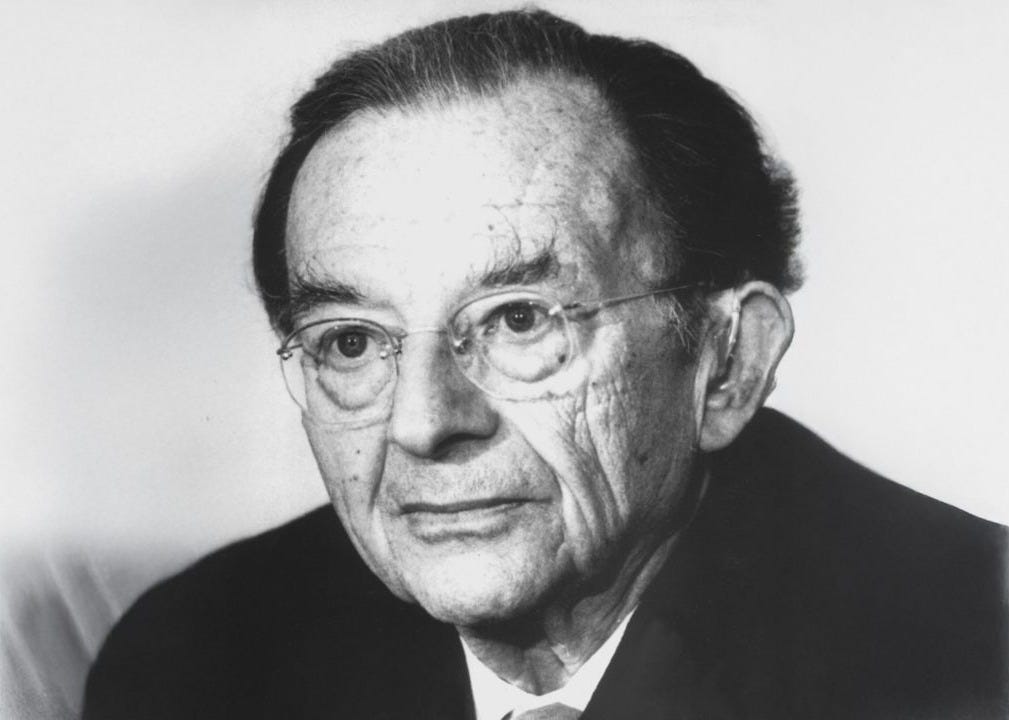
Erich Fromm, The Escape from Freedom
America’s rise as a global power brought material abundance that previous generations could scarcely imagine. Americans who had survived the Great Depression no longer worried about where their next meal would come from. But that security revealed a different, thornier question: who am I?
The postwar decades saw an explosion of entertainment, self-expression, and personal freedom. The 1960s and 1970s in particular reflected a culture experimenting with new lifestyles, new experiences, and new identities. We now had the freedom to choose. But with that freedom came the responsibility of choosing.
We had no shortage of amusement. What we lacked was meaning.
Erich Fromm captures the American character in the opening sentence of Escape from Freedom, noting: “Modern European and American history is centered around the effort to gain freedom from the political, economic, and spiritual shackles that have bound men.”
That observation is especially true of the United States. Our defining moment is the Declaration of Independence and the Revolution. Freedom is not just a political principle for Americans. It is a central part of our identity.
But freedom remains surprisingly difficult to define. We speak of it constantly. We defend it fiercely. We build our institutions around it. Yet few of us can clearly explain what it means.
Fromm notes that after the First World War, many believed they had witnessed the end of tyranny and the birth of freedom. Even after the Second World War proved that assumption wrong, the underlying belief remained intact.
We came to see tyranny as an aberration sustained by fear, propaganda, and coercion. The populations who lived under such systems were assumed to be unwilling participants, silenced rather than supportive. We could not understand that many did not simply endure these systems. They embraced them.
We assumed that electoral democracy was the natural order of things—that people, given their choice, would naturally gravitate toward a government that looked very much like ours. We would not, or could not, entertain the idea that individuals might willingly exchange freedom for certainty and liberty for meaning.
Manufactured Meaning and the American Strongman
An American Strongman will arrive not as a tyrant, but as a liberator. He will not present himself as the new Hitler or the next Stalin. He will come as George Washington, promising to break our chains. He will take our vague, ill-defined ideas of freedom and reshape them to his purposes, while convincing us they are our own.
The Strongman will promise us freedom. Then he will redefine it.
He will promise you freedom from dangerous groups who threaten you and from corrupt elites who resent your freedom. He will sell you freedom from red tape, from bureaucracy, and from constraints. Most seductively, he will give you freedom from complexity.
Democracy is a messy process. It involves debate, compromise, and closed-door negotiations. The Strongman will relabel that messiness as corruption. He will replace independent representatives with yes-men and present those changes as freedom.
Liberty will no longer be the right to vote and to dissent. It will be submission to a leader who acts in the people’s name. And many Americans will internalize that new meaning and come to despise those who question it.
The Strongman may be a Democrat, a Republican, or the leader of an entirely new movement. His personality will matter more than his political affiliation. He will reach across party lines, but only to those willing to follow him. The party labels remain, but the power shifts to the man who defines them. Loyalty tests will be recast as bipartisanship.
An American Strongman will have no shortage of enemies, real and imagined. He will arise amidst chaos and conflict, and he will win by promising order and peace. Amidst confusion and complexity, he will provide heroes, villains, and solutions. He will offer hope and promise vengeance.
Humans are social animals. We can withstand hardship, pain, and privation. But the sense that we stand apart from the group is much harder to bear. The Strongman tells his followers where they belong within the world. He gives them allies and enemies. They are no longer alone in a meaningless world.
Once you accept that sense of belonging, it becomes difficult to turn back. Questioning the story risks separation from your group, your cause, and the identity you have built within the Strongman’s system.
Most people will accept a false certainty before they accept being alone.
Why Manufactured Meaning Fails
People don’t choose manufactured meaning because they are stupid. They choose it because, at first, it works.
Manufactured meaning promises clarity and results. In the short term, it often delivers. It offers a clean story in a messy world. It assuages anxiety and soothes alienation. You get the sense that somebody is in control and doing something. More important, you feel that someone cares about you.
But those gains come with a cost.
Certainty leaves no room for disagreement. Questions become threats. Critics become enemies. What begins as a clear, plausible narrative slowly hardens into the only acceptable one.
Reality is tangled. Real systems are contradictory and often unresolved. Manufactured meaning is simpler. It makes the world easier to explain, but it does not describe reality. Eventually, it replaces it. Words stop meaning what they used to. Clear thinking becomes harder. Slogans replace facts and jargon imitates explanation.
Healthy systems absorb feedback. They adjust and evolve. Systems built on control cannot do this without undermining their own authority. Errors accumulate. Whistleblowers are silenced. The structure drifts further from reality until the rot becomes impossible to ignore.
The system can limp on for some time. Insiders have a vested interest in maintaining the lie and are punished for acknowledging the truth. Friends and peers police dissent and reward compliance. But ultimately, a system built on certainty cannot survive contact with truth.
Authentic Meaning: Slow, Difficult, and Real
Manufactured meaning is fast, clean, and certain. Authentic meaning is slow, messy, and unresolved. It emerges over time through contact with reality. It is not something you receive from a charismatic leader. It is something you build, test, and revise.
Authentic meaning is incomplete and provisional. It evolves as you discover new information and changes as reality changes. It forces you to confront limits, tradeoffs, and difficult truths. There is no Director of Meaning to tell you what to believe or how to feel. You find it through participation, not declaration.
It is shaped through disagreement, negotiation, and compromise. No one gets exactly what they want, but the result is something more durable than any one perspective. It is demanding and uncertain. But it can survive contact with reality.
Within those systems, the focus shifts from blame to responsibility. Blame simplifies the world and assigns fault. Responsibility makes the world more complicated. Authentic meaning tells you what to build, not who to hate. It tasks you with maintaining what is good and changing what is not.
Manufactured meaning silences doubt. Authentic meaning normalizes it. You act without full knowledge, revise without total confidence, and proceed without guarantees. You do not eliminate uncertainty—you learn how to live with it.
This requires patience and humility. There is no instant clarity and no moral certainty. Sometimes you will be wrong, perhaps embarrassingly so. Others will see flaws in your argument and catch what you missed. You must accept ambiguity as part of reality and live without the comfort of total righteousness.
Authentic meaning demands more from you—and offers less comfort in return. It is not surprising that many choose to outsource meaning to somebody else.
The Choice
We have achieved a level of material security and personal autonomy that previous generations could scarcely imagine. We are free to choose how we live, what we believe, and who we become.
But that freedom does not come with instructions. It does not tell us what matters. It does not tell us who we are.
Manufactured meaning offers clarity, identity, and direction. It tells us what to think and who to trust. It relieves us of the burden of choosing. It is comfortable and comforting. But it cannot last.
Authentic meaning offers no such escape. It forces us to live inside the tension between freedom and responsibility. It asks us to build something together without guarantees, without final answers, and without moral certainty.
This is the condition of a free society. Not clarity, but complexity. Not certainty, but responsibility.
The question is not whether we will have meaning.
The question is whether we will build it ourselves—or accept whatever is handed to us.


Discussions of freedom always seem to cycle back to that contrast between freedom from and freedom for (or freedom to). Looking at the history of the West, could you identify different eras where one or the other predominated? e.g. immediately post WWII was there more of a 'freedom to reach for the stars' which was later replaced by the 'freedom from the man' of the late 60s?