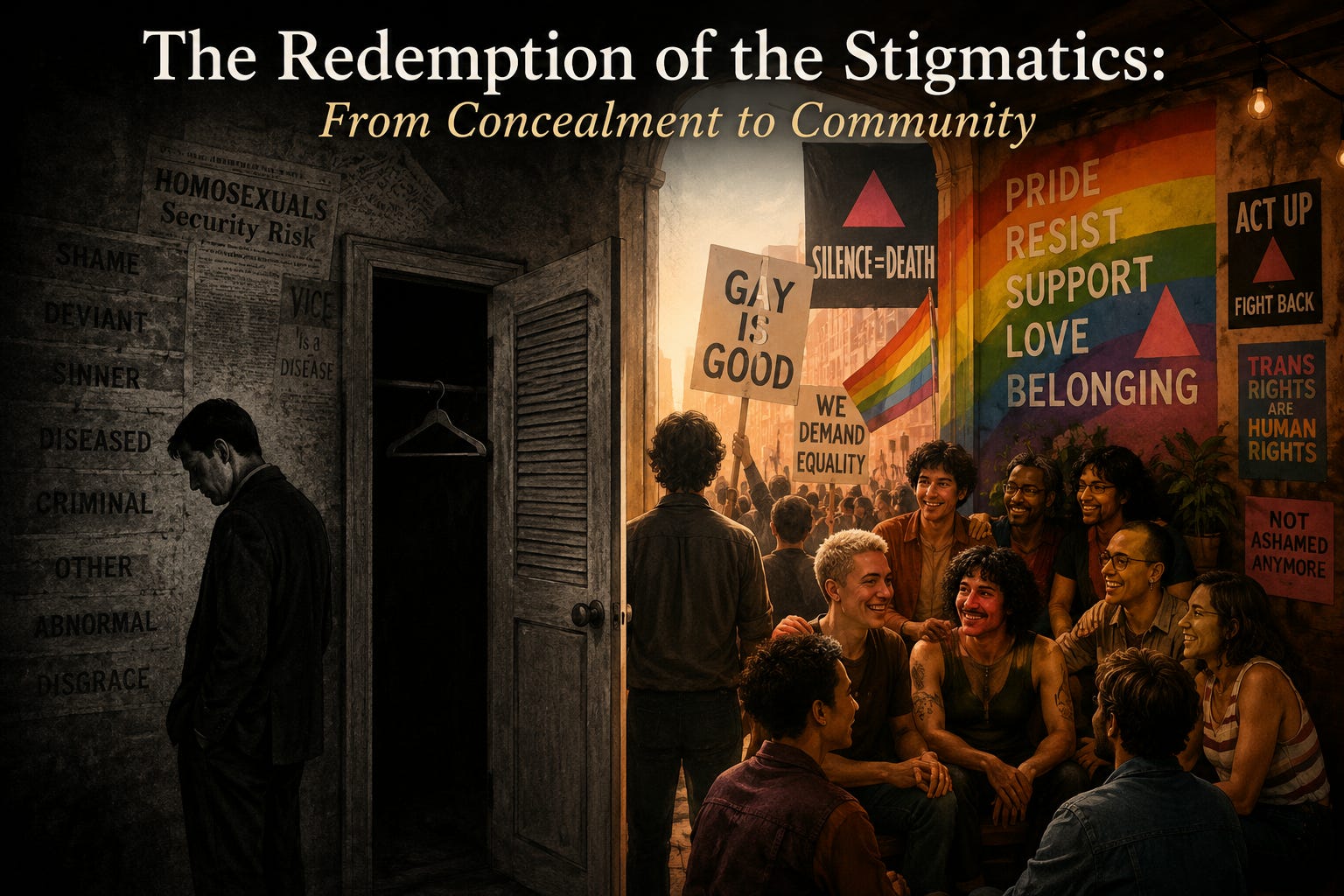
The Redemption of the Stigmatics
From Concealment to Community
Three grossly different types of stigma may be mentioned. First there are abominations of the body—the various physical deformities.
Next there are blemishes of individual character perceived as weak will, domineering or unnatural passions, treacherous and rigid beliefs, and dishonesty, these being inferred from a known record of, for example, mental disorder, imprisonment, addiction, alcoholism, homosexuality, unemployment, suicidal attempts, and radical political behavior.
Finally there are the tribal stigma of race, nation, and religion, these being stigmas that can be transmitted through lineages and equally contaminate all members of a family.
Erving Goffman[1]
For sociologist Erving Goffman, stigma was a socially discrediting condition that individuals carried. This stigma set them apart from what he called “the normals.” Goffman focused on how the stigmatized coped—or failed to cope—in their interactions with a world that saw them as less than normal.
Concealment was a common way of avoiding stigma. A family member’s history of mental hospitalization might be kept secret from the neighbors. Others managed their condition by working diligently to overcome their stigma. A blind person might become a skier or mountain climber. Still others compensated by limiting contact to their Own—those who shared their stigma—or declared that they were not like their fellow “low-grade” mental defectives.
But ultimately, those who could not “pass” as normals were, in Goffman’s view, doomed to be a people set apart. In 1963 America, there was enormous pressure to conform. Those who could not live up to prevailing expectations—fit, conventionally attractive, heterosexual, married, churchgoing, white, and employed, among others—were open targets for scorn.
Goffman noted that self-help clubs helped bring together stigmatized people, including clubs for former alcoholics and addicts as well as informal networks for criminals and homosexuals. He also discussed residential communities where tribally stigmatized persons could live among their own people; he noted, with some admiration, that in these cases the family, not the individual, was the most basic unit of organization—a situation that was already showing signs of stress in the American mainstream by 1963.
Those who can hide their stigma—the closeted homosexual, the reformed ex-convict, the call girl living a double life—live in constant fear of exposure. Loss of status and blackmail are very real threats in Goffman’s America. The individual’s personal and social identities become bifurcated; the façade they build contributes to a growing sense of anxiety and self-loathing. Goffman quotes a closeted homosexual:
When jokes were made about “queers” I had to laugh with the rest, and when talk was about women I had to invent conquests of my own. I hated myself at such moments, but there seemed to be nothing else that I could do. My whole life became a lie.[2]
He also saw how even well-meaning normals treat the stigmatized with paternalism and awkward overcompensation. The disabled weren’t just seeing-impaired, they were helpless children who were incapable of making their own decisions. I saw this dynamic play with my late mother-in-law, who was wheelchair-bound with rheumatoid arthritis. She regularly told clerks and salespeople that she could make her own decisions.
But Goffman also noticed another, less common path: people with stigmas who simply
[F]ail to live up to what we effectively demand of him, and yet be relatively untouched by this failure; insulated by his alienation, protected by identity beliefs of his own, he … bears a stigma but does not seem to be impressed or repentant about doing so. This possibility is celebrated in exemplary tales about Mennonites, Gypsies, shameless scoundrels, and very orthodox Jews.[3]
Founded in 1950, the Mattachine Society emerged as one of the first major homosexual rights organizations in the United States. It was established by longtime communist Harry Hay and several of his fellow travelers. Hay’s original name for the organization—Bachelors Anonymous—was coded, discreet, and defensive. Homosexual identity had to disguise itself within euphemism and anonymity.
He ultimately chose the name “Mattachine” in reference to a French Renaissance masque group. As he later told Jonathan Katz, author of Gay American History:
[W]e took the name Mattachine because we felt that we 1950s gays were also a masked people, unknown and anonymous, who might become engaged in morale building and helping ourselves and others, through struggle, to move toward total redress and change[4]
Hay was later expelled from the Communist Party for his involvement; the CPUSA officially regarded homosexuality as “a result of the degeneracy of a decadent capitalist system.” In 1955, after he was called before the House Un-American Activities Committee, Hay and several of his fellow Reds resigned from Mattachine to protect the organization. Over time, Mattachine’s politics became less influenced by communism than by the emerging Civil Rights movement.
Early homosexual organizations like Mattachine and Daughters of Bilitis sought tolerance and inclusion within mainstream society. In the process, they reframed homosexuality from a sin or a perversion into an immutable identity. Homosexuality was no longer something you did; it was something you were. Like race, sexual orientation came to be understood as an innate condition rather than a moral failing or personal choice.
In the early hours of June 28, 1969, New York City police raided the Stonewall Inn. Three years earlier, Mattachine members had staged a “sip-in” by declaring their sexuality at taverns, daring staff to turn them away, and suing establishments who did. The Human Rights Commission found that homosexuals had a right to drink in New York bars. But homosexual activity—kissing, holding hands, or dancing together—was still illegal.
Thirteen people were arrested during the raid. But an angry crowd had gathered outside, and began throwing bottles, pennies, and cobblestones at police. The police barricaded themselves in the bar as demonstrators outside tried to set it afire. For the next five days protests continued throughout Greenwich Village. On the one-year anniversary of the riots, thousands marched in the “Christopher Street Liberation Day” parade and chanted “Say it loud, gay is proud!”
Following Stonewall, gay men and lesbians began living more openly. In 1973, the American Psychiatric Association removed homosexuality from its list of mental disorders. Christopher Street Liberation Day became Gay Pride Day, and Pride marches were held in many cities. Gay neighborhoods sprang up with gay bars, bath houses, and other homosexual-friendly spaces.
Then, on June 5, 1981, the Centers for Disease Control published a report detailing five cases of Pneumocystis carinii pneumonia (PCP) infections among previously healthy young gay men in Los Angeles. That same day New York dermatologist Dr. Alvin Friedman-Kien called the CDC to report a cluster of cases of Kaposi’s Sarcoma (KS) among gay men in New York and California. Like PCP, KS is associated with weakened immune systems.
Other reports followed. At the end of 1981, there were 337 reports of individuals with severe immune deficiency: 130 had already died. On May 31, the New York Times published an article on Gay-Related Immune Deficiency (GRID); on September 24 the CDC described the epidemic as Acquired Immune Deficiency Syndrome. The public grew increasingly nervous about AIDS—and about the gay men they saw as disease carriers.
In the 1970s, visibility meant gay liberation. In the early 1980s, it once again meant vulnerability. The government showed little interest in the “gay plague.” Congress did not approve dedicated funding for AIDS research until 1983. Not until September 1985 did President Reagan publicly address the AIDS crisis. In 1988, comedian Sam Kinison mocked the crisis with the line: “Heterosexuals die of it too? NAME ONE !”[5]
As the crisis spread through mainstream society, gay communities increasingly relied upon one another for survival. Gay organizations like the AIDS Coalition to Unleash Power (ACT UP) replaced assimilationist caution with gay rage. Identity became simultaneously existential and political. A movement that once wanted simply to be left alone now demanded recognition. It had learned the hard way that Silence = Death.
In 1996, the introduction of Highly Active Antiretroviral Therapy (HAART) caused a sharp decline in AIDS deaths. Many patients found their viral load reduced to undetectable levels. On April 30, 1997, Ellen DeGeneres came out on an episode of her sitcom, Ellen. Two weeks earlier, she appeared on the cover of Time with the caption “Yep, I’m Gay.” By the decade’s end, AIDS had largely moved from a death sentence to a manageable chronic condition.
With that shift, homosexuality increasingly moved from the margins into mainstream American culture. 1998 saw the debut of Will & Grace, a show featuring a gay lawyer and his straight female friend. 2003 introduced Queer Eye for the Straight Guy; in 2004 Showtime premiered The L Word. And on June 26, 2015, 34 years after the CDC’s first AIDS report, Obergefell v. Hodges made same-sex marriage legal throughout the United States. What had once required euphemism and secrecy now received corporate sponsorship and constitutional protection.
The success of the Gay Rights movement inspired many other stigmatized groups to follow its lead. Transgender, queer, neurodiverse, and disabled groups used organizations like ACT UP as a model for their activism. Micro-communities began emulating their approach to strengthen their groups. Today, these models are ubiquitous across the Internet. But many are finding that a model which worked for gay men during a health crisis may not fully fit their needs.
The dogged effort to “denaturalize” gender in this text emerges, I think, from a strong desire both to counter the normative violence implied by ideal morphologies of sex and to uproot the pervasive assumptions about natural or presumptive heterosexuality that are informed by ordinary and academic discourses on sexuality.
Judith Butler[6]
“Coming out of the closet” was not just an acceptance of one’s essential self; it was a refusal to be ashamed. As Goffman might say, “out” homosexuals bear a stigma but do not seem to be impressed or repentant about doing so. The Gay Rights movement increasingly became a model for other stigmatized people seeking to escape what Butler called “the violence of the foreclosed life.”
But ideas like “essential self” do not map well onto Butler’s conception of identity. For her, the self is a product of repeated social acts, norms, and discursive structures. She has little interest in an innate identity core or essential self hiding behind the performance. For Butler, and many other queer theorists, the play’s not only the thing—it’s the identity.
This has produced ongoing epistemic tension within the LGBTQ+ community. Over the course of a single post, an activist might insist:
“I was born this way.”
“Gender is a social construct.”
“I define who I am.”
Essentialism, performativity, and self-creation serve different emotional and political functions. “I was born this way” helps the activist describe how their discomfort with assigned sex and gender roles emerged early and could not be wished away. Claims that gender is socially constructed point to the ways societies define masculinity and femininity differently across cultures and historical periods. Assertions like “I define who I am” emphasize the individual’s right to determine their own labels, pronouns, presentation, or symbolic identity.
These three positions are not philosophically compatible, but each addresses different problems. In a fragmented social system, coherence is less important than utility.
Digital communication has made it much easier for geographically isolated stigmatized individuals to find one another. Identity communities no longer require physical proximity. And what was in 1963 a burden that individuals struggled to conceal has now become a foundation for moral identity, political solidarity, and community formation.
Outsider identities have long been prestigious among certain subgroups. The beatniks looked down on the “squares;” the hippies turned their noses up at “the establishment.” Today, “normie” has become one of the Internet’s most common terms of contempt. Membership in one’s chosen subgroups becomes a source of status. Conformity marks outsiders as gray and faceless “NPCs.” Stigma has become affiliation; affiliation has become identity; identity has become moral legitimacy; legitimacy has become social authority.
The internet allows people to recast feelings of exclusion and alienation into a moral identity. They are no longer awkward outcasts; they are members of tribes that are set apart. Their differences give them meaning and belonging. What were once isolating conditions are transformed into social resources; publicly embracing them becomes a signal of authenticity and courage.
Goffman studied concealment, passing, shame, and fear of exposure. The internet has transformed the social function of outsider identity. It has helped lift the invisibility, isolation, and shame many stigmatized individuals once endured. But it has also fragmented shared frameworks and weakened universal legitimacy structures. Once rebels defined themselves in opposition to a dominant culture. Today they seek their tribe amidst that culture’s ruins.
[1] Erving Goffman, Stigma. Englewood Cliffs, NJ: Prentice-Hall, 1963. 4.
[2] Ibid, 87.
[3] Ibid, 6.
[4] Jonathan Ned Katz, Gay American History: Lesbians and Gay Men in the U.S.A. New York: Meridian, 1992. 413.
[5] Patrick Goldstein, “What Makes Sammy Scream? A Hellish Night Out with Sam Kinison, the Most Dangerous Man in Show Business.” Los Angeles Times, November 20, 1988.
[6] Judith Butler. Gender Trouble: Feminism and the Subversion of Identity (Kindle Locations 290-294). Routledge. Kindle Edition.