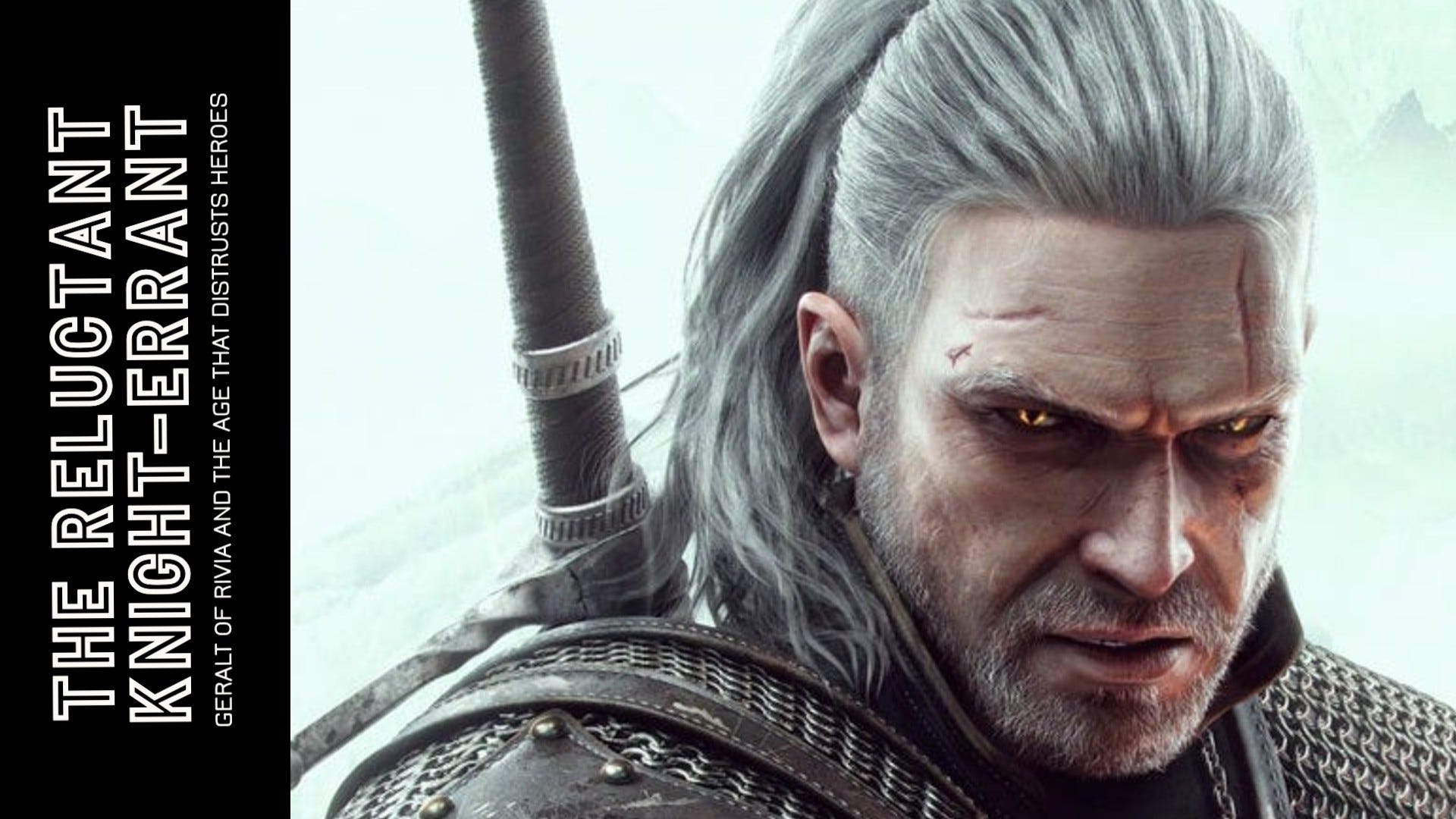
The Reluctant Knight-Errant
Geralt of Rivia and the Age That Distrusts Heroes
“People”—Geralt turned his head— “like to invent monsters and monstrosities. Then they seem less monstrous themselves. When they get blind-drunk, cheat, steal, beat their wives, starve an old woman, when they kill a trapped fox with an axe or riddle the last existing unicorn with arrows, they like to think that the Bane entering cottages at daybreak is more monstrous than they are. They feel better then. They find it easier to live.”
“I’ll remember that,” said Dandilion, after a moment’s silence. “I’ll find some rhymes and compose a ballad about it.”
“Do. But don’t expect a great applause.”[1]
Andrzej Sapkowski’s The Witcher (Wiedźmin in the original Polish) series has spawned a video game franchise, two movies, and a Netflix series. Yet when the first Geralt of Rivia stories appeared in the 1980s, they occupied an uncertain place in Polish literature. Science fiction, led by Stanisław Lem, enjoyed greater prestige than fantasy. Sapkowski’s stories won devoted fans, but they also puzzled readers who expected either heroic fantasy or philosophical science fiction. Geralt belonged comfortably to neither tradition.
The Witcher material is frequently labeled as grimdark, and it uses many of the genre’s conventions. Heroes die; good intentions fail; kings lie; blood is spilled and body parts cut off; war reduces ordinary people to refugees and scavengers. Sapkowski never spares the reader from the consequences of violence. But neither does he mistake cynicism for wisdom. Amidst his gloom we constantly see shimmers of light.
Like many modern heroes, Geralt’s first act of heroism is refusing to believe he is one. He spends over 3,000 pages insisting he is not a knight-errant: merely a neutral party who slays monsters for profit, a witcher whose emotions were stripped away by the Trial of the Grasses. But time and again he risks his life for others, protects the vulnerable, and follows the very ideals he claims to reject.
Geralt spares monsters that do not deserve death and protects strangers who do not pay him. He adopts Ciri despite insisting he wants no attachments. He gradually accumulates a fellowship while insisting he work alone. Arthurian heroes proudly embrace their role. Geralt reluctantly stumbles into it. And he is hardly the only character who engages in this kind of performative neutrality.
The Continent is a violent place full of people who claim to care only for power, profit, or survival. Yet a closer look often reveals something else. A dwarf who admits to robbery and possible murder also escorts refugees across a war-torn countryside. A cynical lawyer who prides himself on having no scruples deliberately misses an easy killing throw. A vampire becomes a monster hunter’s trusted companion.
Sapkowski’s world contains plenty of darkness, but its most memorable characters repeatedly prove better than they pretend to be. The moral tension comes not from the absence of virtue but from virtue surviving in a world that offers little reward for it. There is no shortage of depravity, betrayal, and outright evil. But there is also no shortage of decent people who are forced into difficult choices.
Medieval audiences saw their kings and nobles at a distance. They had no problem believing stories and chronicles of idealized lords and knights. And because war, border skirmishes and violence were part of everyday medieval life, those audiences had no problem believing in evil knights and cruel kings.
That pattern persisted into the modern era. Readers of the early 20th century voraciously read and believed magazines and stories about silver screen stars, industrialists, and war heroes. Many of those accounts were carefully crafted by PR teams, just as medieval legends had often been shaped by court poets and bards. Public figures remained distant enough to become legends.
Today we get to see our leaders up close and in real time. We observe their mistakes and read about their scandals. We take pride in knocking heroes off pedestals, and we expect our heroes to be recognizably human. Geralt of Rivia is courageous, loyal, and self-sacrificing. Yet he is also stubborn and capable of enormous self-deceit.
Arthur and his Knights of the Round Table represented the essence of chivalry. We find that same essence in Geralt. He is not a brightly colored tapestry design or an archetype of knighthood. He is a great but flawed man trying, and sometimes failing, to do what is right. That is our knight-errant. He is neither a rejection nor a continuation of traditional heroism. He is, rather, a hero for an age that distrusts heroes.
Fifteen hundred years before Geralt’s birth, a Conjunction of the Spheres caused multiple dimensions to collide, stranding humans and monsters on the Continent. The Elder Races—Elves, Dwarves, and Gnomes—initially paid little attention to the human newcomers. They were scattered among small nomadic tribes, many of which disappeared through warfare, intermarriage, or simple attrition.
A thousand years later, the first Nordlings made landfall. These humans were more warlike and more prolific than the Elder Races. They were also able to wield magic like the Elves. As a result, they were able to not only gain a foothold on the Continent but to take it over. As Yarpen Zigrin, a Dwarf, explains:
[Y]ou multiply like rabbits.. You’d do nothing but screw day in day out, without discrimination, with just anyone and anywhere. And it’s enough for your women to just sit on a man’s trousers and it makes their bellies swell… why have you gone so red, crimson as a poppy? You wanted to know, didn’t you? So you’ve got the honest truth and faithful history of a world where he who shatters the skulls of others most efficiently and swells women’s bellies fastest, reigns. And it’s just as hard to compete with you people in murdering as it is in screwing.[2]
As protection against monsters, humans created a special class of monster hunters. These “witchers” were trained in combat and given special herbal and magical treatments that made them living weapons. The Trial of the Grasses killed more children than it transformed, but those who survived possessed heightened reflexes, superhuman endurance, and an encyclopedic knowledge of the creatures that stalked the Continent.
The witchers were very good at their job—so good, in fact, that by Geralt of Rivia’s time there were few monsters remaining. Many who sought Geralt’s assistance had fallen for old wives’ tales or stories. People still talked about ghouls, werewolves, vampires, strigas, and other dangerous creatures. But most went their entire lives without encountering one. In following their trade, the witchers had largely made themselves obsolete. The worst monsters Geralt encounters increasingly turn out to be human.
The Elder Races are becoming as rare as monsters. Human cities and towns have been built atop the ruins of abandoned Elf cities. Former temples have been dismantled to build roads, fortresses, and palaces. Elves, dwarves, and other nonhumans still live among the humans, but they are increasingly treated as outsiders in lands their ancestors once ruled.
Some Elders attempt accommodation and coexistence. Others join the Scoia’tael, guerrilla bands that attack human settlements and travelers. Their cause is aided by the Niflgaardian Empire, which happily exploits ethnic grievances to weaken its rivals. Yet should Niflgaard ultimately conquer the North, there is little chance the Elder Races will fare any better under them than with the kingdoms it seeks to replace.
Like the witchers, the Elders belong to a fading world. Geralt’s Continent is filled with such remnants. The monsters are disappearing. The Elder Races are dwindling. The witchers themselves are dying out. The old world is passing away, and no one is entirely certain what will replace it. The witchers and monsters accept decline. The Elder Races mourn it. The sorcerers and enchantresses conspire against it.
Magicians have used their powers to gain considerable wealth and power. But they are also becoming obsolete in a world where Oxenfurt University has opened an Institute of Technology. The mages still wield tremendous power, but they no longer stand unchallenged in a society that is on the brink of an Industrial Age. As a result, many cling to influence, intrigue, and political manipulation in a desperate effort to remain relevant.
Yennefer, Geralt’s on-again off-again lover, claims she has no interest in the endless intrigues of her fellow magicians. Like Geralt, Yennefer is prone to self-deception. She is as given to scheming and backbiting as her rival sorcerers. Yet she also has something many of her peers lack: a conscience. Her deepest attachment is to Ciri, the child she could never have after magic stripped away her fertility. Like Geralt, she repeatedly risks everything for someone she insists she does not need.
The characters of The Witcher face an opponent that cannot be defeated by swords, magic, or intrigue. They stand against history. The monsters are disappearing; the Elder Races are fading; the witchers are dying out. Even the sorcerers sense that their age is drawing to a close. Every major faction in the saga is seeking, in its own way, to halt or redirect unstoppable forces.
They feel, as their readers often feel, that they are being carried by forces larger than themselves, forces that are sweeping away everything they once took for granted. They realize that they, like us, have become anachronisms. The question is not whether change will come, but how one lives honorably in its wake.
Geralt cannot save the old order. He cannot restore the past. He cannot save the witchers from their doom. All he can do is keep his word, protect those entrusted to his care, and try to distinguish between monsters and people. He cannot stop history, but he can at least remain human while history unfolds.
We meet Geralt as a professional monster hunter. But Geralt, like the reader, gradually discovers that monsters are often capable of mercy, loyalty, and love—while many humans are capable of cruelty, cowardice, and betrayal. The massacres that scar the Continent are carried out not by strigas, wraiths, or wyverns, but by ordinary men acting in the service of kings, causes, and ambitions.
Regis is a higher vampire; Geralt knows exactly how dangerous he is, and he understands that their traveling companions have every right to be afraid. Yet he also knows that Regis is a skilled doctor, a polymath, and a genuinely good man despite his penchant for verbosity. Three Jackdaws is a dragon, but one who is trying desperately to save his partner and their hatchling. Human raiders, not monsters, burn down fields and take peasants as slaves. Humans are far more prone to slaughter than ghouls, wargs, werewolves, wraiths, giant wyverns, or strigas.
Geralt regularly declares himself neutral and emotionless. Yet he repeatedly puts himself in harm’s way to save the innocent from harm. Dandelion is a skirt-chasing bard; Yarpen is a foul-mouthed, flatulent Dwarf; Cahir is a Niflgaardian whom nobody trusts; Yennefer is a sorceress with a quick temper and a talent for holding grudges.
None resembles a traditional hero. Yet they repeatedly sacrifice for one another, while kings, generals, and mages betray allies and rivals alike in pursuit of power. Sapkowski places far more faith in friendship than in institutions, and far more faith in loyalty than in ideology. Kings, mages, and generals fall. The bonds between the Geralt and his companions endure, though the bond between Geralt and Yennefer is sorely and frequently tried.
We no longer trust flawless heroes. We know too much about our leaders and institutions. Yet we have not abandoned the desire for heroism. We seek heroes who struggle, fail, doubt themselves, and continue anyway. Geralt embodies that ideal. Arthur is admirable, but distant. Geralt is admirable because he struggles. Arthur begins as an ideal and remains one. Geralt begins in confusion, spends most of the saga doubting himself, and repeatedly fails. Modern readers are more likely to recognize themselves in the latter than the former.
Even after he is officially knighted, Geralt rejects the role of knight-errant. He spends thousands of pages denying it even as he embodies it. He lives in a world that encourages cynicism, despair, and brutality. He cannot change that world. But he will continue to do what is right despite uncertainty, failure, and the knowledge that he will not be remembered kindly if he is remembered at all. That is what heroism looks like in an age that no longer believes in heroes.
Geralt spends the entire saga searching for monsters and discovering people. In the process, he learns that heroism lies not in slaying dragons or strigas, but in preserving one’s humanity when cynicism, fear, and history itself are urging surrender. He is not a hero despite his flaws. He is a hero because of them.
[1] Andrzej Sapkowski, Witcher 1: The Last Wish (1993). E-Book Edition.
[2] Andrzej Sapowlski, The Blood of Elves. (Danusia Stok, Translator). Gollanz E-Book, 2008. 2721.