
The Return of the Local
The People Who Sand the World's Rough Edges

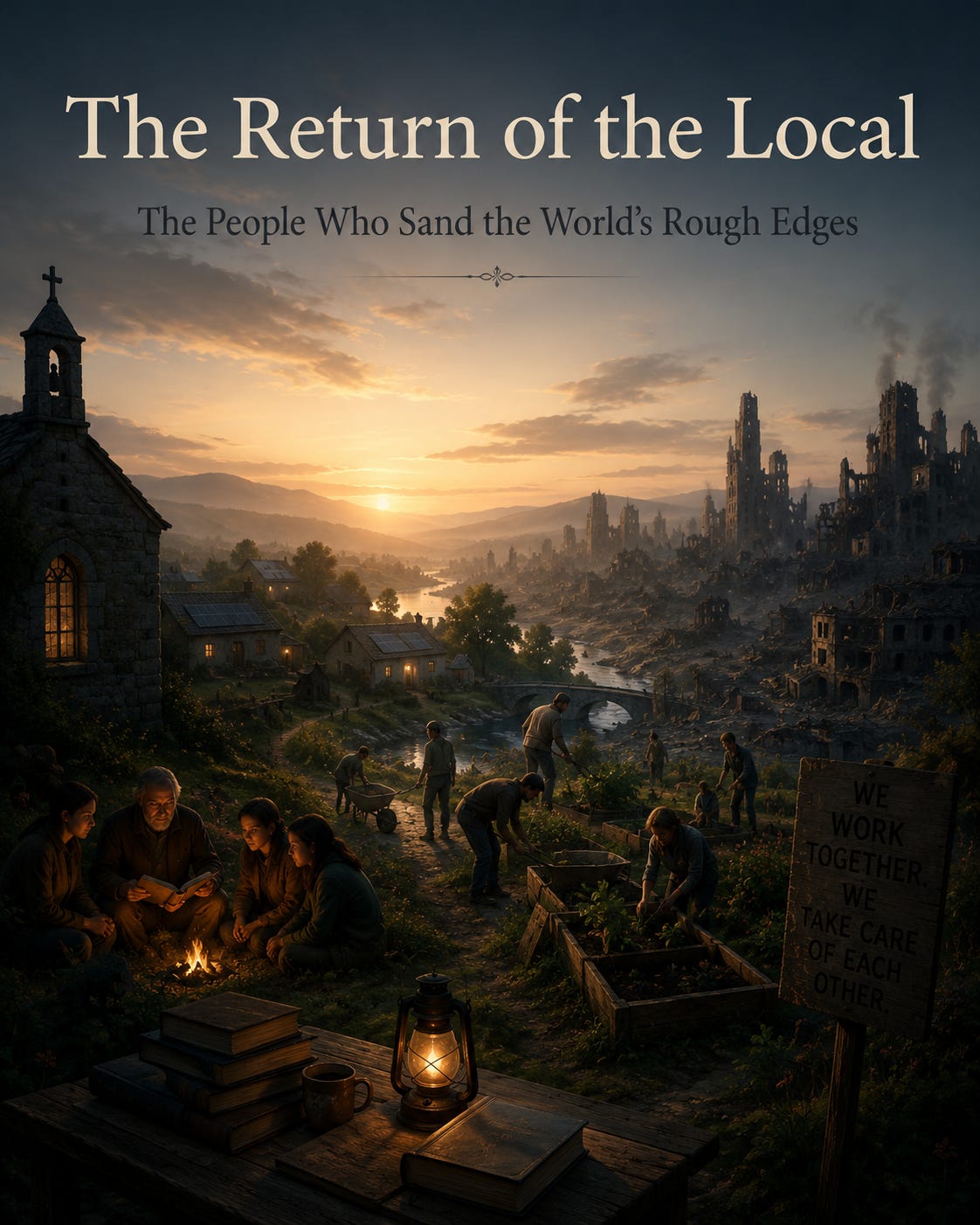
Mass consensus may no longer be sustainable in algorithmic, fragmented, and pluralistic societies. It never was—but it was never required. For most of history, our world was defined by our family, our position, and our community. Most of us would never get more than a few days’ walk away from our birthplace. Everything we knew of the outside world came from travelers and storytellers; our shared myths helped us understand who we were and what we must do.
The telegraph, radio, television, and internet gradually expanded our scale of shared awareness. Today billions of people inhabit the same symbolic environment simultaneously. But though triumphalists of the 1990s predicted a free world spreading free speech through a free internet, what we have witnessed instead is an uneasy blend of tribalization and homogenization.
We form cliques with people around the world and spend our days arguing with people whose names we will never know and whose faces we will never see. As our online communities build increasingly high virtual walls, we find our trusted circles growing ever smaller.
And we are exhausted.
Once we retreated to remote monasteries to maintain what texts we could from the time before the Dark Ages. We stopped being imperial subjects and became villagers and peasants. Our worlds became smaller and distances that once shaped the boundaries of an empire now seemed impossibly large. We interpreted our world in a more immediate way; we built stable relationships and trusted circles as humans always do. Our village had its ways and we internalized them; our world was big enough to sustain us and compact enough to understand.
This was no pre-technological paradise. Famine, violence, and disease were ongoing concerns. Our ancestors were always one bad harvest away from starvation and one bandit raid away from bloody death. But they could put that suffering into perspective; their lives in this world were hard, but they had reassurance of a Heavenly kingdom if they prayed faithfully and lived good lives. Their lives were not comfortable, but they were intelligible.
We cannot simply abandon technology, dissolve global interconnections, and return to isolated villages and fiefdoms. Nor would most of us want to. Given a choice between alienation and the Black Death, an overwhelming majority would go with the first. The question is not “how do we return to our ancestral past?” It is instead the same question that they faced: how do we build intelligible lives within a fragmented world?
As mass trust declines, local trust becomes more important. When it becomes clear that the empire can no longer protect the borders, those living in the borderlands form their own defense forces. As the trade routes crumble and the grain shipments stop, they clear the woods and till their own farms. And as the diplomats and officials stop visiting, they organize their own political systems to suit their needs.
Those systems are not always just: typically, the ruler achieves power by organizing fighters and defeating rival contenders. But these new leaders, for all their flaws, provide a structure that keeps the local society from falling into chaos.
Niche intellectual and religious communities can rise to prominence in times of collapse. During its beginnings, Christianity was frowned upon by Roman authorities who distrusted the faith as a threat to Roman social order. As Roman social order began crumbling, Christianity became the glue that they hoped would hold the Empire together. It helped the Eastern Empire survive as Byzantium; it survived the fall of the Western Empire and helped unite former imperial subjects under the banner of Christendom.
Monasteries and nunneries not only wrote chronicles and preserved ideas from old texts. They also became centers of economic and social life that sustained the communities around them. They provided charity, education, guesthouses for travelers, and centers of agricultural innovation. During a time of chaos, those who rebuild not only acquire power. They also gain considerable control over social and political narratives.
Our meanings will be preserved by small, local groups. Local churches will become important as community centers. Homeschooling networks will preserve learning as official educational networks go dark. Neighborhood farms may spring up in abandoned public spaces. In the post-Roman world, many former imperial sites were repurposed for farming and grazing. These groups may be insular and eccentric. They will certainly be imperfect. But they will preserve what continuity they can and help to reorganize the post-fragmentation world.
When large systems fail to generate trust or legitimacy, somebody must clean out the rubble and keep the utilities running. Shared labor and practical cooperation help to build a sense of local solidarity and shared reality. Those who support their community become community leaders. Participation outweighs belief and sweat equity becomes more important than ideological purity.
This will not eliminate tribalism or conflict; they inevitably arise in post-collapse situations. But it will provide small communities with a defense and reconstruction force. Unlike the oversized bureaucracies that are inevitably found in end stage empires, these local forces will be more approachable, less abstract, and more intelligible.
Civilized men are more discourteous than savages because they know they can be impolite without having their skulls split, as a general thing.
Robert E. Howard[1]
Online interactions encourage symbolic interpretation and ideological reduction. Individuals are sorted by tribe and treated accordingly. Reducing opponents to profile pictures and identity flags is easy. It’s much harder to reduce your neighbor to a slogan. We become more mutually intelligible through repeated contact. We may not always learn to like each other, but we can generally figure out how to avoid conflicts and respect each other’s boundaries.
Internet wars are primarily symbolic. While doxing remains an ongoing issue, most online battles start and end with mutual insults. Slinging those same insults around in person is far more likely to result in painful contusions and nosebleeds. It may also lead to ongoing conflicts with your target’s friends and family. Dialogue survives more easily among people who must continue living together.
Offline relationships can be strengthened by repeated interaction, practical cooperation, and common responsibilities. Helping your neighbor after a storm; working together at community soup kitchens; supporting local charities; purchasing goods at a small local business—all these things help build overlapping understanding and trust. When you see a slogan online, you know that somebody posted it. You have no idea of their motivations or sincerity, and you certainly have no idea of whether you can depend on that person in a crisis.
Shared reality does not require unanimity, ideological purity, or total consensus. It requires enough overlap for your disagreements to remain mutually intelligible. So long as you can communicate your differences and arrive at a mutually agreeable solution to any problems, you can coexist peacefully. The ideological purity required by many online groups is neither possible nor desirable in most offline interactions.
Dialogue is possible—and often necessary—even between sworn enemies. You generally don’t make peace treaties unless you’ve spent some time shooting at each other. There are many other situations where you must sit down with an opponent and hammer out an agreement. Only through mutual understanding will you be able to establish a lasting peace.
“When I use a word,” Humpty Dumpty said in rather a scornful tone, “it means just what I choose it to mean—neither more nor less.”
“The question is,” said Alice, “whether you can make words mean so many different things.”
“The question is,” said Humpty Dumpty, “which is to be master—that’s all.”
Lewis Carroll[2]
No society has ever had perfect consensus. But we have always had at least some overlapping understanding that we could use for conversation and negotiation. It is almost impossible to establish a meaningful dialogue when you and your opponents do not share moral assumptions, factual premises, or interpretive frameworks. Today words increasingly lack stable meanings, and symbolic systems diverge wildly between different groups. Lacking this mutual intelligibility, we can neither agree nor disagree. We can only decide which is to be master.
Today much discourse starts from a simple position which each party shares: I am right and you are wrong. The point is not to persuade opponents but to win the argument in the eyes of your peers. Each side claims ideological victory after the shouting ends. There’s little interest in winning converts and even less in changing the other side’s mind.
Historically dialogue more often functioned as negotiation than battle. Discussions were aimed at managing coexistence, setting boundaries, and helping each side learn a bit more about the other. The conversations had a set purpose, and the parties involved had end goals. Conversations might get heated, but both sides wanted to work towards a conclusion. The point was not so much to resolve disagreement as to find ways to work around it.
It’s difficult to reach an agreement if you assume opponents are acting in bad faith—or if you are convinced that they are ontologically evil. It is entirely possible for somebody to sincerely examine the evidence and arrive at the wrong conclusion. They may be good, decent people who are simply misguided. There’s even a slender chance that you might be the one in the wrong.
Am I saying that nobody ever argues in bad faith? Of course not. Many people come to a discussion with the goal of winning rather than finding the truth. Lots of people misrepresent the evidence—or make it up altogether—to score points. Since “bad faith” is an internal state, it can be difficult to prove that it is a debater’s actual motivation. This is why I assume my opponents are sincere until they provide evidence to the contrary.
Only a very few strongmen have been able to make their subjects obedient in body and mind. The ideological absolutism you see online is a cheap simulation of that luxury belief. It lets you play at being the master, or at being a slave, with no fears of gulag vacations or midnight knocks at the door. Internet absolutism prepares you for politics like Grand Theft Auto prepares you for crime.
Fragmented groups can rally under banners that promise universal explanation and ideological victory. They can play at a semblance of mass moral alignment by spouting the same slogans and declaring solidarity from their keyboards. But those charades do nothing to improve the world, or your place within it. Human beings rarely sustain total consensus for long—especially when that consensus becomes unfashionable.
Developing offline connections is difficult. Trust grows slowly and shared practices matter more than shared beliefs. But volunteer work makes real-world changes and builds connections on something deeper than slogans. The people who sand the world’s rough edges today are going to be the ones who help rebuild a fractured world when the cracks get too deep.
This is not glamorous work. You’re not going to change the world, but if you work hard, you may change a few lives. Those people will remember you long after this month’s slogan has been forgotten. There is no grand ideological synthesis that will heal our divisions. But with hard work and dedication, you might heal yourself.
Reconstruction does not begin with universal agreement, but with small, repeated acts of trust. It will not be sustained by call-outs but by kindness. It will not discover a great explanation, but with hard work and luck it may stumble upon a few solutions. The world we build from the fragments will be a smaller place and a poorer one. But it will be ours.
No matter how fragmented our world becomes, we will remain social creatures. We need trust, companionship, recognition, and meaning. Our dreams of mass consensus may vanish—will vanish—but we will make do as we have always done. We will understand what we can, look for more information, and do a great deal of guessing. We will depend on our neighbors and they will depend on us. We will remember the past through books passed hand to hand and stories told around campfires.
Our memories will be faded and imperfect.
But we will remember.
[1] Robert E. Howard, The Tower of the Elephant. (1933) at Wikisource. https://en.wikisource.org/wiki/The_Tower_of_the_Elephant/Chapter_I
[2] Lewis Carroll. Through the Looking Glass. Chapter VI. At Project Gutenberg. https://www.gutenberg.org/cache/epub/12/pg12-images.html#link2HCH0006.