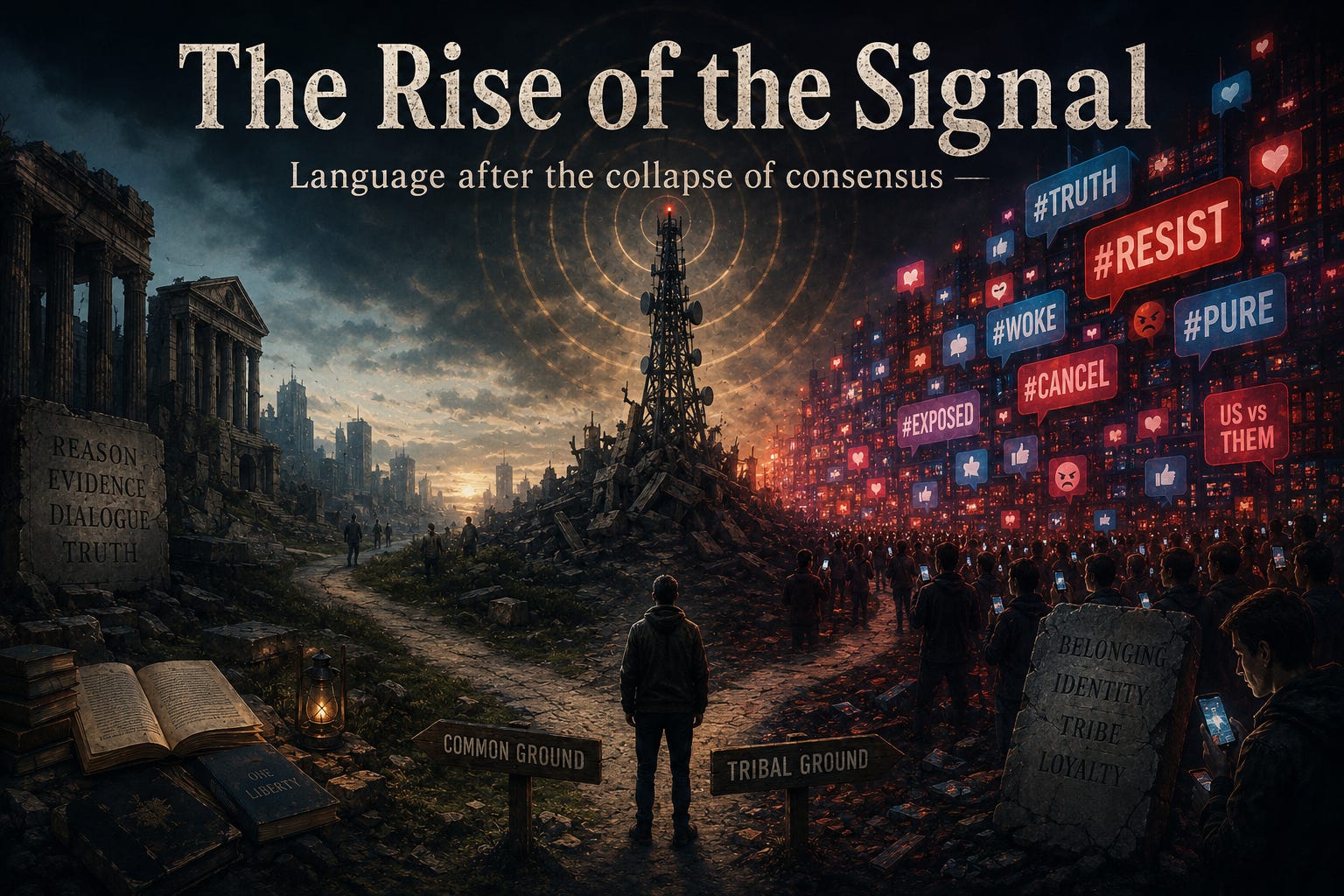
The Rise of the Signal
Language after the collapse of consensus
It offers a ready answer to any question whatsoever; it can scarcely be accepted only in part, and accepting it has profound implications for human life. In an era when metaphysical and existential certainties are in a state of crisis, when people are being uprooted and alienated and are losing their sense of what this world means, this ideology inevitably has a certain hypnotic charm.
Vaclav Havel[1]
We once had faith in persuasion through debate and discussion. We hoped that by making our ideas clear, others would see that we were right. Sometimes we even changed our minds when our opponents raised points we could not refute. Not everybody was open to dialogue; we have never lacked for stubborn people or ideologues. But those traits were generally seen as flaws, not as something to be emulated.
Today slogans have taken the place of arguments. The point of discourse has increasingly shifted from explanation to affiliation. We preach to the choir, and they sing back to us. Converts are neither sought nor desired. Our hashtags, slogans, and memes function less as arguments than as markers of tribal membership.
Persuasion requires shared assumptions and mutual trust. Debaters must start with shared standards for what constitutes evidence and which authorities can be trusted. Without that trust, context fragments. Babel once again falls, leaving us with no common means of communication. Persuasion and debate become exhausting and dialogue retreats into in-groups.
Communication has become more ritualized. Short, blunt declarations of loyalty and denunciations of outsiders are aimed less at persuasion than at belonging. Discourse is no longer aimed at discovering truth so much as locating allies. Without shared truth, communication shifts from deliberation to expression.
Flags and emojis serve as identity markers recognizable at a glance. Hashtags help like-minded strangers discover your content and expand your circle. Political catchphrases and slogans become ritual affirmations that sanctify your community and ward off enemies. They indicate affiliation, demonstrate loyalty, establish trust, and help separate the Elect from the Damned.
These markers are, by definition, simplifications. They are intended to produce instant recognition, not extended rumination. Signals prioritize social affirmation and emotional payload over factual accuracy and internal consistency. The shorter and more distinctive the signal, the more effective it becomes. Its purpose is recognition, not precision.
Social media intensifies this trend. Short, shallow slogans travel further and faster than complex arguments. Explosive emotional payloads win more engagement, and greater algorithmic visibility, than reasoned debate. Many complain that social media is overrun with performative outrage and escalating accusations. Few realize that POSMIWID—the purpose of social media is what it does. These conflicts are not side effects; they are built into a structure that rewards and encourages conflict.
Digital signals reward emotional clarity, repetition, and conflict. Arguments require time, nuance, and concentration. Like video clips, we now see political and social issues reduced to slogans and emotionally loaded but decontextualized fragments. Our discourse becomes saturated with viral outrage clips and angry responses that display emotion but offer little in the way of potential solutions. Instead of productive debate, we are flooded with material that is cognitively cheap and emotionally efficient.
Havel speaks of a greengrocer who puts a Workers of the World, Unite flyer in his window. Shoppers do not notice his sign, any more than they notice it in other shop windows or bulletin boards. They do not need to read it, because the flyer is everywhere. It would be more noteworthy, in fact, were the grocer to take the sign out of his window. Its absence would be more visible—and riskier—than its presence.
The slogan’s function is not persuasion but ritual affirmation. Its real message is “I belong. I understand the rules. Leave me in peace.” We see a similar dynamic in modern signaling culture. Hashtags, profile symbols, slogans, and ritual declarations operate as ritual demonstrations of alignment. In highly polarized environments, silence itself becomes suspicious.
Moral statements function as public performances in signaling environments. We often hear “virtue signaling” dismissed as performative compassion aimed more at impressing peers than producing change. But in many circles, failing to display expected signals can draw the same kind of scrutiny a greengrocer in 1970s Czechoslovakia might get for taking down his sign. Politically suspect views can cost people friends, promotions, and social status.
“Outrage signaling” demonstrates vigilance, loyalty, and ideological purity. Public condemnation establishes community boundaries and reinforces social limits. Ritual denunciations of controversial public figures and ideological opponents function not only as expressions of disagreement, but as demonstrations of commitment to the group itself. Visible hostility toward shared enemies often becomes a marker of belonging.
These participants are not necessarily insincere. Many genuinely believe that the people they condemn pose real threats to their communities or values. But they express those beliefs within systems that reward performative extremity and emotional escalation. Over time, repeated performances of outrage blur the line between social ritual and deeply held conviction. Boundaries that regulate behavior become walls that corral thought.
Social performances are not new. As sociologist Erving Goffman noted, public performances often serve as “an expressive rejuvenation and reaffirmation of the moral values of the community.”[2] Outrage signaling frequently functions in precisely this manner. Public condemnations do more than express disagreement; they ceremonially reaffirm the group’s moral order and reinforce its boundaries.
Signals are fast, recognizable, and emotionally legible. Explanations are slow, nuanced, and cognitively demanding. In a signal-dominant environment, complexity becomes a liability. Ambiguity becomes suspect in cultures accustomed to the clarity of signals. People either interpret ambiguous material in its worst possible light or reject it because it “doesn’t make sense.” Nuance appears to be weakness or collusion in a culture that divides the world between friend and enemy.
In persuasion-based cultures, explanation is central. Arguments are tools used to persuade outsiders and to test and strengthen one’s own worldview. In signaling cultures, the audience already agrees. Challenging community frameworks risks epistemic collapse. Emotional certainty becomes more persuasive than evidence, and discourse shifts from understanding to affirmation.
Discourse increasingly relies on templates, scripts, slogans, and ritual phrases. These signals reinforce one’s position within the community, minimize ambiguity, and avoid reputational risk. They are socially safe and rhetorically effective. There’s little incentive to argue with opponents when a simple “do better” or “educate yourself” can end the conversation immediately. “Listen to marginalized voices” serves simultaneously as a show of support, an assertion of moral legitimacy, and a claim to interpretive authority.
Signals travel faster in algorithmic environments where immediate emotional reactions are prioritized. But they also compress information into short symbolic expressions. This compression eliminates nuance, uncertainty, and interpretive openness. Long-standing conflicts are reduced to “Make America Great Again,” “Black Lives Matter,” or other slogans that are emotionally rich but cognitively reductive. These statements simplify complex issues into symbolic identity markers that carry little explanatory meaning outside their in-groups.
Slogans function as symbolic containers for broad emotional and political identities. “Black Lives Matter” can signify a desire for police reform, anti-racist action, progressive affiliation, or solidarity with Black communities. “Make America Great Again” can invoke nostalgia, nationalism, immigration concerns, economic frustration, or cultural resentment.
These symbols are emotionally precise because they are factually ambiguous. Large and internally diverse groups can rally around the same phrase while interpreting it in radically different ways. The slogan succeeds not because it communicates precision, but because it compresses affiliation into a recognizable symbolic form.
Mass media outlets once broadcast information to a mass audience through television channels, radio stations, and news wires. Today social media sends and receives signals targeted toward countless virtual micro-communities. Mass media operated through centralized systems of editorial curation and verification. The signals shared in today’s online communities seek to stir passion and prove affiliation.
Media is not the only victim of our cultural fragmentation. Once we were united by religious denominations, economic class, national narratives, and broadly trusted institutions. We had recognized authorities and shared interpretive frameworks. Those structures have begun to crumble. As often happens during a Dark Age, we have begun building new structures from raw materials scavenged from the wreckage.
The rough Latin of the fallen Western Empire transformed itself into languages like Occitan, Provençal, Catalan, Portuguese, Sardinian, French, Spanish, and Italian. We are seeing a similar reconfiguration of language today. Communities increasingly speak different symbolic languages, consume separate media ecosystems, and interpret events through incompatible lenses.
Signals rise and fall through repetition. At first, they spread more widely with each repost. But in time, they lose their emotional force. The outrage engine needs new fuel; the community attempts to recapture its former glory with ever-louder denunciations and purity tests. Emotional intensity becomes normalized—but once it is normalized, it is no longer intensity.
The internet allows individuals to organize around increasingly narrow identities and ideological distinctions that would have remained socially marginal or geographically isolated in earlier eras. We will likely see continued fragmentation and tribalization for a time. That will lead to increasingly ritualized discourse, self-censorship, and continued defensive communication.
But what if the internet fails? Many of today’s highly fragmented identity communities depend upon stable digital infrastructures and continuous global connectivity. Economic instability or technological disruption would weaken many of these structures. This would push people back toward geographically local forms of organization and mutual dependence. Without constant access to algorithmically amplified outrage, slower and more reflective forms of engagement are likely to reemerge.
What if those internet structures remain in place for the foreseeable future? In that case, we will see the hybrid culture which is already developing. Signaling and short-form communication will dominate mass discourse, while long-form discussions will survive in niche spaces. Networks like Patreon and SubscribeStar have made it possible for niche authors to earn a modest—or sizable—income by appealing to devoted fans. The system which promotes fragmentation also provides an increasingly robust structure that lets micro-communities provide mutual support.
No matter what happens, humans will still need meaning, trust, belonging, and explanation. The institutions capable of sustaining shared interpretation may shrink and fragment; in time new institutions will arise to sustain those needs.
Signals are not inherently evil. We have recognized our comrades and opponents by banners and symbols since at least the Bronze Age. But society cannot survive solely through symbolic affiliations. Deliberation requires patience and trust. It requires an openness to new ideas and a willingness to admit error.
Our current struggle is not merely political; it is epistemological. Signals can tell us who belongs. They are far less capable of telling us what is true. Since the Enlightenment and the Age of Reason, our culture has prioritized a search for truth. That approach has led us both to extraordinary achievements and colossal horrors.
If we turn away from that search, we will lose both the good and the bad. Our age of science will become as distant to us as Rome’s Golden Age. And our descendants will be left to make their own meaning and rediscover what we have squandered.
[1] Vaclav Havel, “The Power of the Powerless” (October 1978). https://www.nonviolent-conflict.org/wp-content/uploads/1979/01/the-power-of-the-powerless.pdf
[2] Erving Goffman. The Presentation of Self in Everyday Life. Edinburgh: University of Edinburgh, 1956. 23.