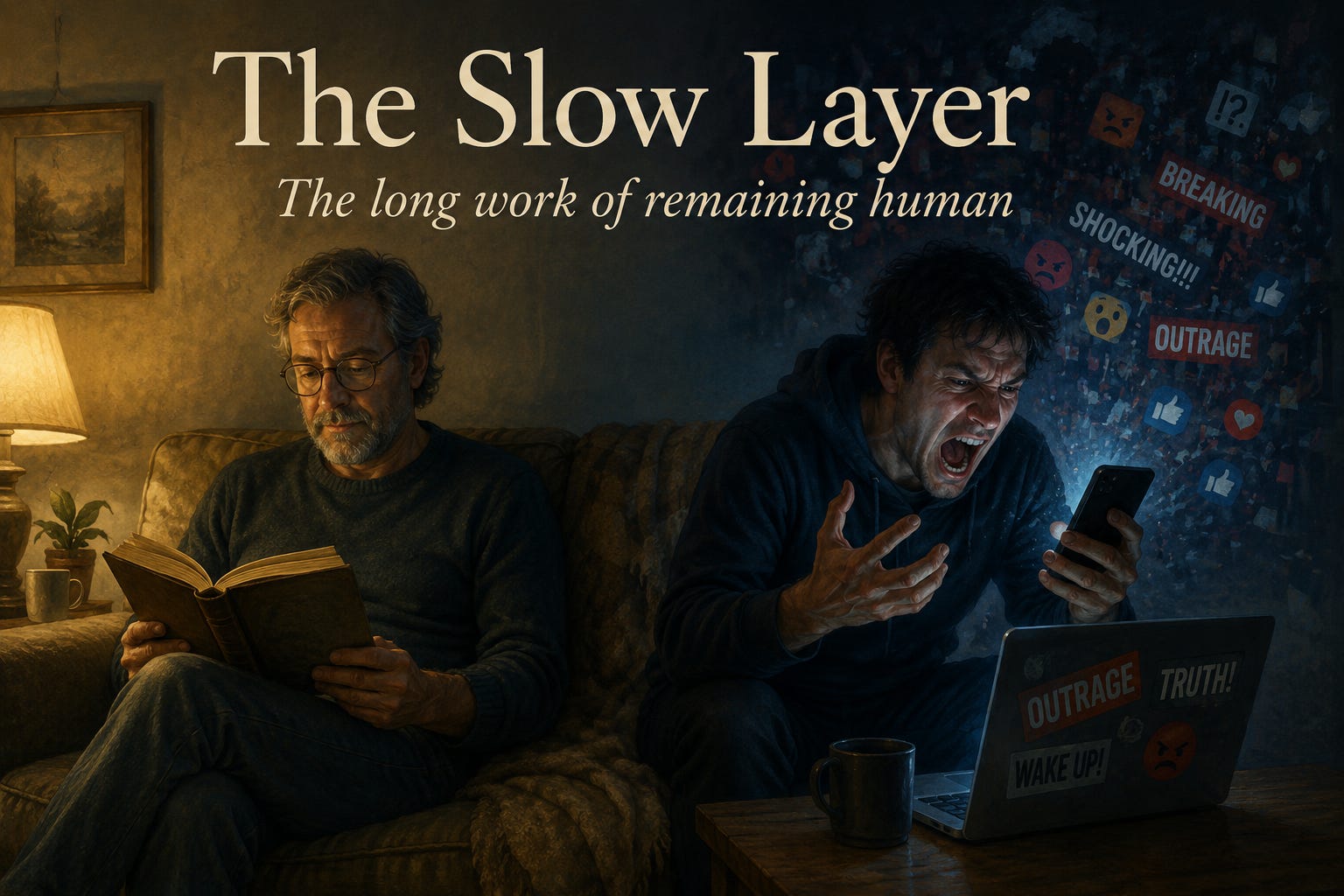
The Slow Layer
The long work of remaining human
Poetry feeds and waters the passions and desires; she lets them rule instead of ruling them… [W]e may allow the excellence of their intentions, and agree with them in thinking Homer a great poet and tragedian. But we shall continue to prohibit all poetry which goes beyond hymns to the Gods and praises of famous men. Not pleasure and pain, but law and reason shall rule in our State.
Plato, The Republic, Book III
Socrates feared that chanted poetry was too emotionally stimulating; he favored the more sedate and rational approach of writing and reading. Literacy provided a cushion between reason and the passions. It also served as a gatekeeper. While any fool could be stirred up by a poet, only those with proper training could read and write texts. Rhetoric—spoken speeches—were for the public. Dense philosophical treatises were only available to the right sort of thinkers.
Plato’s Athens was on the cusp between verbal and literate culture. Socrates taught through oral discussions; his disciple preserved his words in writing. Athenian leaders feared and despised Socrates for his difficult questions. Ultimately, Athens condemned Socrates for his unsettling words—a sentence which he accepted.
The Greeks got their alphabet from the literate cultures they pillaged around the Aegean. The story of barbarians sacking the city the locals called Wilusa and the Greeks called Ilium was first memorialized as an oral epic preserved by a blind bard named Homer. The conquered Trojan, Minoan, and Cretan cultures became the bedrock of a new Greece that saved its stories and debates in writing.
But while he wanted to ban poets from his ideal city, Socrates also recognized the limitations of the written word. In Phaedrus he says:
[W]riting is unfortunately like painting; for the creations of the painter have the attitude of life, and yet if you ask them a question they preserve a solemn silence. And the same may be said of speeches. You would imagine that they had intelligence, but if you want to know anything and put a question to one of them, the speaker always gives one unvarying answer.
Writing preserved information. But, unlike a speaker, a text could not clarify a point or answer questions. Yet Socrates also warned that:
neither poetry nor prose, spoken or written, is of any great value, if, like the compositions of the rhapsodes, they are only recited in order to be believed, and not with any view to criticism or instruction.
While social media relies on text, it functions in many ways like an oral information exchange. Exchanges on social media are immediate and participatory. Conversations are emotionally responsive and socially performative. Words and memes are repeated, remixed, and adapted for different situations like proverbs, ritual phrases, and oral storytelling motifs. And, like rhetoric, it can inflame a populace far more immediately than a broadsheet or a novel. All these traits have caused us ongoing difficulties as we struggle to incorporate social media into our culture.
The Spectre is the Reasoning Power in Man; & when separated
From Imagination, and closing itself as in steel, in a Ratio
Of the Things of Memory, It thence frames Laws & Moralities
To destroy Imagination, the Divine Body, by Martyrdoms & Wars.
William Blake, Jerusalem: The Emanation of the Giant Albion
For Marshall McLuhan, Blake’s Imagination “is that ratio among the perceptions and faculties which exists when they are not imbedded and outered in material technologies.”[1] Once the perceptions and faculties are outered, interplay between those systems breaks down. They become closed systems, fragments of a once-unified self. Blake’s lithographs and visionary poetry were an attempt to free those systems and restore our unity.
McLuhan saw the mainstream media of the early 1960s as a “mosaic of the postures of the collective consciousness.”[2] That mosaic was drawn from many viewpoints and was ultimately a collection of emotional fragments and symbolic postures. But because it was aimed at the masses, it was a shared mosaic. McLuhan never saw the mass media become personalized; he never envisioned a world where everyone had their own mosaic.
Television and cinema gave viewers individual participation inside mass emotional systems. They cried when Bambi’s mother died and when JFK was shot. They laughed at Charlie Chaplin and Jackie Gleason; they snickered at Rich Little’s Nixon impression. These experiences did more than create an illusion of community. They helped spark conversations at the office and the dinner table.
Social media creates virtual community and virtual communications. Viewers no longer wait until the show is over to offer their thoughts; they can comment on the action as it happens. The tribe synchronizes in cyberspace, and there it remains. It shouts into the aethyr and waits to hear itself in the echoes. We are imbedded in a material technology and reduced to fragments.
For McLuhan, the Internet would be just the latest in a long line of technological challenges. He called his 1962 book The Gutenberg Galaxy because of the cognitive and social changes wrought by ready distribution of printed media and the rise of literacy. Mass-produced media gave us easy access to information that we once heard only in shared stories and conversations with traveling strangers. We now learned what was happening in the world from printed stories shaped by the linear fashion of journalism, not the wandering style of mythology.
The printing press also had an enormous influence on our spiritual lives. Before widespread literacy, religion was transmitted by ritual and ceremony. A priest explained your moral duties and told stories from Scripture; the congregation saw Christ’s death in a crucifix and his resurrection in a chalice. Now they could buy pamphlets from a bookseller or read broadsheets at their favorite pub. They gained agency over their spiritual lives, and over time those old rituals and hierarchies started looking less like a temple and more like a prison.
Many complain, not without reason, that the Internet has coarsened our discourse and become a sewer of obscene speech. But let’s look at this 1790 rant from Jacques Hébert (“Le Père Duchesne”), entitled “Fuck the Pope.”
Who does he take us for, that bastard of an indulgence seller? Does he think that with his toilet paper–his bulls–his cannons without primers, and all the thunder and idiocies with which he put to sleep or scared our fathers, fuck, does he still believe he leads the French of today? We’re no longer in the time of King Dagobert, and today we’re no longer such dupes as to buy the pardons that priests trafficked in in past centuries, nor to be upset by an interdiction that the bishop of Rome will cast upon the Kingdom. [3]
In 1517, printed copies of Luther’s 95 Theses spread throughout Europe and sparked the Reformation. In 1524, engraver Marcantonio Raimondi produced I Modi (The Positions), a series of sexually explicit engravings. A 1527 edition included the Sonetti lussuriosi (Luxurious Sonnets) of Pietro Aretino. Printed pornography was widely condemned by Catholic and Protestant leaders alike, but their finger-waggling did little to slow its spread.
Social media did not create these problems; it rediscovered them. What started as expensive engravings and moved on to pulp erotica became Pornhub and OnlyFans; Père Duchesne was replaced by an endless supply of foul-mouthed trolls. The Internet differed from previous media revolutions in its speed and in drawing us into the story as active participants. But its consequences followed an old and well-trodden path.
Between 2004 and 2023 the share of Americans who read for pleasure dropped from 28 percent to 16 percent—a 40 percent drop over two decades. The researchers defined “reading” to encompass books in print, electronic, or audio form. Daisy Fancourt, a psychobiology and epidemiology professor at University College London, worried:
Even though reading is often thought of as more of an individual activity, when we read stories, we actually form connections with characters The empathy that we feel for them is actually real, and these connections with characters can be ways that we can feel less alone, that we can feel socially and emotionally validated.[4]
We experience the internal lives of characters in a book more clearly and vividly than we experience those of our social media peers. Most of our social media engagements are exchanges between personas. Authors labor to give their characters depth and meaning; we communicate to each other what we want to be, and what we think the other wants to hear. And in time we come to mistake our masks for our faces.
Reading a book—even on your smartphone—takes you out of that performance. You enter an intimate relationship with the author and gain a glimpse of their worldview. If you have grown accustomed to an endless stream of bite-size fragments, it may take some time to become accustomed to lengthier paragraphs and information that does not reveal itself on the first glance. But the learning curve is not steep, and the rewards are considerable.
The characters created by great writers are more human than the personalities we build for social media. They illuminate our lives in all their contradiction and complexity. Social media reduces our opponents and our allies to caricatures. And, in time, it reduces us. Devoting some time to reflection reminds you that you are something more than slogans and shouting. And you don’t have to read like it’s a painful duty. A good potboiler is more fun and less exhausting than an online argument and relies on more entertaining clichés.
Social media drives passion. Research deepens your understanding of the causes you care about. Academic papers, books, and deep dives into a topic leave you better able to defend your position—and refine it. Instead of shouting slogans, long form content educates you on the ambiguities and nuances of the issue. This may drive away some of the more earnest but uninformed, but it can help spark serious conversations that lead to real action.
Scrolling gives you on-demand synchronized emotional activation. Reading and study slow and focus perception. Instead of constant stimulus, you discover uncertainty and contradiction. Through reflection and close attention, you gain understanding. This does not mean that you must give up social media. Technologies exist alongside each other. Writing did not destroy speech; movies did not destroy stage plays; short-form posts will not destroy long-form content.
New forms of media do not simply change how we communicate; they also change the way we perceive the world. We are still discovering how the Internet has changed our cognition. We are still learning how to live in personalized mosaics, and how to communicate across individualized realities. We fear that social media will turn us all into zombies; sixty years ago, we feared television would have the same effect. The medium changes. The slow work of discovering how to remain human within it continues.
[1] Marshall McLuhan, The Gutenberg Galaxy. Toronto: University of Toronto Press, 1962. 265.
[2] Ibid, 268.
[3] Jacques Hébert, “Fuck The Pope” (1790) at Marxists.org. https://www.marxists.org/history/france/revolution/hebert/1790/pope.htm.
[4] Maggie Astor, “Fewer People are Reading for Fun, Study Finds.” New York Times, August 20, 2025.


I do know that with a traumatic brain injury, that reading is better for the brain. I remember when I could read non-fiction. It was years later that I could read fiction and image the word pictures.
Meanwhile, social media and the like hurts the brain. I can only spend an hour a day on the computer. I don't possess a smart phone but use a desktop.
Problem for me is that the modern world has decided that folks who use flip phones or landlines do not exist. Sigh. I remain a challenge for these modern programmers. That is my goal in life these days.