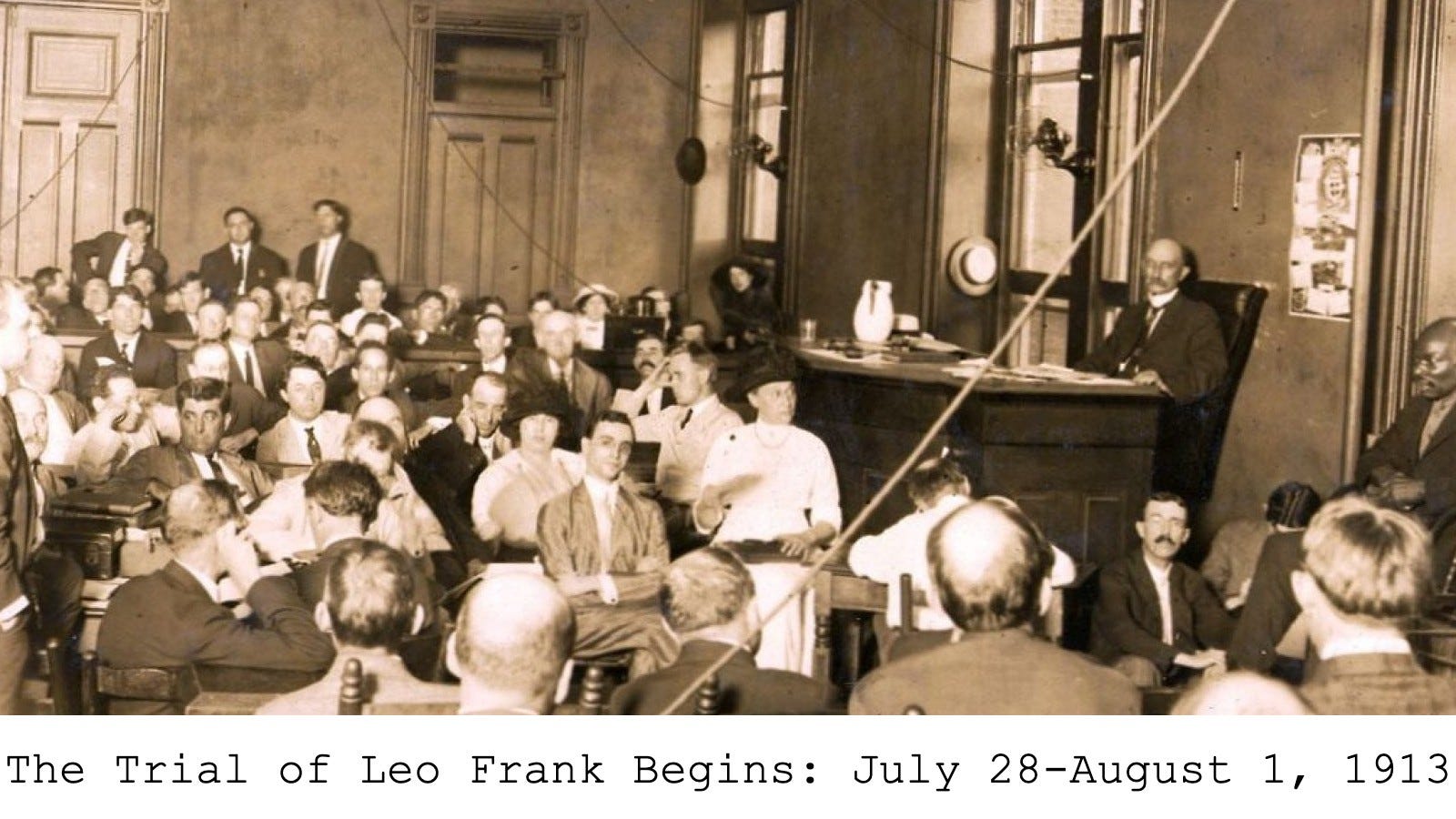
The Trial of Leo Frank Begins
July 28-August 1, 1913
The fact that Frank is under indictment today means that to many minds that he is therefore guilty, and even those of education and high intelligence sometimes give this meaning to an indictment. In the eye of the law, Frank is an innocent man, as innocent as is the soul of little Mary Phagan, and before the law he will remain so until a jury of twelve men shall have heard all the evidence presented and then agreed unanimously that he is guilty.
Vernon Stiles, “Phagan Trial Will be Great Legal Battle,”
Atlanta Constitution, July 27, 1913. B3.
Leo Frank’s defense team began the trial with a calculated risk. At the swearing-in of witnesses, they provided the names of many prominent Atlanta Jews, as well as faculty members and graduates from Cornell University. They were expected to testify to Leo Frank’s character and reassure the jury that Frank was not the sort of man to commit such a heinous murder.
Introducing these witnesses would highlight the differences between Frank’s reputation and Conley’s checkered past. But by introducing character witnesses, the defense opened the way for the prosecution to offer rebuttal witnesses. Rumors that Frank had behaved inappropriately toward factory girls had already appeared in the newspapers. Dorsey could now bring that evidence before the jury for their consideration.
There is no perfect legal strategy, only different tradeoffs. Rosser understood how his socially awkward client would likely be read by an Atlanta jury. Character witnesses might humanize the defendant and counter the impression that Frank was cold, aloof, or “just not right.” Those benefits, Rosser evidently believed, would outweigh the damage the prosecution might do with their rebuttal. Given that he called over one hundred character witnesses, he apparently felt it best to let others speak on Frank’s behalf as much as possible.
This strategy came at a significant cost. Dorsey took every opportunity to comment about Frank’s alleged sexual misdeeds, including insinuations that he was homosexual and that police had caught him molesting a young girl in the park. With the benefit of hindsight, we can debate whether Rosser made the right strategic choice. He did not have that luxury. Ultimately, we will never know how much good Rosser’s decision did for Frank’s case or how much the extensive commentary on his bad behavior influenced the jury.
By noon the jury had been selected and sworn in. The afternoon opened with the trial’s first witness, Mary Phagan’s mother. Dressed in a black hat and veil, Fannie Coleman testified about the last day of her daughter’s life while one of Dorsey’s assistants displayed the bloodstained clothes Mary had been wearing when her body was found. Overwhelmed with emotion, Coleman was soon excused.
Next to testify was Walter Epps, the boy who told investigators to Phagan was unnerved by Frank’s unwanted advances. Dorsey’s questions on that subject were quickly stifled by Rosser, whose objections were sustained. But Rosser’s efforts to question Epps’ claim that he had waited in vain for Mary until 4:30 p.m. on April 26 failed.
The steps leading up to a criminal trial are like a chess game. Each side carefully maneuvers to ensure it begins the trial in the strongest possible position. Once the trial begins, the proceedings are more like a boxing match. Rosser and Dorsey were two seasoned brawlers trading blows. Each expected the other would land a few hard shots. Each hoped to emerge victorious when the jury announced its verdict. Both were expecting a long, hard-fought battle.
The third witness, night watchman Newt Lee, was important to both the prosecution and defense. Newt’s testimony was potentially devastating for either side. What had begun as a contentious trial now moved closer to open hostility. Rosser had, understandably, been relatively gentle with the newspaper boy and with Phagan’s grieving mother. Newt Lee endured nearly five hours of aggressive, confrontational questioning.
Rosser sought to cast suspicion on Lee and implied that he was the actual author of the murder notes. He tried to show that Newt had been coached to lie by police detectives. He asked leading questions and returned repeatedly to the same themes in an effort to trip Lee up. And Lee weathered the storm, impressing both journalists and the crowd. The jury had now heard Lee describe Frank’s extreme nervousness on the day of Phagan’s murder, as well as his tale of the manipulated timecard.
Tough cross-examination also comes with risks. If the witness slips up or cracks under pressure, they appear evasive or dishonest. But if the witness holds steadfast despite hours of questioning, they now appear to be forthright and truthful. A hard cross-examination either leaves the witness discredited or more credible than ever.
In the case of Lee, and later of Conley, Rosser faced another challenge. Most white Atlantans had no trouble assuming a negro would lie. But if the negro stuck to his story without wavering, many courtroom observers would be inclined to think he was honest. Surely no poor black laborer would be able to remember all the details of a lie under hours of relentless interrogation. They would slip up somewhere, then entangle themselves in new lies as they desperately tried to keep their story straight.
Rosser’s legal strategy was not unsound. In fact, it may have been his only realistic strategy. Lee could describe Frank’s demeanor on the day of the murder and inspire doubts about his timecard. Conley’s testimony was critical. He alone could tell the jury how the murder happened and who did it. He was the sole person who could place Frank at the scene of the crime and describe what happened on April 26.
Discrediting Conley and Lee would tear the heart out of the prosecution’s case. Without them, the prosecution was left with a factory manager who was in his office on a day and at a time he was usually there. Outside of Conley’s testimony, there was no direct evidence linking Frank to the murder, and there were over a hundred witnesses ready to testify to Frank’s good character.
Few witnesses, truthful or otherwise, could withstand hours of cross-examination under one of Dixie’s most noted defense attorneys. If Rosser could lead either man to slip up, there was little chance Dorsey could sustain a conviction. But when neither man broke under pressure, Rosser’s bare-knuckle tactics strengthened rather than weakened their credibility. Like his list of character witnesses, his aggressive cross-examination was a smart legal attack that backfired.
Rosser next challenged one of the prosecution’s exhibits. A diagram of the National Pencil Company traced Mary’s path into the office, then depicted Leo following Mary into the metal room before carrying her body to the elevator and from there to the basement.
Rosser objected that the display presented these actions as if they were already proven facts rather than the prosecution’s unproven theory of the case. Dorsey responded by citing precedents where judges had previously included similar displays into evidence. States Exhibit A was allowed to remain, albeit with the printed narrative removed.
This exchange reveals the give-and-take of an adversarial trial. Rosser argued the prosecution was treating speculation as established fact. Dorsey responded with legal precedents and argued States Exhibit A merely charted the state’s case. Roan allows the display to remain but removes text that might unfairly prejudice the jury. At face value, this exchange suggests that both sides are presenting their case vigorously and Judge Roan is attempting to accommodate their concerns without bias toward either side.
On Wednesday, July 30, Hugh Dorsey questioned Detective Boots Rogers. The solicitor focused on an important question: had Leo Frank forged Newt Lee’s card to make it appear as though he had left the factory for a period?
“Mr. Frank says ‘I had better put in a new slip, hadn’t I, [Assistant Superintendent] Darley?’ Darley told him yes, to put in a slip. Frank took his keys out, unlocked the door of the clock and lifted out the slip, looked at it and made the remark that the slip was punched correctly.”
“Where was Newt Lee?”
“Lee was right behind me, handcuffed.”
“Where was Darley?”
“He was right there.”
“What happened next?”
“Mr. Frank went to his office, brought out a new slip. He took out the old slip and wrote on it ‘Removed 8:26.’”
“What did he do with it?”
“He folded it once and went into his office.”
“Did you see that slip?”
“Yes, I glanced at it. The first punch was 6:01 and the second at 6:32. There did not appear to be any skip in it.”[1]
Newt Lee’s timecard was one of the prosecution’s most damning pieces of evidence. In and of itself, the forged timecard would not prove that Frank murdered Phagan. But if he deliberately created it, it would show that he was willing to tamper with evidence to interfere with an ongoing investigation. The immediate question would be “why?” The obvious answer, then and now, would be “to cover up his own guilt.”
Frank had access to the time punch machine. As an engineering graduate, he almost certainly possessed the dexterity and technical knowledge to remove the punch from the machine, use it to manually create a new timecard—exactly what police and prosecution were claiming he did—and then put the machine back together. He had the access and the apparent ability. If the police assumed, as they did, that he was involved in Mary Phagan’s murder, he also had a clear motive.
The other suspected killer, Jim Conley, had neither the access nor the apparent technical skills to create a fake timecard. And even if he did, why would Leo Frank later authenticate that altered timecard as legitimate? The fraudulent timecard was one of the only pieces of material evidence that called Frank into suspicion.
After Dorsey concluded questioning, Luther Rosser stepped up for cross-examination. He joked with the audience. He asked how Rogers knew that Frank was “unusually nervous” when he had never met the man before. But he did not ask questions about the timecard.
Rosser’s silence on that matter is noteworthy. As we have already seen and will see later, Rosser was merciless when attacking evidence that might sway a jury. Yet he chose not to pursue the timecard, one of the few pieces of physical evidence against Frank, or to challenge the detectives’ conclusion that it had been altered. Observers might have wondered why the notorious bulldog had gone so easily on Rogers.
Some might have wondered if Rosser had gone soft on the next cross-examination. But though he treated Grace Hix, a National Pencil Company employee, with the courtesy expected of a southern gentleman, Rosser achieved his goals. Under polite questioning, Miss Hix acknowledged that she had never spoken to Frank and only rarely had seen him chatting with her coworkers. She further noted that many of the girls, including several blondes, regularly combed their hair near the lathe where detectives had purportedly found Mary Phagan’s hairs.
When Detective John Black took the stand, those observers learned that the bulldog still had teeth. Rosser launched a blistering cross-examination, peppering Black with questions about the time Frank arrived at police headquarters, the time the detective reached Frank’s home, and even the color of the tie Frank had supposedly struggled to knot. Then he turned to the time slip.
“You saw Frank at the clock?”
“Yes.”
“He opened the clock and took out a slip?”
“Yes.”
“When did Frank turn over this slip that he took out of the clock?”
“I don’t know.”
“Didn’t you tell Mr. Dorsey a few minutes ago that he turned over the slip on Monday morning?”
“I don’t remember.”
“Look here, Black. Is your memory so bad you can’t remember what you told Dorsey twenty or thirty minutes ago? And yet you attempt here to state the words of conversations that occurred more than three months ago?”[2]
That evening the Atlanta Georgian printed an Extra edition, as it had often done throughout the Frank trial. The left column headline declared DETECTIVE RETRACTS PART OF HIS STORY UNDER ROSSER ATTACK. Three days into the trial, the consensus was that Wednesday was the best day yet for the defense. As Sidney Ormond of the Atlanta Constitution put it:
It was only a short while ago that John Black, according to the statement of Lee, was “blim-blamming” at him night and day in an effort to get something new in regard to the death of Mary Phagan. Lee was not allowed to sleep, and you know that means to a negro. No sooner would he curl up on his bunk to dream of yellow-legged chickens, watermelons, and the fresh air of liberty, then along would come Black or Starnes or some other member of the detective force to harass him with questions …
The mere fact that Newt had no education stood him in good stead. His memory, or his “recollection,” as he termed it, had been developed just in proportion as his education had been neglected. Luther Rosser never budged him from his original story…
With John Black, the case was different, and the manner in which he became muddled up and confused under the crossfire of Mr. Rosser’s questioning proves that the memory of the illiterate is often more reliable than the memory of a person of fairly good education.[3]
Thursday was largely uneventful, save for a special guest at the defense table. Carrie Appelbaum, widow and shooter of Jerome Appelbaum, was now seated beside the Franks as a guest. The Appelbaum trial had been extensively covered by the Georgian. On Friday, April 25, 1913—one day before Mary Phagan would show up at the National Pencil Company for her pay—Carrie Appelbaum was acquitted by an Atlanta jury. Hugh Dorsey was the prosecutor.
The Appelbaum trial was seen as a slam-dunk for the state. Carrie Appelbaum had been married three times and divorced twice. Her second husband, J.A. Keller, described the former Caledonia Scott as “a pretty good sort of fellow” but also cautioned “she’s her own worst enemy” and described her as “one of the most jealous-hearted creatures alive.”[4] And her fourth husband died of bullet wounds after Mrs. Appelbaum discovered that he was carrying on a romantic correspondence with a woman in Saginaw, Michigan.
We will never know exactly why the jury chose to acquit Carrie Appelbaum. But for the Atlanta public, the answer was simple: the state lost this trial because of Hugh Dorsey’s incompetence.
The Appelbaum case is often cited as the reason why Dorsey chose to prosecute Frank. He was still stinging from an embarrassing defeat. Rosser and Arnold certainly knew what they were doing when they put her on the bench and when she declared her belief in Frank’s innocence to courtroom journalists. But did Dorsey hope to come back from his recent humiliation by framing an innocent man? For some, the answer is obvious. But the contemporary evidence paints a less clear picture.
Why would Dorsey, a man purportedly fueled by ambition and unscrupulous enough to send an innocent man to the gallows, target a prosperous white man of good reputation—and a man whose family could afford a team of Georgia’s best defense attorneys? Albert Lasker, a Jewish advertising executive who contributed to Frank’s post-trial law fund, donated $100,000 ($3.3m in 2026 dollars). William Smith received $40 ($1,350 in 2026) for his defense of Jim Conley.
If Dorsey wanted to coach his witnesses into convicting Frank, why would he not help Frank craft a devastating story that would point the blame squarely on a poor black laborer? Why did he instead choose to stake his case on the word of a black ex-convict who had already confessed to moving Phagan’s body and writing the notes? Any claim that Dorsey framed Leo Frank must address the question of why he passed over two much easier targets.
The simplest explanation is not always the correct one. Dorsey was no less ambitious than any other prosecutor, and we cannot know why he ultimately believed Conley over Frank. The issues I have raised do not prove or disprove Dorsey’s alleged part in framing Leo Frank. But they do raise the evidentiary bar for those who insist that a respected prosecutor and future governor knowingly charged an innocent man with a capital offense.
Dorsey appeared unshaken by Mrs. Appelbaum’s presence, and Thursday and Friday were largely anticlimactic. Both prosecution and defense had their sights on Saturday afternoon, when the State’s most important witness would be taking the stand.
[1] Oney, 211-212.
[2] Ibid, 220.
[3] Sidney Ormond, “Bearing of Black and Lee Forms a Study in Contrast,” Atlanta Constitution, July 31, 1913. 4.
[4] “Former Husband Tells of Her Shooting Scrapes,” Atlanta Georgian, February 27, 1913. 2.


