
Twilight and Ashes
Middle-earth, Westeros, and the mythologies of decline

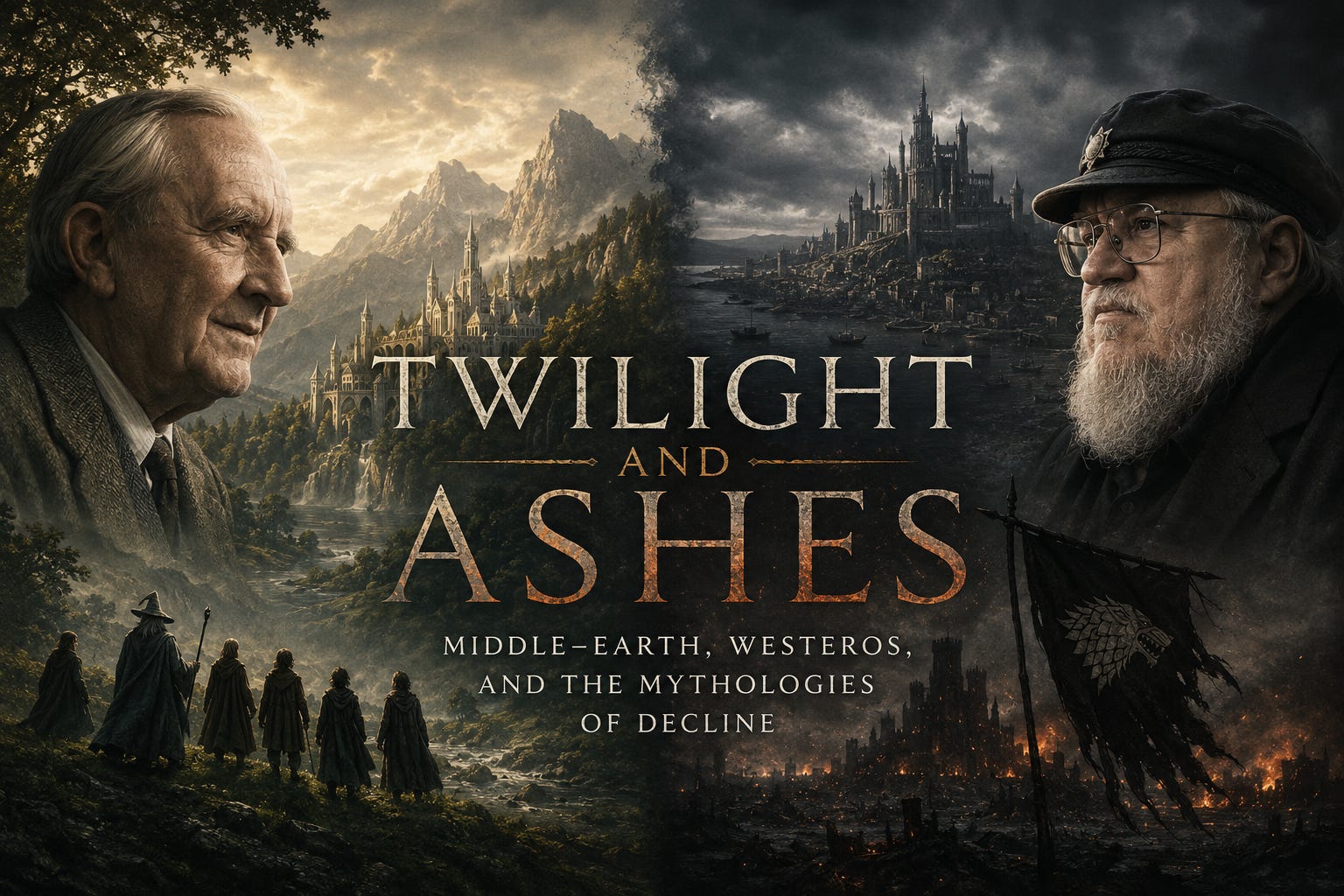
J.R.R. Tolkien’s The Hobbit and The Lord of the Rings transformed modern fantasy. Ursula LeGuin saw Middle-earth and gave us Earthsea; Terry Pratchett gave us Discworld; J.K. Rowling gave us Dumbledore and Voldemort. But these diamonds shone amidst a great pile of dung. Many lesser writers copied Tolkien’s elves, dwarves, and wizards while missing the elegiac beauty, mythic dread, and civilizational melancholy that made Middle-earth feel alive.
In 1977 the Estate of J.R.R. Tolkien released the first major collection drawn from Tolkien’s unreleased notes. The Silmarillion gave us Middle-earth’s creation as Arda, explained the origin of the Elves, and revealed that Sauron was merely a servant of the first and greatest Dark Lord—the fallen Vala Melkor, remembered in terror as Morgoth. Over the next decades, the Estate released still more material from Tolkien’s vast Legendarium.
That same year Rankin-Bass released their musical version of The Hobbit. While it won a Peabody and a Christopher award, there were grumblings in many quarters. Some criticized the animation, produced by a Japanese studio that would later become Studio Ghibli. Others felt too much of the book had been cut. But as an adaptation of a children’s book, it succeeded marvelously.
In 1978, a year after The Silmarillion’s release, Ralph Bakshi released what was to be the first part of a two-part Lord of the Rings. The movie received mixed reviews. Bakshi’s rotoscoped Orcs and Nazgul were widely recognized as nightmare fuel, flickering through scenes like half-glimpsed visions of something unwholesome. But he struggled to convey the majesty of Rivendell and the tragic beauty of the Elves. Saul Zaentz, who held the film rights, ultimately declined to finance the second half.
1980 saw Rankin-Bass return to Middle-earth with The Return of the King. Today it is best remembered for the song, “Where There’s Whip, There’s a Way.” The gentle whimsy that made The Hobbit work was ill-suited for the darker themes of Lord of the Rings. We could see Tolkien’s influence in He-Man’s endless battles with Skeletor; in hits like The Neverending Story and flops like Willow. But for over twenty years Tolkien’s world largely vanished from the screen.
In December 2001, America was still reeling from the fall of its two towers. Peter Jackson’s highly anticipated The Fellowship of the Ring gave us exemplars of quiet courage in Frodo and Samwise, a king uncrowned in Strider, and deep wisdom and heroic sacrifice in Gandalf. Drawing on Art Nouveau and pre-Raphaelite influences, Jackson recreated Middle-earth with a grandeur nobody before or since has achieved. My first response upon leaving the theatre was “this is our generation’s Wizard of Oz.”
While he captured Middle-earth’s light, Jackson had difficulty capturing its shadows. His Nazgul were loud, heavy, and bestial predators where Bakshi’s Ringwraiths were accursed ghosts. His Orcs were brilliant examples of stage makeup, where Bakshi’s Orcs were a dimly glimpsed foulness. But as Jackson was recreating Middle-earth’s beauty, a new master was drawing inspiration from the darkness.
By 1990 George R.R. Martin was a well-established writer with three Hugo Awards and screenwriting credits on Twilight Zone, Beauty and the Beast, and Max Headroom. But he still yearned to write an epic fantasy trilogy like J.R.R. Tolkien, one of his childhood influences.
In 1991, while working on a science fiction novel, Martin suddenly envisioned a boy watching a man beheaded in the snow beside a litter of direwolf pups. He began sketching maps, genealogies, and family histories, but his work was interrupted by an offer for a television series that ultimately never aired. By 1994 he had completed the first 200 pages and sent them to his agent. But when the manuscript was finally complete, it stretched beyond 1,400 pages.
In August 1996, a 1,088-page version was released as A Game of Thrones. The remaining 300 pages became the opening for a second novel, A Clash of Kings. The series was no longer marketed as a trilogy. It had become A Song of Ice and Fire.
The armies of Martin’s Westeros must be fed and organized; they do not simply storm over hills at the proper cinematic moment. He also takes account of how slowly information travels in a world without wireless communications or printing presses—and how easily it can be distorted. His world is full of imposters, rumors, forged identities, and fatal misunderstandings. Battles end not merely in glory or defeat, but in burned crops, shattered villages, and starving peasants regardless of which side wins.
Tolkien spent little time worrying about battle logistics. Sauron’s armies never burn Gondor’s farms and starve the people behind siege walls. Aragorn’s rise to power is resisted by Denethor, but he faces neither poisoned cups nor succession crises. We are told Aragorn’s rule as King Elessar is just, but we never learn how he rebuilt a land wracked by long decades of war. For Tolkien’s imitators, logistics were little more than plot devices used to place the hero in temporary danger—devices easily discarded whenever they threatened the momentum of victory.
Tolkien survived the horrors of trench warfare in the Great War; Martin was a conscientious objector during the Vietnam era. Yet Martin’s detailed research gave Westeros a gritty immediacy that Middle-earth often lacked. The rolling hills of the Shire smell of fresh air, pipeweed, and baking bread; the streets of King’s Landing reek of mud, dirt, sweat, and horse shit.
But what we consider more “realistic” only seems so because we know urban decay far better than agrarian peace. To modern readers, Tolkien’s pastoralism feels idealized and fantastical. Yet Tolkien knew that green world intimately—and knew how quickly it was disappearing beneath industrial modernity. We recognize Martin’s crowded cities and filthy streets because we have become accustomed to them. His world feels realistic because it resembles our own.
Middle-earth is a world that once was, a place captured in its last wistful twilight. It is saudade given form. Westeros is our world plus dragons and minus modern technology. It is a moral sinkhole given form. But how well does Martin’s vision map against either past or present?
In everything that can be called art there is a quality of redemption. It may be pure tragedy, if it is high tragedy, and it may be pity and irony, and it may be the raucous laughter of the strong man. But down these mean streets a man must go who is not himself mean, who is neither tarnished nor afraid. The detective in this kind of story must be such a man. He is the hero; he is everything. He must be a complete man and a common man and yet an unusual man. He must be, to use a rather weathered phrase, a man of honor—by instinct, by inevitability, without thought of it, and certainly without saying it. He must be the best man in his world and a good enough man for any world.
Raymond Chandler[1]
Aragorn represents the ideal king; when Sauron is defeated and he is crowned, the land is healed. This seems unrealistic to modern minds, but it is precisely how most subjects viewed their king. They thought that a good and wise king would bring blessings to the realm and peace to his people, while an evil, weak ruler would bring curses and despair. This may oversimplify monarchic politics, but there are many grains of truth within it.
Aragorn is an honest man. His word is his bond, and both friends and adversaries know they can trust him. He is also a powerful man and a mighty warrior who has stood outside Mordor’s gates. It is in the best interests of his adversaries to seek an honorable peace. They know, as Aragorn’s subjects know, that he has rid the world of a great evil. Their lives are better for his victory. The reign of King Elessar will not be Utopian—Tolkien was never at risk of falling for that old lie. But it will be a good and a just one.
Ned Stark is the closest thing Martin gives us to an ideal king. He is honorable, compassionate, and beloved by his people. Yet he dies at Joffrey’s command just as Joffrey’s grandfather died at the hands of the Mad King Aerys. Martin rejects the old belief that a good ruler can heal the land—but he repeatedly shows us how thoroughly evil rulers can poison it.
Martin seeks to de-romanticize fantasy and puncture heroic narratives. That approach sweeps away many tired old cliches. But it can also replace them with new ones. The Marquis de Sade interrogated morality, chastity, and idealism. To that end, he produced a great deal of pornography that was occasionally philosophical but more often simply tedious. Martin sometimes veers perilously close to that edge. Sexual assault is a horrifying reality in war-torn societies. But there’s a reason his saga earned him the nickname “George Rape Rape Martin.”
In troubled times, we frequently see religious revivals. There are hints of this within ASoIaF. Melisandre and Thoros believe sincerely in the Lord of Light. Thoros, a lukewarm priest at best, has a conversion experience when he prays over his deceased friend and unexpectedly raises him from the dead. Yet the Faith of the Seven is often portrayed less as a deeply rooted cosmology than as a thinly veiled version of modern Christian fundamentalism projected backward into a medieval setting.
Not until The Silmarillion did Tolkien fans learn about the Valar and Erū Ilúvatar. There are no overt religious rituals in The Hobbit or Lord of the Rings. Yet we clearly see many Catholic and Christian ideals given form—grace, providence, sacrifice, and mercy are all presented as living virtues. We even see the mortal sinner struggling for grace and resisting temptation in the person of Sméagol/Gollum. Tolkien’s lived faith shines through his work as Martin’s secular modernity shines through his.
Tolkien was a world-renowned philologist deeply familiar with Old English, Old Norse, Gothic, and Germanic languages and myths. This shaped not only his invented languages but also his entire worldview. His characters behave like figures out of an early European myth because they were inspired by those myths. This gives them a sense of timelessness that simultaneously draws us to them and sets them apart.
By contrast, Martin’s characters behave like modern people placed in a feudal world. They share our angst, our appetites, our sexual liberation, and our spiritual disinterest. Villains like Gregor Clegane and Ramsay Bolton feel less like medieval black knights than monsters from post-Code comic books—unremittingly evil and theatrically perverse. Tyrion Lannister is a noir antihero; Jon Snow is a noir hero.
Some will tell you that Martin “demythologizes” high fantasy. But 8,000 pages of a truly demythologized story would be unreadable. Mythic structures provide the framework through which audiences make emotional, logical, and moral sense of events. Martin does not abandon myth; rather, he incorporates modern mythology into his medieval world.
Modern readers were raised in an age of cynicism, institutional distrust, and moral fragmentation. We were taught that skepticism and irony are virtues, that nihilism is realism, and that sacred truths are meant to be deconstructed. The violence, corruption, and betrayal that permeate A Song of Ice and Fire feel believable to us because they align with our assumptions about human nature.
A wind came across the ocean, sweeping with it a pall of fine white ash. The ash fell into the sea and into the breakers. The breakers washed dead shrimp ashore with the driftwood. Then they washed up the whiting. The shark swam out to his deepest waters and brooded in the cold clean currents. He was very hungry that season.
Walter M. Miller, Jr., A Canticle for Leibowitz
On November 14, 1904, Mabel Tolkien died after slipping into a diabetic coma. She was 34; her sons John and Hillary were 12 and 10. Their father had died in 1896. Fr. Francis Xavier Morgan became their legal guardian.
In 1916, Tolkien was deployed to the Western Front. He returned home after contracting trench fever. Most of his closest friends did not. That sense of melancholy, loss, and longing for a vanishing world would become the emotional spine of his writing.
George R.R. Martin was born in 1947, at the height of the Baby Boom. He came of age during the Vietnam war; not long after he sold his first story, America learned of a burglary at the Democratic headquarters inside Washington’s Watergate complex. His career unfolded amid stagflation, institutional distrust, and cultural malaise. That skepticism became the bedrock upon which he would build Westeros.
The heroic narratives offered by Tolkien and his imitators increasingly felt naïve and emotionally dishonest. Martin gave readers a world that offered real consequences. Even his heroes—nay, especially his heroes—could meet a bad end. Good was rarely rewarded and evil was even more infrequently punished. Westeros felt emotionally true to audiences raised amid institutional decline and moral fragmentation.
But just as romanticism can degenerate into sentimentalist tropes, anti-romanticism can quickly become a pastiche of ugly, brutal cliches. Cynicism provides an endless effluvium of corruption, institutional failure, betrayal, and violence. Martin’s tale gives us many examples of power corrupting goodness. It has less to say about goodness surviving tragedy and disillusionment.
Tolkien understands that even under terrible circumstances people still seek meaning, grace, and redemption. Martin more often portrays corruption as the final political reality beneath human aspiration. His characters, with few exceptions, struggle not for redemption but for survival, power, or fleeting moments of human connection.
Modernity tried to reduce myth to lies, fairy stories, and old wives’ tales. It preferred the clear, verifiable world of science and reason. Martin got his writing start in science fiction, at a time when optimistic space opera was giving way to collapse narratives and dystopian futures. Movies like Soylent Green and novels like A Canticle for Leibowitz served as requiems for the gleaming technological future Martin had consumed so avidly in his youth.
Martin is neither “the American Tolkien” nor is he “the anti-Tolkien.” Tolkien saw a rapidly changing world and asked what we had lost. Martin came of age in a declining world and wondered what we had become. Both reveal truths about humanity. But both high fantasy and grimdark cynicism ultimately collapse into cliché and exhaustion. Sam carries Frodo toward Mount Doom; Jon Snow stands alone on the Wall. Both refuse to become as broken as the world they have been cast into. The myths change. The human hunger beneath them does not.
[1] Raymond Chandler, “The Simple Art of Murder: An Essay.” Atlantic Monthly, December 1944.