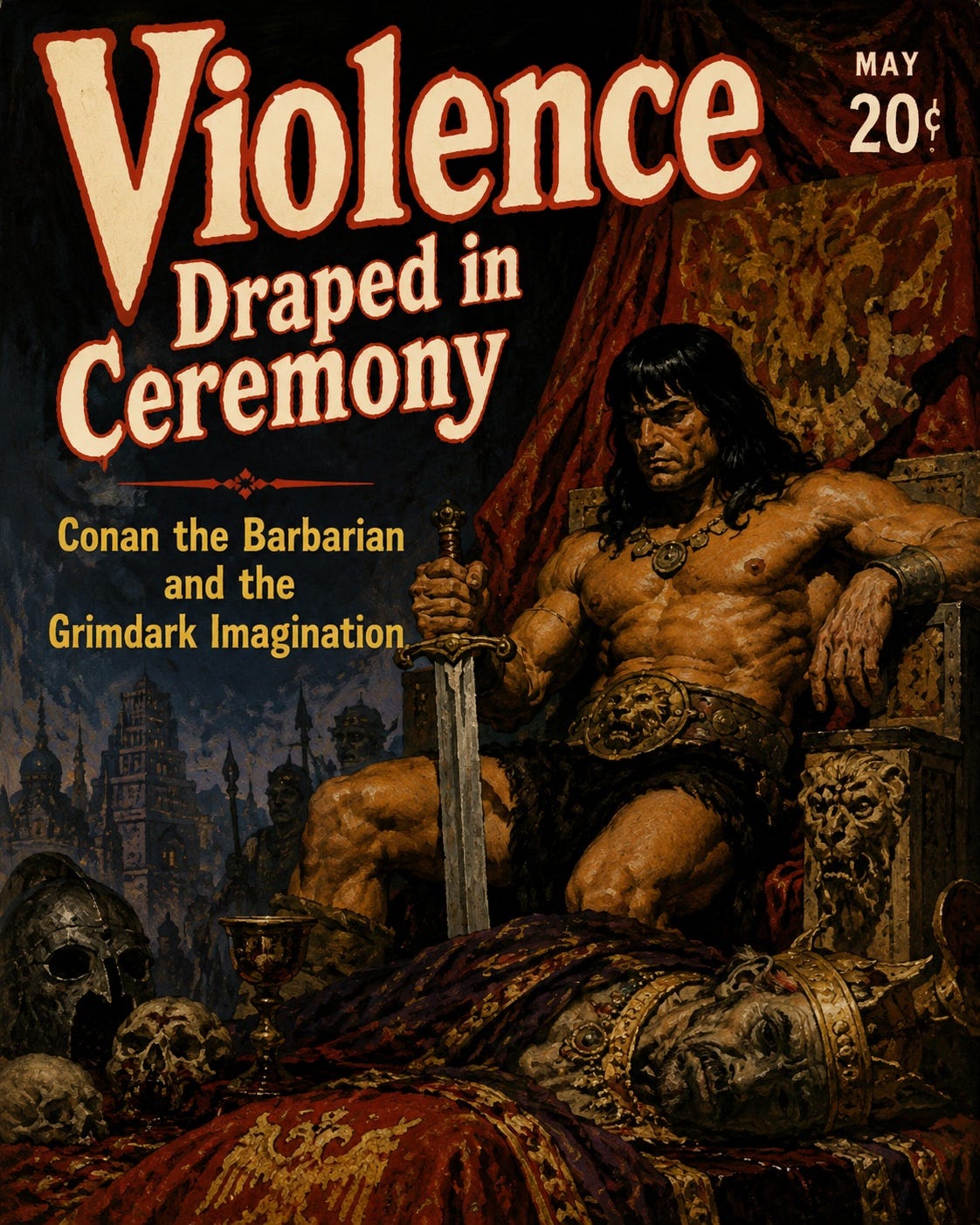
Violence Draped in Ceremony
Robert E. Howard, Conan the Barbarian, and the Grimdark Imagination
The governor turned toward Conan and stared at him thoughtfully.
“The soldiers, who do not believe in ghosts or devils,” he said, “are almost in a panic of fear. You, who believe in ghosts, ghouls, goblins, and all manner of uncanny things, do not seem to fear any of the things in which you believe.”
“There’s nothing in the universe cold steel won’t cut,” answered Conan. “I threw my ax at the demon, and he took no hurt, but I might have missed, in the dusk, or a branch deflected its flight. I’m not going out of my way looking for devils; but I wouldn’t step out of my path to let one go by.”
Robert E. Howard[1]
Lovecraft’s protagonists stared into the abyss and went mad. Conan the Barbarian reached for his sword. His interest in Holy Grails usually ended with how much gold he could get for stealing one, and he only trusted wizards when they were headless. Nearly a century after he first sprang like a panther from Robert E. Howard’s pen, Conan still reminds the world that barbarism is mankind’s natural state.
Howard’s Conan stories are not just sword and sorcery adventures. They are violent anti-civilizational fantasy. While Conan occasionally makes exceptions for a stout-hearted few, he generally holds civilized folks in contempt. They are rude because nobody ever put the fear of a good skull-splitting into them; they are soft because they have the luxury of pretending the world is a safe and stable place.
Tolkien’s The Hobbit, released two years after Howard’s “Beyond the Black River,” tells the story of Bilbo Baggins and his adventures stealing rings and fighting dragons. But when his wanderings end, Bilbo returns to his comfortable hobbit-hole in the Shire. Conan would have found the place unbearably dull, though he might have admired the hobbits’ skill with slings and arrows. And if he realized how much Bilbo’s mithril shirt was worth, we never would have had a Lord of the Rings.
Westeros would not have led Conan to reconsider his views on civilization. He might get on well enough with the Hound, and he certainly wouldn’t have been foolish enough to approach the Mountain after running him through. Conan would almost certainly have wound up beyond the Wall at some point, though he would be just as likely to join the Wildlings as the Night’s Watch. And he would have absolutely no patience for Martin’s sprawling web of political alliances, betrayals, and dynastic intrigue.
Tolkien laments lost civilizations; Martin catalogues a decaying civilization; Conan distrusts civilization altogether. He assumes that every high culture, no matter how noble its rhetoric, will eventually sink into corruption and decadence. Readers of The Silmarillion may have to grudgingly admit that Conan is on to something. Violence is the natural state of mankind; civilization is only a thin veneer that always peels away. He distrusts soft-handed nobles and trusts only cold steel—two instincts that echo throughout modern grimdark fantasy.
Robert Ervin Howard spent his early years traveling rural Texas with his father, a country physician. He came of age to tales of lynchings, blood feuds, and Indian raids. The oil boom transformed the old frontier almost overnight. It gave former cattle drivers new work while the growing railways carried cattle more efficiently to meatpacking centers. But prosperity also brought a great deal of violence and corruption financed by rail barons and aspiring oil tycoons.
Howard also witnessed constant strife at home. Tensions between his mother and father simmered for years before his father abandoned life on the medical circuit in 1915 and settled in Cross Cut, Texas. Four years later the family moved to a house in nearby Cross Plains, where Robert E. Howard would live for the remainder of his life.
When they arrived, the oil boom was still raging. Prostitution, gambling, and street fights were ordinary features of life in their small town. Howard would later say of the experience, “I’ll say one thing about an oil boom: it will teach a kid that life’s a pretty rotten thing about as quick as anything I can think of.”[2] But when the boom ended, the roughnecks and speculators moved on and Cross Plains once again became a sleepy Texas town. This boom and bust helped shape Howard’s realization that civilization was temporary and conditional.
Cities in Conan’s world are dens of thieves, corrupt priests, and decadent aristocrats. Conan has a grudging respect for the more capable criminals and is never above earning a living as a thief when mercenary work dries up. But the pampered inhabitants of these decadent cities are portrayed as weak, parasitic, and hypocritical. Life among barbarians, rogues, and warriors is harsher, but also more honest.
From an early age Howard was a voracious reader. His mother, Hester Howard, encouraged his literary ambitions. She regularly read poetry aloud and enthusiastically supported his writing. Classmates were impressed by his reading speed and his ability to memorize long passages. But Robert was an indifferent student who chafed at authority. He studied enough to get by but dedicated most of his reading time to Arthur Conan Doyle, Mark Twain, Sax Rohmer, and the pulp magazines that would eventually publish his own stories.
Howard later explained why he became a writer:
I could have studied law, or gone into some other occupation, but none offered me the freedom writing did – and my passion for freedom is almost an obsession…. I hardly think anybody would deny that there is more freedom in writing than there is in slaving in an iron foundry, or working – as I have worked – from 12 to 14 hours, seven days a week, behind a soda fountain. I have worked as much as eighteen hours a day at my typewriter, but it was work of my own choosing…. at least I’ve managed for several years now to get by without grinding at some time clock-punching job.[3]
Like his creator, Conan distrusts institutions and despises hierarchy and bureaucracy. He sees civilization as spiritually deadening and prefers work of his own choosing to obeying another man’s orders. That obsession with autonomy became a foundation of many grimdark heroes. Like Conan, the heroes of grimdark prefer freedom to comfort and stability. Unlike Conan, they are rarely able to achieve it.
From 1923 to 1927 Howard made a few sales to Weird Tales, but since the magazine paid (poorly) upon publication money remained tight. To support himself, he worked a series of temporary jobs as a stenographer, oil geologist’s assistant, and soda jerk. Finally, he enrolled in a bookkeeping course at Howard Payne College, promising his father that if writing didn’t work out, he would find a bookkeeping job.
By early 1928, however, it became clear that Howard could indeed make a modest living as a writer. Weird Tales and several other magazines eagerly purchased his prose and poetry. Alongside Conan stories, Howard sold tales featuring the grim Puritan Solomon Kane, Kull of Valusia, the jovial sailor Steve Costigan, a variety of westerns, and numerous stories featuring ghosts, violence, and boxing. He also helped care for his mother, who was steadily deteriorating from tuberculosis.
Conan’s eternally grim outlook on life was inspired by yet another source: Howard’s lifelong battle with depression. Friends later recalled frequent conversations about suicide, and Howard openly declared he did not wish to outlive his mother. As Hester Howard fell into her final unconsciousness, Howard borrowed a .380 Colt automatic from a friend. Dr. Isaac Howard had already locked away the family firearms as Robert’s emotional state deteriorated.
On the morning of June 11, 1936, Hester Howard’s nurse informed Robert that his mother would never regain consciousness. He then walked out of the house, climbed into his 1935 Chevrolet, and shot himself above the right ear. Howard died later that afternoon at 4 pm. His mother died the following day. On the 10th, Robert had traveled to Brownwood Cemetery and purchased a lot for three burials, with perpetual care. His father died in 1944 and was buried alongside his wife and their only child.
Howard’s Conan fundamentally changed fantasy’s moral landscape. There were monsters, beasts, wizards, and scantily clad women in medieval bikinis long before Conan pillaged Hyboria. But the heroes were generally good guys who fought and triumphed over the bad guys. Conan was a violent pragmatist surviving in a corrupt and dangerous world. He was certainly heroic, but you couldn’t exactly call him virtuous. He trusted cold steel more than noble destinies and was more comfortable destroying order than restoring it.
Conan is at various times a thief, mercenary, pirate, and killer. He is never a moral exemplar. He is not given to wanton slaughter, but he does what he must in a world where violence is constant and unavoidable. Conan survives because he understands reality clearly. He values autonomy above almost everything else, and his loyalty is always conditional. Personal strength and individual freedom matter more to him than moral codes imposed by priests, kings, or civilized society.
Howard’s stories helped establish many of the defining conventions of modern dark fantasy. Decaying kingdoms and ancient ruins; monsters lurking beneath forgotten cities or summoned by evil sorcerers; corrupt priests and decadent nobles; wilderness ever encroaching upon civilization. Howard made violence less stylized and more immediate—less like legend and more like survival. He gave fantasy writers permission to create worlds that were sweaty, bloody, and unstable rather than mythically distant.
George R.R. Martin inherits Howard’s pessimistic view of civilization. Yet unlike Howard, Martin remains firmly ensconced within civilization and modernity. He can imagine a cold, muddy, pre-technological world, but he cannot understand how uncivilized people think. Both writers understand that power corrupts and politics is merely violence draped in ceremony; they both understand that heroism often fails. But Martin still thinks in terms of dynasties and systems, while Conan would rather have as little to do with them as possible.
Like Aragorn, Conan ultimately becomes a king. His path to the throne is a bit more direct; he kills the mad monarch and places the crown on his own head. Yet once in power Conan, like Aragorn, proves to be a capable and surprisingly just ruler. Nobles who prey upon their peasants are warned to stop. If they refuse, Conan stops them himself. He is very much a hands-on and heads-off kind of king.
But where the people of Gondor adore Aragorn, Conan finds himself ruling over a restive kingdom whose subjects miss the oppressive madman who once ruled them. Even under a better king, Howard suggests, civilization remains psychologically attached to hierarchy, decadence, and cruelty. Indeed, civilization is so corrosive that not even the mightiest of barbarians can resist its charms.
In one revealing moment, Conan refuses to slay a poet who is stirring up the people against the barbarian king, stating “A great poet is greater than any king. His songs are mightier than my scepter; for he has near ripped the heart from my breast when he chose to sing for me.”[4] Conan’s newfound love of poetry nearly costs him his kingdom and his life. Many fantasy writers speak of saving civilization; others dream of restoring it. Howard questions whether it deserves saving.
Modern grimdark writers declare, as Howard declared before them, that civilization is fragile, comfort is temporary, and violence always lurks beneath the surface. Nearly a century later, today’s dark fantasy writers still walk in the Barbarian’s shadow; sword in hand, distrustful of kings, and well aware that civilization can crumble at any moment. Conan endures because Howard understood something grimdark would later make explicit: civilization does not eliminate violence. It merely teaches violence better manners.
[1] Robert E. Howard, “Beyond the Black River.” Weird Tales, May/June 1935. Project Gutenberg. https://www.gutenberg.org/files/42254/42254-h/42254-h.htm.
[2] Rusty Burke, “A Short Biography of Robert E. Howard” (2023) at the Robert E. Howard Foundation. https://rehfoundation.org/biography/.
[3] Ibid.
[4] Robert E. Howard, “The Phoenix on the Sword.” Weird Tales, December 1932. At Gutenberg Australia. https://www.gutenberg.net.au/ebooks06/0600811h.html.