
Watergate Gothic
Richard Nixon and the rise of American cynicism

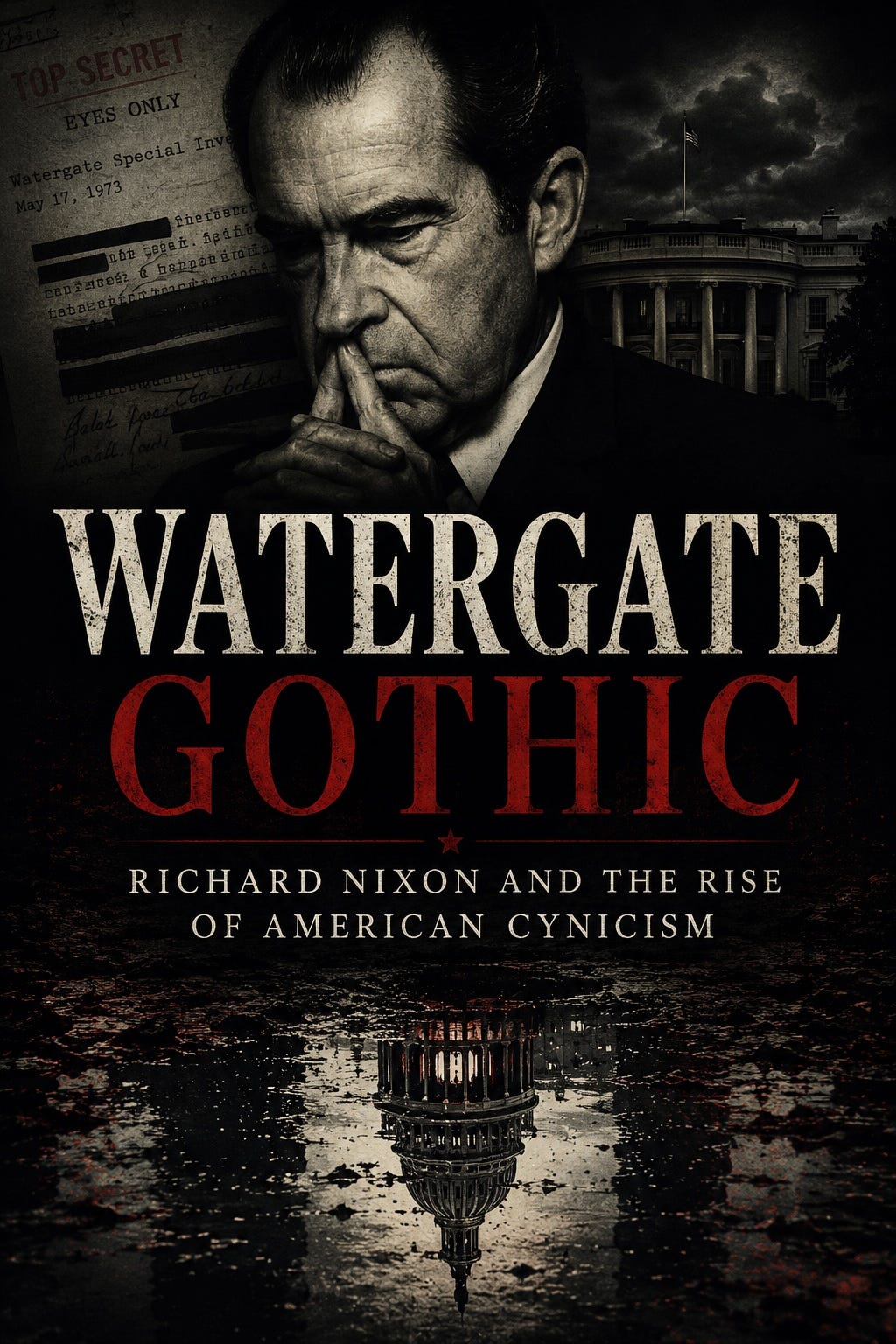
Were it not for one catastrophic act of overreach, Richard Milhous Nixon would probably be remembered as one of the 20th century’s best presidents. There was no need to plant listening devices in the Democratic Party’s Watergate headquarters. Nixon would go on to defeat George McGovern in the 1972 election by a margin of 520 electoral votes to 17. His fall was like Macbeth’s; he created enemies because he could not trust his colleagues. Had he not struggled so desperately for power he already possessed, it would never have been stripped from his hands.
Nixon achieved détente with the Soviet Union and opened relations with China; he founded the Environmental Protection Agency and signed Title IX into law; he came into office as a war hawk but pulled American soldiers out of Vietnam when he ultimately accepted the battle was unwinnable.
Yet today Nixon’s name is synonymous with scandal and corruption. People have largely forgotten the details of the Watergate burglary, but they remember very well that Nixon was forced out of office in disgrace. The evil that he did lives after him; the good was interred with his resignation. And when he departed the White House in a helicopter, American trust in our political system left with him.
In 1922 the Harding administration was rocked by the Teapot Dome scandal. But ultimately Interior Secretary James Fall went to prison and Warren B. Harding fortuitously died of a stroke in 1923. His successor, Vice President Calvin Coolidge, was noted for being both taciturn and honest. Watergate was different. We had always known there were crooked politicians, but after Nixon we began to doubt that there were any honest ones. Corruption was no longer seen as an aberration but as an endemic part of the system.
Andrew Johnson was impeached in 1868. Nixon resigned in 1974 in the face of a near-certain impeachment. Since his resignation we have seen three impeachments; Bill Clinton in 1998 and Donald Trump in 2019 and 2021. What was once used only in extremis has become political theater. Reagan faced investigation over the Iran-Contra scandal in 1987. Clinton was cleared on a vote along party lines; George W. Bush and Barack Obama faced repeated impeachment threats; Trump was cleared twice on votes along party lines.
So what does Richard Nixon have to do with modern grimdark? He helped create the audience. Writers can crank out stories of corruption, despair, and betrayal until their keyboards wear out. But if they can’t find people willing to read those stories, they’re soon going to seek out new genres. Nixon made grimdark’s pessimistic themes seem not only plausible but resonant. To a country reeling from the exposure of rot at the highest levels, movies like Taxi Driver and Chinatown seemed less theatrical and more realistic.
Nixon’s first run for the Presidency ended in a controversy over stolen ballots. The 1960 election was one of the closest in history, with John F. Kennedy receiving 49.72% of the vote to Nixon’s 49.55%. But many Nixon supporters believed Lyndon B. Johnson’s Democratic political machine used ballot stuffing to give the Kennedy-Johnson ticket a 51%-49% win. Earl Mazo, Nixon’s biographer, covered Nixon’s 1960 campaign in Illinois and later recalled:
There was a cemetery (in Chicago) where the names on the tombstones were registered and voted. I remember a house. It was completely gutted. Nobody was there, but there were 56 votes for Kennedy in that house.[1]
Those claims of election fraud were hotly denied in 1960 and remain controversial today. What we know for certain is that Nixon chose not to contest the results. He told Mazo “our country cannot afford the agony of a constitutional crisis” and asked him to stop writing stories accusing the Kennedy campaign of voter fraud.[2]
Others credited JFK’s narrow victory to the televised debates. John F. Kennedy was a photogenic candidate with a winning smile. Nixon’s five o’clock shadow and shifty eye gestures made him look sneaky and untrustworthy. In his 1950 California senatorial race, which he won, ads urged voters to “Look at ‘Tricky Dick’ Nixon’s Republican Record.” That label would follow him for the rest of his political career.
After losing the presidency in 1960, Nixon ran for governor of California in 1962. Many, including Nixon, believed his loss to incumbent governor Pat Brown marked the end of his political career. In an impromptu post-election speech, he railed at journalists for their perceived favoritism toward his opponent, closing with “You don’t have Nixon to kick around anymore. Because, gentlemen, this is my last press conference.”
Leaving California, Nixon and his family moved to New York City, where he became a senior partner in a prestigious law firm. In 1967 he argued his first and only case before the Supreme Court, Time Inc. vs Hill, on behalf of a family suing over an inaccurate story in Life magazine. When Time Inc. won the case, Nixon said “I always knew I wouldn’t be permitted to win a big appeal against the press.” He also decided then to make a second presidential run.
In January 1968, the Viet Cong launched the Tet Offensive; in March, Lyndon B. Johnson withdrew as a presidential candidate after a disappointing showing in New Hampshire; in June Democratic presidential candidate Robert F. Kennedy was killed just moments after winning the California primary.
Hubert Humphrey, Johnson’s vice-president, was privately against the ongoing Vietnam war but was unwilling to speak out publicly against it. Antiwar protestors gathered outside the Chicago Democratic National Convention, only to be beaten and arrested en masse by Mayor Richard Daley’s police forces. While Humphrey began calling for peace talks as the campaign went on, he had lost the trust of many antiwar voters. Nixon won the popular vote by less than a percentage point (43.4% to 42.7%) but scored 301 electoral votes to Humphrey’s 46.
I saw many signs in this campaign; some of them were not friendly, some were very friendly. But the one that touched me the most was one that I saw in Dexter, Ohio, at the end of a long day of whistle-stopping. A little town, I suppose five times the population was there in the dusk, and it was almost impossible to see, but a teenager held up a sign, ‘Bring us together’. That will be the great objective of this administration at the outset, to bring the American people together.[3]
In 1968, “bring us together” was a tall order. The passage of the 1964 Civil Rights Act had done little to ease tensions between America’s white and black communities. But Nixon genuinely wanted to heal those divisions. He had promised “peace with honor” in Vietnam, and vowed to uphold the values of the “silent majority” that loved America and wanted to see it rise above the riots, protests, and civil unrest consuming the country.
During his first term, it looked like he was largely keeping his promises. He had begun withdrawing American troops from Vietnam; he made huge diplomatic strides in China and the Soviet Union; he oversaw the first moon landing on July 20, 1969. His battles against inflation and high interest rates were less successful, as were his efforts at price controls. There was lots of grumbling, and many sarcastic Nixon impressions from comedian Rich Little. But he was still popular enough to win a landslide victory against George McGovern in 1972.
Behind closed doors, Nixon worried constantly about “leakers” who were giving out information. In 1969 he ordered wiretaps to discover who had tipped journalists off to a secret bombing campaign in Cambodia. When Daniel Ellsberg released a 7,000-page study of the Vietnam war (the “Pentagon Papers”) to the New York Times in 1971, Nixon had G. Gordon Liddy and E. Howard Hunt burglarize his psychiatrist’s office in search of blackmail material.
On June 17, 1972, five men were caught breaking into the Democratic Party headquarters at the Watergate Complex in Washington, DC. They carried wiretapping equipment and large amounts of cash. While they were clearly attempting some form of political espionage, the motivations behind the break-in remain disputed. It is entirely possible that Nixon, or the people he trusted, were uncertain as to what they hoped to accomplish and what they expected to gain from it.
What mattered politically was less the burglary itself than the atmosphere it created. Watergate confirmed growing suspicions that hidden surveillance, secret operations, institutional deceit, and political sabotage had become normal parts of American public life.
Let me just say this, and I want to say this to the television audience: I made my mistakes, but in all of my years of public life, I have never profited, never profited from public service--I have earned every cent. And in all of my years of public life, I have never obstructed justice. And I think, too, that I could say that in my years of public life, that I welcome this kind of examination, because people have got to know whether or not their President is a crook. Well, I am not a crook. I have earned everything I have got.[4]
Nixon’s speech on November 17, 1973 did little to convince the public that he was indeed not a crook. Political cartoonists had a field day with “Tricky Dick” caricatures and “I am not a crook” became one of the most popular slogans of 1973. Viewers tuned in to televised coverage of the Watergate hearings and read transcripts of Nixon’s taped conversations. Nixon continued to maintain his innocence, but he soon realized that his battle was as unwinnable as Vietnam. On August 8, 1974 Richard Nixon announced his resignation. My family watched it on CBS.
Chinatown, Three Days of the Condor, Barry Lyndon, 1900, All the President’s Men, etc. One has the impression of it being a question of perfect remakes, of extraordinary montages that emerge more from a combinatory culture (or McLuhanesque mosaic), of large photo-, kino-, historicosynthesis machines, etc., rather than one of veritable films.
Jean Baudrillard[5]
1974’s Chinatown brought a noir sensibility to 1930s California. But where Hayes Code noir films had to end with the villains punished for their misdeeds, the corrupt politicians and child-molesting tycoons walk away unscathed. Private eye Jake Gittes (Jack Nicholson) tries to save Evelyn (Faye Dunaway) and Katherine, her sister/daughter, but to no avail. Evelyn is gunned down and a distraught Katherine leaves with Noah Cross, her wealthy father/grandfather. When he tries to save her, an associate tells him “Forget it, Jake. It’s Chinatown.”
In 1975 Robert Redford starred in the spy thriller Three Days of the Condor. Redford’s Joe Turner (codenamed “Condor”) was a bookish CIA analyst, not a stylish James Bond figure. He comes back from lunch to find his colleagues have been gunned down. He alerts his supervisor, who tries to kill him and then reports Turner as the murderer. By the time the movie ends, Turner has revealed the plot to the New York Times and insists that the paper will print the story. The final line comes from his superior officer, who yells back “How do you know?”
All the President’s Men (1976) sees Robert Redford teamed up with Dustin Hoffman as Bob Woodward and Carl Bernstein, the reporters who broke the Watergate story in the Washington Post. They face an uphill battle in convincing their editors that the President was involved; why would Nixon endanger his position when he was certain to triumph against McGovern? But ultimately their conversations with “Deep Throat” pay off and the movie ends with Nixon’s resignation and Vice President Gerald Ford’s inauguration.
These films did indeed give 1970s Americans a McLuhanesque mosaic of their culture. Another 1973 film, Serpico, gave us a biographical crime drama about Frank Serpico (Al Pacino), an honest cop who tries and fails to fight endemic corruption in the NYPD. The movie ends as the real Serpico’s quest ended; a bullet to the face, fellow officers who deliberately fail to report the shooting, and a disability pension that spells the end of his time on the force. Corruption was increasingly seen not as an aberration but as the rule.
Hippies and radicals had been screaming about “pigs” and “the Establishment” for years. After Nixon’s resignation, many of those ideas percolated into the mainstream. But the radicals found themselves unable to use this new distrust as revolutionary leverage. America was exhausted after the Vietnam War, tired of political shouting, and unable to believe that our underlying problems could be cured. Instead of hitting the streets, Americans surrounded themselves in discos, drugs, and strange flesh.
Like jaded comrades waiting in 1970s Soviet breadlines during the Brezhnev era, post-Watergate Americans had lost hope in their government—and in the idea that it could be saved. You can’t have a revolution without revolutionaries you trust, and America was not in a trusting mood. The distraction of short-term pleasures appeared more tempting, and more real, than the struggle for long-term change.
The pessimism of grimdark would have seemed excessively cynical, implausible, and nihilistic before the 1970s. Audiences weaned on Philip Marlowe would find Travis Bickle a thoroughly unpleasant and unrealistic protagonist. The idea of Noah Cross walking off with his abused daughter would be disgusting. Of course, such things might happen in life—but you don’t put them on the big screen any more than you film your bowel movements.
Grimdark did not emerge because audiences suddenly became evil nihilists. It emerged because optimism began to feel naïve. Nixon did not create corruption, paranoia, or betrayal. In a different time he might have been cast as a tragic hero brought down by his own flaws. Instead he became a spark that set our confident postwar world afire and left us ruling over ashes.
[1] Sami Moubayed, “Controversial elections in American History.” Al Majalla, November 4, 2024. https://en.majalla.com/node/322919/documents-memoirs/controversial-elections-american-history.
[2] Scott Bomboy, “The drama behind President Kennedy’s 1960 election win.” National Constitution Center, November 7, 2017. https://constitutioncenter.org/blog/the-drama-behind-president-kennedys-1960-election-win.
[3] Richard Nixon, “Remarks in New York City Accepting Election as the 37th President of the United States” (November 6, 1968) at The American Presidency Project. https://www.presidency.ucsb.edu/documents/remarks-new-york-city-accepting-election-the-37th-president-the-united-states.
[4] Richard Nixon, “I Am Not A Crook,” (November 17, 1973). At Emerson Kent. https://www.emersonkent.com/speeches/i_am_not_a_crook.htm.
[5] Jean Baudrillard, Simulacra and Simulation. Trans. Sheila Glaser. University of Michigan Press, 1994, p. 45.