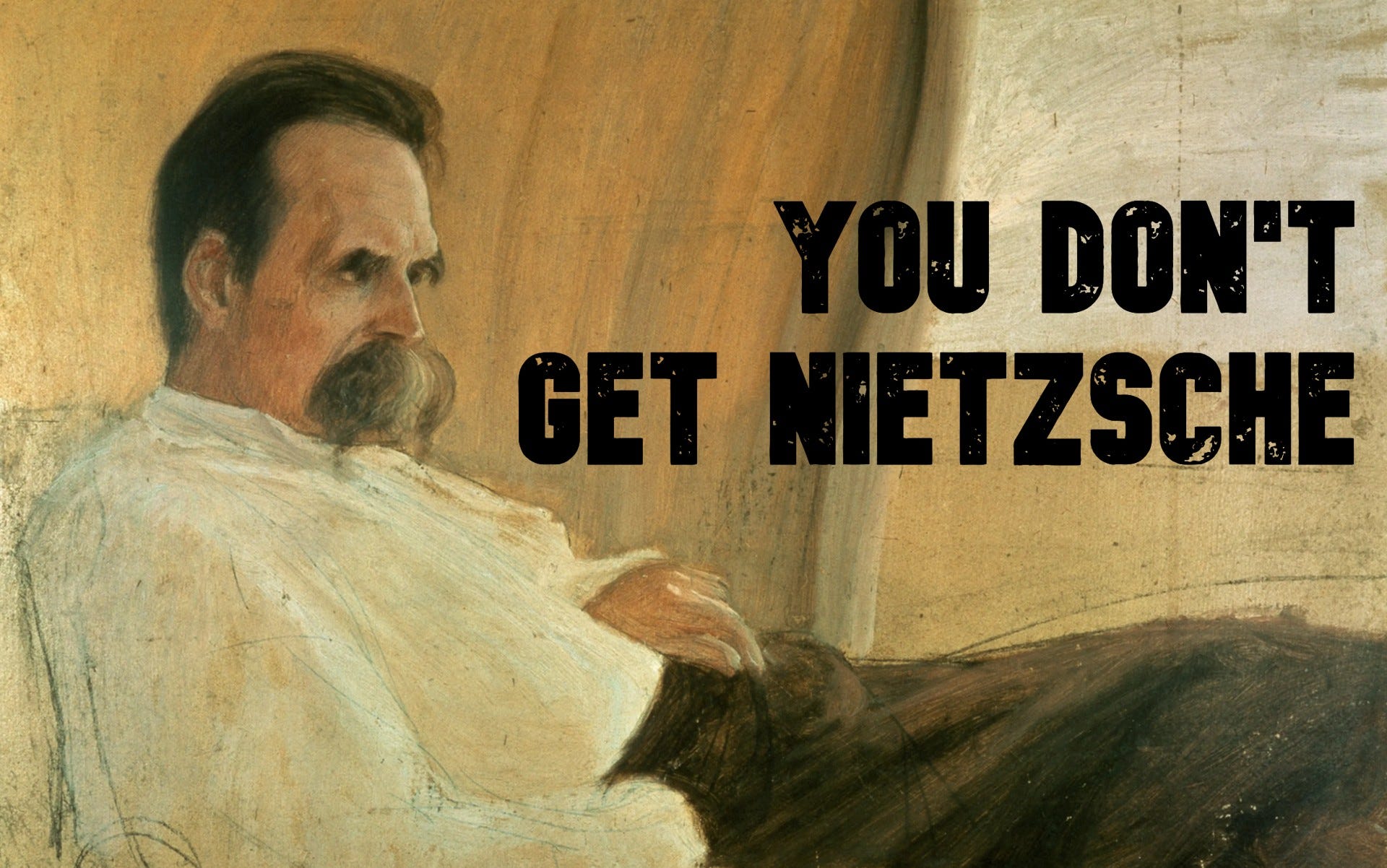
You Don't Get Nietzsche
The Philosopher of What Comes Next
Sade is easy to understand. There is no god, morality is an affectation, and strength comes from cruelty. Many assume Friedrich Nietzsche holds a similar philosophy: God is dead, the only worthwhile morality is that of the master, and the Übermensch cares only about gaining power, no matter the cost in bloodshed and suffering. They see Nietzsche’s writings as proto-Nazism, celebrations of violence that undergirded the fascist movements of subsequent decades.
They are wrong.
Nietzsche is one of our most readable philosophers. His pithy aphorisms and clean prose can be followed by a smart, angry fifteen-year-old. But reading and understanding are two different things. Young intellectuals who read Ayn Rand often see themselves as Howard Roark. Teenage Nietzscheans dream of being the Superman. They rarely stop to think that these authors might be criticizing their behavior rather than praising it. And I say this as a former fifteen-year-old who dreamed of being Howard Roark, Nietzschean Superman.
Today we largely understand Nietzsche as a caricature. He is condemned as a Nazi, though he broke with Wagner over his German nationalism and anti-Semitism. He is celebrated as a philosopher of cruelty, though his last sane act was to throw his arms around a beaten workhorse’s neck and shield it from a whipping. He is alternately praised and reviled for his vision of the Superman by readers who forget that the will to power was first and foremost a call for self-mastery.
The heart of Nietzsche’s philosophy is not cruelty, atheism, or brutality. It is the desperate search for meaning in a world whose certainties have collapsed.
“Whither is God?” he cried; “I will tell you. We have killed him—you and I. All of us are his murderers.
But how did we do this? How could we drink up the sea? Who gave us the sponge to wipe away the entire horizon?
What were we doing when we unchained this earth from its sun?”[1]
In 1882, when Nietzsche released The Gay Science, atheism was coming out of the closets and into the streets. Two decades earlier, Darwin’s 1859 On the Origin of Species had challenged the underpinnings of Christian creation mythology. Ludwig Feuerbach’s atheistic 1841 The Essence of Christianity led a young Karl Marx to write in a note “Philosophers have only interpreted the world, in various ways; the point, however, is to change it.”
Many intellectuals of the time were celebrating the Industrial Age and the triumph of Reason and Science over Superstition and Mythology. Nietzsche recognized something they missed. He saw that mythology was not simply soothing lies savages told each other to explain things they could not understand; it is the gestalt upon which we construct our worldview. Christianity had been the foundation of European civilization for centuries. Its assumptions shaped European law, morality, ethics, and cosmology. And now we had unchained the earth from its sun.
Today, many angry atheists treat “God is dead” as a cry of celebration. For Nietzsche, it was a shriek of horror. He foresaw that we would replace our dead faith with something new and terrible. The masters and supermen imagined by later generations were not his ideal. They were the shadows cast by a civilization struggling to find its way after the death of God. Nietzsche was not rooting for tyranny; he was pointing out that a civilization without gods will inevitably seek out new idols.
The year The Gay Science was published, Marx and Engels wrote a new preface to the Russian edition of the Communist Manifesto; they argued that Russian peasants might “serve as the starting point for a communist development.”[2] Six years earlier, a former rabbi named Felix Adler founded the Society for Ethical Culture in New York. This secular society schooled children, brought doctors and nurses to the sick, and fulfilled many of the duties traditionally assigned to church organizations.
The Soviet Union may have fallen but billions of people still adhere to communist-inspired philosophies. Americans have come to expect the government to fulfill many of the material needs once met by the church. Secularism has become our default setting, and we have almost grown accustomed to a world without religion.
Or have we?
20th century pulp magazine readers devoured space operas and tales of star-spanning empires. Science became for many what religion had once been. It was no longer a toolkit for understanding phenomena but a force that would heal the sick, feed the poor, and lift us up to the heavens in rocket-powered chariots. Who needs angels when you have benevolent aliens?
This flavor of scientism became especially popular in post-WWII America; it reached its apex with the moon landings. Those old space operas seemed positively prescient. We were certain the moon was just our first stop; in a few decades, we would be colonizing space, eradicating disease, and eliminating hunger and poverty. Progress was the future and the future was progress.
Those dreams were challenged by an oil embargo, Watergate, and ongoing stagflation. By the 1980s, the future was looking less like Star Trek and more like Blade Runner and Alien. Technology was no longer a savior that was going to bring us into a new utopian age. It was a powerful tool, but one that could be and often was used for nefarious purposes by powerful interests. We didn’t lose trust in science, but we started looking askance at scientists. And even this was nothing new: we’ve seen “mad scientists” since Mary Shelley’s Frankenstein.
Mid-20th century Scientism got a second wind with COVID-19. Once we would have gone to church in the face of plague rumors. During the epidemic, many declared they “trusted the science,” advertised their vaccination status, and called for the sternest punishments against heretics who spread “disinformation” about the virus.
On the other side, many declared adherence to yet another popular religious substitute—conspiracy theory. They not only declared the vaccines ineffective and possibly dangerous; they insisted the COVID vaccinations were part of a depopulation plan that was designed to kill millions. Some looked to public health officials; others relied on internet prophets. Both sought certainty in the face of fear and confusion.
The Superman is the meaning of the earth. Let your will say: The Superman SHALL BE the meaning of the earth!
I conjure you, my brethren, REMAIN TRUE TO THE EARTH, and believe not those who speak unto you of superearthly hopes! Poisoners are they, whether they know it or not.
Despisers of life are they, decaying ones and poisoned ones themselves, of whom the earth is weary: so away with them!
Once blasphemy against God was the greatest blasphemy; but God died, and therewith also those blasphemers. To blaspheme the earth is now the dreadfulest sin, and to rate the heart of the unknowable higher than the meaning of the earth!
Once the soul looked contemptuously on the body, and then that contempt was the supreme thing:—the soul wished the body meagre, ghastly, and famished. Thus it thought to escape from the body and the earth.
Oh, that soul was itself meagre, ghastly, and famished; and cruelty was the delight of that soul!
But ye, also, my brethren, tell me: What doth your body say about your soul? Is your soul not poverty and pollution and wretched self-complacency?
Verily, a polluted stream is man. One must be a sea, to receive a polluted stream without becoming impure.
Lo, I teach you the Superman: he is that sea.[3]
The two great Founding Fathers of Existentialism could hardly be more dissimilar. Søren Kierkegaard saw a complacent Christianity deteriorating into atheism. In response, he called on us to make the “leap of faith.” Nietzsche saw a world where faith was losing its authority. He asked us what we were going to do now that God is dead.
Kierkegaard’s role model was Abraham, who was willing to sacrifice Isaac despite his fear and trembling in response to God’s command. Nietzsche’s model was Zarathustra, coming down from the mountain with a prophecy of godlessness—a prophecy that he found every bit as horrifying as Abraham standing before Isaac bound to the altar.
Zarathustra’s Superman was not about superiority, domination, Aryan strength, or any of the other twaddle that often gets credited wrongly to Nietzsche. Rather, he was the man who was willing to look in the godless abyss and turn away toward the earth rather than denying it in search of a new phantasm. That Superman understands that we are tasked with creating our own meaning, and he sets about the difficult work of doing so.
Nietzsche contrasts the Superman to come with the “last man”—not a tyrant or a monster, but one whose highest aspirations are peace and comfort. As Zarathustra describes them:
“What is love? What is creation? What is longing? What is a star?”—so asketh the last man and blinketh.
The earth hath then become small, and on it there hoppeth the last man who maketh everything small. His species is ineradicable like that of the ground-flea; the last man liveth longest.
“We have discovered happiness”—say the last men, and blink thereby.
They have left the regions where it is hard to live; for they need warmth. One still loveth one’s neighbour and rubbeth against him; for one needeth warmth.[4]
Abraham is willing to sacrifice the son he loves for God. The Übermensch is willing to carve meaning out of uncertainty and build order out of chaos. The Last Man is unwilling to risk anything at all. He has chosen safety over growth and comfort over creation.
We can see traces of the Last Man in those who refuse the burden of creating meaning for themselves. Some lose themselves in entertainment and distraction. Some surrender their judgment to political movements or ideological tribes. Still others adopt ready-made identities and wear them like uniforms. Each path promises the same thing: certainty without struggle, belonging without self-examination, and meaning without creation.
If you listen closely, you can hear them all whistling past the graveyard. If you’re wise, you’ll take a long and hard look in the mirror.
If we must create our own values, where did our old values come from in the first place? Nietzsche’s Beyond Good and Evil sought to answer that question. Traditionally, we believed our ethical codes came from on high, carved in stone tablets or revealed by the Holy Spirit. But now that God was dead, we needed to take a closer look at the moral codes we once considered divine commandments. If morality did not originate in Heaven, where did it come from?
Nietzsche’s goal was not to replace Christian morality with “might makes right.” He wanted instead to understand how we arrived at the ideas we inherited from religious traditions—and whether those traditional ideas could still survive in a Godless world.
Even today many atheists who reject Christian theology still cling to ideas about compassion, equality, dignity, and human worth. Nietzsche might well agree that some of those ideas had merit. But he raised two unnerving questions: how long can they last after the religious framework that supported them no longer exists, and what will replace them?
Nietzsche realized that ethical philosophers offered “eternal truths” that squared with their pre-existing personal values. The internet has let us see the rise and growth of different ethical systems up close and personal. The death of God has done nothing to stop online tribalism, political grandstanding, and religious wars without religion. Our godless society still demands orthodoxy, punishes heresy, and excommunicates those who ask inconvenient questions.
He further believed that many moral systems, particularly Christian morality, arise not out of strength or wisdom, but ressentiment. Ressentiment is a way by which the disempowered transform weakness into virtue and power into vice. I have questions about this interpretation; for one thing, it doesn’t account for the many canonized warrior saints. But I cannot deny that there is a special kind of spiteful virtue that you find only in the most loudly moral people.
This spiteful virtue has become a hallmark of online political discourse. Many try to prove themselves to be “decent human beings” by wishing death and disease upon their opponents, by cheering when members of the other team are wounded or killed, by gloating at the other side’s distress and suffering. Nietzsche would have recognized this pattern immediately. The language of morality often conceals emotions that are anything but moral.
Nietzsche believed Christianity wrapped ressentiment in pious language and divine justifications. Modern politics dresses it in different costumes. Sometimes it appears wrapped in rainbow flags; sometimes it wears a MAGA hat. The symbols change, but the underlying impulse remains. God may be dead, but we still cling to old behaviors as we bow before our new idols.
Like Marx, Nietzsche was a diagnostician of modernity. Both understood that the old certainties were collapsing beneath industrialization, secularization, and social change. Unlike Marx, he had deep concerns about our ability to rebuild a better new world from the wreckage of the old one. Marx thought that religion was the opiate of the masses and that we would build a more just and fair society once we got clean. Nietzsche realized that the collapse of traditional beliefs was not something you could paper over with slogans, political theories, or economic reforms.
Nietzsche did not kill God; he simply wrote the obituary and warned us all of what we had lost. Over a century after his death, we are still grappling with his funeral speech. He knew that a civilization stripped of its old gods would inevitably create new ones. We would replace the old truths with new orthodoxies, new prophets, and new heresies. We have not escaped religion so much as scattered it into thousands of competing faiths. We have declared ourselves our own gods, only to discover that we have neither creed nor congregation.
[1] Friedrich Nietzsche, The Gay Science. (Walter Kaufmann, tr.) New York: Vintage Books, 1974. 188.
[2] Karl Marx and Frederich Engels, The Communist Manifesto: Preface to the 1882 German Edition. At Marxists.net. https://www.marxist.net/marx/m2frame.htm?communist.htm.
[3] Friedrich Nietzsche, Thus Spake Zarathustra. (Thomas Common, tr). Available at Project Gutenberg. https://www.gutenberg.org/files/1998/1998-h/1998-h.htm.
[4] Ibid.